Wednesday, January 23, 2008

This and That

I’m guessing 17 days was long enough for regular visitors to grok my last entry, the cartoon I posted in the first week of this month? I’m back in the saddle now, and bursting at the seams with fresh, 2008ish content for the blog. Thanks for your patience.

The year is off to a fine and proper start. Last Thursday my 13-year-old son and I took the train to San Francisco for the annual pilgrimage to MacWorld Expo. I was pleased to discover a souped up Notepad utility that may help mitigate a little problem I have with making lists—to-do lists, book lists, bills to pay, letters to write. I make lots of lists, until I end of with thick wads of them in various pockets, and digital ones scattered across multiple computers. I know I could just consolidate my lists in any old word processor, but I will buy a specific software application for every little quirk and habit if it promises a new, transcendent level of organization. And if it’s OSX native.

After a day with the Cult of Mac acolytes, we hiked over near Portsmouth Square for some lumberjack-sized medium rare cuts at Alfred’s Steakhouse. Nothing tops off a day of uber geekdom like a tender filet mignon and a martini. Sure, we revel in our elegant technology, and the trappings of civilization, but we will jettison it all at sundown to eat a juicy cow, if it's cooked right.

The Civil War connection? I thought you’d never ask.
Hampton's Beefsteak Raid? You might think so. No, I was recalling that this is the part of San Francisco that William T. Sherman describes so colorfully in his Memoirs—the area around Portsmouth Square (what he calls the Plaza), which is today several blocks inland from the Bay, on the edge of Chinatown. Sherman wrote:

At that time (July, 1847), what is now called San Francisco was called Yerba Buena. A naval officer, Lieutenant Washington A. Bartlett, its first alcalde, had caused it to be surveyed and laid out into blocks and lots, which were being sold at sixteen dollars a lot of fifty varas square; the understanding being that no single person could purchase of the alcalde more than one in-lot of fifty varas, and one out-lot of a hundred varas. Folsom, however, had got his clerks, orderlies, etc., to buy lots, and they, for a small consideration, conveyed them to him, so that he was nominally the owner of a good many lots. Lieutenant Halleck had bought one of each kind, and so had Warner. Many naval officers had also invested, and Captain Folsom advised me to buy some, but I felt actually insulted that he should think me such a fool as to pay money for property in such a horrid place as Yerba Buena, especially ridiculing his quarter of the city, then called Happy Valley. At that day Montgomery Street was, as now, the business street, extending from Jackson to Sacramento, the water of the bay leaving barely room for a few houses on its east side, and the public warehouses were on a sandy beach about where the Bank of California now stands, viz., near the intersection of Sansome and California, Streets. Along Montgomery Street were the stores of Howard & Mellus, Frank Ward, Sherman & Ruckel, Ross & Co., and it may be one or two others. Around the Plaza were a few houses, among them the City Hotel and the Custom-House, single-story adobes with tiled roofs, and they were by far the most substantial and best houses in the place. The population was estimated at about four hundred, of whom Kanakas (natives of the Sandwich Islands) formed the bulk.
As Homer Simpson would say, "Mmmm, sandwich islands." One wonders what culinary specialties these majority Hawaiians had established by the time of Sherman's visit. Note that Sherman’s scoffing refusal to invest in San Francisco real estate came one year before the discovery of gold on the American River. "Old Brains" Halleck got in on the action—I wonder if there's a record of when he sold his piece. Sherman's caution was fully justified, no doubt. Still, it's fair to say he had a higher aptitude for real estate seizure and destruction than for real estate speculation (whatever you think of his tactical shortcomings).


Speaking of Seizure and Destruction, I couldn’t be more excited by the upcoming (12th) Civil War Forum Battlefield Conference, March 27-30, as we tackle Sherman’s Campaign for Atlanta (4-day abbreviated version). There are approximately 8-10 seats left on the bus, open to anyone interested. When those are full we’ll cut off registration, because anything more than a busload of 50 people gets unwieldy. The program is coming together nicely, and I’ll announce our headquarters hotel this week (in Marietta). If interested, send me an email at civilwarforum@mac.com, or post a message here and I’ll give you registration information. Or you can go to the Civil War Forum start page and click on the photo of Sherman on his horse for more details.

The Campaign for Atlanta (last best chance to reserve your seat):
We’ll take in Resaca to Kennesaw on the first day (concentrating most on Pickett’s Mill and Kennesaw), and take in some Peachtree Creek and Battle for Atlanta sites on the second full day of tours. We’ll also get a private presentation by Gordon Jones at the Atlanta History Center of the most important and impressive Civil War collections outside of the Museum of the Confederacy. Additionally, we’ll work in sidetrips to some of Francis Shoup’s few remaining Shoupades on Johnston’s Chattahoochee River Line, and visits to “The General” at Big Shanty, and the Atlanta Cyclorama.


I have enlisted three after dinner speakers (Thurs., Fri., Sat.): Dr. Steven Woodworth of TCU, Dr. John Fowler of Kennesaw State, and Atlanta historian Steve Davis. All of that—3 dinner talks, 2 full days of touring (lunch included), and two half-days of touring runs $250 a person. It’s cheap because we aim to get as close to break-even as possible, with anything left over donated to The Civil War Trust, or a local group. Every year about 2/3rds of the attendees are people who have attended all or several of the 12 meetings, and the rest are first-timers and veterans of the last few outings. We come from all over the country, and some from other countries (Canada and the U.K. regularly represented). Besides this notice, I’ll make an announcement in some other online venues until the bus fills up. Alert and faithful readers of this blog will have the first shot at those 8 seats.


Speaking of letters to the editor (see comic in last blog entry), this presidential election cycle—specifically the Republican South Carolina Primary—has seen another flurry of interest in the Confederate battleflag. Mr. Huckabee’s recent comments prompted an incisive essay by favorite intellectual atheist cocktail enthusiast Christopher Hitchens, who takes Huckabee and Ron Paul to task for Civil War related comments. For example,
And not merely racist incitement. So slack is our grasp of history and principle that we seem unable to think of the Confederacy as other than "offensive" to blacks. But there are two Republican candidates in this election—the absurd and sinister Ron Paul being the other—who choose this crucial moment in our time to exalt those who attempted to destroy the Union by force, and those who solicited the help of foreign powers in order to do so, and whose treason led to the violent deaths of hundreds of thousands of Americans. Should their patriotism be questioned? I would say most definitely yes, and questioned repeatedly, at that, perhaps especially if they are seeking the nomination of the party of Lincoln.
Hitchens’s Slate.com essay, in turn, generated the kind of responses that are usually restricted to Civil War discussion groups and publications. As one would expect, these discussions quickly devolved into angry flame wars. Check out Moira Redmond’s “Fraywatch,” a column that monitors the goings-on in various Slate.com discussion areas.

For example:

There were two key, tightly-connected, questions: is that flag racist? Readers went for it here. And, was the Civil War was actually about slavery or not? Battle lines drawn here. Nobody seemed to change anyone else's mind, and it wasn't all that civil. Richmond says "We're beyond the point of asking 'What would Gen. Lee do?' partly because we know the answer ('Surrender and tell the troops to go home.') and partly because he's dead."

Sunday, January 06, 2008

The Truth About Black Confederates


(click on image for larger view)

Thursday, January 03, 2008

North and South

Most of my life, when people ask me where I’m from, I have always said Iowa, because that’s where I spent my formative years, sixth grade through high school graduation, and because it is the state where my parents grew up. At this point, usually, the inquisitive person will say something about potatoes, to which all Iowans reflexively (and politely) say, no, I think that's Idaho.

If someone were to ask “where” in Iowa, I would say a small town in Western Iowa, over toward Omaha. If they persisted, or if it was clear they knew the geography, I would tell them I come from Denison. They painted “It’s a Wonderful Life” on the water tower sometime after I left town. Not because I left town, but to honor a favorite daughter. I still feel a strong connection to the state, though after nearly 25 years in the Wild West (the west coast of Iowa), nearly all of the rest of the country feels foreign to me.

My family occupied a number of abodes in the center of the country. My oldest siblings, my two sisters, were born in Iowa, then my father took a job with Arthur Anderson in Texas, where all three of my brothers and I were born, one in Corpus Christi and the rest of us in Houston. In the early 60's we moved (children of an itinerant CPA) to New Orleans, Joplin, Missouri, and Schuyler, Nebraska before alighting in the Hawkeye State, where I feel fortunate to have received a quality public education.

I didn’t start kindergarten and grade school till we were in Missouri, then had some more grade school in Nebraska, and I honestly cannot remember studying the Civil War at any level of school prior to college. I’m sure we must have read about it (it's not as if I can remember studying other things either). There must have been something about freeing the slaves. On my own, however, I recall at some point in high school reading my first Bruce Catton book. That was inspired by a trip to Gettysburg during junior high (the sort of visit so many people point to as the starting point of a life-long interest). We toured Gettysburg on our first family trip to the East Coast where my sister -- who lived near Hagerstown and was stationed at Fort Ritchie – was getting married. Now all these years later my oldest son, an 8th-grader, is preparing for a class trip to Washington, which will include a sidetrip to Gettysburg.

When I started this little blog entry – fast becoming a sentimental autobiography – I meant only to highlight the fact that I “belong” to two places in the middle of the country: Iowa, where I have roots, and where I spent seven important years, and Arkansas, where my parents moved soon after I left for college in Indiana. They lived in a lovely spot in the north-central part of the state, on Greers Ferry Lake, and are buried there. Two of my brothers live in the area, and one of my sisters is not far off in Memphis. All of that means that every time I've gone “home” since the late 70s, it was to The Natural State.

I am from the North and the South, but view them both as an outsider would, blowing in from the west. I am sort of ashamed to say that, in my seven years in Denison, I never noticed (or can't remember noticing) the Civil War monument on the courthouse lawn [I stole this picture from my friend Mark Knowles’ web site – I’ll try to remember to ask for permission later]. Must have driven by it a thousand times.


That gives you a good idea of the extent of my, and my friends’ Civil War consciousness in small town Iowa of the 1970s.

I've no idea what they teach about the Civil War in the schools of Arkansas, but I do know what they sell at the local five & dime-type market. As I mentioned in some posts last summer, I spent a week down there in July. Who knows what kinds of non-Donna Reed souvenirs they sell in the shops of Denison these days, but such is the enduring legacy of the Civil War in parts of the South that even in tiny Greers Ferry, population 930 as of the last census, you can find, along with extra batteries, sun screen, and flotation devices, a collectible ceramic depiction of the surrender ceremony at Appomattox Court House (signing what appears to be a surrender novel), and battleflag shower curtains (below).


It's been said before, here and elsewhere, that a lot of this overt sectional "nationalism" seems to be a fairly recent phenomenon, perhaps in reaction to the anti-flag publicity of recent decades. I never saw so many battleflags in the 80s or 90s as I did on this last trip. On the other hand, I never saw an Appomattox souvenir down there either, with its message of peace and reconciliation. That last one must be for the tourists and the transplants, as the Ozarks slowly become the retirement capital of the upper Midwest.

More on my Arkansas trip, and my newly kindled interest in Jo Shelby, in the next blog entry.


Thursday, December 27, 2007

When Luck Runs Out. . .

Some survived the war, but not the peace. Emerson Opdycke, at left, overcame a grievous wound at Shiloh—and was in the thick of things throughout the war—but mortally wounded himself many years later in an unfortunate accident.

There’s no way to know how many rank and file Civil War veterans managed to survive combat and exposure to disease in the Civil War years, only to have their lives cut short in post-war years by something other than natural causes. Or how many succumbed to wounds or war-related ailments many years after the fact. The numbers would be staggering, no doubt.


Not surprisingly, information on the demise of high-ranking officers and other officials is, by and large, easier to come by. I compiled the following lists from John and David Eicher’s, Civil War High Commands (Stanford University Press, 2001). Just by chance, while looking up one individual or another, I came across two or three in short succession who had been murdered after the war, and a couple who drowned. Turns out it was not as common as it was beginning to seem, but it piqued my curiosity enough to do an electronic search of an early Eicher manuscript (my curiosity would not have been piqued enough to flip through 1,000 pages of the published book).


I restricted my search to those members of the “high command” who were murdered, who drowned, or who suffered some other fatal accident. I excluded murders, drownings, and accidents that occurred between April of 1861 and April of 1865, since war certainly made all of those things somewhat more likely. I'm sure I missed a few entries in the Eicher book in which the search terms were not present (though the authors are consistent with the phrasing, for the most part).

Missing from my lists, among others, are such notables as Clement Vallandigham and Allan Pinkerton, who did not fit the Eichers’ criteria for “high command,” but who made the cut on at least one website’s list of the “30 Strangest Deaths in History”—Vallandigham: “Death by Jury Demonstration,” and Pinkerton: “Death from Biting One’s Tongue” (scroll down at the link to find more details).


Some of the deaths listed below are better known, like the mysterious drowning of Thomas Meagher, the subject of many narrative footnotes. Others came as a surprise to me, such as the drowning of George Wright, whose name came up here in discussions about Alcatraz, and McDowell. Didn't realize he died so soon after the war.


Without further adieu, here is my unofficial survey of high commanders who were victims of murder, drowning, or other unhappy accidents.


Murdered:


William Wirt Adams, CS: murdered by John Martin, a newspaper editor, in a quarrel on a street in Jackson, Miss., 1 May 1888; int. Greenwood Cemetery, Jackson.


Joseph Bailey, US: murdered while acting as a sheriff in Nevada, Mo., 21 Mar. 1867; int. Evergreen Cemetery, Fort Scott, Kans.


William Felix Brantley, CS: murdered by a shotgun blast at Winona, Miss., 2 Nov. 1870; int. Old Greensboro Cemetery near Tomnolen, Miss.


James Holt Clanton, CS: murdered by political rival David M. Nelson, who shot Clanton 15 or more times with a double-barreled shotgun, at Knoxville, Tenn., 27 Sept. 1871; int. Oakhill Cemetery, Montgomery, Ala.


Archibald S. Dobbins, CS: believed to have been murdered near Itaituba, Brazil, 1869.


Hiram Duryea, US: murdered by a deranged son, Brooklyn, N.Y., 5 May 1914; int. Woodlawn Cemetery, New York, N.Y.


Bryan Grimes, CS: murdered by William Parker, a hired assassin, Pitt County, N.C., 14 Aug. 1880; int. “Grimesland,” Pitt County; cenotaph in Trinity Churchyard, Pitt City, N.C.


Thomas Carmichael Hindman, Jr., CS: murdered by an assassin or assassins in the face, neck, chest, and hands, supposedly by members of the radical “Loyal League,” at Helena, Ark., 28 Sept. 1868; int. Maple Hill Cemetery, Helena.


William Scott Ketchum, US: died Baltimore, Md., 28 June 1871; int. Rock Creek Cemetery, Washington, D.C. (Ketchum was probably murdered by his landlady, Elizabeth G. Wharton, who presumably gave him poisoned lemonade; she was indicted but acquitted on 24 June 1872 in a disputed trial.)


St. John Richardson Liddell, CS: murdered on the Black River steamboat SS St. Mary by Charles Jones (ex-Lt. Col. 17 La. Inf.), in an action with its roots in the 1852 duels, 14 Feb. 1870; int. Liddell Cemetery, near Jonesville, Catahoula Parish, La.


Edwin Stanton McCook, US: murdered while making a speech at Yankton, Dak. Terr., 12 Sept. 1873; int. Spring Grove Cemetery, Cincinnati, Ohio.


Theodore A. Ripley, US: probably murdered in Emanuel County, Ga., 23 July 1866; int. Evergreen Cemetery, Winchester, Vt.


William Feimster Tucker, CS: murdered at Okolona, Miss., 14 Sept. 1881; int. Odd Fellows Cemetery, Okolona.

Drowned:

Orville Elias Babcock, US: drowned in Mosquito Inlet, Fla., 2 June 1884; int. Arlington National Cemetery, Va.

Charles Gratiot Bartlett, US: died New York, N.Y. by drowning in Staten Island ferry boat collision on 14 June 1901; int. West Point National Cemetery, N.Y.


Henry Haywood Bell, USN: drowned at Osaka, Japan, 11 Jan. 1868; int. Hiogo, Japan.


Samuel Thompson Busey, US: drowned while fishing at Mantrap Lake, Minn., 12 Aug. 1909; int. Woodlawn Cemetery, Urbana, Ill.


Henry Boynton Clitz, US: disappeared and supposed to have drowned at Niagara Falls, N.Y., 30 Oct. 1888; cenotaph in Elmwood Cemetery, Detroit, Mich.


Thomas Francis Meagher, US: died 1 July 1867, during a drinking party aboard the SS Thompson near Fort Benton, Mont. Terr., when he fell into the Missouri River and drowned “under mysterious circumstances;” his body was never recovered.


Samuel Ross, US: died by drowning, Jefferson Valley, N.Y., 11 July 1880; int. Lancaster Cemetery, Lancaster, Pa.


William Terry, CS: drowned in Reed Creek (near Wytheville), Va., 5 Sept. 1888; int. City Cemetery, Wytheville, Va.


Alfred Thomas Archimedes Torbert, US: drowned off Cape Canaveral, Fla. in the sinking of the SS Vera Cruz, 29 Aug. 1880 (his body was recovered 31 Aug. 1880); int. Methodist Episcopal Cemetery, Milford, Del.


James Henry Van Alen, US: missing and presumed drowned when he fell overboard from the SS Umbria, Atlantic Ocean, 22 July 1886.


George Wright, US: drowned off Crescent City, Calif. in the wreck of the SS Brother Jonathan, 30 July 1865 (his body was recovered at Bay Flat, Calif., in Oct. 1865); int. City Cemetery, Sacramento, Calif.


Accidental death, other than by drowning:


Alonzo Granville Draper, US: died from an accidental gunshot wound, Brazos de Santiago, Tex., 3 Sept. 1865; int. Pine Grove Cemetery, Lynn, Mass.


Thomas W. Grosvenor, US: killed by accident by a sentry during the great fire, Chicago, Ill., 21 Oct. 1871; int. Oak Woods Cemetery, Chicago, Ill.


Heber Le Favour, US: killed in carriage accident, Pawtucket, R.I., 25 Feb. or 25 July 1878; int. Swan Point Cemetery, Providence, R.I.


Samuel Emerson Opdycke [photo at top], US: mortally wounded when he accidentally shot himself in the abdomen, 22 Apr. 1884, and died New York, N.Y., 25 Apr. 1884; int. Oakwood Cemetery, Warren, Ohio.


Francis Engle Patterson, US: died when he was accidentally shot or committed suicide at Fairfax Court House or near Occoquan, Va., 22 Nov. 1862; int. Laurel Hill Cemetery, Philadelphia, Pa.


Israel Canton Smith, US: killed accidentally while hunting near Grand Rapids, Mich., 27 Nov. 1899; int. Oak Ridge Cemetery, Grand Rapids.


Frederick Steele, US: died from an injury in a buggy accident, San Mateo, Calif., 12 Jan. 1868; int. Woodlawn Memorial Park, Colma, Calif.


William Warren Stewart, US Commission Agent: killed in a railroad accident, Chicago, Ill., 6 Dec. 1893; int. Marengo Cemetery, Marengo, Ill.

Tuesday, December 18, 2007

Restless Conqueror, part one

There’s something about Civil War veterans who go on to make their mark as explorers that really piques my interest. Two that have been the subject of modern biographies are worthy of mention here. I’m readying a more detailed post on John Wesley Powell, about whom much has been written, he who lost an arm at Shiloh, and who went on to navigate the Colorado River.

And now comes a brand new biography of Henry Morton Stanley, The Restless Conqueror. (photo at top). Holy Johosaphat, what a fascinating story. The Welshman had a rough childhood. Fleeing that, as a young adult he found himself in the South at the beginning of the Civil War. Quoting David Gilmour’s review in a recent NewYork Review of Books:


In 1861, when he was living in Arkansas, Stanley felt obliged to enlist in the Confederate Army because someone had sent him a petticoat, implying he was a coward. Captured the following year at the Battle of Shiloh, he was taken to Chicago to a federal prison camp and subsequently released on condition that he join the Union Army. But while stationed with the artillery in West Virginia, he was prostrated by dysentery and left in the local hospital when his regiment moved on. Although he later claimed he had been discharged, he had actually been told to rejoin his unit when his health improved. His refusal to do so thus turned him into a deserter.


Before the war was over, Stanley returned to America and enlisted in the U. S. Navy, then deserted one more time. His post-war career as a journalist on the Plains was more remarkable yet. Quoting again from Gilmour:


On his return to America in 1867, Henry Stanley finally discovered what he was good at: describing battles and other adventures in the newspapers. During a year in which he reported for the Missouri Democrat on expeditions against the Cheyenne and on negotiations between the Plains Indians and the government, Stanley got to know Wild Bill Hickok, Colonel George A. Custer, and General William Tecumseh Sherman, who later told him that his journey to Livingstone was a greater feat than his own "March to the Sea." His success as a journalist convinced James Gordon Bennett Jr., the proprietor of the New York Herald, to hire him to cover a British expedition to Abyssinia, to write about the 1868 revolution in Spain, and, more famously, to "FIND LIVINGSTONE," an injunction that, as Jeal points out, was much dramatized in Stanley's account of the negotiations.


And all this before the events that made him “famous.” I have to quote one more passage of Gilmour’s review, as it strikes a chord all students of history respond to, even if they don’t want to hear it:


Adult readers of history have to unlearn many of the things they remember from their schooldays. This is especially true of quotations of famous people because before the invention of tape recording virtually anything they said from the Old Testament onward was almost certain to be misquoted unless they wrote it down themselves.

The correction of misquotations is often a relief. It is good to learn that the Duke of Wellington could not have made the foolish remark that "the battle of Waterloo was won on the playing fields of Eton": apart from the absence of evidence, the school's fields were not used for organized sports when he was a schoolboy in the 1780s, and in any case he never played on them. But sometimes it is sad to find that well-remembered sayings—pithy, pungent, and redolent of the speaker—were never uttered, that Oliver Cromwell did not dismiss the Rump Parliament with the words "Take away these baubles," that he never told the painter Peter Lely to depict him "warts and all." These are the historical equivalents to learning that Sherlock Holmes never said "Elementary, my dear Watson," or that Humphrey Bogart in Casablanca does not say "Play it again, Sam."

Now comes an even greater shock. In his impressive, revealing, and well-written biography of the explorer Henry Morton Stanley, Tim Jeal argues that the most famous greeting in history was never delivered. As a child I saw an engraving of the meeting between Stanley and David Livingstone above the caption "Dr Livingstone, I presume." I loved both the greeting and the picture of the two strangers, surrounded by Arabs and Africans, solemnly doffing their hats on the shore of Lake Tanganyika. More impressed than I am now by the virtues of being laconic, hlegmatic, and English, I admired the formality and sangfroid of men who, after long and hazardous journeys, had finally met in "darkest" Africa. The later discovery that Stanley was a Welshman pretending to be an American, and that he had prepared a greeting in the style of an English gentleman, added pathos as well as absurdity. So did the knowledge that the greeting swiftly became a joke in London's music halls.

Yet according to Jeal, nothing memorable was actually said, and Stanley invented the words afterward when he wanted to infuse the occasion with a striking phrase. Thus he was forced to cut out the pages in his diary that described the encounter. But he could not censor Livingstone's letters, which record the meeting in detail to various correspondents, and do not mention any such greeting. One of the many ironies of Stanley's life is that he is remembered more for a remark he did not make than for his career as the greatest explorer of the nineteenth century.

Monday, December 03, 2007

Attorney at Law, Bigfoot Wrestler


I stumbled upon a "huge depository of Unusual Links about Abraham Lincoln" here at the always engaging Grow-a-brain blog (there's a nice list on Nixon as well). It's a grab bag sure to cause you to lose more precious time—some of it is obscure and riveting, like the photo of Abraham Lincoln's business card above. Click on the image to read the small print, which makes mention of Abe's difficulty in "crossing the stream." The Library of Congress source link says this was "probably printed by the Democratic Committee in 1864."

Much of it is irreverent, like the once heavily circulated Gettysburg Address Powerpoint Presentation. For those of us who spend much time in company conference rooms, this Powerpoint parody still retains its power.
Or this attractive T-Shirt: Bigfoot versus Abe Lincoln. For this and other unique apparel, visit the fine folks at Glarkware. I love the sales copy. We're accustomed to researching historic figures and discovering all their flaws. "But wouldn't it be great if scholars peered into the lives of your most beloved historic figures and discovered that they were even cooler than you thought?" Like the time Abe came to blows with a Sasquatch.

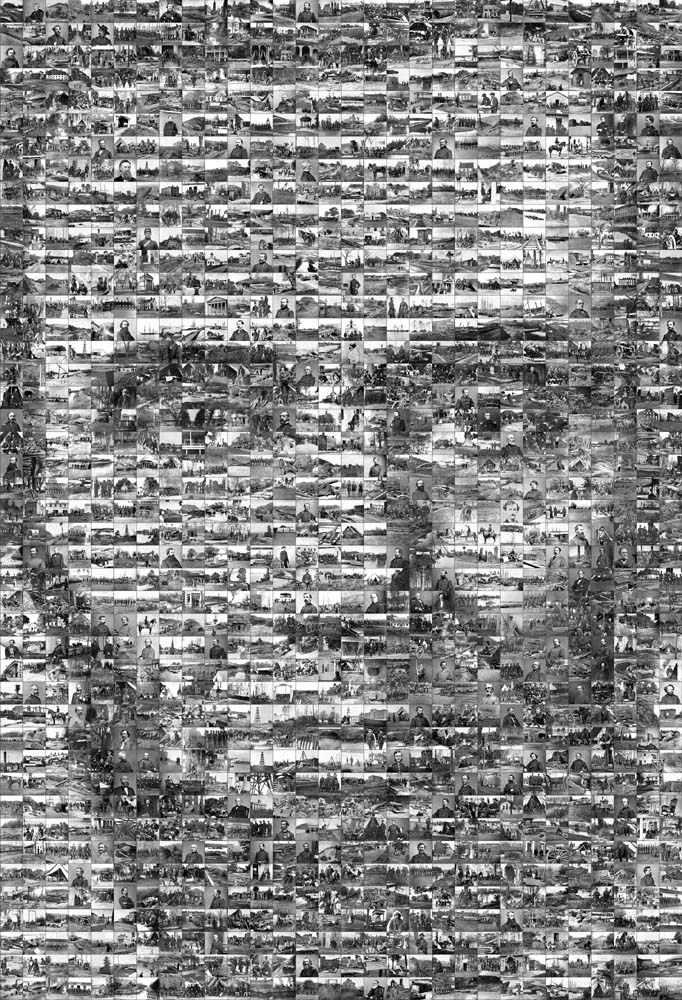
Below is a Lincoln photomosaic using contact prints or just very small Civil War photographs. I bought a copy of this in the gift shop at the Library of Congress many years ago—I imagine they still sell it. It's a pretty remarkable effect. Click on it for a larger view—you may be surprised at how many of these miniature images are instantly familiar.


Tuesday, November 27, 2007

Odds and Sods

A number of the Civil War blogs listed in the lower right column covered the interesting discovery of what appear to be glimpses of Abraham Lincoln amidst the crowd in some 1863 Gettysburg photos. Here's one newspaper report of the story (USA Today) with close-ups of the new views, along with the more familiar head shot sifted out of the crowd in 1952.

WHAT THE ?!


Another Lincoln photo caught my eye around the same time while browsing the blogosphere (it wasn't a current news item, and is nothing new to people who study such things). Doctored photos have been around as long as photography has been around, and certainly the Civil War era was fair game for pre-Photoshop photographers looking to spice up or repair a shot.

Apart from staged photos (see William Frassanito's expositions on the movement of corpses at Devil's Den, for example), there is the case of Lincoln's head on Calhoun's body (see here), and some housekeeping with group photos (see here for the complete before and after shots of Sherman's generals, with and without Francis Blair).
To see a parade of digital manipulations from the Civil War era to more modern shenanigans, have a look at this photo essay, "Digital Tampering in the Media, Politics and Law," which includes brief explanations of the two snippets above (click on the images there to see side-by-side comparisons).

All of those pages are from the website of Hany Farid, Professor of Computer Science at Dartmouth, who has an big time interest in digital forensics.


WALKING TOURS

Another neat idea, this one made available free from the folks at Civil War Traveler magazine: podcasts of walking tours, recorded on the battlefield, narrated by National Park Service historians—with accompanying pdf maps you can print out. Ahhh, sweet, sweet technology.

ATLANTA, THE MUSICAL

First, there was the world premiere of the opera Appomattox in San Francisco (see my review here). Now, as if to poke a finger in the other eye of conservative, California-phobic Civil War buffs, the musical "Atlanta" is opening in Los Angeles.

Playbill offers these particulars: "Grammy Award-winning Nashville songwriter Hummon—who has penned hits for Dixie Chicks, Rascal Flatts, Wynonna, Tim McGraw and more—teams with actor, writer and director Pasdar ('Heroes,' 'Desperate Housewives') on the musical, which mixes select prose by William Shakespeare with original bluegrass music and country tunes. Hummon provides the music and co-wrote the book with Pasdar. Set 'toward the end of the Civil War, in the waning days of the Confederacy,' reads a show description, 'a young Yankee, Paul, assumes the persona of a Confederate soldier in order to keep alive behind enemy lines.'"

Shakespeare. Desperate Housewives. Bluegrass. Sounds pretty damn good to me. In all seriousness, the centrality of American roots music to this production, and the subject matter, cause me to reconsider my (opera review) vow that the only current musical I would consider attending is Spamalot. I'm not expecting something so transcendent as Jack White singing "Wayfaring Stranger" on the Cold Mountain soundtrack, or the haunting renditions of "Man of Constant Sorrow" from Oh Brother Where Art Thou, but maybe something along those lines.

Go to the Geffen Playhouse site, and click on the "Preview Atlanta Here" box for sense of what they're trying to deliver.

EASTERN KENTUCKY GRAVEHOUSES

Somehow, even with a life-long near-obsession with cemeteries, and as an earlier subscriber to the on-again off-again Grave Matters newsletter, I came to be in my late 40s without ever hearing anything about "gravehouses"in the style of these structures in Eastern Kentucky. Check out the photos at this site. I am utterly fascinated by this. Out of curiosity, I have queried the photographer about the Union soldier he references in the text. Click on the "Project Home Page" link, and have a look at the whole site, entitled, "Sickness and Death in the Old South."

Monday, November 26, 2007

Nearly Fired and Never Knew It

Readers of the last blog entry here may have noted that the controversy over the Alacatraz photographs really took off in early August of 1864, and that by August 5th, Department of the Pacific commander Irvin McDowell was assuring the War Department that the situation was under control (the prints and negatives seized, and the customers' names obtained). In subsequent correspondence, he was compelled to defend the honor of Capt. Winder, whose loyalty had been called into question.

Little did McDowell know, mid-August of that year also brought an informal performance review of his own position, though not for issues related to loyalty. McDowell's record in Virginia in the early years of the war was indelibly stamped with the defeat at First Bull Run, one of many connected topics intriguingly explored at fellow blogger Harry Smeltzer's Bull Runnings site.


Continuing my browsing of volume 50, part II of the Official Records of the War of the Rebellion, I came across this missive from U.S. Grant down at City Point—bogged down as he was with Robert E. Lee at Petersburg—to Secretary of War Stanton (click on the image for a slightly better view):


Ouch. "Unofficially," Grant says, McDowell is a disaster waiting to happen. He is not a good military commander, nor is he suited to deal with civilian authorities. He will do more harm than good. I'm struck by the seemingly casual tone of Grant's recommendation that McDowell be summarily dismissed or demoted from department command. The Secretary of War, to his credit, replies with a solid defense of General McDowell.

Nicely done. Stanton lays it all out: 1) there have been no complaints about him (unlike his predecessor), 2) he works well with the governor, 3) he's a good administrator, and 4) he's scrupulously honest. Yet he defers to Grant on the matter.

At last, to Grant's credit, he backs off the recommendation, reiterating that his poor impressions were based on unofficial sources— indeed, based only on something he'd heard [from one or more McDowell detractors]. Good thing, too. From all I can learn, McDowell was an able department head, was a well liked and effective administrator, and the civilian authorities Grant was concerned about were well pleased with his service. His post-war army career took him around the country, but he returned to the West Coast to command the Division of the Pacific before his retirement in 1882. He is regarded highly in San Francisco, where his service as a park commissioner was instrumental in the development of Golden Gate Park, one of the nation's great urban green spaces (photo below: Google Maps).

Monday, November 19, 2007

When Kingcome Came, Winder Took a Shot at Him, part two


Just a quick follow-up to my last blog entry, in which I mentioned how Captain William A. Winder, commanding the Civil War-era garrison on Alcatraz island in San Francisco Bay, raised hackles among our British allies by firing a shot across the bow of their Pacific fleet flagship. That incident blew over with an exchange of brusque communiques, and the rest of Winder's Alcatraz command remained uneventful, until 1864, when he got a hankering to document his island fortress in a series of detailed photographs.

The San Francisco outfit of Bradley and Rulofson was chosen for the task, and they set about exposing two thousand negatives of the island defenses from, presumably, innumerable angles. When a member of Corps of Engineers, Lieutenant Elliot—eager to show his superiors the progress made at Alcatraz—forwarded some sample photos to Washington, congratulations were not forthcoming.

Historian John Martini, in a 1992 article for American Heritage, picks up the story:


Upon receiving Elliot’s letter on August 1, Chief of Engineers Delafield immediately fired off a telegram informing the lieutenant in blunt language that all such photographs were to be “instantly suppressed.” That same day the Chief of Staff of the Army, Gen. Henry Halleck, sent off his own wire, containing a frightening directive: Secretary of War Edwin Stanton had personally ordered the photographs seized.

Things moved quickly. Three days later the San Francisco Evening Bulletin ran a story under the headline FORT ALCATRAZ TAKEN!, which reported that at 4:00 P.M. on August 2 a party of armed soldiers had arrived at the Montgomery Street studios of Bradley and Rulofson. Brandishing orders from the War Department, the soldiers had seized all the photographs, negatives, and correspondence relating to the Alcatraz contract, including the name and address of every customer who had ordered a copy set.

On August 5 General McDowell was able to report to Halleck that “the provost-marshall-general has all the. negatives and all the copies, except those Elliot sent to the Engineer Department.”

That nearly did it for Captain Winder. He was the grandson of a prominent American general in the War of 1812, and the son of a distinguished Mexican War veteran. But that all changed in 1861. The fact that his father, John H. Winder, had resigned his U.S. commission, ultimately becoming a Major General in the Confederate army in charge of all POW camps east of the Mississippi—and a pariah in the northern press—cast a dark cloud over the loyalties of the young captain. It didn't help that Captain Winder was now distributing detailed photos of the lynchpin in the San Francisco Bay defenses. Must have seemed like a good idea at the time.

Irvin McDowell, then commanding the department, defended Captain Winder, assuring Washington that the young officer was motivated by pride in his command, rather than in any effort to aid the enemy. Still, a humiliated Winder resigned his command at Alcatraz and transferred to the sleepy post at San Jose, at the south end of San Francisco Bay.

Most interesting is the saga of the photos themselves. They were thought to have been destroyed upon Stanton's orders. Only by chance did John Martini, author of Fortress Alcatraz and the aforementioned American Heritage article, discover one image mistakenly identified as Ft. Point. Through a fortunate series of events, this led to the discovery of eight other images in the series, all mislabeled and hidden away in Sacramento for over 100 years.

The lost Alcatraz photographs can be seen in Fortress Alcatraz, but it's difficult to find any of the photos online. They also appeared in the November 1992 issue of American Heritage, but only the text of the article appears online—here. Read the AH piece for the fascinating story of how Martini identified the photos—a tale that warms the cockles of history buffs' hearts. Archives everywhere are full of such undiscovered treasure, or so I want to believe. Page 48 of the Google Books version also has a sidebar summary of Mr. Martini's happy sleuthing.

Thursday, November 15, 2007

When Kingcome Came, Winder Took a Shot at Him, part one

Reading the Official Records of the War of the Rebellion, even at random, never fails to produce something of interest. Continuing the last entry's focus on Left Coast (Civil War-era) fortifications, I want to put up at least two short pieces on San Francisco's Bay's most famous island, if not its most spectacular (saving Angel Island for still another entry). You know the one—what the Spanish named Isla de Alcatraces, or Pelican Island. Later just called Alcatraz. Or for you criminal types, The Rock.

Alcatraz was the centerpiece of harbor defenses, able to reach anything coming or going with her massive guns. For most of the Civil War period, the installation was commanded by William A. Winder, the son of a Confederate general. Sons of rebellious fathers are always looked upon with suspicion, never more so than during wartime. Winder served his country with honor, but nevertheless brought unwanted attention down upon his far-flung post.


Here is some correspondence from the Official Records about the time the Commander-in-Chief of Britain's Pacific Fleet came calling, and, as he saw it, was rudely fired
upon by Captain Winder. Tomorrow, or tonight, look for another Alcatraz entry on how Captain Winder's loyalty subsequently came under question all the way back in Washington.

To summarize the following (click on individual telegrams for a slightly more readable view), Rear-Admiral Kingcome, making a courtesy visit, moved into San Francisco Bay with his flagship Sutlej. The day was so calm, his colors could not be discerned, and Winder fired a shot to bring to the unidentified ship. Kingcome took umbrage and wrote Winder's boss, George Wright. Winder gave his side of the story, but Kingcome wasn't entirely satisfied. A couple years later, the son of the Confederate general would have bigger problems (next entry).

Thursday, November 08, 2007

Some of the greatest preservation "victories" were not even contested, but instead depended on something as tenuous as one man's opinion.

Fort Point, in San Francisco's Presidio, was one of the 1850-1884 "Third System" harbor fortifications that included such well known Civil War-related structures as Monroe, Morgan, Jackson, Pulaski, Pickens, and Sumter.

Fort Point was finished in 1861, and was the first tier of San Francisco Bay defenses covering the Golden Gate. As Emanuel Lewis wrote in Sea Coast Fortifications, "from the technical standpoint, this large group of massive, vertical-walled forts represented the general embodiment and the fullest development of features which had previously appeared in only a few and isolated instances, i.e., structural durability, a high concentration of armament, and enormous overall firepower.
"

Fort Point today is one of San Francisco's historic treasures, but it might easily have been
demolished to make way for the Golden Gate Bridge in the 1930s. Interestingly, the principal resistance to destroying the fort, in the future-looking world of 1937, came from the builder. Thank goodness for Joseph Strauss (look for his statue on the south overlook next time you visit the bridge).

The NPS website on Ft. Point includes a worthwhile, downloadable pdf history of the fort ("Fort Point: Sentry at Golden Gate" — scroll down to find link), written by historian John Martini (speaking of martinis, in another post I'll find some way to weigh in on the Bay Area's prideful claim to have created that cocktail). Mr. Martini writes:


Chief Engineer Joseph Strauss initially concluded that Fort Point sat on the optimal location for a huge concrete caisson anchoring the bridge’s San Francisco end. After touring the empty fort, however, he changed his mind. In a 1937 memorandum to the bridge’s Board of Directors, Strauss wrote: “While the old fort has no military value now, it remains nevertheless a fine example of the mason’s art. Many urged the razing of this venerable structure to make way for modern progress. In the writer’s view it should be preserved and restored as a national monument…” Strauss made some additional calculations and concluded that the fort could be spared by moving the southern anchorage several hundred feet south. However, in order to make up the difference in the total length, he would have to add a ‘bridge within the bridge,’ and consequently designed a steel arch in the southern anchorage to span the old fort. Fort Point would be overshadowed by the new bridge, but it would be preserved.

The bridge itself is a wonder to behold, but I always find myself looking for that little arch on the south end—the bridge within a bridge—that serves no other purpose than to protect an old pile of bricks. Thank you, Mr. Strauss. As it turns out, the top deck of that fort offers one of the most amazing views of the bridge, and Strauss probably thought of that too.


Monday, November 05, 2007

About one year ago, in my October 30, 2006 blog entry I made passing mention of some Civil War-related "Roadside Attractions"

inlcuding a reenactment of what is claimed to be the Civil War's first amputation in Philippi, West Virginia (scroll down at that link to read about the unfortunate surgery). Philippi also boasts the Mummies of the Insane exhibit, which I'm guessing draws more visitors.

There's much more to the amputation, story, however. I chanced upon one of many news reports about American service personnel in Iraq who have been fitted with the latest in prosthetic devices. I don't recall where I read it now, but the article made mention of the Civil War amputation in Philippi, which caused me to dig a little deeper. Turns out that first patient, James Edward Hanger—a Confederate cavalryman wounded in the Battle of Philippi
—later designed his own artificial leg [editor's note: see the comment below from Steve M., who says that Hanger did not enlist on either side, but wanted to join Union forces initially). Perhaps this story is more widely known than I realized, but it was the first I'd read of Mr. Hanger (pictured at top) in any detail.

According to a company history of the Hanger Orthopedic Group, young Hanger "designed an artificial leg with the first hinged knee and hinged foot, forming it out of whittled barrel staves, rubber, wood, and metal components (the illustration at right is from Hanger's patent). According to a history of prosthetics from Northwestern University Medical School, Hanger 'replaced the catgut tendons of the American leg [an earlier prostheses named in 1856] with rubber bumpers to control dorsiflexion and plantarflexion and he used plug fit wood socket.'"

Eventually, Hanger set up shop in Richmond producing limbs for other Civil War amputees. The company he started, and that still bears his name, has since supplied advanced prostheses to amputees of every American military conflict. Today, the company has over 3,500 employees and a presence in 45 states (
here's a fascinating short history of "Orthopedics at War," by Danielle Cohen; the Hanger company timeline is at the company website, and also here).

Hanger is not the only company that dates back in some form to the American Civil War. And the Hanger Limb was not the only innovative advance to spring from those years of slaughter, but I'd wager there are a lot more items on the killing and maiming side of that particular balance sheet. Take a moment this evening to raise your glass to James Edward Hanger, 1843-1919, considered by some to be the father of modern prosthetics.

Thursday, November 01, 2007

Where is the statue to Mrs. Arnold?

Many a woman answered the call in the Civil War years, and devoted herself to taking care of wounded soldiers back from the front. In what would become the newly-minted Union state of West Virginia, one woman in particular, Laura Arnold, was well remembered by convalescing Union troops, one of whom wrote that "her fragile form was almost ubiquitous in the hospitals, and with her own tender hands she soothed the aching temples of many a dying soldier boy, far away from the loved ones at home."

Colonel Moore of the 28th Ohio Infantry called Mrs. Arnold "the most loyal woman in West Virginia." Years later, in 1897, the assembled Society of the Army of West Virginia made her an honorary member for her "patriotism and past efforts on behalf of Union arms."

After the turn of the century, in 1905, she was on hand for a reunion of the 5th West Virginia Cavalry, which had occupied Beverly, (West) Virginia following the 1861 Battle of Rich Mountain. The old veterans named her "Mother of the Regiment" for her efforts as nurse to their injured.

When Laura learned in 1863 that her brother, "Stonewall" Jackson, had died, a Pennsylvania Cavalry officer recorded her reaction in a letter home. When she "heard of her brother's death," he wrote to his father, "she seemed much depressed, but said she would rather know that he was dead than to have him a leader in the rebel army."

Laura and Thomas Jonathan Jackson remained close, even with the advent of war. Each named a child after the other. In an earlier blog entry, I highlighted some of the voluminous correspondence between these two siblings, some of which can be read online from the Virginia Military Institute archives. The VMI site also has a photo of Laura, here.

THEY BATHE HORSES, DON'T THEY?

Where is the statue or memorial to Mrs. Arnold? I hope faithful readers can point me to it. Her brother was particularly skilled at killing United States soldiers, while she did her best to save a few. Statues and memorials to Stonewall abound. His arm warrants its own grave, and his trusted mount is is still getting makeovers (albeit, only every 140 years or so).

Most of what I know about Laura Jackson Arnold I gleaned from the VMI site, and Albert Castel's essay, "Arnold vs. Arnold: The Strange and Hitherto Untold Story of the Divorce of Stonewall Jackson's Sister" (appearing in Winning and Losing in the Civil War, Essays and Stories, University of South Carolina Press, 1996). It's a fascinating and somewhat sad story that might have come across as sordid or sensational in the hands of a less talented historian. But that's another story, for another night.

Is there a lesson to be learned in this short entry? I can't think of one, unless it's that history loves a warrior more than it does the person who dresses the wounds the warrior inflicts— even if the two are related.

Thursday, October 25, 2007

Flags of our (Great-Grand) Fathers


I try not to blog about my political opinions here -- there are other venues where I let off that kind of steam. I find it jarring when history-themed blogs morph into contemporary Op-Ed sections, even when I agree with the sentiments expressed. Some issues, of course, bridge the distance between the Civil War era and the politics of 2007 – such is the reach, and the legacy, of that cataclysmic struggle. One of those enduring issues is a simple but universally recognized emblem and the emotions it evokes. Thankfully, wayward Californian John Coski at the Museum of the Confederacy wrote the book on the Confederate battle flag, so you don’t have to.

Speaking of Op-Ed sections, the battle flag controversy was highlighted in one of my local papers several months ago. I made note of it, and intended to write a letter to the editor, but responding to long-discredited “black Confederate” mythology (the part of the editorial that pushed my buttons) seems increasingly pointless. It’s here to stay. I’m reminded of something I read recently in the acknowledgments to Ray Mulesky’s book, Thunder From a Clear Sky. While Ray was trying to ferret out the details of the “battle” of Browning Springs, Kentucky, with Harold Utley of the Hopkins County Historical Society, Mr. Utley made the profound and sadly accurate comment that “once something is wrong in print, it is likely wrong forever.”

If that was true in the past, it’s all the MORE true in the age of the internet.


The SF Chronicle essay in question, “Give the Confederate flag a break: The Stars-and-Bars is a diversion in the nation's fight for racial harmony,” is a well-intentioned call for people to cool their jets, take the long view, and remove the chips from their shoulders (take a moment to read it in full if you want to make sense of my specific references here). It’s also another subtle example of something wrong in print that will help perpetuate misconceptions until the end of time (and I’m not speaking of the common mislabeling of the battle flag as the “Stars and Bars,” which refers, in fact, to a Confederate national flag).

The editorial starts off well enough, discussing the relevance of symbols, but quickly swerves off logical kilter with specious analogies. No one is suggesting the flag be banned from country music concerts. Legal objections to the flag (from organizations like the NAACP) have to do with it being used in a quasi-official capacity – flying over a state house, for example. Considering that it represented some of the armies that went to war with the United States, objections to the flag under these circumstances don’t seem unreasonable. And considering that, like it or not, it is historically associated with the most virulently racist organizations in the history of our nation, it’s unrealistic to assert that the meaning many black Americans assign to that symbol is unfair or irrational. Symbols are powerful things, and diametrically opposed interpretations do not cancel each other out. A non-racist sense of pride in one’s heritage, symbolized by that flag, is no more valid, and no more historical, than a sense of revulsion by those who see it as emblematic of the armies that fought to perpetuate slavery. Or who see it as emblematic of the KKK and their ilk.

Had the Op-Ed author, Mr. O’Neill, satisfied himself with the “Heritage not Hate” perspective, I would not feel compelled to comment on it. But I was dismayed to read the fresh renewal, in my Sunday paper, of some of the most discredited mythology about the Civil War. The issue of so-called Black Confederates has been so thoroughly refuted, it's astonishing that rational people continue to raise it (he wrote, “between 60,000 and 90,000 black men, both free and slave, also served under the banner of the Stars and Bars”). The entire rationale (whether extended consciously or not) behind the notion of large numbers of black people fighting for the South is to diminish the connection between slavery and the Civil War. After all, how could it be about slavery if blacks themselves fought with the Confederates?

The answer is that they did not, except in isolated and exceptional instances. It was illegal for blacks to fight. Even as late as 1864, when General Patrick Cleburne suggested recruiting slaves as an answer to the South’s critical shortage of manpower, he was nearly run out of town on a rail for such a radical proposition. The CSA did not consider recruiting slaves in earnest until just before the war ended.

The phrasing is key: 10s of thousands of black men “served” with Confederate armies. This is a staple of neo-Confederate web sites that attempt to remove slavery from the equation entirely. To them, it was a war of aggression by mongrel hordes (immigrants) against those true American patriots – keepers of the Revolutionary flame – who sought only to salvage self-determination. But if the slaves put to work on behalf of southern armies served for the Confederacy, we must likewise conclude that a lot of allied POWs served with Japanese forces in WWII. You can see how absurd it becomes when forced labor is referred to in the context of willing, or even conscripted soldiers.

And while it's true that "the vast majority. . .owned no slaves,” it's a disingenuous argument. The 1860 census shows that close to 25% of all white southern families owned slaves (and in each of those slaveholding families, likely only one person was named as the owner). The institution was part and parcel of the southern economy, and southern antebellum culture. People who did not own slaves aspired to own them, benefitted from the presence of them, or otherwise facilitated the system. And regardless, the armies were sent into battle to achieve the objectives of the government. In this case the objective was independence to protect a system of chattel slavery, and soldiers were fighting for that whether they realized it or not.

The nation was split literally between slave and free soil interests. The election of a president from a party with explicitly abolitionist roots precipitated secession, which in turn led directly to the war. The architects of secession (see Apostles of Disunion), made it painfully clear that slavery was the central issue, and leading Confederates themselves made no bones about the fact that independence was necessary to preserve slavery. With all the primary resources at our disposal, it's a tortured argument for someone today to say the American Civil War was not about slavery, but about states rights. The only state right at issue was the right to preserve and expand the institution into the western territories. Ironically, the Confederate Constitution took that right to the other extreme: it prohibited states of the Confederacy from interfering with slavery even within their own borders. Which is to say states would have to allow slavery whether they wanted it or not. So much for states rights.

Mr. O’Neill makes the oft-seen point that since the U.S. flag flew over the entire nation prior to the Civil War, it, too, was an emblem of slavery. How to explain to someone that the flag of emancipation transcends the reason emancipation was necessary? In the short life of the Confederacy, how could the battle flag transcend the reasons the Confederacy was seeking independence? How could it transcend the negative associations of the next 100 years?

In one concluding paragraph, O’Neill writes, “Though the Confederate flag remains an easy target for politicians looking to take cheap shots, the heritage represented by that flag is far from simple. Though it retains negative power, there surely is not a soul left on the planet who waves that flag in support of slavery. Voters whose ancestors gave their lives under that banner should not be written off by the party that has, historically, best defended their interests."

Certainly the first sentence rings true, but it bears mentioning that many of those voters he refers to wrote off the party – not the other way around – during the an era of forced integration and civil rights protests. Indeed, there was a monumental resurgence of the battle flag in direct response to court-ordered integration, well in advance of the Civil War centennial.

I agree with much of what Mr. O’Neill wrote in his essay. I share his exasperation with the hollow, pseudo-controversies of each successive election cycle. And I certainly agree that people today should be given the benefit of the doubt when celebrating or honoring their heritage -- that a presumption of racism is unwarranted. It’s pointless to pass moral judgment on the common soldier of 1861, and equally pointless to take an emotional stake in defending their honor (this enduring emotional charge may be unique to civil warfare, while more recent enemies quickly become trading partners and allies). But you can't have it both ways. You can't insist that others appreciate your affinity for the banner, while insisting that their interpretations of that symbol are irrational. Both views have a long, tangible history.

Mr. O’Neil may think I am missing the larger points of his editorial while focusing on a few passing comments (I will email him a copy of this blog entry). But I think everything hinges on this issue of states rights vs. slavery. If one is to easily dismiss the negative connotations that generations of African-Americans, for example, assign to the battle flag, one must first make the case that the war was not really about slavery, then rationalize the particular association of the battle flag with the Klan. Good luck with that exercise.

But one needn’t rewrite the history of the Civil War to make the other, thoughtful arguments. No one who honors the service and sacrifice of their Confederate ancestors owes anyone an apology today. Individuals fought for all kinds of reasons, and in the final analysis, it’s just history. It’s always best to face it head-on.

I really liked this passage in O'Neill's essay, and it's a good one to close with here:


And so it goes, in the words of recently departed Kurt Vonnegut, a wry commentator on human folly in all its guises whose leavening humor and wisdom will be sorely missed in a nation fairly bereft of both qualities. And nowhere is that wisdom and humor needed more than in our bogged-down-in-B.S. attitudes toward race, wherein we continue to countenance unequal schools and a vast disparity in opportunity while arguing about words and old flags.

Thursday, October 18, 2007

iTunes U


Even though I did not own an iPod or other MP3 player until just recently, I have amassed a vast library of free podcasts—mainly of various radio programs—that I thought might be nice to listen to during long walks or drives, or while outside doing solitary work.

Of course in real life, long walks are hard to come by, long drives feature a live soundtrack of boys fighting in the backseat, and I try to do as little work outside as possible. But still, I love the technology, and the mobility of podcasts, and I continue to collect them just in case.


Lately, I started downloading some interesting-sounding lectures from various universities, on all manner of topics. There are some fairly amazing repositories for college-level presentations—usually introductory—on everything from astronomy to the history of Rome.
If you have iTunes installed, a good starting place is here (click on the link to iTunes U to save you navigating it from scratch). You can also go straight to the university websites, and usually find an iTunes U icon (or search the site with keywords "itunes" or "podcasts"). This web page has a handy list of podcasts by university, with links.

[click on the images at top and bottom of this entry to get a larger view, if necessary]

There's some Civil War stuff there, if you look for it. At UC Berkeley, Jennifer Burns
has a long list of lectures on U.S. history starting with the Civil War—I listened to part of the first one, and took issue with a couple statements, but thought it very listen-able, all in all. That's a tough lecture, any way you shake it.

I see from her biography that she's moving on to the University of Virginia soon. Her apparent interest in Ayn Rand probably informs her interpretations of the Civil War. She does ask the question, "who freed the slaves" (a question we see Kevin Levin took up in his classroom recently). Professor Burns' answer is, the slaves did.


Over at Princeton's website, Dimitri's favorite professor holds forth on "Abraham Lincoln's Invention of Presidential War Powers."
For some of the reasons I mentioned in the 2nd paragraph above, I am very much enamored of the 60-second Lecture series at the University of Pennsylvania. Now that is a cool idea: get over-educated people in various fields to summarize their subjects in one minute. The first thing you'll notice is that many of them run long. "Intracellular landfills" runs over two minutes! My favorite: "What Makes a Poem a Poem," by Charles Bernstein. One minute, twenty-two seconds. And it's really all you budding poets need to know.


Friday, October 12, 2007

Buster Kilrain in Song...

Steve Earle sings "Dixieland": a long introduction, but it's worth it, as Steve explains what the war was really about, and how the 20th Maine saved us all from talking funny:

Dixieland

I am kilrain and i'm a fightin' man and i come from county clare
And the brits would hang me for a fenian so i took me leave of there
And i crossed the ocean in the "arrianne" the vilest tub afloat
And the captain's brother was a railroad man and he met us the boat
So i joined up with the 20th maine like i said my friend
i'm a fighting man
And we're marchin' south in the pouring rain and we're all goin' down to dixieland

I am kilrain of the 20th maine and we fight for chamberlain
cause he stood right with us when the johnnies came like a banshee on the wind
When the smoke cleared out of gettysburg many a mother wept
For many a good boy died there, sure, and the air smelted
just like death

I am kilrain of the 20th maine and i'd march to hell and back again
For colonel joshua chamberlain - we're all goin' down to dixieland

I am kilrain of the 20th maine and i damn all gentlemen
Whose only worth is their father's name and the
sweat of a workin' man
Well we come from the farms and the city streets and a hundred foreign lands
And we spilled our blood in the battle's heat
Now we're all americans

I am kilrain of the 20th maine and did i tell you friend
i'm a fightin' man
And i'll not be back this way again, cause we're all
goin' down to dixieland