 Civil War blogging doesn't get any better than the recent serial entries by Mark Grimsley (at Civil Warriors) on the intriguing process of updating his (and Brooks Simpson's) Gettysburg battlefield guide. See part 1 of "Letting the Ground Argue" here. Part two here. It's a real treat to read a working historian's musings from the field. The exercise imbues an inherently casual medium with a unique and powerful value. Bison Books should consider publishing links to these the making of entries.
Showing posts with label Books. Show all posts
Showing posts with label Books. Show all posts
Thursday, May 28, 2009
The Making of the Revised Edition of Gettysburg: A Battlefield Guide
Civil War blogging doesn't get any better than the recent serial entries by Mark Grimsley (at Civil Warriors) on the intriguing process of updating his (and Brooks Simpson's) Gettysburg battlefield guide. See part 1 of "Letting the Ground Argue" here. Part two here. It's a real treat to read a working historian's musings from the field. The exercise imbues an inherently casual medium with a unique and powerful value. Bison Books should consider publishing links to these the making of entries.

Tuesday, April 21, 2009
The Walk to the Sea
In honor of John Muir's birthday today, I am reaching back three years into the archives to pull out one of my favorite, early posts in this blog. In 1867, Muir took a 1,000-mile walk to the Gulf, through the heart of the former Confederacy, and here are some passages from his notes of that trip, which were eventually published.
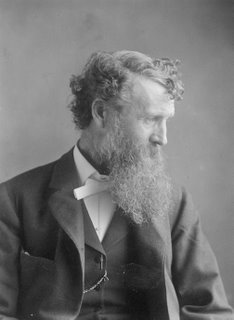
I was slow to come to appreciate the magnitude of John Muir's contribution to conservation, his role in the early establishment of the national park system, his stature as naturalist par excellence. Until I moved to San Francisco in my early 20s, Muir had not even been on my radar. Later, as I came to be captivated by the history and geography of the Sierra Nevada Mountains, Muir became such a towering figure, he was unavoidable. Reading of his adventures as a mountain man — tales of solitary sojourns in the high country expressing unabashed, poetic reverence for sacred wilderness — always makes me itch to break out the tent, gather the Coleman products, and head for the woods.
I was also slow to get around to Muir's early writings. Imagine my delight, then, when I finally came across the unpolished notes of his 1867 walk across the South, from Louisville, Kentucky to Savannah, Georgia, and on into Florida — A Thousand-Mile Walk to the Gulf (Boston and New York: Houghton Mifflin Company, 1916). Muir embarked on his journey to look at the plants — "grass, weeds, flowers, trees, mosses, ferns," and he comments on them passionately, and at length. But he also gives a sense of the ravaged, post-war South. Muir speaks to many freedmen along the way, enjoys the hospitality of residents in the heart of the old Confederacy, and encounters highwaymen in a largely lawless landscape where every person met on the road is a potential threat.
Happily, the entire book can be read at the Sierra Club site, here (follow links to "Books by John Muir"). I've excerpted a number of interesting passages that present observations of the Civil War South, two and a half years after the end of hostilities.
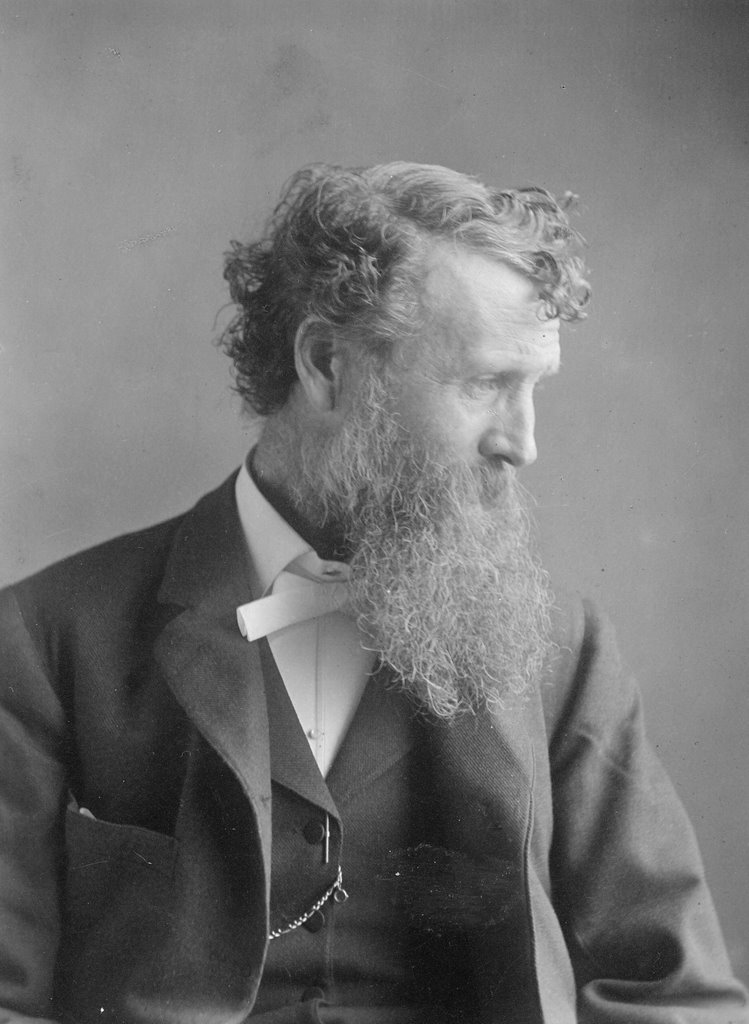
I was slow to come to appreciate the magnitude of John Muir's contribution to conservation, his role in the early establishment of the national park system, his stature as naturalist par excellence. Until I moved to San Francisco in my early 20s, Muir had not even been on my radar. Later, as I came to be captivated by the history and geography of the Sierra Nevada Mountains, Muir became such a towering figure, he was unavoidable. Reading of his adventures as a mountain man — tales of solitary sojourns in the high country expressing unabashed, poetic reverence for sacred wilderness — always makes me itch to break out the tent, gather the Coleman products, and head for the woods.
I was also slow to get around to Muir's early writings. Imagine my delight, then, when I finally came across the unpolished notes of his 1867 walk across the South, from Louisville, Kentucky to Savannah, Georgia, and on into Florida — A Thousand-Mile Walk to the Gulf (Boston and New York: Houghton Mifflin Company, 1916). Muir embarked on his journey to look at the plants — "grass, weeds, flowers, trees, mosses, ferns," and he comments on them passionately, and at length. But he also gives a sense of the ravaged, post-war South. Muir speaks to many freedmen along the way, enjoys the hospitality of residents in the heart of the old Confederacy, and encounters highwaymen in a largely lawless landscape where every person met on the road is a potential threat.
Happily, the entire book can be read at the Sierra Club site, here (follow links to "Books by John Muir"). I've excerpted a number of interesting passages that present observations of the Civil War South, two and a half years after the end of hostilities.
September 6. Started at the earliest bird song in hopes of seeing the great Mammoth Cave before evening. Overtook an old negro driving an ox team. Rode with him a few miles and had some interesting chat concerning war, wild fruits of the woods, et cetera. "Right heah," said he, "is where the Rebs was a-tearin' up the track, and they all a sudden thought they seed the Yankees a-comin', obah dem big hills dar, and Lo'd, how dey run." I asked him if he would like a renewal of these sad war times, when his flexible face suddenly calmed, and he said with intense earnestness, "Oh, Lo'd, want no mo wa, Lo'd no." Many of these Kentucky negroes are shrewd and intelligent, and when warmed upon a subject that interests them, are eloquent in no mean degree.
September 7. Left the hospitable Kentuckians with their sincere good wishes and bore away southward again through the deep green woods. In noble forests all day. Saw mistletoe for the first time. Part of the day I traveled with a Kentuckian from near Burkesville. He spoke to all the negroes he met with familiar kindly greetings, addressing them always as "Uncles" and "Aunts." All travelers one meets on these roads, white and black, male and female, travel on horseback. Glasgow is one of the few Southern towns that shows ordinary American life. At night with a well-to-do farmer.
As I turned to leave, after bidding her good-bye, she, evidently pitying me for my tired looks, called me back and asked me if I would like a drink of milk. This I gladly accepted, thinking that perhaps I might not be successful in getting any other nourishment for a day or two. Then I inquired whether there were any more houses on the road, nearer than North Carolina, forty or fifty miles away. "Yes," she said, "it's only two miles to the next house, but beyond that there are no houses that I know of except empty ones whose owners have been killed or driven away during the war."
Met a young African with whom I had a long talk. was amused with his eloquent narrative of coon hunting, alligators, and many superstitions. He showed me a place where a railroad train had run off the track, and assured me that the ghosts of the killed may be seen every dark night.
Had a long walk after sundown. At last was received at the house of Dr. Perkins. Saw Cape Jasmine [ Gardenia florida ] in the garden. Heard long recitals of war happenings, discussion of the slave question, and Northern politics; a thoroughly characteristic Southern family, refined in manners and kind, but immovably prejudiced on everything connected with slavery.
The family table was unlike any I ever saw before. It was circular, and the central part of it revolved. When any one wished to be helped, he placed his plate on the revolving part, which was whirled around to the host, and then whirled back with its new load. Thus every plate was revolved into place, without the assistance of any of the family.
Toward evening I arrived at the home of Mr. Cameron, a wealthy planter, who had large bands of slaves at work in his cotton fields. They still call him "Massa." He tells me that labor costs him less now than it did before the emancipation of the negroes. When I arrived I found him busily engaged in scouring the rust off some cotton-gin saws which had been lying for months at the bottom of his mill-pond to prevent Sherman's "bummers" from destroying them. The most valuable parts of the grist-mill and cotton-press were hidden in the same way. "If Bill Sherman," he said, "should come down now without his army, he would never go back."
On no subject are our ideas more warped and pitiable than on death. Instead of the sympathy, the friendly union, of life and death so apparent in Nature, we are taught that death is an accident, a deplorable punishment for the oldest sin, the arch-enemy of life, etc. Town children, especially, are steeped in this death orthodoxy, for the natural beauties of death are seldom seen or taught in towns.

Of the people of the States that I have now passed, I best like the Georgians. They have charming manners, and their dwellings are mostly larger and better than those of adjacent States. However costly or ornamental their homes or their manners, they do not, like those of the New Englander, appear as the fruits of intense and painful sacrifice and training, but are entirely divested of artificial weights and measures, and seem to pervade and twine about their characters as spontaneous growths with the durability and charm of living nature. In particular, Georgians, even the commonest, have a most charmingly cordial way of saying to strangers, as they proceed on their journey, "I wish you well, sir." The negroes of Georgia, too, are extremely mannerly and polite, and appear always to be delighted to find opportunity for obliging anybody.
The traces of war are not only apparent on the broken fields, burnt fences, mills, and woods ruthlessly slaughtered, but also on the countenances of the people. A few years after a forest has been burned another generation of bright and happy trees arises, in purest, freshest vigor; only the old trees, wholly or half dead, bear marks of the calamity. So with the people of this war-field. Happy, unscarred, and unclouded youth is growing up around the aged, half-consumed, and fallen parents, who bear in sad measure the ineffaceable marks of the farthest-reaching and most infernal of all civilized calamities.
Friday, April 10, 2009
Groom adds voice on famous siege
 [from an article today at Salon.com]
By WALTER PUTNAM Associated Press Writer
Apr 10th, 2009 "Vicksburg 1863" (Alfred A. Knopf, 496 pages, $30), by Winston Groom: Many books have examined the Union siege of Vicksburg, Miss., over the years, but that's no reason Winston Groom should not lend his unique voice to the subject -- one of the most critical campaigns of the Civil War.
Apr 10th, 2009 "Vicksburg 1863" (Alfred A. Knopf, 496 pages, $30), by Winston Groom: Many books have examined the Union siege of Vicksburg, Miss., over the years, but that's no reason Winston Groom should not lend his unique voice to the subject -- one of the most critical campaigns of the Civil War.
The Alabama author best known for his novel "Forrest Gump," brought to life by Tom Hanks in the 1994 movie, has considerable experience and expertise in both fiction and nonfiction.
With "Vicksburg 1863," Groom brings the novelist's touch to history, personalizing characters such as Union Gens. Ulysses S. Grant and William T. Sherman, as well as Jefferson Davis and Gen. Joseph E. Johnston of the Confederacy, in an easily relatable way for the average reader.
=======================
You can read the full article here. Historical fiction set in the American Civil War has long been an interest of mine -- if only more of it were readable or interesting. For every Cold Mountain or Killer Angels, there are twenty Gods and Generals'.
I was struck by Mr. Bloom's McMurry-esque comments on the relative importance of Gettysburg versus Vicksburg in the fortunes of the war. He goes so far as to say the war was over when Vicksburg fell.
The author noted that Vicksburg fell into Grant's hands the same day that the North prevailed in the battle of Gettysburg, ending Confederate Gen. Robert E. Lee's lone invasion of Union territory. He said Gettysburg, though, pales in comparison to Vicksburg.
"In Vicksburg, not only did you lose your whole Army, you also lost the entire Mississippi River valley and half of your territory," Groom said.
"The South was almost mad to continue the war after that," he said, adding that President Abraham Lincoln would have provided much more favorable terms had the Confederates ended it then rather then almost two years later.
Friday, September 19, 2008
Odds and Sods — recent items that caught my eye

The Fort Morgan Mystery Ship
The last time this mystery ship was visible was after Hurricane Ivan hit the Alabama Gulf Coast on September 16, 2004. At that time a much smaller portion of the ship was visible above the sand. Soon after Ivan revealed this historic treasure, the shifting sand covered the relic again. [many photos]
Lehman Brothers: Cotton Speculators, Confederate Sympathizers
Lehman Brothers, the storied investment firm that filed for bankruptcy protection yesterday, was no stranger to crisis. Early in its 158-year life, the firm was nearly crippled by the Civil War. But back then there was some cotton to cushion the fall. [photo]
Casualties of Valverde?
“We know 27 Confederate soldiers died in the old hospital in 1863 following the Battle of Valverde, and all the evidence as to where they were buried points to the old graveyard where Peralta Drive is now,” he said in 2004. “These human remains and the decayed wood bring us one step closer to identifying who is buried under the street and in the adjacent lot.”
Confessions of a Teenage Civil War Reenactor
I hid my family’s secret hobby from my schoolmates like we were Russian child-bride smugglers.
Battle of Shepherdstown
A preservation group has filed an appeal with the U.S. Supreme Court over a state ruling allowing a housing development on the site of the 1862 Civil War Battle of Shepherdstown.
Kansas Before Massachusetts
About 30 volunteer members of a Kansas regiment were patrolling the land about five miles southwest of Butler, in western Missouri's Bates County that October day in 1863 when they were ambushed by about 130 rebel horsemen near Island Mound, a low hill near the Marais-des-Cynges River. The Kansas soldiers drove off their attackers in a brief skirmish.The significance is that this was the First Kansas COLORED Infantry. This fight was the first time that black soldiers went into combat on behalf of the Union during the Civil War.
Idiot Removes Tag
On September 1, Stover's Auctions reported the theft of a tag that was affixed to an important Civil War lot with multiple items from a captain in the battle of New Bern, N.C. A sword was included, which had an old cloth tag attached to it from the same captain. The tag would add roughly $2,000–$3,000 to the lot. [photo]
The Other Burns? That would be Ric
"The night before 'The Civil War,' we thought it was going to be a failure," confessed Ric Burns, who co-produced and co-wrote the colossal documentary series for his brother, Ken. "Who would watch a program stitched together from old photographs?"
Badges and Courage
Tobruk is loosely based on Stephen Crane’s classic American Civil War novel The Red Badge of Courage, and anyone familiar with Crane’s book will appreciate Marhoul’s homage. If there is a flaw to this film it’s that, unlike with Crane’s central character, Henry, audiences can’t always be certain whose story Marhoul wants us to follow.
Good Morning Vicksburg
"Good Morning America" will report from the historic, Civil War riverfront city of Vicksburg on Sept. 26.
The Buffaloes of North Carolina
The Civil War in that part of North Carolina was not the war of waving the Confederate Stars and Bars or the Union Stars and Stripes, of masses of men in butternut or blue charging up slopes toward some “little clump of trees,” or standing toe-to-toe in bloody musket volley fire.
It was more like a backwoods bushwhacking or a shootout in a snake-infested swamp along the Chowan River. It was a nighttime raid on a hog farm to drive off critters meant to supply bacon for the Army of Northern Virginia, or to burn a creekside warehouse where cured bacon was already stored.
Interview with David Williams of Valdosta State University
Q: When they couldn’t feed their families, Southern women started food riots. There was a big one in Richmond. Were there any in Georgia?
Interview with David Williams of Valdosta State University
Q: When they couldn’t feed their families, Southern women started food riots. There was a big one in Richmond. Were there any in Georgia?
A: Every major city in Georgia had food riots. We’ve documented more than 20. In Atlanta, a woman walked into a store on Whitehall Street and drew a revolver and told the rest of the women to take what they wanted. They moved from store to store.
Really cool 35-star flag discovered
At 21-feet-long and 15-feet-wide, the flag surely wasn’t missed when it flew 70 feet above the Civil War monument at Rocky Point in West Boxford. [photo]
Really cool 35-star flag discovered
At 21-feet-long and 15-feet-wide, the flag surely wasn’t missed when it flew 70 feet above the Civil War monument at Rocky Point in West Boxford. [photo]
From the Diaries of My Father
June 19, 1862: To-day I shot 654 passenger pigeons. That axe I bought from that lousy trapper has a rotten handle. I think the dog has typhoid. I like living in a sod house. Is civil war imminent?
June 19, 1862: To-day I shot 654 passenger pigeons. That axe I bought from that lousy trapper has a rotten handle. I think the dog has typhoid. I like living in a sod house. Is civil war imminent?
May 11, 1866: D—n! I just found out about the Civil War! That's what you get when you print a news-paper hundreds of miles from civilization, I suppose. To-day I shot 1,297 passenger pigeons.
Friday, July 04, 2008
Civil War Sacrilege

One of the most controversial Civil War books of the past 15 years is a thoughtful 1991 treatise on Robert E. Lee by the
Q. (Civil War Forum): Few titles have generated as much discussion and controversy in Civil War circles as your Lee Considered -- Civil War enthusiasts of every stripe are still critiquing your work, and prominent historians have weighed in on both sides of the matter. All of this confirms one reviewer’s conclusion that it is a book which "cannot be ignored." How has the response to the book been from your perspective, from reviews, and from engaging the public at speaking events?
If you add it up and weigh it all based on reviews, it was favorably received. And I could tell from Round Table invitations that there was a lot of interest on the grass roots level, among Civil War buffs. It's just gone into paperback, and there's also a 3rd printing in hard back. The press doing the paperback is hopeful that it will be adopted by college professors teaching Civil War history, and I know Gary Gallagher at
All in all it's been a good experience. If I've hurt anybody's feelings, I'm sorry, and I know I have . . . but I also think it's historic, and the people whose feelings are hurt are romantic. I belong to the non-romantic school about the Civil War. I think of it as sort of the American holocaust, and the idea that it was somehow glorious, or that leaders like Lee were somehow glorious, seems to me to be mythological.
And then of course in September of 1864 he wrote a letter that said he thought it was going to be impossible to keep Grant out of Richmond Lincoln 's reelection, and I think that everyone knew in November, 5 months before Appomattox Appomattox
My point, based on the analysis I've given here, is that that is not glorious. I'm more concerned with the common soldier in his army, and the union army, who were killed after he knew it was over. If you believe that Lee did the right thing when he surrendered atAppomattox Appomattox
My point, based on the analysis I've given here, is that that is not glorious. I'm more concerned with the common soldier in his army, and the union army, who were killed after he knew it was over. If you believe that Lee did the right thing when he surrendered at
Q. (Civil War Forum): As you did your research, what surprised you the most about Lee, in comparison to the mental image you had of him before you began?
Q. (Civil War Forum): With regard to the point you raised about Lee's failure to surrender earlier, do you think Lee felt he had the authority to take such a momentous decision, given that the surrender of the Army of Northern Virginia would have effectively finished the Confederacy? Could we not equally say his perseverance was a tribute to a belief in the supremacy of his political masters in such decisions?
Q. (Civil War Forum): Was post-war Lee the apolitical figure, preaching reconciliation and forgiveness, that he is usually portrayed?
A. (Alan Nolan): My answer to that is no. He certainly on occasion could be very conciliatory, but his ordinary position was that of a defeated Southerner. He was very resentful of the North. He was very resentful of black people. He felt that the South should be readmitted to the Union with no conditions, and no delay—he wanted the U.S.
Thursday, December 27, 2007
When Luck Runs Out. . .
 Some survived the war, but not the peace. Emerson Opdycke, at left, overcame a grievous wound at Shiloh—and was in the thick of things throughout the war—but mortally wounded himself many years later in an unfortunate accident.
There’s no way to know how many rank and file Civil War veterans managed to survive combat and exposure to disease in the Civil War years, only to have their lives cut short in post-war years by something other than natural causes. Or how many succumbed to wounds or war-related ailments many years after the fact. The numbers would be staggering, no doubt.
Not surprisingly, information on the demise of high-ranking officers and other officials is, by and large, easier to come by. I compiled the following lists from John and David Eicher’s, Civil War High Commands (Stanford University Press, 2001). Just by chance, while looking up one individual or another, I came across two or three in short succession who had been murdered after the war, and a couple who drowned. Turns out it was not as common as it was beginning to seem, but it piqued my curiosity enough to do an electronic search of an early Eicher manuscript (my curiosity would not have been piqued enough to flip through 1,000 pages of the published book).
I restricted my search to those members of the “high command” who were murdered, who
 drowned, or who suffered some other fatal accident. I excluded murders, drownings, and accidents that occurred between April of 1861 and April of 1865, since war certainly made all of those things somewhat more likely. I'm sure I missed a few entries in the Eicher book in which the search terms were not present (though the authors are consistent with the phrasing, for the most part).
Missing from my lists, among others, are such notables as Clement Vallandigham and Allan Pinkerton, who did not fit the Eichers’ criteria for “high command,” but who made the cut on at least one website’s list of the “30 Strangest Deaths in History”—Vallandigham: “Death by Jury Demonstration,” and Pinkerton: “Death from Biting One’s Tongue” (scroll down at the link to find more details).
Some of the deaths listed below are better known, like the mysterious drowning of Thomas Meagher, the subject of many narrative footnotes. Others came as a surprise to me, such as the drowning of George Wright, whose name came up here in discussions about Alcatraz, and McDowell. Didn't realize he died so soon after the war.
Without further adieu, here is my unofficial survey of high commanders who were victims of murder, drowning, or other unhappy accidents.
Murdered:
William Wirt Adams, CS: murdered by John Martin, a newspaper editor, in a quarrel on a street in Jackson, Miss., 1 May 1888; int. Greenwood Cemetery, Jackson.
Joseph Bailey, US: murdered while acting as a sheriff in Nevada, Mo., 21 Mar. 1867; int. Evergreen Cemetery, Fort Scott, Kans.
William Felix Brantley, CS: murdered by a shotgun blast at Winona, Miss., 2 Nov. 1870; int. Old Greensboro Cemetery near Tomnolen, Miss.
James Holt Clanton, CS: murdered by political rival David M. Nelson, who shot Clanton 15 or more times with a double-barreled shotgun, at Knoxville, Tenn., 27 Sept. 1871; int. Oakhill Cemetery, Montgomery, Ala.
Archibald S. Dobbins, CS: believed to have been murdered near Itaituba, Brazil, 1869.
Hiram Duryea, US: murdered by a deranged son, Brooklyn, N.Y., 5 May 1914; int. Woodlawn Cemetery, New York, N.Y.
Bryan Grimes, CS: murdered by William Parker, a hired assassin, Pitt County, N.C., 14 Aug. 1880; int. “Grimesland,” Pitt County; cenotaph in Trinity Churchyard, Pitt City, N.C.
Thomas Carmichael Hindman, Jr., CS: murdered by an assassin or assassins in the face, neck, chest, and hands, supposedly by members of the radical “Loyal League,” at Helena, Ark., 28 Sept. 1868; int. Maple Hill Cemetery, Helena.
William Scott Ketchum, US: died Baltimore, Md., 28 June 1871; int. Rock Creek Cemetery, Washington, D.C. (Ketchum was probably murdered by his landlady, Elizabeth G. Wharton, who presumably gave him poisoned lemonade; she was indicted but acquitted on 24 June 1872 in a disputed trial.)
St. John Richardson Liddell, CS: murdered on the Black River steamboat SS St. Mary by Charles Jones (ex-Lt. Col. 17 La. Inf.), in an action with its roots in the 1852 duels, 14 Feb. 1870; int. Liddell Cemetery, near Jonesville, Catahoula Parish, La.
Edwin Stanton McCook, US: murdered while making a speech at Yankton, Dak. Terr., 12 Sept. 1873; int. Spring Grove Cemetery, Cincinnati, Ohio.
Theodore A. Ripley, US: probably murdered in Emanuel County, Ga., 23 July 1866; int. Evergreen Cemetery, Winchester, Vt.
William Feimster Tucker, CS: murdered at Okolona, Miss., 14 Sept. 1881; int. Odd Fellows Cemetery, Okolona.
Drowned:
Orville Elias Babcock, US: drowned in Mosquito Inlet, Fla., 2 June 1884; int. Arlington National Cemetery, Va.
Charles Gratiot Bartlett, US: died New York, N.Y. by drowning in Staten Island ferry boat collision on 14 June 1901; int. West Point National Cemetery, N.Y.
Henry Haywood Bell, USN: drowned at Osaka, Japan, 11 Jan. 1868; int. Hiogo, Japan.
Samuel Thompson Busey, US: drowned while fishing at Mantrap Lake, Minn., 12 Aug. 1909; int. Woodlawn Cemetery, Urbana, Ill.
Henry Boynton Clitz, US: disappeared and supposed to have drowned at Niagara Falls, N.Y., 30 Oct. 1888; cenotaph in Elmwood Cemetery, Detroit, Mich.
Thomas Francis Meagher, US: died 1 July 1867, during a drinking party aboard the SS Thompson near Fort Benton, Mont. Terr., when he fell into the Missouri River and drowned “under mysterious circumstances;” his body was never recovered.
Samuel Ross, US: died by drowning, Jefferson Valley, N.Y., 11 July 1880; int. Lancaster Cemetery, Lancaster, Pa.
William Terry, CS: drowned in Reed Creek (near Wytheville), Va., 5 Sept. 1888; int. City Cemetery, Wytheville, Va.
Alfred Thomas Archimedes Torbert, US: drowned off Cape Canaveral, Fla. in the sinking of the SS Vera Cruz, 29 Aug. 1880 (his body was recovered 31 Aug. 1880); int. Methodist Episcopal Cemetery, Milford, Del.
James Henry Van Alen, US: missing and presumed drowned when he fell overboard from the SS Umbria, Atlantic Ocean, 22 July 1886.
George Wright, US: drowned off Crescent City, Calif. in the wreck of the SS Brother Jonathan, 30 July 1865 (his body was recovered at Bay Flat, Calif., in Oct. 1865); int. City Cemetery, Sacramento, Calif.
Accidental death, other than by drowning:
Alonzo Granville Draper, US: died from an accidental gunshot wound, Brazos de Santiago, Tex., 3 Sept. 1865; int. Pine Grove Cemetery, Lynn, Mass.
Thomas W. Grosvenor, US: killed by accident by a sentry during the great fire, Chicago, Ill., 21 Oct. 1871; int. Oak Woods Cemetery, Chicago, Ill.
Heber Le Favour, US: killed in carriage accident, Pawtucket, R.I., 25 Feb. or 25 July 1878; int. Swan Point Cemetery, Providence, R.I.
Samuel Emerson Opdycke [photo at top], US: mortally wounded when he accidentally shot himself in the abdomen, 22 Apr. 1884, and died New York, N.Y., 25 Apr. 1884; int. Oakwood Cemetery, Warren, Ohio.
Francis Engle Patterson, US: died when he was accidentally shot or committed suicide at Fairfax Court House or near Occoquan, Va., 22 Nov. 1862; int. Laurel Hill Cemetery, Philadelphia, Pa.
Israel Canton Smith, US: killed accidentally while hunting near Grand Rapids, Mich., 27 Nov. 1899; int. Oak Ridge Cemetery, Grand Rapids.
Frederick Steele, US: died from an injury in a buggy accident, San Mateo, Calif., 12 Jan. 1868; int. Woodlawn Memorial Park, Colma, Calif.
William Warren Stewart, US Commission Agent: killed in a railroad accident, Chicago, Ill., 6 Dec. 1893; int. Marengo Cemetery, Marengo, Ill.
Tuesday, December 18, 2007
Restless Conqueror, part one
 There’s something about Civil War veterans who go on to make their mark as explorers that really piques my interest. Two that have been the subject of modern biographies are worthy of mention here. I’m readying a more detailed post on John Wesley Powell, about whom much has been written, he who lost an arm at Shiloh, and who went on to navigate the Colorado River.
And now comes a brand new biography of Henry Morton Stanley, The Restless Conqueror. (photo at top). Holy Johosaphat, what a fascinating story. The Welshman had a rough childhood. Fleeing that, as a young adult he found himself in the South at the beginning of the Civil War. Quoting David Gilmour’s review in a recent NewYork Review of Books:
In 1861, when he was living in Arkansas, Stanley felt obliged to enlist in the Confederate Army because someone had sent him a petticoat, implying he was a coward. Captured the following year at the Battle of Shiloh, he was taken to Chicago to a federal prison camp and subsequently released on condition that he join the Union Army. But while stationed with the artillery in West Virginia, he was prostrated by dysentery and left in the local hospital when his regiment moved on. Although he later claimed he had been discharged, he had actually been told to rejoin his unit when his health improved. His refusal to do so thus turned him into a deserter.
Before the war was over, Stanley returned to America and enlisted in the U. S. Navy, then deserted one more time. His post-war career as a journalist on the Plains was more remarkable yet. Quoting again from Gilmour:
On his return to America in 1867, Henry Stanley finally discovered what he was good at: describing battles and other adventures in the newspapers. During a year in which he reported for the Missouri Democrat on expeditions against the Cheyenne and on negotiations between the Plains Indians and the government, Stanley got to know Wild Bill Hickok, Colonel George A. Custer, and General William Tecumseh Sherman, who later told him that his journey to Livingstone was a greater feat than his own "March to the Sea." His success as a journalist convinced James Gordon Bennett Jr., the proprietor of the New York Herald, to hire him to cover a British expedition to Abyssinia, to write about the 1868 revolution in Spain, and, more famously, to "FIND LIVINGSTONE," an injunction that, as Jeal points out, was much dramatized in Stanley's account of the negotiations.
And all this before the events that made him “famous.” I have to quote one more passage of Gilmour’s review, as it strikes a chord all students of history respond to, even if they don’t want to hear it:
Adult readers of history have to unlearn many of the things they remember from their schooldays. This is especially true of quotations of famous people because before the invention of tape recording virtually anything they said from the Old Testament onward was almost certain to be misquoted unless they wrote it down themselves.
The correction of misquotations is often a relief. It is good to learn that the Duke of Wellington could not have made the foolish remark that "the battle of Waterloo was won on the playing fields of Eton": apart from the absence of evidence, the school's fields were not used for organized sports when he was a schoolboy in the 1780s, and in any case he never played on them. But sometimes it is sad to find that well-remembered sayings—pithy, pungent, and redolent of the speaker—were never uttered, that Oliver Cromwell did not dismiss the Rump Parliament with the words "Take away these baubles," that he never told the painter Peter Lely to depict him "warts and all." These are the historical equivalents to learning that Sherlock Holmes never said "Elementary, my dear Watson," or that Humphrey Bogart in Casablanca does not say "Play it again, Sam."
Now comes an even greater shock. In his impressive, revealing, and well-written biography of the explorer Henry Morton Stanley, Tim Jeal argues that the most famous greeting in history was never delivered. As a child I saw an engraving of the meeting between Stanley and David Livingstone above the caption "Dr Livingstone, I presume." I loved both the greeting and the picture of the two strangers, surrounded by Arabs and Africans, solemnly doffing their hats on the shore of Lake Tanganyika. More impressed than I am now by the virtues of being laconic, hlegmatic, and English, I admired the formality and sangfroid of men who, after long and hazardous journeys, had finally met in "darkest" Africa. The later discovery that Stanley was a Welshman pretending to be an American, and that he had prepared a greeting in the style of an English gentleman, added pathos as well as absurdity. So did the knowledge that the greeting swiftly became a joke in London's music halls.
Yet according to Jeal, nothing memorable was actually said, and Stanley invented the words afterward when he wanted to infuse the occasion with a striking phrase. Thus he was forced to cut out the pages in his diary that described the encounter. But he could not censor Livingstone's letters, which record the meeting in detail to various correspondents, and do not mention any such greeting. One of the many ironies of Stanley's life is that he is remembered more for a remark he did not make than for his career as the greatest explorer of the nineteenth century.
Subscribe to:
Posts (Atom)