Friday, April 18, 2014

18th Civil War Forum Conference (April 4-5, 2014) -- Ball's Bluff and Monocacy (Early's 1864 raid)

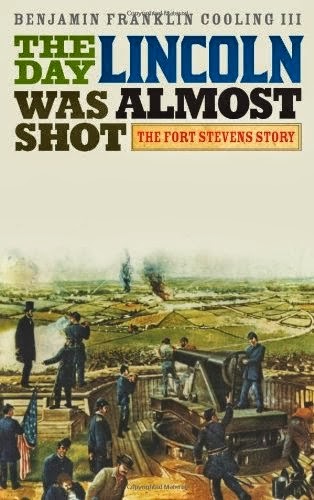
Fort Stevens, where Lincoln was almost shot. On the left, R. Keith Young, former Commander of the sub U.S.S. Silversides, and right, historian and author Dr. Benjamin Franklin Cooling

Point of Rocks, with the inimitable Rich Gillespie.
Jim Morgan, the authoritative Ball's Bluff historian at Fort Evans. 
Worthington House, Monocacy Battlefield

Worthington House, Monocacy Battlefield

Works by our Tour Guides:
http://www.amazon.com/Little-Short-Boats-Battles-Edwards-ebook/dp/B005AV1QNY/ref=sr_1_1?ie=UTF8&qid=1397851572&sr=8-1&keywords=a+little+short+of+boats


http://www.amazon.com/Day-Lincoln-Was-Almost-Shot-ebook/dp/B00CDJR176/ref=sr_1_1?s=digital-text&ie=UTF8&qid=1397851643&sr=1-1&keywords=fort+stevens+cooling
 

Monday, April 14, 2014

Police blotter on the night Lincoln was killed

This Washington, D.C., Metropolitan Police Department logbook for the night of April 14, 1865 recordsthe news of the Lincoln assassination in the bottom right-hand entry.
full story here

Thursday, March 20, 2014

Maryland man may have found two lost or forgotten photos of Lincoln’s funeral procession

From the Washington Post. . .
Mathew Brady/The National Archives - This quad photograph is believed to show President Abraham Lincoln's catafalque as a blur moving past Grace Episcopal Church on Broadway in New York on April 24 or 25, 1865. There were funeral ceremonies around the country for the slain president.

Read the full article here.

Monday, March 17, 2014

Indiana University Press book sale

Good deals on some good books. 
http://www.iupress.indiana.edu/


Monday, February 17, 2014

150 years ago: Hunley sinks the Housatonic


(CNN) -- Born and built amid gray-cloaked secrecy during the American Civil War, the H.L. Hunley — the first submarine to sink an enemy ship — has held tight to its murky mysteries. The 150th anniversary of the Hunley's daring and dangerous raid will be marked this weekend and Monday, but the overarching question remains: What caused the submarine and its eight-member crew to slip to the bottom of the sea on the moonlit evening of February 17, 1864, after it signaled to shore a success that changed naval warfare. Read the full article here.

For some thoughtful reflections on "The men lost on the U.S.S. Housatonic," see Robert Moore's February 17 Cenantua blog entry.

More "Thoughts on the U.S.S. Housatonic the the H.L. Hunley" can be found on Craig Swain's,
To The Sounds of the Guns blog.

And, of course, interesting information on the Confederate submarine is generously offered by the Friends of the Hunley.

Wednesday, February 05, 2014

Ball's Bluff and Monocacy -- 18th Civil War Forum Reunion

18th Civil War Forum Battlefield Conference
Ball’s Bluff, and Monocacy
(with a side trip to Antietam)

Leesburg, Virginia, April 3-6, 2014
Headquarters hotel:
Best Western Leesburg Hotel & Conference Center
726 E. Market Street
Leesburg, Virginia 20176
703-777-9400

Registration is $285.  Registration will cover your seat on the bus (or other transportation, such as a ferry), entrance fees, box lunches for Friday and Saturday, and buffet dinner and presentation on Saturday evening.

Tour guides, speakers, and expert consultants
Jim Morgan, author of, A Little Short of Boats: The Civil War Battles of Ball's Bluff and Edwards Ferry, October 21 - 22, 1861 
B. F. Cooling, author of Monocacy, the Battle that Saved Washington, and The Day Lincoln Was Almost Shot: the Fort Stevens Story
Rich Gillespie, director of education for Mosby Heritage Area Association
Steve Meserve, gentleman, scholar, raconteur

Tentative Itinerary (subject to change):
Thursday, April 3, 1:00 p.m: optional afternoon outing by carpool: Antietam National Battlefield. We'll begin with a presentation by historian Ted Alexander at the Visitor Center, then make a couple stops on the battlefield with a NPS ranger to interpret
Thursday, April 3, 6:00 p.m: informal reception, check-in, programs, name tags (location to be announced); dinner on your own
Friday a.m., April 4: walking tour of historic Leesburg with Rich Gillespie, including visits to Harrison Hall (now known as the Glenfiddich House) where Lee stayed when he passed through town on his way to Maryland in 1862, and where he met with Longstreet, Stuart and Jackson before crossing the river. A short distance from there is the John Janney home, where Lee made his only social call while in town. Janney, I am sure you recall, came within a single vote of becoming President of the United States when John Tyler was chosen instead as Vice President to William Henry Harrison. He later served as President of the Virginia Secession Convention and was the man who offered Lee command of Virginia's troops in 1861. [The latter house is private, and requires special arrangements to tour — thanks to Steve Meserve for recommending these two stops and providing the historic background.]
Friday lunch: picnic on the grounds of Morven Park, one-time estate of Virginia Governor Westmoreland Davis. The Executive Director will present a talk for us while we enjoy our lunches. 
Friday afternoon: visit to Fort Evans, then to Ball’s Bluff battlefield with Jim Morgan for detailed battlefield hikes (3-4 hours all told). 
Saturday a.m., April 5: Frederick, Maryland — visit to the National Museum of Civil War Medicine and, if time permits, the Barbara Fritchie House
Saturday afternoon, April 5: Tour Monocacy battlefield, and visit Ft. Stevens with B. F. Cooling 

Saturday evening, April 5, 6:30-10:00 p.m, in the ballroom at Morven Park Mansion: reception from 6:30-7:00; buffet dinner at 7:00; after-dinner speaker at 8:00 p.m.
Guest speaker: Dr. Benjamin Franklin Cooling

Wednesday, January 15, 2014

‘History of the Slave South’ Online Course Taught by Penn’s Stephanie McCurry Starts Jan. 20


[press release]

In the world of the Internet, slavery and the American Civil War are explosive topics of debate, so Stephanie McCurry is preparing to be globally fact-checked by those with a passion for the subject matter. The University of Pennsylvania history professor and scholar will teach a 10-week, massive open online course, or MOOC, called “History of the Slave South.” It starts January 20.

So far, more than 10,000 people from around the world have signed up for the free, online course.

McCurry, a specialist in 19th century American history, with a focus on the South and the Civil War era and the history of women and gender, is the author of numerous articles and review essays as well as two books, including Confederate Reckoning: Power and Politics in the Civil War South.

Born in Belfast, Northern Ireland, she attended college in Canada before moving to the United States for graduate school. She says that her version of Civil War history is not a Southern history course offered by a Southerner but rather a course taught by an outsider.

“I’ve always thought that’s why my version of it was different and in some ways worth listening to,” she says. “It’s a gripping story in the making of the modern world, how slavery becomes so tied up in the generation of this enormous wealth by the 18th and 19th centuries, but is such a different way of producing wealth than we associate with modernity.”

For people who are not American and who don’t have direct national or ancestral connections to the South, McCurry’s “History of the Slave South” course will articulate what the stakes of slavery were in America.

She says that the course is a thematically concentrated version of what she teaches at Penn. Each week, students will view two online video lectures embedded with quiz questions. There will be weekly discussion questions. Documents and primary sources will be read, with new assignments given every two weeks.

McCurry says she believes that the time is right for a global online course on the slave South given the renewed dialogue spurred by the release of two major motion pictures. Last year’s “12 Years a Slave” and the 2012 film “Django Unchained” explored the brutality and horrors of slavery from the point of view of the enslaved.

McCurry recalls sitting in a theater in the Manayunk section of Philadelphia watching “12 Years a Slave” with a mixed, largely African-American audience. So powerful was the film that she felt silenced, needing to listen, not talk.

She wonders if people can talk about America’s slave history now because “we’ve hit this moment where people feel less directly implicated because they weren’t part of segregation, for example.”

At Penn, McCurry teaches a wide variety of undergraduate and graduate courses in American, Southern and women's history and on the comparative history of slavery and emancipation.

A group of students enrolled in the online course have started a Facebook page and a SlaveSouth MOOCTwitter account @SlaveSouthMOOC. Course registration is available by clicking the Learn for Free banner at https://www.coursera.org/course/slavesouth.

Friday, December 13, 2013

Excerpt from Smithsonian's, "Last of the Blue and Gray"

The last veteran who said he fought for the Union was Albert Woolson; Walter Williams said he was the last Confederate. One of them indeed was a soldier, but one, according to the best evidence, was a fake. One of them had been living a great big lie.
And intriguing excerpt from Richard A. Serrano's, Last of the Blue and Gray (Smithsonian Books) can be read here

Saturday, December 07, 2013

Travelogue: Battle of Apache Pass


In September I attended the 34th Annual Order of the Indian Wars Assembly in Tucson—“On the Trail of Geronimo"—for a few days of talks and tours. Some of this country's top authorities on the Apache were in attendance, including Ed Sweeney, who has authored biographies of both Cochise and Mangas Coloradas. In four days we covered a lot of ground with stops at Mission San Xavier del Bac, San Jose de Tumacacori Mission Church, The Horse Soldier Museum, Fort Huachuca, Tombstone, the Arizona Historical Society Museum (with a special display on Geronimo), Fort Lowell, Dragoon Springs, the American Indian Museum (Amerind). Along the way we drove past Cochise’s stronghold.

For me, the highlight of the weekend was our Sunday hike through the heart of Apache Pass. Our trail took us across a clearly discernible stretch of the Butterfield Overland Mail Route, near the site of the Apache Pass station. Apache Pass station also marks the scene of the infamous Bascom Affair—known to the Apache as “Cut the Tent—the betrayal of Cochise that, along with the execution of some of his family members, led to eleven years of unremitting warfare between the U.S. and the Chiricahua Apaches. 

Butterfield Overland Trail near Apache Station
Continuing beyond this point, we passed Apache Spring, the water source so critical to travelers in the area, and a favorite spot for the Apaches to ambush passers-by. Here, too, is the ground over which the Battle of Apache Pass was fought on July 15-16, 1862, when a detachment of Colonel James H. Carleton’s California Column under Captain Thomas L. Roberts twice drove Apaches under Cochise and Mangas Coloradas from defensive positions on the high ground above the spring. 

To secure this important mountain pass once and for all, Carleton established Fort Bowie, and our hike continued past the ruins of the original fort, as well as the grounds of the relocated fort. Today, there is a NPS installation there, with a small museum and bookstore. 

The Battle of Apache Pass sesquicentennial fell squarely between the sesquicentennials of the Seven Days Battles, and Second Bull Run, so you're forgiven if you forgot to commemorate it.

A mountain howitzer similar to the two used by Roberts to dislodge the Apaches. 
Historian Neil Mangum on the Battle of Apache Pass
Site of the Bascom Affair

Ruins of first Fort Bowie, and the Valley of Apache Pass


Site of the second Fort Bowie.

"Geronimo surrendered this rifle to Indian Agent John Clum in 1877" — U.S. Springfield Model 1868 Military Rifle, Single-shot "Trap Door," Serial No. 28988, Arizona Historical Society, Tucson.
"Eyes of the Army" -- monument to Apache Scouts at Fort Huachuca

Friday, November 29, 2013

Grant, Sherman, and Sheridan slept here. Joe Hooker and Kit Carson too. . . my kids are unimpressed

The operative phrase is, "according to local tradition."
But it could have happened.

Blue Wing Inn, across the street from the Sonoma Mission

After a tremendous Thanksgiving meal and visit with my brother and his family in Glen Ellen (Jack London country), on the way home we decided to take the boys downtown to the Sonoma plaza, one of the true holy lands in the landscape of California history.

We have three sons spread out over a number of years, and it dawned on me that in the lifetime of our three boys, when visiting my brother we have routinely skirted Sonoma proper in favor of more direct and less congested routes. Even the 19- and 15-year-old would have been too young to remember those occasions when we used to walk around the town square. What a grand opportunity to expose the young'uns to some essential Golden State historic sites. All of our kids, when they passed through 4th grade, participated in the requisite study of the California missions (reportedly, and I believe it, there is an underground market for foam-core models of Spanish missions well supported by 4th grade parents), and here in Sonoma, on the plaza, is the northern-most of all the Californian missions. Not only that, but other historic structures abound, like the barracks, and look over there—a monument commemorating the Bear Flag Revolt which happened right on this spot!

First rule, and I should have known better, don't go down to the town square in Sonoma (or any place in the Wine Country, or any other popular destination in California) on a day when nearly everyone is off work, like weekends or holidays. It's crowded, and the road infrastructure doesn't support the volume. Second rule, don't ever think that your kids will even remotely share your interests in history. Don't think they will shiver in awe at the significance of some patch of grass or pasture, or look in wonder on what today, you have to admit, is just a ratty old shed that preservationists—through herculean efforts and much expense—managed to keep from falling down. When we got to the plaza, the two younger boys insisted on "waiting in the car" while we older trio took a stroll. Third rule, don't even try to force them to come with you, because their clinical lethargy, their superhuman disinterest, and their involuntary robo-chants of "can we go now" will detract from your own very real pleasure. No, just crack the windows and say "see you in a bit."

Oh how I enjoyed revisiting California's largest plaza.

Blue Wing Inn

Mission San Francisco Solano (Sonoma Mission)
Founded July 4, 1823

Operation Steal California from Mexico, Phase One

Wednesday, November 20, 2013

Review: Voices of the American West


Voices of the American West, Volume 1: The Indian Interviews of Eli S. Ricker, 1903-1919, by Eli Ricker, edited by Richard E. Jenson, University of Nebraska Press, 2012. 495 pages.

Voices of the American West, Volume 2: The Settler and Soldier Interviews of Eli S. Ricker, 1903-1919, by Eli Ricker, edited by Richard E. Jenson, University of Nebraska Press, 2012. 470 pages.

Eli Ricker, a Civil War veteran who marched with Sherman, tried his hand at a number of occupations after the war, including lawyer, judge, and newspaperman. He came to live in Chadron, Nebraska, in 1885, not far from Fort Robinson, where Crazy Horse had been killed just eight years earlier. Chadron was also in close proximity to the battlefields and reservations of western South Dakota, and it was at Chadron around the turn of the century that Ricker began conducting interviews, compiling notes, and doing research on the rapidly changing “Old West.” His intention was to write a book he called, “The Final Conflict Between the Red Men and the Palefaces,” but a quarter century later he was still gathering material.

As early as 1903, Ricker, who spent two full winters on the Pine Ridge Reservation -- began writing down eyewitness accounts about what transpired at Wounded Knee both from the 7th Cavalry perspective as well as from survivors of Big Foot’s Lakota Band. Ricker was sympathetic to the plight of Indians at a time when white Americans nearly universally regarded them as savages. Indeed, he advanced the radical proposition that Indian historical testimony was as valuable and legitimate as that of the white man.  One of Ricker’s notes, quoted in the Introduction, gives a sense of his enlightened sensibilities: “The Indians sneer at the whiteman’s conventional reference to the Custer massacre and the Battle of Wounded Knee. They ridicule the lack of impartiality of the whites in speaking of the two events – when the whites got the worst of it it was a massacre; when the Indians got the worst of it it was a battle.”

Alas, Ricker’s long-researched book never materialized. A stint at the U.S. Office of Indian Affairs in Washington, D.C. allowed him to fortify his research, but also served to overwhelm him with the amount of Indian resources demanding his attention. Already past the age of 60 when he began the project, Ricker died before he could complete more than some sections of a rough draft.

Ricker left behind stacks of tablets containing transcriptions of his interviews -- a treasure trove of unique and invaluable oral histories. Happily, after selling much of his collection, including his library, Ricker’s family donated the precious tablets to the Nebraska State Historical Society, where they were received on November 2, 1926. The collection remained relatively obscure for decades, though some Western historians like Robert Utley have accessed it in support of their own studies (Nebraskan Mari Sandoz cataloged and collated the interviews, and incorporated some of the material in her writings as well).

Finally, the 2005 publication in two volumes of Voices of the American West has made Ricker’s painstaking work readily available to scholars and history buffs alike (being reviewed here are the 2012 paperback releases of both volumes). Editor Richard Jensen has done an expert job organizing the Ricker material, intuitively devoting one volume to Indian interviews, and the other to Settlers and Soldiers. Within each volume, interviews are grouped together into major subject areas. Volume one includes chapters on The Garnett and Wells Interviews, The Ghost Dance and Wounded Knee, and The Old West – Indians and Indian Fights. Volume two chapters include: Wounded Knee, Little Bighorn, Beecher Island, Lightning Creek Incident, Biographical Sketches, and The Old West. 

Though there is a heavy emphasis on military affairs in the interviews, they also present perspectives on a broad range of other aspects of the Old West, from life on the reservations to the fur trade. Fully 200 pages of volume one are devoted to interviews with
William Garnett and Philip F. Wells, mixed-blood men who spent decades as Lakota interpreters. Garnett and Wells, in addition to discussing warfare, offer insights on treaties, Sun Dances, Sioux customs, religion, and languages. Garnett, sometimes called Billy Hunter, is reported to be the son of Confederate General Richard B. Garnett, who died in Longstreet’s assault at Gettysburg. While stationed at Fort Laramie before the war, Garnett took an Oglala woman, named Looks at Him, as his common-law wife, resulting in the birth of William.

Maps, illustrations, useful appendixes and an exceedingly generous index enhance the text, and Jensen’s voluminous endnotes not only demonstrate his utter mastery of the subject matter (Jensen was a senior research anthropologist at the Nebraska State Historical Society), but render the oral histories exponentially more useful and interesting.

Bison Books, the trade paperback line of the University of Nebraska Press, has consistently released some of the most fascinating and valuable works of American history.  Voices of the American West is another brilliant offering in a catalog of over 900 in-print titles spanning more than 50 years.  


Tuesday, November 19, 2013

150 years ago -- the Gettysburg Address

One of only five known copies of the Gettysburg Address written in Lincoln's hand, this one resides at the Cornell University Library. Lincoln sent it to historian George Bancroft for inclusion in a special publication intended to provide assistance to soldiers.


Friday, November 15, 2013

We pass over the silly remarks of the president

Timely retraction. . . 

In the editorial about President Abraham Lincoln’s speech delivered Nov. 19, 1863, in Gettysburg, the Patriot & Union failed to recognize its momentous importance, timeless eloquence, and lasting significance. The Patriot-News regrets the error. 


http://www.pennlive.com/opinion/index.ssf/2013/11/a_patriot-news_editorial_retraction_the_gettysburg_address.html

Hat tip to Mother Jones. 

Monday, October 28, 2013

Strolling down memory lane: South Bay Civil War Roundtable

DW, left, and TPS, August 24, 2013
Way back in 1988, my wife and I flew from San Francisco to San Diego where I was excited to attend the Annual West Coast Civil War Conference, then organized by Jerry Russell of Civil War Round Table Associates. I had just finished reading McPherson’s, Battle Cry of Freedom, and relished the prospects of listening to some authors hold forth on a variety of subjects. The featured historian was William C. “Jack” Davis, a tremendously knowledgeable and entertaining speaker. He told a story that had the audience laughing so hard, I remember it to this day (maybe some of you have heard it at other events – it involved him traipsing around his house with a Civil War saber, looking for a possible intruder). Bob Younger of Morningside Books was also there, and so I dropped a lot of cash on new reading material.

That conference was also where I met Ted Savas, who was then living in San Jose. He and his wife Carol, and Anne and I, gravitated together -- some of the only people in attendance who were still in their 20’s -- and the only four who had come down from Northern California (or so it seems to me now). We soon learned we had other things in common, such as Ted and I both hailing from Iowa (my mother grew up in his home town, and my father grew up nearby).

Not long after returning to the Bay Area, we got together at the Winchester Brewpub – just down the street from the legendary Winchester Mystery House – and started planning the creation of the South Bay Civil War Roundtable (at that time, there were roundtables in San Francisco, and on the Peninsula, one in the East Bay, but nothing in the area of San Jose, the most populous city in the area).

Our first meeting was held at Ted’s house with about 14 people in attendance. Ted became the first president, and I took up duties as the newsletter editor (and eventually became the 2nd president). At the first meeting, Zoyd Luce spoke on Benjamin “The Beast” Butler. Ted spoke the following month on Longstreet’s Suffolk Campaign, and I spoke at the third meeting on John Hunt Morgan’s Indiana/Ohio Raid. And just like that, we were off to the races, eventually finding a regular meeting place and steadily increasing the membership.

Within the next couple years, our group hosted the West Coast Conference after it had devolved into a moribund affair, and Jerry Russell was imploring the round tables themselves to take turns organizing it. The year after San Diego it was held in a dingy motel in Burbank, with very low attendance. It was in its death throes, and Russell was ready to give up. The following year we hosted the event near Fisherman’s Wharf in San Francisco, got the word out far and wide, and saw a great crowd turn out to hear a roster of speakers topped by Robert K. Krick, whose compensation included two tickets to the next 49ers game. That San Francisco conference was also where Ted and I debuted volume 1, number 1 of Civil War Regiments journal, which, along with a number of stand-alone campaign studies, would consume so much of our lives for years to come. After San Francisco, the Long Beach CWRT held a large, well-attended conference with James McPherson, and the meeting has been a rollicking success ever since.

It’s no exaggeration to say that the South Bay CWRT revived and re-energized the West Coast Conference, which today routinely sees 100+ in attendance, in nice venues, and with top-flight historians and authors (Richard Hatcher and Craig Symonds will be on hand next month).

At some point, I don’t remember when exactly, I stopped attending meetings of the South Bay CWRT in favor of the CompuServe forum I have administered for nearly 20 years, effectively an online CWRT whose members discuss the Civil War era all year long, and meet in person every spring to tour a battlefield. I eventually moved on to work at Stanford University Press, and Savas Woodbury Publishers became Savas Publishing, then Savas Beatie, and anyone who loves books on the Civil War knows what a strong presence Savas has been in that arena all these years later.

I’m pleased to say the South Bay CWRT is still going strong as well, compiling over the years a long record of generous donations to Civil War preservation organizations. When I saw that they were celebrating their 25th anniversary (which I calculate to be March of 2014), and that Ted was the guest speaker at the annual summer picnic, I decided to surprise him. We had not seen each other in over 10 years. I wish I could describe the look on his face when he glanced my way for the first time after arriving.

It was a lot of fun, and many memories were refreshed. Ted gave a masterful, no-notes talk on “The Battle of Payne’s Farm, November 27, 1863: Command & Competency During the Mine Run Campaign.” That, in itself, caused many more memories to surface, as I was with Ted at Payne’s Farm when he first began researching that fight, and when, using metal detectors, he established an artillery position by finding canister balls in the woods right where he surmised they would be found. He found the remnants of canister. My metal detector was so poor it literally could not detect a quarter sitting on the surface. I know because I tried. 

Tuesday, October 15, 2013

Indians and Braves, but no 7th Cavalry

from the Times-Georgian. . .
. . . the Heard County High School football team is hoping to rebound from a frustrating opener this week when it travels to Chattanooga for a powwow with the Indians at 7:30 on Friday night at Little Big Horn Stadium in Summerville.

Sunday, October 13, 2013

Review: Smithsonian Civil War


Smithsonian Civil War, Inside the National Collection, edited by Neil Kagan and Stephen G. Hyslop (Smithsonian Books, 2013).

Establishment of the Smithsonian predates the Civil War by 15 years. The iconic "Castle" on Washington's National Mall was completed in 1855, and became home to the institution's first secretary, Joseph Henry, and his family, who witnessed some of the opening scenes of the war. Young Mary Henry, Joseph's daughter, recorded in her diary on July 16, 1861, "We went up into the high tower to see the troops pass over into Virginia." Today, the Smithsonian has grown to nineteen museums and nine research facilities, which together preserve tens of thousands of objects related to the American Civil War, including Mary Henry's diary. 

Smithsonian Civil War is the only book of its kind, that I know of, to present together in a single volume some of the most important and representative Civil War artifacts from 13 separate Smithsonian entities (the press release mentions 12 museums and research centers). According to the introduction, curators, archivists, historians, interns, and volunteers (more than 100 staff members) "spent hours in locked vaults, storage rooms, and cabinets, researching and evaluating items" for inclusion, after which the Civil War 150 Editorial Committee debated which items held the "greatest historical value or the most compelling stories attached to them." The results of that exhaustive selection process are positively spectacular. 

This lavishly illustrated, brilliantly assembled coffee table book couldn’t have come at a better time, presenting an "exhibit between hard covers" at a time when the dysfunctional government of the United States has shuttered its doors. 

Commemorating the Civil War Sesquicentennial, Smithsonian Civil War offers 150 thematic essays written by a large number of Smithsonian contributors. Though organized chronologically, the entries amount to stand-alone articles covering a broad spectrum of topics—pre-war through Reconstruction.

The 550 full-color photographs constitute the volume's real strength—highlighting, with high production values, some of the most rare and fascinating objects in the Smithsonian holdings. A number of items will be familiar, such as Lincoln's top hat or the bullet-riddled tree stump from Spotsylvania, but many other objects pictured here have never been on public exhibit. 

Of particular interest are the instances where related objects from different repositories are brought together for the first time. For instance, a portrait of J.E.B. Stuart from the National Portrait Gallery, sits opposite an image of a pistol from the National Museum of American History, a present to Stuart from Major Heros von Borke. Likewise, from the same museums, a portrait of John Brown is featured together with images of weapons Brown and his followers carried in Kansas, and Virginia, including one of the hundreds of pikes Brown stockpiled at Harpers Ferry.

The collections at the NPG and NMAH are most represented, but this eclectic assemblage also features contributions from the Air and Space Museum (Civil War-era aircraft designs), the Postal Museum (printing plate for Confederate stamps), the Museum of Natural History (ornithological specimens), the Museum of African American History and Culture (slave tags), and others.

As impressive as this work is, some of the narrative will raise eyebrows among critical readers. A few examples: the entry on Harriet Beecher Stowe perpetuates the legend that when Lincoln met Stowe, "he reportedly said to her, 'So you're the little woman who wrote the book [Uncle Tom's Cabin] that started this great war!'" While the author did at least use the qualifier "reportedly," it's surprising to see the anecdote given passing credence in a Smithsonian publication. The story is entirely apocryphal, a product of Stowe family lore, and did not appear in print until 34 years after the fact by a Stowe biographer.


In the essay, "Sherman Moves South," we read that after capturing Atlanta, "Sherman ordered Atlanta evacuated and then burned everything he considered of military significance. Nearly one-third of the city went up in flames. Enraged, Hood wrote that his actions surpassed 'in studied and ingenious cruelty, all acts ever before brought to my attention in the dark history of war.'" Students of the Atlanta Campaign, however, will note that the correspondence in question dates to September 7, about the order to evacuate civilians. The burning of Atlanta did not occur until mid-November, when Sherman left on his March to the Sea.

More surprising, perhaps, is the entry entitled, "Searching for Shoes at Gettysburg," which begins with, "A search for shoes has often been cited as the spark that ignited a blistering three-day battle in the bucolic fields around Gettysburg, Pennsylvania, on July 1, 1863." General A.P. Hill is pictured in the article, across from a full-page photo of brogans, with the caption explaining that Hill unwittingly launched the battle by "sending in Henry Heth's division to 'get those shoes. . .'" This essay goes so far as to quote Heth's 1877 letter to the Southern Historical Society, in which he fleshes out the shoe story. Heth's after-action report, written two months after the battle, makes one mention of shoes (among other supplies he was seeking), but the consensus among historians is that the shoe story was concocted by Heth to excuse the fact that he brought on a general engagement despite explicit orders not to do so. I'm fairly certain that the National Park Service considers the shoe story as officially debunked. 

These examples are not terribly significant flaws since, as mentioned, the great power of this work are the photographs, and the 150 articles are generally succinct and spot-on, chock-full of useful information on a rich constellation of subjects. The barcode lists this book at $40, but I see it can be purchased in any number of places online for around $24 -- a good price for such a pretty book.

Wednesday, October 09, 2013

Gettysburg Magazine acquired by University of Nebraska Press


The University of Nebraska Press will take over publication of Gettysburg Magazine in 2014. They're looking for a new editor

Saturday, October 05, 2013

Review: Decided on the Battlefield, Grant, Sherman, Lincoln and the Election of 1864

Decided on the Battlefield: Grant, Sherman, Lincoln and the Election of 1864, by David Alan Johnson (Prometheus Books, 2012).

Judged solely by its cover, this Prometheus release promised to be an interesting and insightful examination of the critical 1864 presidential election – how it came to unfold the way it did, and the possible ramifications to the nation had Abraham Lincoln lost his bid for re-election. Unfortunately, there is very little new introduced that could not have been gleaned from a general history of the war, and the author’s almost complete reliance on secondary sources (Bruce Catton is cited 43 times, Carl Sandburg 21, and so on), makes for a shallow treatment of a deep subject. Both the seasoned student and the well-read buff are likely to be dissatisfied with what, in the end, amounts to a simple affirmation of what many have long understood to be a Civil War truism—that the ascendancy of Grant and Sherman, and their slow-but-steady battlefield successes, particularly the capture of Atlanta in the run-up to the election—assured the reelection of Lincoln, and ended any hope of an independent Confederacy.

Decided on the Battlefield is not without merit. It is an easy read with a serviceable account of military events. Informed as it is by the popular histories of Catton, Shelby Foote, Doris Kearns Goodwin, et. al., the story is held together by an efficient, quick-moving narrative adorned with some of the literature’s most familiar anecdotes. Most interesting, to me, was the author’s discussion of the main party’s respective national conventions, and for those topics—at least—official proceedings were liberally consulted.  

Whatever the book’s shortcomings in the main text, it goes completely off the rails in the Epilogue. To ram home his point about the over-arching importance of Lincoln’s victory, the author devotes 18 pages to a bizarre and thoroughly pointless reverie about how things would have been different had Lincoln gone down to defeat. He doesn’t merely speculate about the Balkanization of North America, but paints an elaborate alternate history up through the Cold War and into the 1980s, even imagining, by name, the presidents of five separate American countries (the U.S., the C.S.A., Texas, Utah, and California, the last governed by President Ronald Reagan). In this fantasy, the C.S.A. (eventually the Confederate Commonwealth after annexing Cuba) did not send troops overseas in WWI, but since Tennessee seceded from the C.S.A. and rejoined the U.S. in 1866, U.S. troops in the First World War do include men from the Volunteer State. Thus, we’re told, Lincoln’s election loss in 1864 would have had no bearing on Tennessean Alvin York winning the Medal of Honor for actions in the Argonne Forest. I’m pretty sure the author didn’t get that last part from Bruce Catton.