Thanks to Kevin Levin at Civil War Memory for bringing this series of collectibles to our attention. Buy the courthouse and get the R. E. Lee figurine for free. Buy Confederate Station and they'll throw in Stonewall Jackson.
It's not as realistic as this photo of Richmond in ruins, but then I don't suppose the intended audience wants a free figurine of Presdient Lincoln, surrounded by joyous slaves, strolling over to the White House of the Confederacy to rummage through Jeff Davis's desk.
Reflections, observations, random thoughts and bon mots, relating to the literary and geographic landscapes of American history. And book reviews too.
Friday, March 25, 2011
Thursday, March 03, 2011
One of last 2 WWI veterans turns 110 in Australia
By ROHAN SULLIVAN The Associated Press
Wednesday, March 2, 2011; 10:50 PM
SYDNEY -- One of the last two known veterans of World War I celebrated his 110th birthday Thursday with at least three generations of family and a contingent of navy officers in dress uniform. His daughter said he didn't want a fuss. Claude "Chuckles" Choules, who sneaked into the British navy in 1915 aged just 14, has lived quietly in Australia for more than 80 years, though his longevity has brought him closer to history with the passing of each comrade who fought the war that was meant to end all others.
They say the last Civil War veteran died around 1959, the year I was born. Now, a mere half century later, my grandfather's generation of WWI veterans are down to two (that we know of). History is a work in progress. Every day we watch it unfold, and the events of today are profound even if we cannot discern the ramifications. The nightly news is nothing short of astonishing. Not the Charlie Sheen part. The medical and technological advances part. The revolutions in the Middle East part.
Thursday, February 10, 2011
Tour of the Seven Days Battlefields
The Seven Days Battles
with Richmond National Battlefields Historian
Robert E. L. Krick
with Richmond National Battlefields Historian
Robert E. L. Krick
The 15th Civil War Forum
Battlefield Conference
Richmond, Virginia
March 31-April 3, 2011
Battlefield Conference
Richmond, Virginia
March 31-April 3, 2011
There's still room to join us on a spectacular weekend of battlefield tramping with the most authoritative guide on the Seven Days battles, the culmination of the Peninsula Campaign of 1862 and a major turning point in the war. We have 40-some souls signed up so far, and will cut off registration when we fill our coach (either a 44- or a slightly larger coach).
ITINERARY:
Thursday afternoon, March 31st:
WALKING TOUR: 1:00-4:30 p.m.
a guided stroll with narrative interpretation through Hollywood Cemetery with historian Chris Ferguson (see bio below)—we'll carpool from the hotel. Gather in the hotel lobby at 12:30 p.m. prepared to leave by 12:45 p.m.
No evening event scheduled for Thursday night.
Friday: April 1st:
BUS TOUR: 8:30 a.m. to 4:30 p.m.
Dabbs House (Lee's HQ); Meadow Bridges; Mechanicsville battlefield; lunch at Cold Harbor County Park; Gaines's Mill battlefield (extensive walking here); to close the day, we'll take the opportunity to stop at Yellow Tavern, since our hotel is on the edge of the battlefield, and the Stuart monument is less than a mile away and hard to find for most folks on their own.
RECEPTION: 6:00 p.m. to 7:00 p.m. (Yellow Tavern Bar, in the hotel)
DINNER: 7:15 p.m. (Glen Restaurant -- in our reserved seating area)
AFTER-DINNER SPEAKER: 8:00 p.m. (York Room)
Robert E. L. Krick, on "Drewry's Bluff: Gibraltar on the James"
Saturday: April 2nd:
BUS TOUR: 8:30 a.m. to 4:30 p.m.
Savage's Station; White Oak Swamp; lunch at Elko Community Center, Frayser's Farm/Glendale (only recently accessible thanks to CWPT); and Malvern Hill (extensive walking here).
RECEPTION: 6:00 p.m. to 7:00 p.m. (Yellow Tavern Bar)
DINNER: 7:15 p.m. (Glen Restaurant -- in our reserved seating area)
AFTER-DINNER SPEAKER: 8:00 p.m. (York Room)
John Coski, "After the Seventh Day They Rested"
John is the Historian and Director of Library & Research,
Museum of the Confederacy, Richmond, Virginia
Sunday: April 3rd:
OPTIONAL car pool tour: 9:00 a.m. to noon:
Drewry's Bluff and Battery Dantzler (the two best sites between Richmond and Petersburg)
Gather in the hotel lobby at 8:30 a.m. for 8:45 a.m. departure.
REGISTRATION:
$295
—includes Thursday, Friday, Saturday, and Sunday tours
—includes box lunches on Friday and Saturday
—includes buffet dinner and after dinner speakers on Friday and Saturday evenings
Breakfast is not included, but you'll receive a discount voucher when you check in. No formal meeting is scheduled for breakfast, but we will still have a reserved seating area from 7:00-8:00 a.m. for anyone who has breakfast in the restaurant]
[Registration does not include lodging]
Pay by check or money order, or credit card via PayPal (request a PayPal invoice)
Mail checks or money orders (made out to David Woodbury)
to: Civil War Forum
P.O. Box 19130
Stanford, CA 94309
HOTEL ACCOMMODATIONS
Wyndham Virginia Crossings hotel and conference center
1000 Virginia Center Parkway
Glen Allen (Richmond), Virginia 23059
http://www.wyndhamvirginiacrossings.com/
Cost: $99 (with tax, it comes to 111.87 per night)
Most attendees will check into the hotel Wednesday evening (3/30/11) and check out Sunday morning (4/3/11).
RESERVATIONS: Individuals will be responsible for their own reservations. Reservations will be accepted over the telephone by calling (804) 727-1400 or (888) 444-6553 and referencing “15th Civil War Forum Battlefield Conference.” Book your rooms!
Our Tour Guides:
Robert E. Lee Krick is a historian at the Richmond National Battlefield, and is recognized as one of the nation’s leading authorities on the Peninsula Campaign of 1862, and the Seven Days battles, as well as many other aspects of the Civil War in the East. He is the author many articles, as well as a regimental history of the 40th Virginia Infantry.
Bobby Krick is also author of a well-regarded reference work, Staff Officers in Gray: A Biographical Register of the Staff Officers in the Army of Northern Virginia, which profiles over 2,000 officers—a fine companion on your bookshelf to his father’s Lee’s Colonels. Check out this interview with Bobby Krick at the Civil War Preservation Trust website. More Malvern Hill videos, maps, and other resources from the same site.
Chris Ferguson is a native of Atlanta, Ga., currently residing in Winchester, Va. with his wife of 30 years and their beloved cat Romeo. He's a graduate of Georgia State University, BS: Criminal Justice, 1977, and is presently Vice President with Zwicker & Assoc., P.C., a national law firm based on Andover, MA. He is the author of two books covering the Confederate dead in Hollywood Cemetery, and co-author, with Robert K. Krick, of the Gettysburg Death Roster. He is also the author of numerous articles covering Confederate dead removed from Virginia battlefields.
WALKING TOUR: 1:00-4:30 p.m.
a guided stroll with narrative interpretation through Hollywood Cemetery with historian Chris Ferguson (see bio below)—we'll carpool from the hotel. Gather in the hotel lobby at 12:30 p.m. prepared to leave by 12:45 p.m.
No evening event scheduled for Thursday night.
Friday: April 1st:
BUS TOUR: 8:30 a.m. to 4:30 p.m.
Dabbs House (Lee's HQ); Meadow Bridges; Mechanicsville battlefield; lunch at Cold Harbor County Park; Gaines's Mill battlefield (extensive walking here); to close the day, we'll take the opportunity to stop at Yellow Tavern, since our hotel is on the edge of the battlefield, and the Stuart monument is less than a mile away and hard to find for most folks on their own.
RECEPTION: 6:00 p.m. to 7:00 p.m. (Yellow Tavern Bar, in the hotel)
DINNER: 7:15 p.m. (Glen Restaurant -- in our reserved seating area)
AFTER-DINNER SPEAKER: 8:00 p.m. (York Room)
Robert E. L. Krick, on "Drewry's Bluff: Gibraltar on the James"
Saturday: April 2nd:
BUS TOUR: 8:30 a.m. to 4:30 p.m.
Savage's Station; White Oak Swamp; lunch at Elko Community Center, Frayser's Farm/Glendale (only recently accessible thanks to CWPT); and Malvern Hill (extensive walking here).
RECEPTION: 6:00 p.m. to 7:00 p.m. (Yellow Tavern Bar)
DINNER: 7:15 p.m. (Glen Restaurant -- in our reserved seating area)
AFTER-DINNER SPEAKER: 8:00 p.m. (York Room)
John Coski, "After the Seventh Day They Rested"
John is the Historian and Director of Library & Research,
Museum of the Confederacy, Richmond, Virginia
Sunday: April 3rd:
OPTIONAL car pool tour: 9:00 a.m. to noon:
Drewry's Bluff and Battery Dantzler (the two best sites between Richmond and Petersburg)
Gather in the hotel lobby at 8:30 a.m. for 8:45 a.m. departure.
REGISTRATION:
$295
—includes Thursday, Friday, Saturday, and Sunday tours
—includes box lunches on Friday and Saturday
—includes buffet dinner and after dinner speakers on Friday and Saturday evenings
Breakfast is not included, but you'll receive a discount voucher when you check in. No formal meeting is scheduled for breakfast, but we will still have a reserved seating area from 7:00-8:00 a.m. for anyone who has breakfast in the restaurant]
[Registration does not include lodging]
Pay by check or money order, or credit card via PayPal (request a PayPal invoice)
Mail checks or money orders (made out to David Woodbury)
to: Civil War Forum
P.O. Box 19130
Stanford, CA 94309
HOTEL ACCOMMODATIONS
Wyndham Virginia Crossings hotel and conference center
1000 Virginia Center Parkway
Glen Allen (Richmond), Virginia 23059
http://www.wyndhamvirginiacrossings.com/
Cost: $99 (with tax, it comes to 111.87 per night)
Most attendees will check into the hotel Wednesday evening (3/30/11) and check out Sunday morning (4/3/11).
RESERVATIONS: Individuals will be responsible for their own reservations. Reservations will be accepted over the telephone by calling (804) 727-1400 or (888) 444-6553 and referencing “15th Civil War Forum Battlefield Conference.” Book your rooms!
Our Tour Guides:
Robert E. Lee Krick is a historian at the Richmond National Battlefield, and is recognized as one of the nation’s leading authorities on the Peninsula Campaign of 1862, and the Seven Days battles, as well as many other aspects of the Civil War in the East. He is the author many articles, as well as a regimental history of the 40th Virginia Infantry.
Bobby Krick is also author of a well-regarded reference work, Staff Officers in Gray: A Biographical Register of the Staff Officers in the Army of Northern Virginia, which profiles over 2,000 officers—a fine companion on your bookshelf to his father’s Lee’s Colonels. Check out this interview with Bobby Krick at the Civil War Preservation Trust website. More Malvern Hill videos, maps, and other resources from the same site.
Chris Ferguson is a native of Atlanta, Ga., currently residing in Winchester, Va. with his wife of 30 years and their beloved cat Romeo. He's a graduate of Georgia State University, BS: Criminal Justice, 1977, and is presently Vice President with Zwicker & Assoc., P.C., a national law firm based on Andover, MA. He is the author of two books covering the Confederate dead in Hollywood Cemetery, and co-author, with Robert K. Krick, of the Gettysburg Death Roster. He is also the author of numerous articles covering Confederate dead removed from Virginia battlefields.
Wednesday, January 26, 2011
This just in (from Civil War Preservation Trust)
WALMART DROPS WILDERNESS PLAN
In an unexpected development on the day that a trial was scheduled to begin in the case, Walmart announced that it has abandoned plans to pursue a special use permit previously awarded to the retail giant for construction of a supercenter on the Wilderness Battlefield.
“We are pleased with Walmart’s decision to abandon plans to build a supercenter on the Wilderness battlefield,” remarked James Lighthizer, president of the Civil War Trust. “We have long believed that Walmart would ultimately recognize that it is in the best interests of all concerned to move their intended store away from the battlefield. We applaud Walmart officials for putting the interests of historic preservation first. Sam Walton would be proud of this decision.”
Monday, January 24, 2011
Tarnished Reputations
Five years ago, I posted a blog entry entitled “Eagles, Scalpels, Reputations – all tarnished,” as a clever way to discuss three of Dr. Thomas Lowry’s books, The Story the Soldiers Wouldn’t Tell, Tarnished Eagles, and Tarnished Scalpels. These three and other titles are the product of his prodigious research into Civil War-era courts martial records at the National Archives.
Today, Dr. Lowry stands accused of altering a historic document in order to be the one to make a prominent discovery, about which he wrote and gave talks for ten years.
- The National Archives offered this press release, complete with embedded video
- Lowry maintains his innocence in this Washington Post article.
- Historian Brooks Simpson presents some interesting commentary on the subject on his “Crossroads” blog.
- The New York Times weighs in as well.
==========
UPDATE: Since originally reporting this strange story, it has been the subject of much commentary in the blogosphere -- nowhere more than at Brooks Simpson's blog -- and Lowry himself has created a blog in which he denied the allegations and vigorously defended himself. This Civil War Times article explains that Lowry passed a polygraph test. He has also submitted a sample for handwriting analysis. It appears this strange story may not be as cut-and-dried as it first appeared.
==========
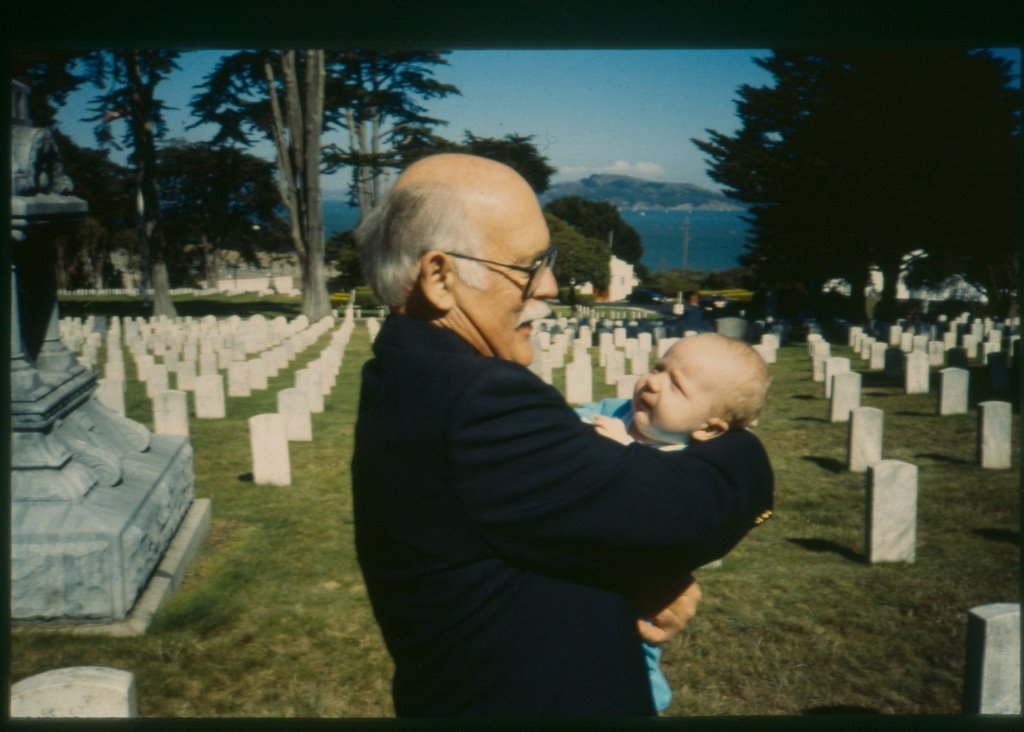
After reading the 1863 court-martial report of Pvt. Patrick Murphy of California, who had been characterized as “idiotic and insane,” Lincoln pardoned him and released him from the military. The otherwise-obscure pardon became part of a National Archives exhibit in 1998, leading Dr. Lowry to conclude in his book: “Fame comes to men in many strange ways.”
![]() |
| Dr. Lowry with my newborn son Atticus, Presidio National Cemetery, San Francisco, circa 1994. |
Saturday, January 15, 2011
Oldest living African-American dies at 113
![]() |
| Mississippi Winn |
"I don't know much about that," Hollins recalled Winn saying when asked about her parents' early years.
[from the Associated Press]
Friday, January 14, 2011
Sunday, January 09, 2011
Ben McCulloch
![]() | |
| Brigadier General Benjamin McCulloch, McCulloch's Division, Army of the West |
This song by Steve Earle is my favorite Civil War-themed tune, of which he's written a few. I love that he takes the perspective of a southern soldier in the Trans-Mississippi, not really knowing what he's gotten himself into. And I like the references to Wilson's Creek and the Boston Mountains, a part of the country for which I have a great fondness, and a battlefield—Pea Ridge in particular—that is among my favorites to visit. I also appreciate that Earle chooses not to glorify the war in some cliched manner, or to present a sentimental ditty about the rightness of one side's cause.
As long as the link works, you can hear the original Steve Earle version here. Otherwise, you may need to listen to one of many covers on YouTube. Better yet, you can buy it on iTunes for a buck.
We signed up in San Antone my brother Paul and me
To fight with Ben McCulloch and the Texas infantry
Well the poster said we'd get a uniform and seven bucks a week
The best rations in the army and a rifle we could keep
When I first laid eyes on the general I knew he was a fightin' man
He was every inch a soldier every word was his command
Well his eyes were cold as the lead and steel forged into tools of war
He took the lives of many and the souls of many more
Well they marched us to Missouri and we hardly stopped for rest
Then he made this speech and said we're comin' to the test
Well we've got to take Saint Louie boys before the yankees do
If we control the Mississippi then the Federals are through
Well they told us that our enemy would all be dressed in blue
They forgot about the winter's cold and the cursed fever too
My brother died at Wilson's creek and Lord I seen him fall
We fell back to the Boston Mountains in the North of Arkansas
CHORUS
Goddamn you Ben McCulloch
I hate you more than any other man alive
And when you die you'll be a foot soldier just like me
In the devil's infantry
And on the way to Fayetteville we cursed McCulloch`s name
And mourned the dead that we'd left behind and we was carrying the lame
I killed a boy the other night who'd never even shaved
I don't even know what I'm fightin' for I ain't never owned a slave
So I snuck out of camp and then I heard the news next night
The Yankees won the battle and McCulloch lost his life
Steve Earle
Tuesday, January 04, 2011
The United States Constitution: Read it and Weep
The problem with the Tea Party's new Constitution fetish is that it's hopelessly selective. As Robert Parry notes, the folks who will be reading the Constitution aloud this week can't read the parts permitting slavery or prohibiting cruel and unusual punishment using only their inside voices, while shouting their support for the 10th Amendment. They don't get to support Madison and renounce Jefferson, then claim to be restoring the vision of "the Framers." Either the Founders got it right the first time they calibrated the balance of power between the federal government and the states, or they got it so wrong that we need to pass a "Repeal Amendment" to fix it. And unless Tea Party Republicans are willing to stand proud and announce that they adore and revere the whole Constitution as written, except for the First, 14, 16th, and 17th amendments, which totally blow, they should admit right now that they are in the same conundrum as everyone else: This document no more commands the specific policies they espouse than it commands the specific policies their opponents support.
Tuesday, December 28, 2010
Don't Spin the Civil War
. . .and another timely essay, for good measure. This one from Washington Post columnist E. J. Dionne, Jr., well worth a read. Full article here.
My neighborhood friend Jon Udis got a subscription to Civil War Times Illustrated, and our regular discussions of sports heroes Bill Russell, Johnny Unitas and Carl Yastrzemski were briefly interrupted by talk about Grant and Lee, Sherman and "Stonewall" Jackson.
But our conversations, like so many about the war, focused on people and battles, not on why the confrontation happened in the first place. There remains enormous denial over the fact that the central cause of the war was our national disagreement about race and slavery, not states' rights or anything else.
Saturday, December 25, 2010
Civil War message opened, decoded: No help coming
The bottle, less than 2 inches in length, had sat undisturbed at the museum since 1896. It was a gift from Capt. William A. Smith, of King George County, who served during the Vicksburg siege.
It was Wright who decided to investigate the contents of the strange little bottle containing a tightly wrapped note, a .38-caliber bullet and a white thread.
But the coded message, which appears to be a random collection of letters, did not reveal itself immediately. . . .The code is called the "Vigenere cipher," a centuries-old encryption in which letters of the alphabet are shifted a set number of places so an "a" would become a "d"—essentially, creating words with different letter combinations.
It was Wright who decided to investigate the contents of the strange little bottle containing a tightly wrapped note, a .38-caliber bullet and a white thread.
But the coded message, which appears to be a random collection of letters, did not reveal itself immediately. . . .The code is called the "Vigenere cipher," a centuries-old encryption in which letters of the alphabet are shifted a set number of places so an "a" would become a "d"—essentially, creating words with different letter combinations.
Tuesday, December 21, 2010
Timely essays on secession and the War of Southern Aggression
BY PAUL FINKELMAN
...for South Carolina, slavery and states’ rights were not mutually exclusive; in fact, they were the same thing. Today too few people understand the intricate legal history that connects slavery to states’ rights—and as a result a needless debate continues, 150 years after secession began.
BY EDWARD BALL
The next five years will include an all-you-can-eat special of national remembrance. Yet even after 150 years full of grief and pride and anger, we greet the sesquicentennial wondering, why did the South secede? I can testify about the South under oath. I was born and raised there, and 12 men in my family fought for the Confederacy; two of them were killed.
BY GLENN W. LAFANTASIE
In April 2009, Rick Perry, the Republican governor of Texas, suggested that his state might ponder secession if "Washington continues to thumb their nose at the American people." In response, the audience began to chant, "Secede, secede," hoping, one assumes, that everyone there would soon begin to party like it was 1860.
BY BROOKS SIMPSON
It’s clearly a tough time for those people who are enamored of the Confederacy and who work hard to downplay slavery, one way or another. One of those groups embraces the slogan, “Heritage not Hate,” but frankly I don’t see it that way.
BY ADAM GOODHEART
A new phrase was coined to describe Rhett and his political cohorts: “the fire-eaters.” Their constant theme was that white Southerners, rather than black slaves, were America’s true oppressed class. “I am a Traitor,” he said in 1850, “in the great cause of liberty, fighting against tyranny and oppression.”
BY JIM LEPORE
On Dec. 2, 1859, the day John Brown was hanged, Longfellow wrote in his diary, “This will be a great day in our history, the date of a new Revolution quite as much needed as the old one.”
BY CAROLYN CLICK
On a foggy day near Christmas 1860, a delegation of South’s Carolina wealthiest, most powerful citizens—planters, judges, legislators and clergy, all white men—assembled at Columbia’s stately red brick-columned First Baptist Church to contemplate smashing the Palmetto State’s bond with the United States of America.
Wednesday, December 01, 2010
Civil War blogging at its best
I was thinking of doing a year-end roundup of Civil War blogs, mainly as a vehicle for highlighting the five or ten favorites to which I am regularly drawn. I suppose I’ve avoided that in the past, because the Civil War blogosphere is a pretty small place, and I don’t want to have to explain why some blogs pique my personal interests and others do not. It’s all about the content.
For now, however, I want to take a moment to draw your attention to Mysteries and Conundrums, an unofficial blog maintained by NPS staffers at Fredericksburg and Spotsylvania National MilitaryPark, born of discussions about the string of battlefields in their jurisdiction, to include Chancellorsville and the Wilderness. The blog began just this past March, but the authors have made it chock full of meaty content. It is intended that readers accept the open invitation to join in those discussions, to better understand what happened in those historic venues, and to participate in the ongoing challenges of preservation.
This post by historian John Hennessy is a masterpiece -- The legacy of misplaced assumptions -- and really highlights the value of blogs as a living resource for students of American history. Preservation strategies have necessarily evolved over the years, and this brief history explains a lot about the present state of four major battlefields, including how their close proximity to each other ultimately short-shrifted each of them in terms of total park acreage.
The bulk of the entries come from resource managers Eric Mink and Noel G. Harrison, and chief historian John Hennessy, whose published works are well regarded in the Civil War community. In entry after entry, the contributors to Mysteries and Conundrums draw the reader into an intriguing discussion, and enrich their offerings with period photographs and useful maps. Look at Mr. Harrison's labor-intensive offering in another recent post, Finally Found: the Location of Waud's Fredericksburg Pontoon-Laying Sketch?
Take a gander at their sister blog as well, Fredericksburg Remembered.
Nicely done.
The bulk of the entries come from resource managers Eric Mink and Noel G. Harrison, and chief historian John Hennessy, whose published works are well regarded in the Civil War community. In entry after entry, the contributors to Mysteries and Conundrums draw the reader into an intriguing discussion, and enrich their offerings with period photographs and useful maps. Look at Mr. Harrison's labor-intensive offering in another recent post, Finally Found: the Location of Waud's Fredericksburg Pontoon-Laying Sketch?
Take a gander at their sister blog as well, Fredericksburg Remembered.
Nicely done.
Shouldn't the Culbertson Guidon from the Little Bighorn be in the Smithsonian?
It's said to be worth $2 to $5 million, but an upcoming Sotheby's auction will tell the tale. Would that this ragged flag could reveal the story that occurred beneath it in June of 1876.
I have been deeply fascinated with the Battle of the Little Bighorn since at least the time I first heard Johnny Horton singing "Commanche" on our old hi-fi in Schuyler, Nebraska, Sometime later, I read the Mari Sandoz books on the battle, and on Crazy Horse, and was hooked (in another nod to Johnny Horton, that same LP had "Sink the Bismarck," and I managed to find a copy of a book on that subject in our school library. I was in fifth grade when Horton turned me on to the Bismark, circa 1969 . The other night I saved the movie of the same name in my Netflix queue – I don’t remember ever seeing it).
The fight at the Little Bighorn has taken on an iconic stature in American memory far out of proportion to the size and scope of the battle itself, and its cultural legacy transcends the initial shockwaves that sped west and east from the remote interior, en route to the population centers of the then 100-year-old nation (Happy Birthday, America!). I have not read everything I could find on the battle, but quite a lot, and have been lucky to come of age at a time when great historians began to systematically clear away the murky cloud of mythology and popular history. Today, it may be the most written about battle in North America after the Battle of Gettysburg.
For over 100 years, the narrative description of the Battle of the Little Bighorn relied principally on the recollections and testimony of surviving members of Reno's command, a hodgepodge of incomplete and often confusing recollections translated in some fashion from Indians long after the fact, and the suppositions offered by burial parties and other early visitors to the battlefield.
Then, in 1983, a massive wildfire cleared the battlefield and presented irresistible opportunities for an exhaustive archaeological investigation of the field. What a stroke of luck, as it turned out. The resulting studies in the intervening years have produced the most compelling, and most complete story to date. It wasn’t exactly a case of "everything you know is wrong," but some traditional interpretations took a beating.
How did they figure all this stuff out? This NPS page sums it up:
The project archeologists chose to view the battlefield as a crime scene and by using a combination of forensic techniques such as studies of firing pin marks on cartridge cases and rifling marks on bullets, and standard archeological field, laboratory, and analytical techniques they have been able to determine the variety of weapons used by the various participants.
By combining crime lab methods with the archeological constructs of spatial patterning and individual artifact analysis, they have been able to discover evidence for the movement of individual firearms over the field of battle, verify cavalry positions, and define previously unknown Indian fighting areas.
Not everybody is happy with the changing story, of course. The traditional stories of a glorious "last stand" do not hold up very well under the new evidence. That is not to say that the soldiers under Custer's command were not brave, or that they did not die in heroic fashion, but the evidence on the ground suggests they were quickly overwhelmed in a rout, and were running for their lives before getting cut down. Whatever you conclude, much mystery remains, and for that reason the Little Bighorn will always excite the imagination. For Native Americans, of course, their greatest victory was also the death knell, making the fight along the Greasy Grass the proverbial beginning of the end.
Archaeology, History, and Custer's Last Battle: The Little Big Horn Re-examined, by Richard Allan Fox, is an essential read about what insights we've gained from the post-fire digs. Fox is of the opinion that it wasn't so much a "last stand" as a last chase, or a series of abortive running stands (as in pausing long enough to get a shot off at the people chasing you). Fox's marriage of archaeology, "combat modeling," and the documentary record sets a new standard for examination of the battle. Future authors may disagree with his analysis, but they cannot ignore it.
Likewise, Archaeological Perspectives on the Battle of Little Bighorn, by Douglas D. Scott, Richard A. Fox, Melissa A. Connor, and Dick Harmon.
Where Custer Fell, Photographs of the Little Bighorn Battlefield Then and Now, by James S. Brust, Brian C. Pohanka, and Sandy Barnard, is a beautiful work. Yes, that's the same (late) Brian Pohanka so highly regarded for his work as a Civil War historian. He loved studying this battle, and I believe this was one of the last major projects he saw to completion before his untimely death.
Check out this article by Thomas Powers, "How the Battle of Little Bighorn was Won," adapted from his book, The Killing of Crazy Horse, for a perspective built upon Indian recollections of the battle.
My most recent purchase is The Last Stand: Custer, Sitting Bull, and the Battle of the Little Bighorn, by Nathaniel Philbrick. I have high hopes for it, given the reception some of his other books have received (it’s shelved next to another Philbrick book, The Mayflower, also unread as yet. Can't wait to get to these two.
A great resource: Friends of the Little Bighorn Battlefield.
If you have a hankering to own a piece of this history, you need only place your bid with Sotheby's. This video explains the significance of the Culbertson Guidon. Answering my own question at top, I say "yes." Were I independently wealthy, I'm sure I would enjoy owning such amazing pieces of American history, but shouldn't things this delicate be entrusted to the care of museum professionals? Hopefully some rich guy will buy it and donate it to the nation.
As for the Bismarck, I couldn't have been more thrilled when Robert Ballard turned his attention to the German battleship, and actually discovered the wreck in 1989. Too bad Johnny Horton wasn't around to see it.
![]() |
| Bismarck's bow. Photo taken in 2002 (courtesy of the Discovery Channel). |
Saturday, November 13, 2010
Now that's authentic!
Arkansas celebrates the Civil War sesquicentenary
by electing an actual Confederate.
League of the South member, Loy Mauch—who said that the Confederate battle flag is "a symbol of Jesus Christ above all else. It's a symbol of Biblical government"—has been elected to the Arkansas statehouse from district 26. My little brother, longtime resident of Arkansas, says Mauch is famous for his letters to the editor bemoaning the war crimes of Abraham Lincoln (I'll bet there was nary a squawk about water-boarding, though). The Arkansas Times reports that Mauch's local Sons of Confederate Veterans Camp "hosted a conference in Hot Springs called 'Seminar on Abraham Lincoln—Truth vs. Myth,' with a keynote address called 'Homage to John Wilkes Booth.'"
Mauch apparently has a sharp eye for important municipal improvements. In a letter to the Hot Springs Sentinel-Record, Mr. Mauch promoted a project to enlarge the Confederate monument in Hot Springs, a flag and statute at the fork of Central and Ouachita Avenues (from the same Arkansas Times article).
Biblical government indeed! Slaves and all.
Oh Alabama Arkansas
Can I see you
and shake your hand.
Make friends down in Alabama Arkansas
I'm from a new land
I come to you
and see all this ruin
What are you doing Alabama Arkansas?
You got the rest of the union
to help you along
When DuPont became Grant
How many times has a street named for one prominent military figure been renamed in favor of another who fought for the same cause? Probably not too many.
Grant Street in San Francisco, the main street through Chinatown, started off in the Spanish period as Calle de la Fundacion ("street of the founding"), back when San Francisco was still called Yerba Buena, or "good herb" (a remarkably apt name for the town even today).
![]() |
| Samuel F. DuPont |
![]() |
| Grant Street, circa 1920 |
In 1846 the street was renamed DuPont, in honor of naval officer Samuel F. DuPont, who commanded Commodore Stockton's flagship, the USS Congress, at the outbreak of the Mexican War. DuPont's exploits in that conflict included the capture of San Diego, and operations to seize or destroy all enemy ships in the Gulf of California.
DuPont's Civil War service started off with great success against Confederate forts on the Eastern Seaboard, gaining him promotion to Rear Admiral, but after a failed attempt to capture Charleston, SC in April of 1863, his fortunes began to wain.
DuPont Street, meanwhile, became the center of the largest community of Chinese in America, many of whom refer to the street as Du Pon Gai even today. San Francisco's Chinatown was largely destroyed in the fire following the 1906 earthquake, but soon rebuilt. Rising from the ashes, the thoroughfare was christened anew as Grant Street in honor of the 18th president. Neither Grant or DuPont lived long enough to enjoy, or rue the changeover.
DuPont's Civil War service started off with great success against Confederate forts on the Eastern Seaboard, gaining him promotion to Rear Admiral, but after a failed attempt to capture Charleston, SC in April of 1863, his fortunes began to wain.
DuPont Street, meanwhile, became the center of the largest community of Chinese in America, many of whom refer to the street as Du Pon Gai even today. San Francisco's Chinatown was largely destroyed in the fire following the 1906 earthquake, but soon rebuilt. Rising from the ashes, the thoroughfare was christened anew as Grant Street in honor of the 18th president. Neither Grant or DuPont lived long enough to enjoy, or rue the changeover.

Grant Street starts at Market and one block later crosses Geary Boulevard, the only time the street intersects with another named for a Civil War general. John Geary was an alcalde before statehood, and San Francisco's first mayor afterwards (at 31, he remains the city's youngest mayor, beating out Gavin Newsom by about five years or so).
From Geary, a block below the high-end shopping at Union Square, Grant Street moves through the Financial District and passes into Chinatown at the Bush Street archway. It traverses Chinatown before crossing into North Beach, finally ending at The Embarcadero at Pier 39. Every block of Grant is steeped in history, from the early Spanish settlement, through the American conquest, the Gold Rush, and beyond.
I've encountered a number of Grant streets throughout the Bay Area (and cross the great triumvirate of Grant, Sherman, and Sheridan nearly every day in Palo Alto), but none of the Grants are so grand as the old Du Pon Gai in San Francisco—a worthy tribute to the great general.
DuPont, robbed of his street in the Wild West, is memorialized today by DuPont Circle in the neighborhood or district of the same name, in Washington DC (formerly Pacific Circle). A statue of the Admiral first graced the traffic circle, but was moved to Wilmington, Delaware by relatives who subsequently hired Daniel French and Henry Bacon—whose portfolio included the Lincoln Memorial—to build a fountain in the statue's place (see a photo of the statue here and more photos at the bottom of this page).
Grant street, incidentally, is not the only tribute to Grant in San Francisco. There's this handsome memorial in Golden Gate Park.
Thursday, November 11, 2010
Interesting article: The Civil War at 150
Certainly, Lincoln's election in 1860 precipitated secession, which resulted in war, and the sesquicentennial of that event, on November 6, truly marks the beginning of the forthcoming cycle of commemoration. Douglas R. Egerton's Year of Meteors: Stephen Douglas, Abraham Lincoln, and the Election That Brought on the Civil War (Bloomsbury Press, out this month) offers a thorough analysis. The contest featured four candidates: John C. Breckinridge, of Kentucky, nominee of the Southern Democrats; Stephen A. Douglas, of Illinois, candidate of the Northern Democrats; John Bell, of Tennessee, representing the Constitutional Union Party; and, of course, Abraham Lincoln, of the Republican Party, whose very nomination entices us into playing the counterfactual game: What if the Republican convention had not been held in Lincoln's home state, in Chicago, a site chosen over St. Louis by one vote? Egerton does not speculate about what might have occurred had the convention been held in Missouri, but it certainly would have boosted the chances of Edward Bates, who had lived there since before the territory became a state.From The Civil War at 150
Louis P. Masur is chair of American studies at Trinity College in Connecticut and author of The Civil War: A Concise History, forthcoming from Oxford University Press.
Tuesday, November 09, 2010
Saturday, November 06, 2010
World's worst sculptor dies at age 96
Controversial jack-of-all-trades, slavery apologist and lousy sculptor, Jack Kershaw, passed away on September 7. He was best known as a defense attorney for James Earl Ray, and author of a conspiracy theory regarding the assassination of Martin Luther King, Jr. According to Jack Kershaw, Ray was working for a shadowy figure name Raul, the mastermind behind the murder. Kershaw's theory pretty much dissipated after he arranged for Ray to do an interview for Playboy magazine, in preparation for which Ray agreed to a lie detector test [Kershaw's unpublished manuscript on the matter reportedly remains in a "secure location"].
The test indicated Ray was lying when he claimed not to have murdered King. It also indicated he was telling the truth when he denied taking part in a conspiracy. Ray dismissed Kershaw as his attorney after he discovered Kershaw was paid for facilitating the interview.
![]() |
| Investigator Gary Revel (from left), James Earl Ray, Jack Kershaw, and Ray’s brother Jerry met in 1977. (Associated Press) |
Kershaw, a member of the so-called Fugitive Poets of Vanderbilt in the 1920s, later in life became a co-founder of the ridiculous, neo-Confederate "League of the South," a thinly-veiled white-supremacist group dedicated to achieving that which the original Confederate states failed to do in four years of bloody warfare: create an independent nation from states that made up the old southern slavocracy.
Between James Earl Ray and the League of the South, Mr. Kershaw seems to have had a difficult time choosing a good cause to get behind.
Curiously, everything I could find on-line about Kershaw refers to him as the heir of an Admiral Kershaw, CSA, of South Carolina, but I know of no other high-ranking Kershaw than the famous major general in the Army of Northern Virginia (James). Maybe "Admiral" was a first name, like Senator K. Torvaldson of Lake Wobegon.
Endearing himself to fellow citizens, Kershaw was once quoted by the Times Picayune as saying "Somebody needs to say a good word for slavery. Where in the world are the Negroes better off today than in America?”
Endearing himself to commuters on I-65 south of Nashville, Kershaw is best known for erecting a nightmarish statue of former Confederate general and KKK Grand Wizard, Nathan Bedford Forrest on a private swath of land along the interstate. I made passing reference to the Forrest statue in an early blog entry about Civil War-related roadside attractions. The always entertaining website Roadside America calls the statue "ugly," and "like a cartoon statue." But the best critique I've come across was by one Patrick R. in this Yelp.com entry, May 5, 2008:
Between James Earl Ray and the League of the South, Mr. Kershaw seems to have had a difficult time choosing a good cause to get behind.
Curiously, everything I could find on-line about Kershaw refers to him as the heir of an Admiral Kershaw, CSA, of South Carolina, but I know of no other high-ranking Kershaw than the famous major general in the Army of Northern Virginia (James). Maybe "Admiral" was a first name, like Senator K. Torvaldson of Lake Wobegon.
Endearing himself to fellow citizens, Kershaw was once quoted by the Times Picayune as saying "Somebody needs to say a good word for slavery. Where in the world are the Negroes better off today than in America?”
Endearing himself to commuters on I-65 south of Nashville, Kershaw is best known for erecting a nightmarish statue of former Confederate general and KKK Grand Wizard, Nathan Bedford Forrest on a private swath of land along the interstate. I made passing reference to the Forrest statue in an early blog entry about Civil War-related roadside attractions. The always entertaining website Roadside America calls the statue "ugly," and "like a cartoon statue." But the best critique I've come across was by one Patrick R. in this Yelp.com entry, May 5, 2008:"The Nathan Bedford Forrest Memorial, which is beside I-65 South in Brentwood, is probably Nashville's most appalling landmark. And I'm not only saying that because of the historical and racial implications—it's also aesthetically atrocious. . ." Forrest "is depicted in this statue as a ghastly, screaming dwarf. The horse on which Forrest rides makes the general look like a nine-year-old with a radically contorted face wearing a false beard and a skirt."
Wednesday, November 03, 2010
There's an App for that. . .
This looks pretty cool. Certainly the price is right (.99 cents). Civil War Preservation Trust has released its first virtual battlefield guide, with ready access to "orders of battle, battle facts, historical photos, troop positions, chronologies," battle maps, and video clips of historians holding forth. Not to mention GPS to tell you exactly where you are on the battlefield.
The potential for this kind of App is really exciting. Imagine pulling up one of CWPT's beautiful maps, locating yourself on that map, and then reading some after-action reports referring to the spot where you're standing. At present, only part of the Gettysburg battlefield is covered, and the App only works on the iPhone and iPad, but it will soon expand to more fields and other platforms.
Subscribe to:
Posts (Atom)