Tuesday, March 13, 2012

On the naming of the U.S.S. Kearsarge

Who came up with the name of the USS Kearsarge, and which New Hampshire mountain does it honor? This is another of those enduring Mysteries of History (the fact that few people today know the matter was ever in question, and even fewer people care about a resolution notwithstanding). I had read about the controversy, but it held no particular interest for me. That is, at least, it didn't until I discovered that a distant relative of mine arguably deserves the credit. Now I'm ready to defend the honor of that remote cousin, and to denigrate the pretenders who would elbow in on my family's glory.

There have been four United States naval vessels named the Kearsarge. Civil War and history buffs, upon hearing the name, will picture the original sloop of War, launched in 1861, which did battle with the infamous Confederate vessel, CSS Alabama, and sent the raider to the bottom of the sea. Interestingly, while the Kearsarges in the U.S. Navy were named for a mountain in New Hampshire, there is a mountain in California named by miners for the Civil War-era sloop itself, commemorating the victory over the Alabama. The naming of the California mountain soon prompted Confederate-sympathizing miners to name a range of Sierra foothills the Alabama Hills (most famous as the backdrop for television and movie westerns). So what we have is a mountain giving its name to a ship, which in turn gave its name to another mountain, which inspired the naming of a range of hills for yet another ship.

A strong case can be made that the name Kearsarge was suggested by the wife of Assistant Secretary of the Navy Gustavus Fox, Virginia Woodbury Fox, daughter of the supreme over-achiever in my family tree, Levi Woodbury [I wanted to include a photo of Virginia here, but am having trouble locating one]. Levi was, like me, descended from our first ancestor in this country, John Woodbury -- one of the original “Old Planters” of Beverly, Massachusetts -- though my line comes off of one son and Levi’s another. Unlike me, Levi served as a governor (New Hampshire), a senator (New Hampshire), as Secretary of the Navy under Andrew Jackson, as Secretary of the Treasury under two presidents, and as a justice of the United States Supreme Court (nominated by James K. Polk). He tried twice to win the Democratic Party nomination for president, and fell short. My only elective office was a two-or-so year stint as president of a local Civil War Round Table.

My recent Civil War-related revelation was that two of Levi Woodbury's daughters were neck deep in Washington political families during the administration of Abraham Lincoln. As mentioned, Virginia was married to Gustavus Fox, described as the de facto chief of naval operations and a major proponent of ironclad technology. Virginia's sister Mary Elizabeth Woodbury was wed to Montgomery Blair, Lincoln’s Postmaster General and brother of Major General Frank Blair. Mary Elizabeth’s father-in-law was Francis Preston Blair, a political juggernaut who founded Silver Spring, Maryland and the man who arranged the Hampton Roads Peace Conference.

According to Secretary of the Navy Gideon Welles, Virginia Fox Woodbury, a native of New Hampshire, recommended that one of the navy's new warships bear the name of a well known mountain in her home state's Carroll County. Turns out there were two mountains in the state bearing roughly the same Abenaki Indian name, with various spellings, and controversy ensued when a newspaperman in Concord—Mr. Henry McFarland—insisted that the idea for naming the ship was his, and that it was in honor of a smaller Merrimack County peak. McFarland claimed to have made the suggestion in a letter to Secretary Welles, who subsequently disavowed any knowledge of the missive and said he recalled speaking only to Assistant Secretary Fox about the matter.

William Marvel addresses the naming controversy in Appendix 1 of his book, The Alabama and the Kearsarge, the Sailor’s Civil War. When, in 1875, McFarland endeavored to refresh Welles’s memory and gain corroboration for his claim, Welles told him it would be “meet and gallant to commemorate” the Carroll County mountain “in accordance with the suggestions of a lady.”

Nothing doing, said McFarland. The credit-seeking newspaperman soon recruited the president of the state historical society, Nathaniel Bouton, who was also a state legislator, and an effort was launched to change the name of the Carroll County mountain.

William Marvel adds, “Gustavus Fox spared no expense in defense of his late wife’s claim. He hired researchers in London to examine colonial maps, engaged a Catholic priest who was fluent in the Abenaki dialect to demonstrate how the two mountains could have derived the same name from different Indian words, and he interviewed dozens of Carroll County residents who had never known their mountain as anything but Kearsarge, including one who had been born there early in the Revolution.”

Fox presented his assembled evidence to a three-person historical society committee, assembled by Bouton, which summarily rejected his argument and officially called for giving a new name to the Carroll County eminence -- “Mount Pequawket.” McFarland rejoiced in the decision. Years later he endeavored to seal his claim by publishing a book relating his version of the naming of the U.S.S. Kearsarge.

The sheer weight and breadth of McFarland’s crusade to claim credit appeared to have ended the matter, particularly as all of the principals in the naming controversy passed away (Fox and Welles were gone by the time Fox mounted a victory lap with the publication of his “proof”).

The story doesn’t end there, however. Late in the game an elderly Baptist minister. Joseph Gilmore, trumpeted his claim to have named the Kearsarge. His father was the governor of New Hampshire at the time, he said, and when the Navy Department requested some New Hampshire Indian names for the christening of new vessels, the governor assigned the task to his boy. The minister, it turns out, was either feeble-minded, or a liar. Writes Marvel, “Reverend Gilmore’s reputation as a theologian appears to have prevented anyone from pointing out that his father did not take office as governor until 1863 – two years after the Kearsarge was first named.

Kearsarge Mountain North
Fifty years after the end of the Civil War, the U.S. Geographic Board resolved to settle the confusion over the names of the respective New Hampshire mountains. Siding with the preponderance of McFarland’s spurious “evidence,” the Board concluded that Fox’s mountain should be called Pequawket, reserving the name “Kearsarge” solely for McFarland’s Merrimack County peak. Locals ignored the pronouncement – they had always known the mountain by one name and it was going to take more than the proceedings of an obscure government board to change that.

Finally, in 1958, after 43 years of residents refusing to abide by the Geographic Board’s decision, the government changed its mind and sought a compromise, assigning the name “Kearsarge North” to the peak. Needless to say, the locals still simply called it Kearsarge. 

Marvel is careful to point out that all of the machinations of McFarland, and the government’s decision to determine the proper designations of the two mountains, tell us nothing about which of the two mountains gave the U.S.S. Kearsarge her name. It was enough to establish that, at the time the warship was christened, Kearsarge North/Pequawket was known to Virginia Fox and others as Kearsarge.

That just leaves the question of who suggested the name to the Navy. Marvel nails it. “The only credible candidates are Henry McFarland and Mrs. Fox. The only evidence that McFarland thought of the name is his own insistence on it . . . . [and his claim to have sent a letter to Welles. Later, in his booklet, he claimed to have sent the letter to Fox, intimating that the assistant secretary stole the idea on behalf of his wife.] Whether or not McFarland submitted such a letter, Mrs. Fox had the better opportunity to influence the secretary of the navy, who could not remember talking about it with anyone but her husband.”

As intriguing as the idea is to me that a relative gave the name to the famous warship, doubly intriguing to me is the likelihood that a relative was a crewman on the Kearsarge during the duel with the Alabama. There was a John C. Woodbury from Massachusetts aboard, and Massachusetts is where it all started for Woodburys in this country -- at Salem, and Beverly, and Cape Ann where they went down to the see in ships. More on that later, if I can connect the lines. 

Left: John C. Woodbury, detail from a photo in Marvel's book, page 145, showing the sailor at a reunion of Kearsarge survivors in 1915. 

Fisherman's Memorial Statue, Gloucester, MA
"They that go down to the sea in ships,
That do business in great waters;
These see the works of the Lord,
And his wonders in the deep." 
USS Kearsarge, 1862-1894
USS Kearsarge (BB-5), 1900-1920, the only U.S. battleship not named for a state.


USS Kearsarge, 1946-1970

USS Kearsarge (LHD-3), commissioned 1993


Monday, March 12, 2012

"The Battlefield and Beyond" — forthcoming essay collection from LSU Press

PRESS RELEASE, March 12, 2012:

LSU Press to Publish Collection of Civil War Essays in May 2012

Leading Civil War Historians Link Past and Present By Exploring the Military, Political, and Social Aspects of the Civil War

"[Offers] fresh insights, notably on the critical intersections of biography with social, military, and political history."-Eugene D. Genovese, author of "Roll, Jordan, Roll: The World the Slaves Made"

Baton Rouge, LA: — In The Battlefield and Beyond leading Civil War historians explore a tragic part of our nation's history though the lenses of race, gender, leadership, politics, and memory. The essays in this strong collection shed new light on the defining issues of the
Civil War era.

Orville Vernon Burton, Leonne M. Hudson, and Daniel E. Sutherland delve into the master-slave relationship, the role of blacks in the army, and the nature of southern violence. Herman Hattaway, Paul D. Escott, and Judith F. Gentry offer innovative perspectives on the influential leadership of President Jefferson Davis, Lieutenant-General Stephen D. Lee, and General Edmund Kirby Smith.

Other contributors consider politicians and the public: Michael J. Connolly and Clayton E. Jewett investigate how despotism contributed to Confederate defeat; David E. Kyvig and Alan M. Kraut examine the war's impact on the Constitution and racial relationships with Jews; and Bertram Wyatt-Brown, Kenneth Nivison, and Emory M. Thomas discuss the critical function of memory in our understanding of Lincoln's assassination.

The essays in "The Battlefield and Beyond" consider the fundamental issue of the Confederacy's failure and military defeat but also expose our nation's continuing struggles with race, individual rights, terrorism, and the economy. Collectively, this distinguished group of historians reveals that 150 years after the nation's most defining conflict its consequences still resonate.

Clayton E. Jewett is lecturer in history at Baylor University and the author or editor of "Texas in the Confederacy: An Experiment in Nation Building," "Slavery in the South: A State-by-State History," and "Rise and Fall of the Confederacy: The Memoir of Texas Senator Williamson S. Oldham, CSA."

May 2012
352 pages, 6 x 9
ISBN 978-0-8071-4355-1
Cloth $47.50s, ebook available

Confederate Captain Saves Princess, on Mars

from The Dialog blog:
A risky and on the whole successful venture, “John Carter” was adapted from “A Princess of Mars,” the first of 11 books Burroughs centered on an ex-Confederate captain who is propelled to the Red Planet where he becomes embroiled in a war between two city states and falls in love with a comely royal.

Friday, March 09, 2012

"John Ross's Big Mistake"

This grossly inaccurate Currier and Ives print of the Battle of Pea Ridge
shows members of the Five Nations decked out in Plains Indians regalia. 
Speaking of Pea Ridge, this NY Times Opinionator column, by Gregory D. Smithers, explores the calculated gamble by Cherokee leadership in aligning with the Confederacy. The Cherokee were the largest of the Five Civilized Tribes, and the most assimilated into the ways of the White Man. Many Cherokee, particularly mixed-blood individuals, were slave-owners and deemed to have common cause with the secessionist states. The American Civil War was an especially tragic war-within-a-war for the Five Tribes -- a continuation of the bloody feuding that had split the nations prior to the Trail of Tears, when the Ridge/Watie/Boudinot faction signed away ancestral lands in the East, leaving the remaining Cherokee under John Ross to square off with Andrew Jackson.
 
As organized Indian units went in the Civil War, those fighting for the Confederacy were chiefly mixed-blood Indians, like Stand Watie, a three-quarter Cherokee, and members of the Five Tribes who fought for the Union were principally pure-blood. John Ross himself was only 1/8th Cherokee, and a owned a great many slaves. 

The Opinionator. . .   From John Ross’s perspective, the news from Pea Ridge was a disaster. Stories soon appeared in Northern and Southern newspapers reporting that Cherokee troops had scalped, tortured and desecrated the bodies of Union soldiers. These reports prompted newspaper editors to characterize Cherokee soldiers as “barbarous,” ill-disciplined drunkards. Albert Pike also attracted newspaper criticism. The New York Tribune accused him of leading an “Aboriginal Corps of Tomahawkers and Scalpers.” [see full essay here]

Wednesday, March 07, 2012

Battle of Pea Ridge, 150 years ago

Brigadier General Benjamin McCulloch,
McCulloch's Division, Army of the West

To commemorate the 150th anniversary of the Battle of Pea Ridge, or Elkhorn Tavern, I am reposting an updated blog entry originally published here about one year ago. Pea Ridge is one of my favorite battlefields to visit -- there is very little little in the way of monuments or memorials, and the field is compact and pristine. When the Civil War Forum visited there on one of our annual outings, we were fortunate to be led around the park by William Shea who, along with Earl Hess, wrote the definitive campaign study.

Pea Ridge is notable for a number of reasons, foremost among them the fact that it effectively secured the border state of Missouri for the Union. Another fascinating aspect derives from the Confederate use of Native Americans from the Indian Territory, including the 1st and 2nd Cherokee Mounted Rifles


Union skirmishers took a toll on Confederate leadership at Pea Ridge. First, Ben McCulloch, a division commander in Van Dorn’s army, was shot from his horse by a volley from skirmishers of the 36
th Illinois Infantry. No one in the Confederate ranks saw him go down, or didn’t realize it was him. For over an hour, McCulloch’s troops sat idle, awaiting orders. When, in time, Brig. Gen. James McIntosh took command of McCulloch’s column, he too was shot dead from his horse – by another volley from the 36th Illinois – after riding forward to scout the land. Reading about the death of McCulloch invariably causes me to start humming a little ditty from Steve Earle's Train a Comin' album.
 
This song is my favorite of Earle's numerous Civil War-themed tunes. I love that he takes the perspective of a southern soldier in the Trans-Mississippi, not really knowing what he's gotten himself into. And I like the references to Wilson's Creek and the Boston Mountains, a part of the country for which I have a fondness
. I also appreciate that Earle chooses not to glorify the war in some cliched manner, or to present a sentimental declaration about the rightness of one side's cause. And though Earle's rebel foot soldier "ain’t never owned a slave" – most rank and file Confederates did not – Earle is no Lost Cause apologist, and is under no illusions about the centrality of slavery in the secession crisis, a topic he sometimes muses about when introducing certain songs in concert. 


We signed up in San Antone my brother Paul and me
To fight with Ben McCulloch and the Texas infantry
Well the poster said we'd get a uniform and seven bucks a week
The best rations in the army and a rifle we could keep
When I first laid eyes on the general I knew he was a fightin' man
He was every inch a soldier every word was his command
Well his eyes were cold as the lead and steel forged into tools of war
He took the lives of many and the souls of many more

Well they marched us to Missouri and we hardly stopped for rest
Then he made this speech and said we're comin' to the test
Well we've got to take Saint Louie boys before the yankees do
If we control the Mississippi then the Federals are through

Well they told us that our enemy would all be dressed in blue
They forgot about the winter's cold and the cursed fever too
My brother died at Wilson's creek and Lord I seen him fall
We fell back to the Boston Mountains in the North of Arkansas

CHORUS
Goddamn you Ben McCulloch
I hate you more than any other man alive
And when you die you'll be a foot soldier just like me
In the devil's infantry

And on the way to Fayetteville we cursed McCulloch`s name
And mourned the dead that we'd left behind and we was carrying the lame
I killed a boy the other night who'd never even shaved
I don't even know what I'm fightin' for I ain't never owned a slave

So I snuck out of camp and then I heard the news next night
The Yankees won the battle and McCulloch lost his life
Steve Earle

Wednesday, February 29, 2012

The Spotsylvania Civil War Blog

by John F. Cummings is one of the better Civil War blogs going, in my estimation. It's fresh, cleanly designed, beautifully illustrated, and rewards the reader with keen observations in succinct nuggets. John lives on a portion of that enormous, but poorly preserved battlefield (1/2 mile from the fighting at Myer's Hill), and takes his inspiration from the landscape beneath his feet, and from the stories of people like John Myers, whose home was destroyed by Union troops on May 15 (Cummings tells us that Myersa conscript in the 40th Virginia Infantrywitnessed the destruction of his home from his position in the Confederate defenses). 
Cummings has a knack for ferreting out interesting stories, and I especially enjoy his astute observations on period photographs and drawings, and his skillful, Frassinito-esque 
camera work. lining up angles long disguised by modern sprawl.  Take a look at this nifty blog entry regarding a May 9, 1864 sketch by Alfred Waud.

I am glad to see Spotsylvania given such passionate attention, since it is one of my favorite periods to study in the Overland Campaign. I wrote my last major college paper on the battle, and I cringe to think that a copy of that paper may survive in a file drawer somewhere. It was for an independent study course, the last four credits needed to get my B.A. in History, and had I known then what I know now, I would not have attempted to write anything meaningful about such a large, long, and complicated affair.

Once I delved into it, I was quickly in over my head, but had invested too much time and trouble in the project to reverse course. In the end, I produced a reasonably sourced  semblance of a battle narrative, marred by occasional tangles of impenetrable confusion. Suffice it to say, Spotsylvania kicked my ass and left me bleeding, but I lived to fight another day, unlike so many thousands of poor souls who perished there. The eminent Professor Jaebker was generous, and gave me an A for effort, though his red-ink critiques filled the margins of every page.

Sometime later I learned that my mother's great-grandfather, Francis Marion Kirby of the 5th Wisconsin, was shot in the knee there. The 5th Wisconsin was selected for Emory Upton's bold and ill-fated assault on the salient on May 10, and it seems likely that he got his wound in that action. I wrote about one of my visits to Fredericksburg in this old post from 2006.


Jed Hotchkiss map of Spotsylvania, Library of Congress
It seems incredible to me that one of the most savagely-contested pieces of real estate in the entire war gets relatively short shrift in the literature. Accounts of the fighting at the Mule Shoe are as horrific, the struggle as desperate, as anything that occurred between 1861-65, but in the larger narratives, Spotsylvania is sometimes hurriedly dispatchedtucked between the Wilderness and Cold Harbora bloody wayside on the road to Richmond.

I'm still learning what happened at Spotsylvania, after all these years, because like the war itself, the story is just that big. Given my experience with Dr. Jaebker, I am greatly impressed by the work of historians like Gordon Rhea, and William D. Matter, and feel gratitude that they took the time to sort it all out in proper fashion.

Tuesday, February 28, 2012

protophotoshopping: General Grant at City Point

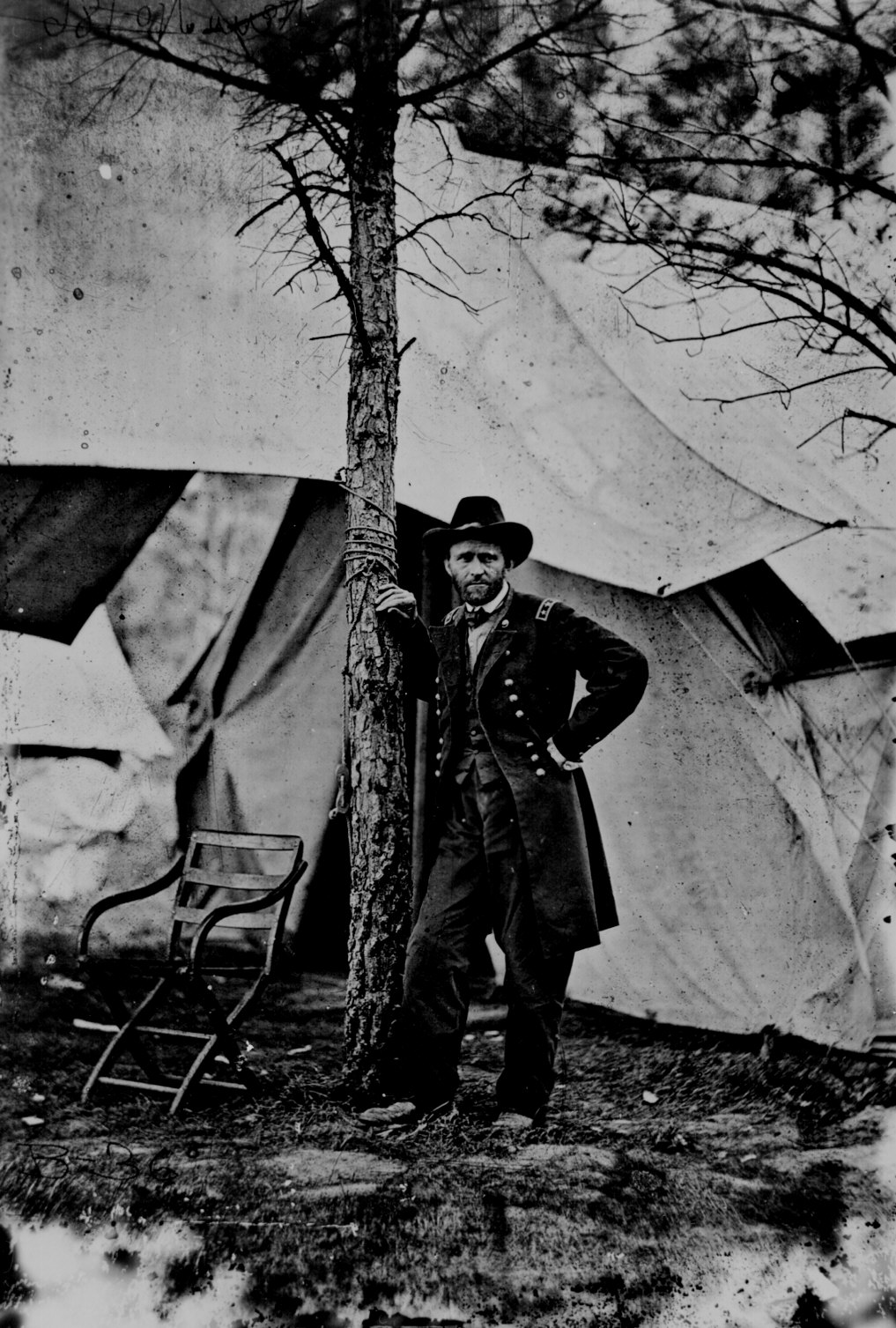
General Grant at City Point. 1902. Prints and Photographs Division. Reproduction Information: Reproduction Nos.: LC-DIG-ppmsca-15886 (digital file from original photograph), LC-USZ62-21992 (b&w film copy neg.); Call No.: PRES FILE - Grant, U.S.--Civil War & with generals [item] [P&P]
Before there was Photoshop, there was the simple act of creating composite photographs from multiple images. This one in the Library of Congress purports to show Ulysses S. Grant astride a horse, in front of the troops at City Point, Virginia. In fact, it's complied from three separate images. The body and the horse belong to Major General Alexander M. McCook (see below). The head shot comes from the well-known photo of Grant at Cold Harbor. There are some other examples of early photo manipulation here.

Clams and Steam Beer Since 1861

In December of 1861, the Old Clam House (originally called the Oakdale Bar and Clam House) opened for business in San Francisco. One hundred and fifty years later, it's still serving up platters of clams, oysters, mussels, crab, shrimp, calamari, and other tasty items. Indeed, it's the oldest restaurant in San Francisco still operating out of its original location (the Tadich Grill predates it by 12 years or so, but it has relocated).

I scanned President Lincoln's December 1861 State of the Union address for mention of the state of fine dining on the Left Coast, but there was nothing.

Thursday, February 16, 2012

Dred Scott rocks

When I want some serious antebellum, prelude to the Civil War history, I turn to Don Fehrenbacher. When I want some serious, world class rock on the radio, I turn to KFOG (104.5 San Francisco, 97.7 San Jose). Curiously, Dred Scott satisfies both needs. 

On this day in 1862, Unconditional Surrender . . .

                         Hdqtrs, Army in the field
                         Camp near Donelson, Feby 16, 1862
Gen. S.B. Buckner, 
Confed. Army:
Sir: Yours of this date proposing Armistice, and appointment of Commissioners, to settle terms of Capitulation is just received. No terms except unconditional and immediate surrender can be accepted.
     I propose to move immediately upon your works. I am Sir: very respectfully
                          Your obt. sevt.
                          U.S. Grant
                          Brig. Gen.

Sunday, February 12, 2012

Mrs. Lincoln, I Presume? Well, as It Turns Out ...

Left, the altered portrait depicting Mrs. Lincoln; right, the restored image, an unknown woman without a Lincoln brooch. Photographs from Abraham Lincoln Presidential Library and Museum.
For 32 years, a portrait of a serene Mary Todd Lincoln hung in the governor’s mansion in Springfield, Ill., signed by Francis Bicknell Carpenter, a celebrated painter who lived at the White House for six months in 1864.

As the conservator Barry Bauman removed paint added to the portrait advertised as being that of Mary Todd Lincoln, a brooch depicting Abraham Lincoln disappeared.

The story behind the picture was compelling: Mrs. Lincoln had Mr. Carpenter secretly paint her portrait as a surprise for the president, but he was assassinated before she had a chance to present it to him.

Now it turns out that both the portrait and the touching tale accompanying it are false.
Read the full New York Times article here.
By PATRICIA COHEN
Published: February 11, 2012

Tuesday, February 07, 2012

The Atlantic's 150th anniversary Civil War issue is now online, with expanded content

Click on image for Table of Contents

The Union Veteran's Son Who Fixed Lucille Ball's Appliances

Hilbert J. Gramelspacher
And not just Lucille Ball's. This son of a Hoosier infantryman also fixed appliances for Jerry Lewis and Joan Crawford. I saw mention of this article (referenced in an online post by Robert Moore of Cenantua's Blog), and wanted to highlight it here.  A couple days ago I posted a link to a story on the death of a man reported to be the last actual son of a Confederate veteran. Turns out there may be as many as 13 sons of Union veterans still alive, including one man in Poplar Bluff, Missouri. I passed through Poplar Bluff -- the "Gateway to the Ozarks" -- many times in the late 70s and early 80s, going back and forth from Evansville, Indiana to my parents new home on Greers Feery Lake, Arkansas. But alas, Gramelspacher did not live there at the time.  
The family did not know much about Joseph's military service until Hilbert's 68-year-old son, Wayne, who lives near Vaughn, Miss., began "looking up family history" and contacted Sons of Union Veterans of the Civil War.
"My father never talked about the Civil War," Hilbert said. He was 11 when his dad died in 1931 at the age of 83.
"He did show me his rifle," Hilbert said. "He gave it to my sister, and her children have it now.".
Full article is here.

Thursday, February 02, 2012

How Egypt Won the American Civil War

by  Matthew Osborn
February 2, 2012
Al Arabiya News
read the full article here

Egypt, which previously accounted for only 3 percent of cotton exports to Europe, saw its profits boom from $7 million to $77 million in just four years. With Egyptian cotton flooding the European market, the demand for Southern cotton disappeared, as did European support for the Confederacy that was based, in part, on a need for the South’s cotton.

Wednesday, February 01, 2012

The last actual son of a Confederate veteran?

Dinwiddie County native Lucas L. Meredith Jr. poses in 2008
with a portrait of his father, who fought for the South.
"A former business owner and one of the last links to the American Civil War died Jan. 28. Lucas L. Meredith Jr.—a native of Dinwiddie County—was the son of a flag bearer during Pickett's Charge at Gettysburg. He died Saturday at age 87." Read all about it in the Petersburg Progress-Index .
Work in the Cameron Art Museum's exhibit “Civil War Drawings from the Becker Collection” depicts scenes from the South during the war. Image courtesy of the Cameron Art Museum

February 2. OPENING RECEPTION: 
Civil War Era Drawings from the Becker Collection
Thursday, February 2
6:00 pm – 8:00 pm
CAM Members: Free, Non-Members: $10.00
(On View Feb. 3 – May 6, 2012)
Civil War Era Drawings from the Becker Collection features 127 “first hand” drawings depicting colorful aspects of life and action during the Civil War era. These original drawings by artist-reporters for the "Frank Leslie’s Illustrated Newspaper", were used to inform a reading public consumed by the need to know what was happening throughout America as it struggled to establish its national identity.

Louise Wells Cameron Art Museum
3201 South 17th Street  Map
Wilmington, North Carolina 28412
(910) 395.5999
http://www.cameronartmuseum.com/

Monday, January 30, 2012

New eBook Series from UNC Press


The University of North Carolina Press -- one of the premier publishers of Civil War titles -- has launched a new digital inititive involving electronic excerpts of various titles. It will be interesting to learn how this new program works out for them. It's not a new idea, exactly, but seems pretty bold and far-thinking for the staid and conservative world of university presses.
 

UNC's Marketing Director, Dino Battista, asserted in a press release that the press is "confident that after reading one of these Civil War Shorts, the reader will want more, and be drawn to the fuller treatment in the original work." That's quite possible, though I wonder if this model will apply to history texts in the same way that students might wish to purchase only the assigned parts of an expensive textbook. A lot of Civil War book buyers, it seems to me, are commonly adding to their personal library, not conducting research or studying for a final. That reader -- it seems to me -- may be unlikely to spend $7.99 to read 177 pages of Michael Ballards excellent book on Vicksburg, for example, when he or she can get all 512 pages for $25.00.
 

On the other hand, important and riveting excerpts from massive volumes may be just what the doctor ordered for people who wish to get right to the heart of the matter, or who are content to focus on one free-standing section of the larger story (e.g., the wounding and death of Stonewall Jackson). I love my Kindle, and my iPad, and have purchased a number of electronic versions of books for which I already have a copy on the shelf -- strictly for the convenience of not carrying around heavy books. I could envision loading up the Kindle with "E-book Shorts" in preparation for traveling and battlefield visits. There is a lot of value in portabillity. Costs for these initial "shorts" run from $2.99 through $9.99.

In addition to offering the Shorts, UNC is also packaging multiple eBooks together in what it's calling Omnibus E-books. Offering up all three Harry Pfanz Gettysburg books in a single e-book is a stroke of genius.
  

From the UNC Press announcement:
"At UNC Press, we pride ourselves on publishing campaign studies that take into account the larger contexts in which Civil War battles were fought. But as we developed our program of E-book Shorts, we were pleased to discover within those longer works tightly written  narratives of the battles themselves that work very well as standalone books," said UNC Press Civil War editor David Perry, who worked with the authors on the original publication of the full books.
"Today's advances in digital content delivery give us great flexibility in how we deliver our content to readers. The E-book Shorts format, delivering readable and engaging accounts of the key battles and other critical moments in the Civil War, is the perfect way to reach new readers for our books," said Dino Battista, the Press's Senior Director of Marketing.
UNC Press Civil War Shorts and Omnibus E-Books are available from Amazon.com for the Kindle ebook reader, at BarnesandNoble.com for the Nook reader, and at Sony's ebookstore.sony.com.
For more information, visit UNC Press at www.uncpressebookshorts.com.

UNC PRESS CIVIL WAR SHORTS

The Mortal Wounding of Stonewall Jackson: A UNC Press Civil War Short, Excerpted from Chancellorsville: The Battle and Its Aftermath, edited by Gary W. Gallagher
by Robert K. Krick
ISBN: 978-0-8078-37108; 38 pp., 6 illus., 2 maps, $2.99

On Pickett's Charge: A UNC Press Civil War Short, Excerpted from Pickett's Charge in History and Memory
by Carol Reardon
ISBN: 978-0-8078-3620-0;74 pp., $6.99

The Battle of Fredericksburg: A UNC Press Civil War Short, Excerpted from Fredericksburg! Fredericksburg!
by George C. Rable
ISBN: 978-0-8078-3622-4; 332 pp., 5 illus., 6 maps, $9.99

The Battle of Vicksburg: A UNC Press Civil War Short, Excerpted from Vicksburg: The Campaign that Opened the Mississippi
by Michael B. Ballard
ISBN: 978-0-8078-3621-7; 177 pp., 10 illus., 2 maps, $9.99

OMNIBUS E-BOOKS

The Harry Pfanz Gettysburg Trilogy
Includes Gettysburg: The First Day; Gettysburg: The Second Day; and Gettysburg:  Culp's Hill and Cemetery Hill
by Harry W. Pfanz
ISBN: 978-0-8078-7281-9; 1648 pp., $75.00

The Earl J. Hess Fortifications Trilogy
Includes Field Armies and Fortifications in the Civil War; Trench Warfare Under Grant and Lee; and In the Trenches at Petersburg
by Earl J. Hess
ISBN: 978-0-8078-7282-6; 1216 pp., $60.00

The Shenandoah Valley Campaigns
Includes The Shenandoah Valley Campaign of 1862 and The Shenandoah Valley Campaign of 1864
Edited by Gary W. Gallagher
ISBN: 978-0-8078-7283-3; 696 pp., $40.00

Thursday, January 26, 2012

“I must post myself in Canuck airs,” said John Wilkes Booth

     John Wilkes Booth Lived Here. . .
       How Montreal fell for the Confederacy

       by Matt Herzfeld
 
       The McGill Daily
       full article is here

Booth’s desire – to seek political refuge in Canada – has been shared by generations of Americans, from British Loyalists after the American Revolution to Iraq War resisters. And as the newest parade of laughable candidates for President takes to the nation’s podiums, town halls, and state fairs, America will ring once again with the rallying cry of, “If so and so is elected, I’m moving to Canada.”

Wednesday, January 25, 2012

Huntington Library acquires trove of Lincoln, Civil War telegrams, codes

( Arkasha Stevenson / Los Angeles Times )
Olga Tsapina, a history curator who will be cataloging the logs, points to Abraham Lincoln's code name, "Ida," in a log listing code names for members of government
A long-unknown, 150-year-old trove of handwritten ledgers and calfskin-covered code books that give a potentially revelatory glimpse into both the dawn of electronic battlefield communications and the day-to-day exchanges between Abraham Lincoln and his generals as they fought the Civil War now belongs to the Huntington Library, Art Collections and Botanical Gardens. . . .

The Eckert collection's code books show that Lincoln had an assortment of aliases: Ida, India, Irving, Ingress, Ingrate and Ingot. His war secretary, Edwin Stanton, was Indigo or Infant. If a message said "shaker" or "sable," it was talking about an attack. The code words for "infantry" were "rapture" and "ramble."

The terminology seems "completely arbitrary," Tsapina said — which may have been why the Confederates were never able to crack the code.

In her initial sifting through the material during the month before the Huntington decided to buy it, Tsapina said, she found some very human moments along with messages that appear to convey historically important facts.

In February 1862, two months before sharing command with Grant at the Battle of Shiloh, an important and extremely bloody Union victory in Tennessee, Gen. Don Carlos Buell sent a telegram from his headquarters in Louisville, Ky., to unknown recipients code-named Andes and Ocean, complaining of "constant intrigue to displace army officers" under his command, "which I beg you to defeat … until I tell you there is just cause. I learn that Col. Hazin is one of the purposed victims. His removal would be gross injustice and a serious loss."

After the concluding signature, "Alvard" — Buell's code name — appear three additional words: "Good for Alvard," a nod of approval by a telegraph operator putting in his own two cents. Tsapina said she also has found instances in which telegraph operators tacked on insider investment tips to one another, based on how the battlefield news they were transmitting might affect the market price of cotton or gold.

Tsapina said there are "masses of telegrams" concerning supplies and railroad operations, which could help scholars studying Civil War logistics.
The full Los Angeles Times article is here.

iTunesU and the National Portrait Gallery

It's been over four years since I wrote this blog entry on iTunesU, and the free lectures available there from a growing number of institutions, from Stanford to Yale. Professor David Blight's 27 lectures on "The Civil War and Reconstruction, 1845-1877" remains one of the exceptional educational offerings on the site. 

Naturally, in the intervening years, there has been a veritable digital explosion of online material presented at no cost. This may explain why pioneers like The Teaching Company are offering some of their packages at greatly reduced discounts [incidentally, I was given the set of Gary Gallagher lectures as a gift, and you can't go wrong with that product]. 

More recently, I happened upon this nifty collection of 15 video and audio pieces from the National Portrait Gallery, ranging in length from a 4-minute snippet to an 85-minute lecture by James McPherson. It's really nicely done, all in the spirit of commemorating the 150th anniversary.

Two thumbs up. You can access all of this material, and much, much more through the iTunesU page of the iTunes store, or through this handy smartphone app

Monday, January 23, 2012

Castle Pinkney back in (Sons of) Confederate Hands

Castle Pinkney, on Charleston Harbor, was the first U.S. fort to fall into Confederate hands, and after passing through federal and then state ownership, now belongs to the Sons of Confederate Veterans. Thanks to fellow blogger Craig Swain for correcting my previous post. Turns out the old fort changed hands again last summer for the price of $10 (which Craig reported on his blog back on June 29).

There's also an article and a video on the sale here.
The State Ports Authority has long wanted to be rid of the Castle Pinckney; selling the crumbling site to theSons of Confederate Veterans for a bargain price of $10. The SPA has owned the site, off and on, since 1958. Twice, they gave the Castle to historic societies, only to have it given back. However, both parties are optimistic about this transfer."We've been looking for a proper home for Castle Pinckney for many years," says SPA spokesmanByron Miller.

Sunday, January 22, 2012

(the erstwhile) Castle Pinckney National Monument

 from National Geographic Daily News:
Pictures: America's "Lost" National Parks
(view the entire slide show here)

Castle Pinckney National Monument
Photograph from Corbis

This Confederate island fortress in the harbor of Charleston, South Carolina, was used to house Union POWs, like these men from the Civil War's First Battle of Bull Run. During the war, Castle Pinckney was bombarded twice before falling to the Union with the rest of Charleston in 1865.

After the war, Castle Pinckney fell into general disuse and then into the hands of the National Park Service in 1933. After more than two sleepy decades, the Castle Pinckney National Monument was abolished in 1956—and still little has changed  since.

Several aborted development schemes later, Castle Pinckney, now owned by the South Carolina State Ports Authority, sits today in a state of gradual decomposition.

Friday, January 13, 2012

Hunley Unveiled

The full article can be read here
Visit the MSNBC Photo Blog on the Hunley here


Tuesday, January 03, 2012

Why did so many Civil War battles take place inside of national parks?

Nice try citizen, but the moon only looks small. 
Michael Lynch, in his Past in the Present blog, has a post reflecting on the confusion of American tourists who somehow conflate the Revolution with the Civil War. This prompted Michael to relate a personal anecdote about an encounter he had with a gentleman while Michael was manning the counter in a small museum in Harrogate, Tennessee. You can read that amusing, and depressing, story here.

In the discussion that followed, a reader of Michael's blog invoked one of the most famous of all Civil War tourist stories -- the one in which a visitor to a battlefield allegedly asks the park ranger, something to the effect of, "why did so many of these Civil War battles take place in national parks?"

It's a good question, and the way I first heard the story -- from Jerry Russell, I think -- was that the ranger, without skipping a beat, replied, "because that's where all the cannon were."
 

Reading this reminded me of a conversation I had with Bobby Krick, historian at Richmond National Battlefields, during the Civil War Forum's visit to Richmond last spring. I knew he had spent many years on battlefields, and that he was the son of a career NPS historian, so figured he must have some good tales to tell. I asked him about the famous story -- the one about why battles were fought on park service grounds -- and whether those kinds of things really happened, or were merely apocryphal. It's easy to imagine that a story like that is made up to accentuate the humor, while still being emblematic of the fact that we are a nation of idiots.

Bobby said that indeed, people do ask questions like that, and he had a pretty good story from his first NPS assignment, one summer years ago at the Little Bighorn Battlefield National Monument. Anyone who has visited, or seen pictures of that battlefield knows that the landscape is open, with little in the way of trees beyond the edges of meager watercourses. Bobby tells of a tourist on Last Stand Hill who, feverishly working through in his or her head how exposed the troopers were to the storm of Indian bullets and arrows, asked, "why didn't the soldiers take cover behind all these grave markers?"

And that, my friends, was Custer's last and probably most egregious mistake. 

Wednesday, December 28, 2011

Tuesday, December 27, 2011

Thursday, December 22, 2011

147 Years Ago: A Christmas Gift for the President

                 Savannah, Ga December 22, 1864
                 Via Ft. Monroe, Va Dec 25.

His Excellency
    Prest. Lincoln.

               I beg to present you as a
Christmas gift the City of Savannah
with 150 heavy guns & plenty
of ammunition & also about
25,000 bales of cotton.

                         W. T. Sherman
                         Major Gen'l

LoC exhibit.

Wednesday, December 14, 2011

Rodgers favors Generals Lee & Jackson, Glad the North Won the War

Thanks to Terry Arliskas for sending in this link. Starting at second 54 of the video, she is one of the three Soldiers Aid Society ladies to query the Green Bay Packer quarterback—a history major—about his favorite Civil War generals. [Sorry Rebs, his favorite color is blue.] Terry also reminds us that the Packers are the only team in the NFL to boast a Lee, Grant, and Pickett on their roster.

620 WTMJ NewsRadio -- "Ask Aarron"

Thursday, December 08, 2011

"Why do so few blacks study the Civil War?"

More from The Atlantic's new Civil War issue. . . an article by Ta-Nehisi Coates

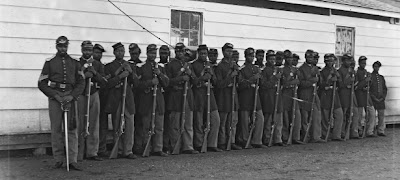
Members of Company E, Fourth U.S. Colored Infantry Regiment, pictured at Fort Lincoln, in Maryland. The regiment, which was organized in Baltimore after the war broke out, lost nearly 300 men. (Library of Congress)

Monday, December 05, 2011

"How Newt's New Novel Plays Politics With the Past"

Congratulations to Kevin Levin, whose book review of Newt Gingrich's latest novel appears in the new, Civil War-themed issue of The Atlantic. 

Newt Gingrich's recent rise in Republican primary polls has occurred in tandem with the release of his historical novel set in the Civil War, which positions him as a champion of the African-American community and at the same time attempts to placate his conservative southern base, whose agenda is interwoven with a traditional narrative of the Civil War that avoids the tough questions surrounding slavery and race. The result is a narrative that grossly distorts our understanding of the war and the important role of black Union soldiers.

Thursday, December 01, 2011

The generosity of Brian Pohanka

Thanks to Eric Wittenberg over at Rantings of a Civil War Historian for bringing this interview with Civil War historian Brian Pohanka to my attention. I'd never seen it before, and it's reportedly his lastthe last of many, many interviews. Brian was one of the most ubiquitous talking heads in the nascent Civil War documentary world, dating back to the Ken Burns series. 

I did not know Brian well, but counted him among my friends in the last years of his life, when he regularly participated in Civil War Forum discussions, and attended our annual gatherings for several years. My first contact with him was to solicit an article for the 2nd issue of Civil War Regiments over 20 years ago, and he graciously submitted something he'd previously published but reworked on his beloved 5th New York at 2nd Manassas. I remember the first time we spoke. All of our contact over his article had been done by mail (USPS), and in some letter or another he had said don't phone me, let's just handle this through written correspondence. He was a private person, and the phone was a distraction from his work (and I understood completely -- I only use the phone, or answer it, with a measure of dread and impatience).

But of course, as a fledgling editor working with a "big name" author, something came up in the hours before sending things off to the printer, and I didn't feel I could go forward without consulting him on some editorial change, lest he take me to task for it until the end of time (I had been instructed to change nothing). I don't remember what it was I so urgently had to get his okay on, but I called him. He answered, and I identified myself, and his first sentence was something to the effect of, "oh, you called anyway" [even though I asked you not to]. 

That experience caused me to think I was off to a bad start in the world of Civil War publishing, and also to think that Brian was prickly. I was wrong on both counts, as I came to learn over time, and I enjoyed getting to know Brian. One year, the annual West Coast Civil War Round Table Conference was hosted (early 90's I think) by the Long Beach Civil War Round Table, and the featured historians were Brian and Joseph Harsh. I sat by Brian in all the bus excursions that weekend, and those casual chats made us friends. Sometimes you just have to sit next to a guy on a bus, through long stretches of dreary freeway, and there it is. 

By the way, yes, there are places in Los Angeles to take a busload of Civil War enthusiasts. Not just cemeteries, but mostly.

But I digress. This interview is about the urgency of preserving what's left of America's Civil War battlefields at a time when commercial development is affecting, at last, even places heretofore protected by their remoteness. I love that Brian salutes Jerry Russell and Annie Snyder as ardent preservationists before we had well-run, efficient, and politically savvy national organizations like the Civil War Trust (the best bang for your preservation buck). Russell and Snyder were untiring advocates of Civil War preservation, loud and cantankerous, and that's what it took to get people's attention while battlefields were quietly being bulldozed. 

I don't think I'm exaggerating to say that without Jerry Russell (and Bob Younger of Morningside), Civil War Regiments (which begat Savas Woodbury, Savas, and then Savas Beatie) might never have gotten off the groundat least not as steadily. Jerry promoted us throughout the land by way of Civil War Round Table Associates, and Bob sold our books and let us share a table at the Gettysburg Book Show, the always sold-out, premier event of the year for anyone peddling books to a hardcore, niche crowd. Brian Pohanka helped us too, by lending his name to our 2nd issue, because battlefield preservation was part and parcel of CWR.


Brian's passion for and knowledge of the Battle of the Little Bighorn was also rivaled by few. Several of us in the Civil War Forum (Margaret, Paula, Keith) were planning to enlist him for a tour there, but we tarried too long. If that subject interests you, you need to pick up a copy of Where Custer Fell. His friends in the Friends of the Little Bighorn tell the tale.

I said Brian put his money where his mouth was. After he died, we learned about his devotion to battlefield preservation in pretty concrete terms. This from a Civil War Trust 
announcement:

In a statement released today, the Civil War Preservation Trust (CWPT) announced a major gift from the estate of historian and ardent preservationist Brian C. Pohanka, who passed away in June 2005. In his will, Pohanka left CWPT — with whom he has been associated since its earliest days — a bequest totaling $1 million earmarked for land acquisition.

In acknowledging the gift, CWPT President James Lighthizer said that the donation is telling of the innumerable contributions Pohanka made to the cause of historic preservation over the years.
"From the very beginnings of the Civil War battlefield preservation movement, Brian Pohanka led the charge," remarked Lighthizer. "He not only gave of his time and talents, but frequently and generously reached into his wallet as well. We at the Civil War Preservation Trust are proud to carry on the work he began nearly two decades ago."

Pohanka's generosity to battlefield preservation was unequalled. In addition to the $1 million bequest, he and his wife Cricket quietly donated an equal amount to CWPT in 2004. Over the years, Pohanka gave generously to CWPT and countless other local battlefield preservation groups — in his will, he also set aside money for the Central Virginia Battlefields Trust ($500,000), the Richmond Battlefields Association ($500,000), and the Save Historic Antietam Foundation ($200,000).