Thursday, July 22, 2010

The Battle of Duncan's Mills

On the Russian River, just upstream from Jenner—that Battle of Duncan's Mills. 

As a San Francisco Bay Area resident, and a self-annointed Civil War blogger, I was interested to see that one of the fresh-faced bloggers over at sfgate.com (the online presence of the slowly vanishing San Francisco Chronicle, and a site I depend on daily) chose to write on her visit to a Civil War reenactment. 

I'd heard that there was some kind of Civil War event in Duncan's Mills, a little town near the coast, a couple hours north of San Francisco, but it never coincided with my occasional forays into Sonoma County, and would have been too far afield from a wine tasting room to get my full attention. [Interestingly, though I've driven that road on several occasions in years past, I did not know of the unincorporated community of "Sheridan" before I took a snapshot of that Google map tonight. As far as I know, that's one of two unincorporated places in California named for the diminutive Civil War general.]

The author of the blog considers a Civil War reenactment to be an exceedingly unusual novelty—she enjoys "highly specific weird subjects," she announces up front—but young urbanites are not expected to be aware of the surprisingly large number of regular reenactments that take place across the state, and which have been going on for decades in some cases. When I spent most of my 20's and early 30's in San Francisco, I became aware of the annual event at Roaring Camp in the Santa Cruz mountains, complete with a steam locomotive transporting troops in open cars, only because I was fully plugged into the all-but-invisible community of Civil War nerds in the Golden State after attending a Civil War conference in San Diego in the late 80's. It's true. In the prime of life, I travelled to the wonderland of San Diego specifically to spend the weekend in a Holiday Inn listening to hours of talks on things like "Berdan's Sharpshooters."

I make light of it, but it was a seminal weekend, ultimately leading to a 16-year career in publishing, and other things. . . That's where I first met Ted Savas, Jerry Russell, Bob Younger — William C. "Jack" Davis was the featured speaker, and he was tremendously inspirational, and hilarious. . .   But I digress. 

historic postcard of Union Square
By and large, San Franciscans don't know the rich Civil War heritage under their feet (same can be said for nearly any city, with reference to any historic period). When they think "Union Square" on Geary Blvd., quite naturally they think of Macy's or other high-end shopping, or the St. Francis Hotel. I think of those heady days when the state declared itself for the Union, right there in that spot (if only for a second, it passes through my mind because it happened there), and I think of General Geary holding his dying son in his arms at the midnight battle of Wauhatchie. Such a sad vision is inescapable. [I hasten to point out that I keep these things to myself, not that you were going to invite me to go shopping with you, or to view the Christmas displays on Black Friday.]

That is what history majors do, if they're like me. They look at a landscape or a cityscape and imagine it the way it was before, always daydreaming in one little pocket of the mind (and reserving one pocket of consciousness for coherent answers to companions). But time travel knows no bounds. I also look at San Francisco and see the wind-swept dunes of a virgin peninsula, the Portolla expedition first sighting the bay from land on the high ridge overlooking SFO, and I try to picture where serpentine was before it got thrust up on top. It's why every year I order the Anchor Steam calendar for my cubicle, to stare at beautifully reproduced works from Bancroft showing views of the city that exist only that artist's historic view. . .   But I digress.

It just occurred to me that I should invite the blogger, Ms. Spotswood, on my next Civil War San Francisco tour.

Nowadays the state is lousy with reenactments. And it's not uncommon to encounter some kind of "Civil War Days" event in any obscure location from one end of the state to the other, from McCloud in the north, to Fort Tejon in the south. 

Our Culture Blogger did an adequate job conveying what happens at events like this. I read it with bated breath, because invariably these kinds of pieces include some choice quotes from a member of the southern camp who takes pains to explain that the war was not over slavery, but states rights (see Claude of the Turbervilles, an earlier blog post). Mercifully, though the most quoted reenactor was on the southern side, the blog entry was entirely free of Lost Cause mythology. I feel like sending a thank you note for that alone.

Other miscues are not so egregious. Saying this reenactment was "3,000 miles from any actual Civil War experiences" did cause me to wince just a little. Even if we disregard the Civil War garrisons in California, or the fighting in Arizona and New Mexico, even if we disregard the experiences of those Civil War soldiers sent to fight the Sioux in the Dakotas, it's less than 2,000 miles to the battlegrounds of Oklahoma, Kansas, Missouri, and Arkansas.

Who am I kidding? Yes, you're right, it's nearly 3,000 miles from Sonoma County to Gettysburg, the only battle of the Civil War. To be fair, what with the Sierra and the Rockies blocking the way, everything on the other side of the mountains might as well be 3,000 miles distant.

Alfred Pleasonton
Speaking of local celebrations, the town of Pleasanton, California—one of Money magazines top 100 places to live—used to incorporate some Civil War stuff into one of their annual celebrations. I used to know the man who dressed up as General Alfred Pleasonton, the late, great Ormond Eckley, who started a CWRT in that area. To me the town will always be most notable for a misspelling (others may remember it as the background for "Rebecca of Sunnybrook Farm").

John H. Kottinger, an 1851 pioneer in the area, named the town in 1867 after Pleasonton, under whom he'd served in the Mexican War. When the post office was established June 4, 1867, a clerical error (it is believed) changed the name to Pleasanton. An 1898 Postal Guide set the record straight again, but in time, the error crept back into the books [this according to Kyle's, Historic Spots in California, and Gudde's, California Place Names]. Apparently, when one comes across the name Pleasonton, there's an irresistable urge to fix it.

Could be worse. At least they didn't spell his name wrong on his tombstone. See General Irwin [should be Irvin] McDowell's grave in San Francisco's Presidio National Cemetery.


Thursday, July 08, 2010

We've all seen the stats.

 
Time and again you come across them. And yet, every time you take a moment to consider them thoughtfully, they seem even more remarkable.


At least 620,000 soldiers lost their lives in the war, 2 percent of the American population in 1861. If the same percentage of Americans were to be killed in a war fought today, the number of American war dead would exceed 6 million. The number of casualties suffered in a single day at the battle of Antietam on September 17, 1862, was four times the number of Americans killed and wounded at the Normandy beaches on D day, June 6, 1944. More Americans were killed in action that September day near Sharpsburg, Maryland, than died in combat in all the other wars fought by the United States in the 19th century combined.

[from the article "Out of War, A New Nation," by James McPherson. Caption for photo above: "an 1870 engraving of the Battle of Gettysburg, possibly Pickett's charge. (Library of Congress)" — Prologue magazine, Spring 2010]

Wednesday, July 07, 2010

When anyone can be a published author. . .


How do you find something good to read in a brave new self-published world?

by Laura Miller

[entire article can be read here]

Readers themselves rarely complain that there isn't enough of a selection on Amazon or in their local superstore; they're more likely to ask for help in narrowing down their choices. So for anyone who has, however briefly, played that reviled gatekeeper role, a darker question arises: What happens once the self-publishing revolution really gets going, when all of those previously rejected manuscripts hit the marketplace, en masse, in print and e-book form, swelling the ranks of 99-cent Kindle and iBook offerings by the millions? Is the public prepared to meet the slush pile?

You've either experienced slush or you haven't, and the difference is not trivial. People who have never had the job of reading through the heaps of unsolicited manuscripts sent to anyone even remotely connected with publishing typically have no inkling of two awful facts: 1) just how much slush is out there, and 2) how really, really, really, really terrible the vast majority of it is. Civilians who kvetch about the bad writing of Dan Brown, Stephenie Meyer or any other hugely popular but critically disdained novelist can talk as much trash as they want about the supposedly low standards of traditional publishing. They haven't seen the vast majority of what didn't get published—and believe me, if you have, it's enough to make your blood run cold, thinking about that stuff being introduced into the general population. . . .


If anyone can "publish" by forking over a few bucks to produce a paperback or e-book, then doing so won't be any more special than, say, printing out the manuscript on your Deskjet and running off a few copies at Kinko's. Readers will be saved from wading through slush by amateur authorities—bloggers and other pundits specializing in particular subjects or genres—who will point their followers to the best books. "People will find new ways to decide which books merit their attention."

Saturday, July 03, 2010

Gettysburg from a distance

Recalling Longstreet's Assault 147 years ago today—also known as the Pickett-Pettigrew-Trimble Charge, also known as Pickett's Charge—I revisited an old but still worthwhile site, Behind the Stonewall, 360-degree Panoramic Images from Civil War Battlefields. It's "dated" technology, the images are small and the resolution could be better, but it's still unique, pretty thorough, and FREE. Here is the menu of Gettysburg panoramas. Here is the one next to the Copse of Trees, which the Confederates targeted in their long march.

Virtual Gettysburg is a nice site, with better images and a large sampling of some of their tours, but you'll need to purchase the CD-ROM set to enjoy the fruits of what looks like considerable labor. A really nice feature there is the database of battlefield monuments, which you can browse at random, or search for in detail. Looking for that teepee monument? There it is, the 42nd New York Infantry, south of the copse of trees.

Another favorite Gettysburg site is
Gettysburg Daily, where you'll find outstanding photographs, and expert captions and essays with a new post every day.

If you're really captivated by Gettysburg and wish to explore the topic with a community of well-read devotees, check out the
Gettysburg Discussion Group. Sign up for the regular emails or the digest—the traffic there is steady, and so there's always something new to read in ongoing conversations. Send them a few bucks to help maintain their servers, and take advantage of expertly-led, GDG-sponsored tours.

There are some good resources at the
NPS official site as well.


on this 147th anniversary

an account from the officer holding the left flank of the Union line at Gettysburg. . .
 

After-action report of Colonel Joshua Chamberlain, 20th Maine


Field near Emmitsburg
July 6, 1863.

Sir:
In compliance with the request of the colonel commanding the brigade, I have the honor to submit a somewhat detailed report of the operations of the Twentieth Regiment Maine Volunteers in the battle of Gettysburg, on the 2nd and 3rd instant. Having acted as the advance guard, made necessary by the proximity of the enemy's cavalry, on the march of the day before, my command on reaching Hanover, Pal. , just before sunset on that day, were much worn, and lost no time in getting ready for an expected bivouac. Rations were scarcely issued, and the men about preparing supper, when rumors that the enemy had been encountered that day near Gettysburg absorbed every other interest, and very soon orders came to march forthwith to Gettysburg. My men moved out with a promptitude and spirit extraordinary, the cheers and welcome they received on the road adding to their enthusiasm. After an hour or two of sleep by the roadside just before day break, we reached the heights southeasterly of Gettysburg at about 7 a. m. , July 2.
Massed at first with the rest of the division on the right of the road, we were moved several times farther toward the left. Although expecting every moment to be put into action and held strictly in line of battle, yet the men were able to take some rest and make the most of their rations. Somewhere near 4 p. m. a sharp cannonade, at some distance to our left and front, was the signal for a sudden and rapid movement of our whole division in the direction of this firing, which grew warmer as we approached. Passing an open field in the hollow ground in which some of our batteries were going into position, our brigade reached the skirt of a piece of woods, in the farther edge of which there was a heavy musketry fire, and when about to go forward into line we received from Colonel Vincent, commanding the brigade, orders to move to the left at the double-quick, when we took a farm road crossing Plum Run in order to gain a rugged mountain spur called Granite Spur, or Little Round Top.
The enemy's artillery got range of our column as we were climbing the spur, and the crashing of the shells among the rocks and the tree tops made us move lively along the crest. One or two shells burst in our ranks. Passing to the southern slope of Little Round Top, Colonel Vincent indicated to me the ground my regiment was to occupy, informing me that this was the extreme left of our general line, and that a desperate attack was expected in order to turn that position, concluding by telling me I was to "hold that ground at all hazards. "This was the last word I heard from him.
In order to commence by making my right firm, I formed my regiment on the right into line, giving such direction to the line as should best secure the advantage of the rough, rocky, and straglingly wooded ground. The line faced generally toward a more conspicuous eminence southwest of ours, which is known as Sugar Loaf, or Round Top. Between this and my position intervened a smooth and thinly wooded hollow. My line formed, I immediately detached Company B, Captain Morrill commanding, to extend from my left flank across this hollow as a line of skirmishers, with directions to act as occasion might dictate, to prevent a surprise on my exposed flank and rear.
The artillery fire on our position had meanwhile been constant and heavy, but my formation was scarcely complete when the artillery was replaced by a vigorous infantry assault upon the center of our brigade to my right, but it very soon involved the right of my regiment and gradually extended along my entire front. The action was quite sharp and at close quarters. In the midst of this, an officer from my center informed me that some important movement of the enemy was going on in his front, beyond that of the line with which we were engaged. Mounting a large rock, I was able to see a considerable body of the enemy moving by the flank in rear of their line engaged, and passing from the direction of the foot of Great Round Top through the valley toward the front of my left. The close engagement not allowing any change of front, I immediately stretched my regiment to the left, by taking intervals by the left flank, and at the same time "refusing" my left wing, so that it was nearly at right angles with my right, thus occupying about twice the extent of our ordinary front, some of the companies being brought into single rank when the nature of the ground gave sufficient strength or shelter. My officers and men understood my wishes so well that this movement was executed under fire, the right wing keeping up fire, without giving the enemy any occasion to seize or even to suspect their advantage.
But we were not a moment too soon; the enemy's flanking column having gained their desired direction, burst upon my left, where they evidently had expected an unguarded flank, with great demonstration. We opened a brisk fire at closes range, which was so sudden and effective that they soon fell back among the rocks and low trees in the valley, only to burst forth again with a shout, and rapidly advanced, firing as they came.
They pushed up to within a dozen yards of us before the terrible effectiveness of our fire compelled them to break and take shelter. They renewed the assault on our whole front, and for an hour the fighting was severe. Squads of the enemy broke through our line in several places, and the fight was literally hand to hand. The edge of the fight rolled backward and forward like a wave. The dead and wounded were now in our front and then in our rear. Forced from our position, we desperately recovered it, and pushed the enemy down to the foot of the slope. The intervals of the struggle were seized to remove our wounded (and those of the enemy also), to gather ammunition from the cartridge-boxes of disabled friend or foe on the field, and even to secure better muskets than the Enfields, which we found did not stand service well. Rude shelters were thrown up of the loose rocks that covered the ground. Captain Woodward, commanding the Eighty-third Pennsylvania Volunteers, on my right, gallantly maintaining his fight, judiciously and with hearty co-operation made his movements conform to my necessities, so that my right was at no time exposed to a flank attack.
The enemy seemed to have gathered all their energies for their final assault. We had gotten our thin line into as good a shape as possible, when a strong force emerged from the scrub wood in the valley, as well as I could judge, in two lines in echelon by the right, and, opening a heavy fire, the first line came on as if they meant to sweep everything before them. We opened on them as well as we could with our scanty ammunition snatched from the field. It did not seem possible to withstand another shock like this now coming on. Our loss had been severe. One-half of my left wing had fallen, and a third of my regiment lay just behind us, dead or badly wounded. At this moment my anxiety was increased by a great roar of musketry in my rear, on the farther or northerly slope of Little Round Top, apparently on the flank of the regular brigade, which was in support of Hazletts battery on the crest behind us. The bullets from this attack struck into my left rear, and I feared that the enemy might have nearly surrounded the Little Round Top, and only a desperate chance was left for us.
My ammunition was soon exhausted. My men were firing their last shot and getting ready to "club" their muskets. It was imperative to strike before we were struck by this overwhelming force in a hand-to-hand fight, which we could not probably have withstood or survived. At that crisis, I ordered the bayonet. The word was enough. It ran like fire along the line, from man to man, and rose into a shout, with which they sprang forward upon the enemy, now not 30 yards away. The effect was surprising; many of the enemy's first line threw down their arms and surrendered. An officer fired his pistol at my head with one hand, while he handed me his sword with the other. Holding fast by our right, and swinging forward our left, we made an extended "right wheel, " before which the enemy's second line broke and fell back, fighting from tree to tree, many being captured, until we had swept the valley and cleared the front of nearly our entire brigade.
Meantime Captain Morrill with his skirmishers (sent out from my left flank), with some dozen or fifteen of the U. S. Sharpshooters who had put themselves under his direction, fell upon the enemy as they were breaking, and by his demonstrations, as well as his well-directed fire, added much to the effect of the charge. Having thus cleared the valley and driven the enemy up the western slope of the Great Round Top, not wishing to press so far out as to hazard the ground I was to hold by leaving it exposed to a sudden rush of the enemy, I succeeded (although with some effort to stop my men, who declared they were "on the road to Richmond") in getting the regiment into good order and resuming our original position. Four hundred prisoners, including two field and several line officers, were sent to the rear. These were mainly from the Fifteenth and Forty-seventh Alabama Regiments, with some of the Fourth and Fifth Texas. One hundred and fifty of the enemy were found killed and wounded in our front.
At dusk, Colonel Rice informed me of the fall of Colonel Vincent, which had devolved the command of the brigade on him, and that Colonel Fisher had come up with a brigade to our support. These troops were massed in our rear. It was the understanding, as Colonel Rice informed me, that Colonel Fishers brigade was to advance and seize the western slope of Great Round Top, where the enemy had shortly before been driven. But, after considerable delay, this intention for some reason was not carried into execution. We were apprehensive that if the enemy were allowed to strengthen himself in that position, he would have a great advantage in renewing the attack on us at daylight or before. Colonel Rice then directed me to make the movement to seize that crest.
It was now 9 p. m. Without waiting to get ammunition, but trusting in part to the very circumstance of not exposing our movement or our small front by firing, and with bayonets fixed, the little handful of 200 men pressed up the mountain side in very extended order, as the steep and jagged surface of the ground compelled. We heard squads of the enemy falling back before us, and, when near the crest, we met a scattering and uncertain fire, which caused us the great loss of the gallant Lieutenant Linscott, who fell, mortally wounded. In the silent advance in the darkness we laid hold of 25 prisoners, among them a staff officer of General [E. M. ] Law, commanding the brigade immediately opposed to us during the fight. Reaching the crest, and reconnoitering the ground, I placed the men in a strong position among the rocks, and informed Colonel Rice, requesting also ammunition and some support to our right, which was very near the enemy, their movements and words even being now distinctly heard by us.
Some confusion soon after resulted from the attempt of some regiment of Colonel Fishers brigade to come to our support. They had found a wood road up the mountain, which brought then on my right flank, and also in proximity to the enemy, massed a little below. Hearing their approach, and thinking a movement from that quarter could only be from the enemy, I made disposition to receive them as such. In the confusion which attended the attempt to form them in support of my right, the enemy opened a brisk fire, which disconcerted my efforts to form them and disheartened the supports themselves, so that I saw no more of them that night. Feeling somewhat insecure in this isolated position, I sent in for the Eighty-third Pennsylvania, which came speedily, followed by the Forty-fourth New York, and, having seen these well posted, I sent a strong picket to the front, with instructions to report to me every half hour during the night, and allowed the rest of my men to sleep on their arms.
At some time about midnight, two regiments of Colonel Fishers brigade came up the mountain beyond my left, and took position near the summit; but as the enemy did not threaten from that direction, I made no effort to connect with them. We went into the fight with 386, all told-358 guns. Every pioneer and musician who could carry a musket went into the ranks. Even the sick and foot-sore, who could not keep up in the march, came up as soon as they could find their regiments, and took their places in line of battle, while it was battle, indeed. Some prisoners I had under guard, under sentence of Court-Martial, I was obliged to put into the fight, and they bore their part well, for which I shall recommend a commutation of their sentence. The loss, so far as I can ascertain it, is 136-30 of whom were killed, and among the wounded are many mortally. Captain Billings, Lieutenant Kendall, and Lieutenant Linscott are officers whose loss we deeply mourn-efficient soldiers, and pure and high-minded men.
In such an engagement there were many incidents of heroism and noble character which should have place even in an official report; but, under present circumstances, I am unable to do justice to them. I will say of that regiment that the resolution, courage, and heroic fortitude which enabled us to withstand so formidable an attack have happily led to so conspicuous a result that they may safely trust to history to record their merits.
About noon on the 3rd of July, we were withdrawn, and formed on the right of the brigade, in the front edge of a piece of woods near the left center of our main line of battle, where we were held in readiness to support our troops, then receiving the severe attack of the afternoon of that day.
On the 4th, we made a reconnaissance to the front, to ascertain the movements of the enemy, but finding that they had retired, at least beyond Willoughby's Run, we returned to Little Round Top, where we buried our dead in the place where we had laid them during the fight, marking each grave by a head-board made of ammunition boxes, with each dead soldiers name cut upon it. We also buried 50 of the enemy's dead in front of our position of July 2. We then looked after our wounded, whom I had taken the responsibility of putting into the houses of citizens in the vicinity of Little Round Top, and, on the morning of the 5th, took up our march on the Emmitsburg road.
I have the honor to be, your obedient servant,
JOSHUA L. CHAMBERLAIN,
Colonel, Commanding Twentieth Maine Volunteers.
[map detail from Civil War Preservation Trust]

Tuesday, June 22, 2010

Welcome Varyag!

The flagship of Russia's Pacific fleet has come to town and is docked at Pier 30-32. It is the first Russian warship to visit San Francisco since 1863, when the Russian Pacific and Atlantic fleets tied up in San Francisco Bay and New York Harbor. The weaponry has been upgraded somewhat. Those earlier vessels were formidable, but this one has 16 cruise missiles with a range of 3,400 miles.

One hundred and forty-seven years ago, the Civil War raged in the East, and U.S. relations with France and Great Britain remained tenuous. The importance of Russia's support for the Union goes underreported in the literature. The bi-coastal sojourns in the U.S. freed the Russian fleets from potential blockades in their home ports, and made for a strong show of force in the event that one of the great Western European powers recognized the Confederacy.


The Russians, of course, had a long and rich history on the West Coast of North America. San Francisco's Russian Hill (North of Nob Hill, and west of Telegraph Hill), was named for a small cemetery of Cyrillic-inscribed tombstones discovered on the crest by 49ers. In 1812, moving down from Alaska, the Russian
American Company established Fort Ross, north of San Francisco, which became the southernmost Russian outpost. Today, it's a well-preserved state historic park, and favored destination for school outings.

Hearty thanks go to the Russians for standing by the Union in her time of greatest crisis, and for the the sacrifice of six sailors who died fighting a conflagration during that 1863 visit. A plaque honoring those sailors was dedicated in San Francisco last week at the foot of Broadway.

[photo at top: Capt. Eduard Muskalenko, commander of the Varyag. Bottom right, a Russian stamp depicting Andrei Alexandrovich Popov, commander of the Pacific Fleet that patroled the U.S. West Coast in 1863.]

Wednesday, June 09, 2010

The Battle of Brandy Station


Today marks the 147th anniversary of what is frequently described as the largest cavalry battle on the North American continent. It's worth paying a visit to the outstanding web resources at the Civil War Preservation Trust site, where you'll find first-rate maps, an interview with author Eric Wittenberg, an article by Bud Hall, photos, video tours, and more.

On the weekend after Labor Day, Eric will be conducting a tw0-day bus tour of Brandy Station, from Kelly's Ford to Trevilian Station. The first 12 registrants (of which there are half a dozen so far) will receive a free copy of Eric's new book on Brandy Station. Additionally, $10 of every registration will be donated to CWPT. More information can be found here.


A Stillness at Appomattox

I'm back in the Golden State after a jam-packed Civil War weekend in Appomattox, and will take some time later this week to post some photos and reflections. After two days of following Patrick Schroeder around—this being my second visit to the area—I'm finally beginning to get the lay of the land. It's a difficult campaign to grasp, and pouring over maps is not quite enough.

For me, it's always been a challenging puzzle to visualize the disengagement of Lee's army from Petersburg, the rapid Federal pursuit, and the precise chronology and movement of pieces of both armies along a network of roughly parallel roads on either side of the Appomattox River. For the first time, I started to see a more complete picture of how the Army of Northern Virginia became disconnected, and how Federal cavalry closed off first one route and then another, forcing the remnants of Lee's army into a "punchbowl" with nowhere to go. Now I need to revisit some of the primary source material, and Chris Calkins's narratives, to finally achieve something approaching fluency in my understanding of the incredibly dramatic closing hours of the war in the East. Virtually all Civil War battlefields require a personal visit to make sense of the complicated and often clumsy descriptions intended to illuminate them, but some require it more than others.

You can't appreciate the swale that swallowed Longstreet's Assault until you personally make the walk to Cemetery Ridge. Once you've seen for yourself the ravines at Shiloh, you won't so casually fault Beauregard for not finishing the job on the first day. And until you
grok the geography and road network on Lee's retreat from Petersburg, you cannot appreciate how close we came to losing the poetry of Catton's title, A Stillness at Appomattox, in favor of a stillness at some other place. I billed this tour as "Unseen Appomattox," and Patrick did not disappoint. We made several forays into heavily wooded areas to locate the ruins of various wartime structures, and some extant defensive works, and saw many other sites that warmed the cockles of our uber-geeky Civil War hearts.

[Photo at top: Appomattox Court House National Historic Park historian Patrick Schroeder, holding up a period photo of Longstreet's headquarters in front of the ruins of that building.]

Tuesday, June 01, 2010

He Ho'omana'o No

You heard me. On this Memorial Day, 2010, the Honolulu Advertiser reports that "Henry Ho'olulu Pitman, the son of a Hawaiian high chiefess, was born in Hilo, served as a young man in the Union Army during the American Civil War, and died from the effects of being held in the South's Libby Prison."

The article asserts that as many as 40 native Hawaiians served on one side or the other during the war, including 12 on the famed raider CSS Shenandoah (probably pressed into service for their sailing skills).

Mustering best Johnny Carson impression: I did not know that.

Texas textbooks and the truth

Monday, May 31, 2010 19:01 ET


Texas is right: We should teach kids about Jefferson Davis
and the Confederacy. But let's tell the whole story
.

By Michael Lind

The Texas State Board of Education, the most astringently reactionary body since the Spartan Ephorate, has decreed that textbooks for the schoolchildren of Texas are to include Confederate President Jefferson Davis’s inaugural address along with the first inaugural of Abraham Lincoln.

This controversy holds particular interest for me. I am a fifth-generation native of Texas. One ancestor of mine had his farm in Georgia incinerated by Gen. Sherman. Another came to Texas in the federal army of occupation of Gen. Custer. One of the last things that my late grandfather said to me was: "Sam Houston was a traitor to the South!" The Civil War ended in 1865, but clearly its meaning is still contested in the 21st century.

By all means, let schoolchildren in Texas read Jefferson Davis’s inaugural address. But there should be more material from the Confederate side of the conflict than that. For generations, apologists for the Confederacy have claimed that secession was really about the tariff, or states’ rights, or something else -- anything other than preserving the right of some human beings to own, buy and sell other human beings.

That being the case, the education of schoolchildren in my state should include a reading of the Cornerstone Speech made by Alexander Stephens, the vice-president of the Confederacy, on March 21, 1861.

You can find the full Salon.com article here. Be sure to read to the end, and behold Sam Houston's stirring appeal to reason in the face of secessionist fervor. Like the author of this piece, I was born in Texas, as was my wife. Something really went haywire when even the venerable Sam Houston was deemed a traitor. Lost Causers—including the people behind the campaign to acknowledge vast legions of phantom Black Confederates—paint a rosy picture of a post-war, independent Confederacy naturally weaning itself peacefully from its economic dependence on slavery by the end of the century. Not likely, given the sacrifice they were willing to make to preserve it. To say nothing of the fact that the institution transcended economics—it was part and parcel of southern culture. Chances are good they would have given Brazil a run for its money when it came to the longevity of slavery. Lind's image of a post-war Confederacy sounds much more feasible, and as a fellow son of Texas, I share his sentiments about the liberation of the Lone Star State.

That is what my fellow Texans of younger generations should learn about the Lost Cause. Under British protection, the CSA might have evolved into a squalid banana republic run by landlords for the benefit of investors and industrialists in Britain. Without British protection, the CSA might have survived as a proto-fascist regime, with an economy of permanent war socialism and a government run by colonels. In either case, the victory of the Confederacy would have been far worse for most white and black Southerners than its well-deserved defeat. For ensuring that I would be born in the United States of America instead of a broken-down failed state that combined the least attractive features of apartheid-era South Africa and death squad-era Honduras, I say: Thank you, President Lincoln, and thank you, Gen.Grant.

Monday, May 17, 2010

Tommy Lee Jones: "Am I dead?" John Bell Hood: "You don't look like it to me"


Certainly Hood saw enough dead men to answer that question correctly. Back in 1994 I picked up a copy of James Lee Burke's In the Electric Mist with Confederate Dead, because it combined two interests of mine, murder mysteries and the Civil War (though in truth, it has virtually nothing to do with the Civil War). In the novel, detective Dave Robicheaux (the sixth installment with this classic, South Louisiana character) encounters the ghost of Confederate General John Bell Hood with whom he has a conversation or two. There's no particular reason to bring Confederate ghosts into the story, but the general serves to bolster the spirits of the struggling lawman while Robicheaux sees connections between a half-forgotten murder he witnessed as a boy and a string of present day serial killings. Hood's main purpose here seems to be to present the ideal of steadfast honor and adherence to principle.

Spring forward to 2010, last month in New Orleans, I was visiting the grave of John Bell Hood at Metairie Cemetery, and the statue at the Army of Tennessee tomb which provided artwork for the original dust jacket of Burke's book. I mentioned In the Electric Mist and was excited to learn from Civil War Forum member John Lancaster that they'd made a movie of the book. Incidentally, next to the Hood grave—in which the Hood name is overshadowed in his wife's family plot—is a large metal plaque giving a biography of the general. It's designed to look like a government issue sign, but as our guide told us, it was placed there by a Hood descendant—the same one, I'm pretty sure, who is on a crusade to rehabilitate Hood's military career, and who took out the ad in Civil War News to attack Wiley Sword for unkind words about the general. The plaque, I can report, is a fairly straightforward biography. I was glad it didn't end with a footnote about Sword being a damned liar.

Somehow, this movie (with the title shortened to "In the Electric Mist") passed me by completely, even though it's only from 2009, and had a fairly substantial cast, including Jones, John Goodman, Mary Steenburgen, Ned Beatty, Buddy Guy, Peter Sarsgaard, and Kelly MacDonald. Last week I finally got around to looking up the film on Netflix, and was pleased as punch to see it was among their "Watch Instantly" offerings. I made time for it the other night, and with no expectations at all, enjoyed it very much. Jones and Goodman work pretty hard at their accents, and pull it off for the most part.

Levon Helm of The Band fame plays the one-legged general, and who can resist that gravelly drawl? For all his range as a singer, it's interesting that Helm's on-screen roles seem only to call for a monotone delivery (and Levon, it's cavalry, not calvary). Take off the general's insignia, and this is pretty much exactly the same character that Tommy Lee Jones had a conversation with in the intriguing, "The Three Burials of Melquiades Estrada," except that then he was an old blind man in Mexico, not a dead Confederate general.

Please don't be alarmed by the severity of my comparison.

Below, Hood's grave, and the aforementioned marker.


Wednesday, May 12, 2010

"Making the Civil War Strange Again"

The current issue of Prologue (Spring 2010, Vol. 42, No. 1) has a brief article by Bruce Bustard, curator of the new Civil War exhibit at the National Archives. The ingenious invention above (click to get a larger view) is featured in the article, and the exhibit. The caption reads: "In 1862 Louis Joubert patented this multipurpose device that could serve as a tent, knapsack, or litter. (Records of the Patent and Trademark Office, RG 241)."

Bustard attributes the phrase "make the Civil War strange again" to historian Edward Ayers. It is that spirit which gave the exhibit its name, "Discovering the Civil War"—in the expectation that even seasoned students of the Civil War era can "rediscover" a familiar subject. I personally am really looking forward to seeing the exhibit on one of my trips to Washington this fall. The notion of making the war "strange" again is really apt, and not a difficult feat. Those of you who have gotten swept away into a years-long fascination (obsession?) with the Civil War period—who, though you may have broad interests in the full spectrum of human history, continue to find yourself drawn to yet one more Civil War campaign study, one more biography, one more monograph on an aspect of the period—know the idea.

It's a subject area that is so big, so all encompassing, so woven into the nation's fabric, so recent, that one can manage to find fresh reading material, and fresh insights, with virtually every trip to the bookstore. One thing I've noticed over the years, something hard to convey to people who don't share an abiding passion for American history (hereafter referred to as soulless robots), is that just when you think you might be getting burned out on the subject, just when you think you can't stomach any more glorification of horrific carnage, when you swear you can not tolerate one more tortured rationalization about fighting for the liberty to keep others in bondage, or one more cliched fairy tale about saintly motivations, something washes over your senses, making you remember why you became fascinated with the subject to begin with.

Some passing thought, or dawning realization, or new-found perspective gives you pause and fills you with awe, causing you to fleetingly grasp—in a moment of clarity—that it's not just a familiar narrative to dissect and critique or challenge or substantiate, but something that actually happened, a strange and amazing story about who we are and where we came from.

History will always be bigger than our attempts to chronicle it.
We shall not cease from exploration
And the end of all our exploring
Will be to arrive where we started
And know the place for the first time.
—from "Little Gidding," T.S. Eliot

Monday, May 10, 2010

Some photos from the Civil War Forum's visit to New Orleans in April, 2010

(click to enlarge):

This first one is from the Army of Tennessee tomb at Metairie Cemetery. I'm convinced this soldier is the same one pictured on the original dust jacket of James Lee Burke's, In the Electric Mist with Confederate Dead. But I could be wrong.


Gallier Hall, on St. Charles Avenue, was city hall in 1862 when Federal officers from the U.S. fleet climbed the steps and demanded the surrender of New Orleans.


Monument to the acclaimed Washington Artillery.
And a boy who climbs on everything.


Henry Clay monument in Lafayette Square.


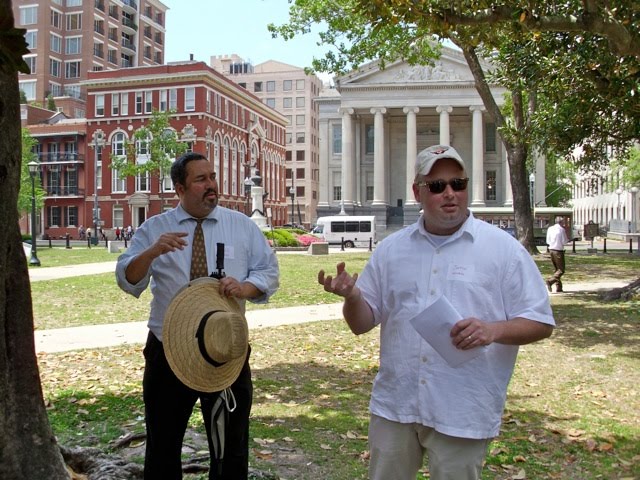
City archivist Greg Osborn, and Loyola history professor Justin Nystrom, begin our walking tour in Lafayette Square, opposite Gallier Hall.


Battle of Liberty Place monument, commemorating the Reconstruction Era fight between the White League and the Metropolitan Police, in 1874. If the South lost the Civil War, this, Nystrom pointed out, was where white supremacists won the peace.


Fort Pike on Lake Ponchartrain, now a Louisiana State Park. Theres' little in the way of interpretation, but the park staff are superb.


The fort was completely underwater after Katrina, though the moat seen here was part of the design.


Original burial place of Jefferson Davis, Metairie Cemetery. Eighteen months after he was buried here, wife Varina had his remains moved to Hollywood Cemetery in Richmond.


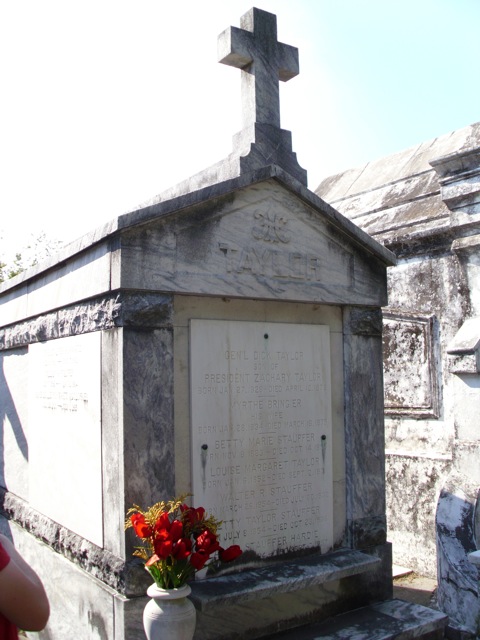
Grave of General Richard Taylor, son of president Zachary Taylor, son-in-law of Jefferson Davis, and author of one of the best reminiscences of the Civil War, Destruction and Reconstruction.


Laura plantation, for many of us, one of the highlights of the weekend. A beautiful spot, quiet and uncrowded when we were there, with a wonderful guide. A unique example of a Creole plantation.


Photo of a slave on the Laura plantation. Note the line of slave cabins on either side of the image.


One of a few surviving slave cabins at Laura, along the Mississippi River. In the distance are sugar cane fields.


Oak Alley Plantation on the Mississippi River. The 300-year-old oaks are pretty stunning, and the architecture presents a classic image of the antebellum plantation, which also makes it one of the more touristy stops on the old river road.


The home of Confederate General Pierre Gustave Toutant Beauregard, from 1866-1868, in the French Quarter.


Bourbon Street. If you're looking for little beers, just keep walking.


This was a long-neglected display window at a liquor store at Canal and Camp. At first I thought that was a voodoo doll holding a giant cookee, but now I think it may be some kind of Aunt Jemima representation holding a tray. The doll, the alligator head and the Confederate battleflag shot glass all combine to broadcast the message that I cannot decipher.


Now this is a message I can understand, and perhaps the only football-related one I saw that did not say "who dat?"

I say, well done Saints!

Friday, May 07, 2010

Doonesbury takes on Virginia's Confederate History Month

It's gratifying to see that Gary Trudeau has turned his attention to another target rich environment. The Confederate History Month theme starts about one week ago, with this strip. Hit "next" to follow the whole string up to today's entry.

Monday, May 03, 2010

"Discovering the Civil War,"


a brand new exhibit, opened at the National Archives last Friday, and by all accounts is an important and substantive presentation. At the heart of it are six original documents, either rarely seen, or never before exhibited, such as Robert E. Lee's resignation from the U.S. army (photo at left).

It's a massive exhibit requiring two visits -- Part I is up and running, and Part II will debut on November 11. At the close of the National Archives show, the combined parts will hit the road for exhibitions at The Henry Ford Museum, Dearborn Michigan (Summer 2011), The Houston Museum of Natural Science, Houston, Texas (Fall 2011 through Spring 2012), and finally at the Durham Museum, Omaha, Nebraska (Fall of 2013).

The exhibit web site is here.

I was reading Drew Wagenhoffer's superb blog this morning, as is my wont


Suddenly it dawned on me. We need to declare a moratorium on Civil War books with "Thunder" in the title, unless the subject of the book is an actual weather event.

Yes, the word evokes the rumbling sound of "deep-throated" artillery, but enough is enough.

Thunder on the River, Valley Thunder, A Distant Thunder, Echoes of Thunder, Thunder in Arcadia Valley, Thunder from a Clear Sky, A Deep, Steady Thunder, Silent Thunder, A Savage Thunder, A Voice of Thunder, Thunder at Gettysburg, Thunder at Hampton Roads, Thunder Along the Mississippi, A Rising Thunder, Fire and Thunder, Gray Thunder, Galloping Thunder. . . you get the idea.

Saturday, May 01, 2010

More on Who Do You Think You Are?

About a month ago I posted a little entry on the episode of NBC's Who Do You Think You Are featuring Matthew Broderick, who made a fascinating discovery regarding one of his Civil War ancestors. The seven-part television series came to a close last night with the genealogical adventures of director Spike Lee.

The concept of the show was pretty interesting, and will no doubt spark tons of subscriptions to Ancestry.com, a not-so-subtle sponsor. Two of the seven "celebrities" were African Americans -- Lee, and former Dallas Cowboys running back Emmit Smith. Their stories illustrated the challenges of tracing one's ancestry through the institution of slavery. Not only are records incomplete, slaves were often listed by only their first name or no name at all, they were sold and relocated, and some who went by the surname of their owner later changed their name to something else.

Still, the paper trail exists to take many African Americans some generations back into antebellum days. In the case of Spike Lee, he was able to trace one of his lines back to a slave owned by a Griswold (of course this made me think of the National Lampoon Griswolds -- a different family). Spike Lee's Griswold was none other the man who gave the name to Griswoldville, Georgia, site of a Confederate armaments factory (at the time producing a knock-off of the Navy Colt revolver), and scene of the only thing approaching a battle during Sherman's March to the Sea.

Upon leaving Atlanta, Uncle Billy sent elements of his Right Wing on a feint toward Macon. On November 20, 1864, 100 men under Captain Frederick Ladd of the 9th Michigan Cavalry burned Mr. Griswold's operation, and his namesake town, to the ground. A couple days later, in what came to be called the Battle of Griswoldville, well-situated troops in Sherman's Right Wing under Brig. Gen. Charles Walcutt withstood assaults from a patched together force of Georgia state troops and militia (mostly old men and young boys), in the only serious infantry fight of Sherman's March.

Interestingly, in the annals of Black Confederate mythology, Griswoldville is one of the places pointed to as having slaves impressed into combat roles in defense of the town, but I don't believe Union accounts of the battle make any mention of these phantom soldiers (we'll let Kevin Levin sort that out in his future book on the subject).

The trail that led to Spike Lee's ancestor at Griswoldville ends with the battle, and there's a pretty good chance he moved on with Sherman's men toward Savannah. It was interesting to see Mr. Lee musing on the irony of his ancestor working to build weapons that would be used to kill the troops sent to liberate him. If you've got 40 minutes to spare, the show is pretty worthwhile, and rams home again why, for so many Americans, all roads lead to the Civil War (full episode can be seen online here). Reminds me of one of my favorite Walker Percy quotes:


The truth of it is, I think, that the whole country, South included, is just beginning to see the Civil War whole and entire for the first time. The thing was too big and too bloody, too full of suffering and hatred, too closely knit into the fabric of our meaning as a people, to be held off and looked at—until now. It is like a man walking away from a mountain. The bigger it is, the farther he's got to go before he can see it. Then one day he looks back and there it is, this colossal thing lying across his past.

—from "The American War," Commonweal 65 (March 29, 1957): 655-57; republished in Signposts in a Strange Land, by Walker Percy, edited by Patrick Samway (New York, 1991).