Wednesday, February 21, 2007

Manly Men in the Service of the Lord

"The Civil War is our only 'felt' history," wrote Robert Penn Warren, and one can certainly feel that in the element of religious fervor that attends our inherited and adopted interpretations of that cataclysmic era. Though no one today was alive in the 1860s, many there are who have a deep, emotional investment in how the story is told (or remembered, as Kevin at Civil War Memory might say).
Certainly Abraham Lincoln has attained saintly status in the literature, but the Southern Cause, in particular, has become synonymous with righteous struggle. There is something fundamentally strange about the way Confederate icons have all but replaced the apostles in the stained glass of southern history. They were the knights of the Confederate round table (minus Lancelot's adulterous betrayal, of course), and the reasons they fought can never be sullied by incidental, political distractions like free soil versus slave soil. The godliness of men like Lee, and Jackson, is cartoonishly caricatured in films like "Gods and Generals," and in the essays of earnest children (see the With Lee in Virginia paragraph of this one, quoted below). But this business about "biblical manhood" puts a new twist on things (see the 2003 winner of biblical manhood essay contest here). The subject of the essay is a Civil War figure, and I'll give you one hint: it wasn't Benjamin Butler.
I don't have the energy or inclination to speak at length about this phenomenon, but I did need an excuse to use Church Sign Generator.


Another book with powerful lessons of providence is With Lee in Virginia. Set in the South during the War Between the States, it explores causes of the war, happenings during it, and lasting effects of it; in it, Henty shows the divine providence which was continually overarching and undergirding the efforts of His people. G.A. Henty sought to remind readers of the religious causes and ramifications of the war. He told how the great leaders of the Confederacy were godly men fighting for godly principles in areas as broad as Christian culture and as specific as decentralized government. He also told how the Reformed faith was what motivated countless men and boys to rise up to defend the South. Most importantly, he showed the grace and mercy of God in the course of the war. The Reverend J.L. Underwood, who also wrote about the war, said in reference to the purpose of the Confederates: “there is a thing better than peace: liberty.” This idea is a recurring theme throughout With Lee in Virginia. Henty explores how God strengthened them to fight what they called the Second War of Independence in a Christian manner and for Christian principles. He gave them resolve to continue in their cause; He gave them strength to act in accordance with their faith throughout the war. Though we still mourn the loss of so many godly men, and though we see that many of the principles for which they fought vanished from society as they died, we can thank God fervently for His providence in preserving their honor and strengthening their faith in the following generations.

Is it just me, or is there something deeply bizarre about groups like "The Vision Forum" assigning Victorian adventure novels (such as G. A. Henty's With Lee in Virginia) to give children today a notion of devout manliness in the antebellum South?

With all due respect to our young essayist and Henty aficionado, and not having read the book, I'm going to take reviewer
Catherine Hood's word for it (from the first critique of With Lee at Amazon): "This book was not exciting, nor is it realistic of antebellum life in Virginia. From the title, you would think that the book would be about the War Between the States and about Robert E. Lee. It is neither. It is what an Englishman thinks it might have been like to be in the South before the war begins, but he doesn't know. The research, if there was any research, was not done well. . . . it is a very tedious, boring, and painful book to read."

That said, after a Google search, I did find a copy of the book online here. I haven't had a chance to go through much of it, but will give an overview in a subsequent post. Our hero, Vincent Wingfield, is an Englishman in Virginia. A slaveowner himself, and sympathetic to the South, he's not above pummeling a plantation owner for whipping a slave:


"You are a coward and a blackguard, Andrew Jackson!"
Vincent exclaimed, white with anger. "You are a disgrace to Virginia, you ruffian!"


Without a word the young planter, mad with rage at this interference, rushed at Vincent; but the latter had learned the use of his fists at his English school, and riding exercises had strengthened his muscles, and as his opponent rushed at him, he met him with a blow from the shoulder which sent him staggering back with the blood streaming from his lips. He again rushed forward, and heavy blows were exchanged; then they closed and grappled. For a minute they swayed to and from but although much taller, the young planter was no stronger than Vincent, and at last they came to the ground with a crash, Vincent uppermost, Jackson's head as he fell coming with such force against a low stump that he lay insensible.

Those riding exercises and schoolyard fisticuffs really paid off.


Saturday, February 10, 2007

Civil War Historian Boots Boring Economist From Ivory Tower

Harvard set to name first female president.
Noted historian, a Radcliffe dean, will succeed Summers
Valerie Strauss, Susan Kinzie, Washington Post Saturday, February 10, 2007

"Harvard University is about to name its first female president since its founding in 1636, tapping a Civil War historian to succeed Lawrence Summers, whose tenure was marked by controversial remarks about women and clashes with faculty members.

Drew Gilpin Faust, 59, dean of the Radcliffe Institute for Advanced Study and a leading historian on the American South, will be formally appointed president as early as this weekend, according to a source.
With Faust's selection, half of the eight Ivy League schools will be run by women: Harvard, the University of Pennsylvania, Princeton University and Brown University."

[from Washington Post, via San Francisco Chronicle]

Thursday, February 08, 2007

More Lies Across America, Civil War category

About one year ago, I posted some comments on James W. Loewen's sequel to Lies My Teacher Told Me (see that post here).

I've got Appomattox on my mind a lot lately, as I finalize plans for a visit there in six weeks. This tripfor the 11th Civil War Forum reunionwill be my first visit to the scene of Lee's surrender. Loewen has an entry on Appomattox, the opening paragraph of which reads:


At Appomattox cemetery, where the Civil War for the Army of Northern Virginia ended, the United Daughters of the Confederacy put up a marker with the words, "Here on Sunday, April 9, 1865 after four years of heroic struggle in defense of principles believed fundamental to the existence of our government Lee surrendered 9,000 men, the remnant of an army still unconquered in spirit, to 118,000 men under Grant." The marker gets the date right, and the Confederacy did put up "four years of heroic struggle." Otherwise, like most markers and monuments put up by the Daughters, it cannot be relied on for accuracy.

The title of that particular chapter is "Getting Even the Numbers Wrong," but if you've read other Civil War-related entries in Loewen's books, you can guess his immediate complaint here. It is about the "principles believed fundamental to the existence of our government." I'll pass on that CSA skewering for now, but highlight something that rings silly to anyone with more than passing familiarity with events following Lee's abandonment of his Petersburg and Richmond lines, and his westward retreat.

The opposed by overwhelming numbers argument as a rationalization for Lee's defeat has a basis
in fact, but is in full bloom, and exaggerated, with the Daughter's marker. Lee's army had become dramatically reduced by this time, but something like three times the 9,000 marker figure received paroles. And while Grant did have an army of nearly 120,000 investing Petersburg, and Richmond, only about half that number were in the vicinity of Appomattox in the lead up to the surrender. Lee was outnumbered, to be sure, but not by 13-1.

COMING SOON, Patrick Schroeder, NPS historian at Appomattox Court House National Historic Park, author of a book on the cemetery there, and on myths related to the surrender, weighs in on some of the issues I've raised here.

Tuesday, January 23, 2007

A Stillness at the War Memorial Opera House


People needing to get that Civil War opera fix may want to travel to San Francisco this October for the premiere of "Appomattox," by Philip Glass.

Today's San Francisco Chronicle breaks the news:

"Appomattox," which will feature baritone Dwayne Croft as Robert E. Lee and bass-baritone Andrew Shore as Ulysses S. Grant, is [David] Gockley's first San Francisco commission. Conductor Dennis Russell Davies, who led the 1984 premiere of Glass' "Akhnaten," and director George C. Wolfe will make their company debuts.

"This is an opera about men and events," Glass said. "There is hardly a person in public life today with the moral and intellectual stature of these two men, and I wanted towell, honor them isn't the right wordbut put them on the stage and see what they were about."

[photo at top: McClean House, NPS, Appomattox Court House National Historic Park]

Tuesday, January 16, 2007

Sometimes heroes sire scoundrels

Federal artillery captain and Medal of Honor-winner Hubert "Leatherbreeches" Dilger died on May 4, 1911 (scroll down on this page for a photo of Captain Dilger). Good thing he didn't live long enough to see his son waging chemical warfare on America during this country's lead-up to and participation in World War I. One naturally assumes Dilger would have been appalled at the prospect of his offspring conniving against the adopted homeland Capt. Dilger so bravely served. But who can say? Perhaps, somehow, Hubert Dilger would have understood his son's devotion to the Fatherland. What a difference a generation makes. Once I finish The Fourth Horseman (great title!), I hope the traitorous son's actions will have been put into the context of an era, and a family, that I know precious little about.

The German immigrants of the 11th Corps took the brunt of the blame for the collapse of the Federal right at Chancellorsville, when Stonewall Jackson's celebrated flanking maneuver caught the Federals off-guard and rolled up Hooker's line. But there was courage and honor amidst the otherwise wholesale Federal flight. Bob Krick, in a
wonderful series of essays archived by the Fredericksburg Free Lance-Star, described the heroics that earned Dilger the MoH at Chancellorsville:


The most famous and dramatic Federal resistance on that afternoon came from a German-immigrant artillery officer, Capt. Hubert Dilger. The captain had turned an Ohio battery into a well-tuned unit, despite what he called "the intrigues & petit jealousies of the different german cliques" in the 11th Corps, and had become recognizable by the doeskin German-style britches he wore. When the Federal right collapsed on May 2, "Leatherbreeches" Dilger retired methodically down the Orange Turnpike (modern State Route 3), firing a single cannon in the road, then falling back and doing it again.

The Medal of Honor (usually miscalled the Congressional Medal of Honor), meant appreciably less during the Civil War than it came to signify for a time during the mid-20th century. Four New Englanders who won the medal for actions near Fredericksburg, for instance, received them three decades later--immediately after (to suggest coincidence strains credulity) one of them became his state's adjutant general, and a second of them became his assistant. It is impossible, however, to doubt that Capt. Dilger richly deserved the honor, by the standards of any era. "Fought his guns until the enemy were upon him," the citation read, "then with one gun hauled in the road by hand he formed the rear guard and kept the enemy at bay by the rapidity of his fire and was the last man in the retreat." The devoutly Virginian historian who chronicled the history of Robert E. Lee's artillery admiringly described Dilger's feat as "an example of almost superhuman courage and energy."

Virginian scenery and people apparently fetched Hubert Dilger. In 1881, having grown rich by inheritance, he bought a large stock farm near Front Royal and began raising pure-bred cattle. Two years later a prize bull, perhaps unconvinced of Dilger's credentials as a freshly converted Virginian, gored him badly, but the old warrior survived and lived into the new century.

Dilger's son, Anton, was born on that Shenandoah Valley farm, but removed to Germany at age 10. Decades later, still a U.S. citizen, he could not enlist in the German army, but as an American loyal to Berlin, he was ideally suited for undercover operations against his homeland. Robert Koenig's new book on Anton Dilger looks to be a good read on an intriguing topic. According to this review in the San Francisco Chronicle:

"Anton Dilger, an American saboteur working for the German government, rented lodgings not 6 miles from the White House. In his basement, he set up a small laboratory and, on behalf of the General Staff in Berlin, he began a highly secret campaign to wage biological warfare on U.S. soil. His target would be the horses and cattle supplied to the Allied armies by the then-neutral United States, and Dilger set about cultivating anthrax bacteria and Pseudomonas mallei, the germ that causes glanders, a crippling equine disease. But who was Dilger, and how did the son of a Union Army captain become a German secret agent?"

Later, Anton Dilger approached the Mexican government to foster an alliance with Germany, tempting the Mexicans with the prospect of reclaiming the American Southwest. As it turned out, the sins of the son failed to eclipse the valor of the father. Anton Dilger, the Shenandoah Valley saboteur with a keen interest in biological warfare, died young (34) at the hands of a common virus, the Spanish Flu. No medals for him.

Thursday, January 11, 2007

My mailbox is regularly crammed with catalogs from several of the university presses that still do Civil War titles, Plains Wars and western history


I look forward to seeing some of them more than others. I like to scan them to discover who's written one more of the books I forgot to write. And I like to make note of those interesting-looking new titles about subjects that weren't on anyone's radar. So many presses are quietly doing solid work in the Civil War arena, like Tennessee, UNC, Fordham, LSU, Kentucky, Kansas.

Two of the catalogs that often hold the most promisefor my particular interestsare those of The University of Arkansas Press (lately), and University of Nebraska Press (always). Arkansas' Spring 2007 catalog announces the latest in their phenomenal "Portraits of Conflict" series, A Photographic History of Tennessee in the Civil War, by Univ. of North Texas associate professor Richard B. McCaslin. Previously, the series has covered Georgia, South Carolina, North Carolina, Mississippi, Louisiana, Texas, and Arkansas. All are stunningly attractive works, expensive to manufacture, and expensive to buybut thank goodness someone is putting these out. I don't actually own any of the volumes of this series, because they cost as much as an iPod Shuffle, and I don't have an iPod yet, even though my collection of unheard KQED Forum Podcasts is burgeoning. But I have seen and examined several books in the Portraits series. I may buy one someday. After I get an iPod.

Another Arkansas series that I like is "The Civil War in the West." The spring catalog has a promising addition to it: Confederate Guerrilla, The Civil War Memoir of Joseph M. Bailey, edited by T. Lindsay BakerI tried to link to a description, but their web site is maddeningly difficult to navigate.

And Nebraska Press, well, what can you say? Here's what you can say: their history list, and their Bison Books imprint, are the best. Their catalog is, without fail, chock-full of intriguing new titles in all subject areas. I like their history books so much, I've twice applied for jobs there (just a little bit afraid that I might actually get an interview, since I love Californianot that I don't have fond memories of Lincoln, where my big sisters went to college, and where once, the Big Red machine was an unstoppable powerhouse). Bison has the masterfully assembled series, "This Hallowed Ground: Guides to Civil War Battlefields" (Brooks Simpson, Mark Grimsley, and Steven Woodworth, series editors).

It's the perfect series: fresh, attractive, well-written, useful. The Spring/Summer 2007 catalog presents The Peninsula & Seven Days, A Battlefield Guide, by Brian K. Burton. He's not a historian most of us would associate with that campaign, but I trust the editors' judgment.

I see over at Civil Warriors, the Wilson's Creek, Pea Ridge, and Prairie Grove guide is out, and there's no one you would want to put together a guide like that besides Earl J. Hess, Richard W. Hatcher III, William Garrett Piston, and William L. Shea. That's as perfect a marriage as you'll find on any one string of battles in the war.


Also in Nebraska's Spring/Summer catalog: Jeb Stuart and the Confederate Defeat at Gettysburg, by Warren C. Robinson, professor emeritus at Penn State (thank you, Nebraska, for paying someone to build a beautiful, easy-to-use web site). I know nothing about this book, and if it came out under any of a half dozen other imprints, I wouldn't consider for one minute buying a book on this subjectI would just go to the Gettysburg Discussion Group archives and read 30 or 40 month-long threads, searching for entries by Licensed Battlefield Guides like the inimitable Wayne Wachsmuth. But because Nebraska published it, my curiosity is piqued.


Nebraska has also brought out Scott Patchan's Shenandoah Summer: The 1864 Valley Campaign. This looks great, and my interest is colored by having spent a couple days with Scott as tour guide on the battlefields of Manassas (Civil War Forum Reunion in 2005). He was impressive. The catalog gives a quote by Bill Miller, saying that Scott "is a 'boots-on-the-ground' historian, who works not just in the archives but also in the sun and the rain and tall grass. Patchan's mastery of the topography and the battlefields of the Valley is what sets him apart and, together with his deep research, gives his analysis of the campaign an unimpeachable authority."

Now, I know Bill Miller, and he doesn't lie. He might even tell you you look fat in those pants, if you ask him, so don't ask if you don't want to know. He doesn't speak well of bad books. Good enough for mecan't wait to read this one.

Wednesday, January 03, 2007

Eicher and Eicher POD? I Say Nay


Like everyone else in our little corner of the Civil War blogworld, I'm a regular reader of Dimitri Rotov's Civil War Bookshelf. I enjoy the periodic, genuinely intriguing flashes of insight that come from really smart history junkies. Likewise, I tune in for Dimitri's gratuitously provocative potshots (comments disabled for good reason), and the mesmerizingly inscrutable diatribes that are becoming something of a signature entry at CWB.

I do want to respond to one of Dimitri's January 2nd posts, since it is directed toward something I worked on. First, he outlined what qualities or circumstances make a work ideal for print-on-demand: "Multi-year, complex research projects, rich in data; Total authorial control over production and design; Aimed at a pre-existing audiences."
And to close the snippet, regarding John and David Eicher's magisterial (I've been waiting to use that word) Civil War High Commands. Dimitri wrote, "For this, therefore, to be brought out by a conventional publisher is preposterous." I read that and wondered if "preposterous" was used in the same sense that a crew member of the Starship Enterprise might regard the archaic notion of currency preposterous when no currency was required, and when the sum total of human knowledge could be had for the asking from the ship's computer.

I have opinions on the subject. I worked on that book at Stanford University Press from start to finish, and even selected the printer. And since I had responsibility for reprints, I was also the person at SUP most involved with the then-fledgling print-on-demand programs that all university presses were beginning to embrace in earnest.
At Stanford, we started out with Ingram's POD outfit, Lightning Source, but eventually transferred everything to the efficient and convenient service offered by the University of Chicago Press, who served as distributors for about 20 university presses at the time. Edwards Brothers, one of the first printers to get a true digital program off the ground, set up a print-on-demand service inside Chicago's distribution facility, and before long they had the ability to fulfill even the smallest bookstore orders for backlist titles that would otherwise have gone out of print. An exciting and dramatic shift. The unit costs are high, but it still pays to keep certain steady sellers available.

Print-on-demand technology is ever-changing, but it only makes sense economically within certain parameters, governed mainly by page length and print run, or demand. Aesthetic considerations went out the window once the technology improved enough to approximate the original.
There are thousands of great candidates for print-on-demand, but the Eicher reference work was not one of them. For starters, when Civil War High Commands came out, there was no POD provider capable of producing a book of more than 1,000 pages, and I'm guessing that hasn't changed (the cut-off used to be around 848pp). But here's the kicker, and why it's "preposterous" to think for even one second that a large reference work like the Eicher & Eicher book could be brought out POD in its first printing. Producing a massive reference work is astonishingly expensive. To then release it as print-on-demand volume would mean trying to recoup those costs by exponentially multiplying the unit cost. As opposed to printing 1,000's of copies conventionally for a fraction of the cost. Dimitri spoke of a "pre-existing audience," but if that audience can be expected to be up over 500 and into the thousands, it would be silly to publish the book at the highest unit cost possible.

I think I do know what he's trying to say—that compilations of data like the Eicher and Eicher book are short-shrifted by conventional publishing, that organic databases like that should be allowed to breathe, and grow with the digital flexibility of frequent updates, and corrections (something happening now with online journals). That's all well and good, if people like David Eicher and his dad are willing to simply make their decades of work available on-line in the spirit of advancing knowledge. We're just not there yet.

A book like Civil War High Commands is, by definition, a labor of love. But it's too costly and impractical for print-on-demand.
If not for a conventional publisher, I would argue, this work would not be published at all. In fact, I would make another distinction. If a university press, devoted to scholarship for scholarship's sake, had not taken on this project, it would not exist in book form.

Hmmm. Didn't realize I felt so defensive about this subject. In truth, I am really into print-on-demandan enthusiastic student of that technologybut I just love that Eicher book, in all its conventional, smyth sewn, acid-free glory.

[cover design at top by Janet Wood, who I think was laid off the same day I was. . .]


Tuesday, January 02, 2007

The Battle of Santa Clara


One hundred and sixty years ago today, men chose sides and squared off to determine the fate of Alta California. There's no trace of the "battlefield" today, just a corroded and forgotten E. Clampus Vitus plaque along the historic King's HighwayEl Camino Realin the old town of Santa Clara. The warriors of 1847 would not recognize the site today. Concrete, discount stores, non-indigenous palm trees (what is with all the palm trees?), and top-flight Vietnamese noodle houses have claimed his hallowed ground, while the barely readable monument momentarily delays Jack in the Box burger wrappers drifting from the nearby bus stop on their way toward San Jose.

I make note of the Battle of Santa Clara today so that effete Eastern readers will come to understand that not all of our nation's storied military history occurred on their side of the Rockies.


ON JANUARY 2, 1847, SOMEWHERE
HEREABOUTS WAS FOUGHT THE LAST
NORTHERN BATTLE OF THE MEXICAN WAR.
THE OFFICIAL CASUALTY REPORT: "DEAD:
NONE, WOUNDED: NONE, MISSING BUT ONE ON
THE AMERICAN SIDE AND HE CAME UP
SHORTLY AFTERWARDS STATING THAT HE
HAD BEEN SEARCHING FOR HIS RAMROD
WHICH IN THE EXCITEMENT, HE HAD
FORGOTTEN TO DRAW FROM HIS GUN AND FIRED
AT THE ENEMY."
DEDICATED OCTOBER 14, 1978,

MOUNTAIN CHARLIE CHAPTER No. 1850
E CLAMPUS VITUS

"RIGHT WRONGS NOBODY"


Monday, December 25, 2006

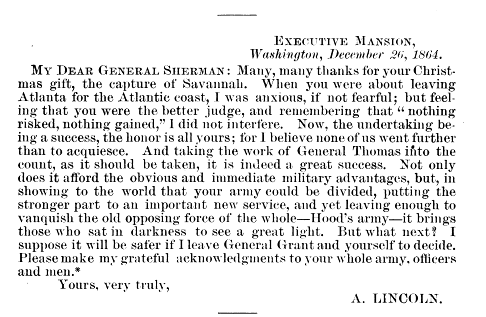
Memorable Christmas gifts and "thank you" notes of the American Civil War


General Sherman to President Lincoln
(Telegram offering Savannah, Georgia as a Christmas present)
—transcription of above—


December 22, 1864
Dec 25 Dec. 25, 1864.

Savannah Ga Dec 22. 1864
Via Ft. Monroe Va Dec 25.


I beg to present you as a Christmas gift the City of Savannah with 150 heavy guns & plenty of ammunition & also about 25.000 bales of cotton.


W. T. Sherman

Major Genl

Thursday, December 21, 2006

Writing less than a year after the Civil War ended, Mark Twain had occasion to see a demonstration of the considerable skills of officers of the Signal Corps—the unsung masters of battlefield communication


It’s more or less a lost art in this age of satellite communications, but the two in this account would make for some unbeatable charades partners. Here's Twain's account of the demonstration in a West Coast newspaper:

from the Territorial Enterprise, February 1866

THE SIGNAL CORPS

Saw something the other night which surprised me more than my late investigations of spiritualism. It was some examples of the methods the United States Signal Corps [used] to telegraph information from point to point on the battle-fields of the rebellion. The Signal Corps "mediums" were Colonel Wicker, of the Russian Telegraph Expedition, and Mr. Jerome, Secretary of Mr. Conway of the same, both of whom were distinguished officers of Signal Corps throughout the war. Besides these two gentlemen there are only two other members of the corps on the coast.

In the late war a signal party was always stationed on the highest available point on the battle-field, and by waving flags they could telegraph any desired messages, word for word, to other signal stations ten miles off. At night, when torches were used, these messages have been read forty miles away, with a powerful glass. The flag, or torch, is waved right, left, up and down, and each movement represents a letter of the alphabet, I suppose, inasmuch as any villainous combination of letters and syllables you can get up can be readily telegraphed in this way with a good deal of expedition. These gentlemen I speak of sent messages the other night with walking-sticks, with their hands, their fingers, their eyes and even their moustaches! It is a little too deep for me.

One sat on one side of a large room, and the other at the opposite side. I wrote a long sentence and gave it to Jerome he made a few rapid passes with his right arm like a crazy orchestra leader, and Colonel Wicker called off the sentence word for word. I confess that I suspected there was collusion there. So I whispered my next telegram to Jerome the passes were made as before, and Colonel Wicker read them without a balk. I selected from a book a sentence which was full of uncommon and unpronounceable foreign words, pointed it out to Colonel Wicker, and he telegraphed it across to Jerome without a blunder. Then I gave Jerome another telegram; he placed two fingers on his knees and raised up one and then the other for a while, and the Colonel read the message. I furnished the latter with the following written telegram:

"General Jackson was wounded at first fire."


He went through with a series of elaborate winks with his eyes, and that other signal-sharp repeated the sentence correctly. I wrote:

"Thirteen additional cases of cholera reported this morning."


The accomplished Colonel telegraphed it to his confederate by simply stroking his moustache. There must be a horrible imposition about this thing somewhere, but I cannot get at it. They say that when they are in lecture rooms and parlors whence they are not close enough to speak to each other, they telegraph their comment on the company with their fingers, on their moustaches, or by gently refreshing themselves with a fan.

The signal Corps was one of the most important arms of the military service in the late war. It saved many a battle to the Union that must otherwise have been lost. Yet many of the officers of the army did not believe in its efficiency, regarded it as an ornamental innovation, and bore it strong ill-will. At the battle of Winchester, the officer in command after General Shields was wounded, had pressing need of reinforcements. The reserve were in full view six miles away. The Acting General asked a signal officer if he could order up a brigade. He said he could.

"Then do it," said the General; "but," said he, "to make everything sure, I will dispatch an orderly for the reinforcements." The signal officer set his flags waving, and telegraphed: "Send up a brigade on the double-quick." Before the orderly was a hundred yards off, the anxious General gazing through his field glass, saw a brigade wheel into the plain, peel their coats and knapsacks off and throw them down, and come sweeping across on the double-quick. "By G--. here they come!
send back the orderly," said the General "but I didn't think it could be done.

[reprinted in The Washoe Giant in San Francisco, edited by Franklin Walker, (George Fields, 1938), pp. 131-33; reprinting the Golden Era, FEB. 18, 1866]
Photo at top: Union signal station at Antietam, Library of Congress.

Thursday, December 14, 2006

"You might as well appeal against the thunder-storm as against these terrible hardships of war."


— Sherman to the mayor of Atlanta

In July of 1864, W. T. Sherman's blue columns, after flanking Joe Johnston out of one position, then another, from Chattanooga to the outskirts of Georgia's largest city (with a few futile head-on assaults thrown in for good measure
Pickett's Mill, Kennesaw), joined a series of battles in and around Atlanta.

John Bell Hoodthe "gallant Hood"took over for Joe Johnston, and fulfilled Richmond's expectations within days by striking the Federal armies. Hood aimed to hit the Army of the CumberlandSherman's largestwhile it was engaged in crossing Peachtree Creek, but too many Federals had crossed before Hood's men were in place, enough to quash Hood's hopes in the July 20 battle.

The Battle of Atlanta (July 22), and Sherman's movement west and southwith more fighting at Ezra Church and Utoy Creekstretched Hood to the breaking point. Finally, the August 31-September 1st fighting at Jonesboro sealed the deal, cutting off the last rail lines into Atlanta and rendering Hood's position untenable.

Six days later, Sherman initiated one of the most interesting exchanges between two opposing generals, I like to think, in the annals of military history. I do wonder how many instances there are in history of two army commanders, in discussing the disposition of a civilian populace, take the time and trouble to argue the reasons for the war itself. The correspondence between Sherman and Hood starts polite, and becomes increasingly acerbic, reminiscent of some internet message board arguments today, where barely masked disdain flares up into a a series of bitter accusations, before both sides, satisfied with their own impenetrable righteousness, agree to disagree and move along.

It's worth taking a few minutes to read the Sherman/Hood messages (and that with the city officials who appeal to Sherman to rethink his orders). This site has gathered them into a clean, chronological read, and of course, they can be read at any of the sites that give access to the Official Records, such as Cornell's wonderful Making of America venue.

Originally I posted this correspondence as a combination of paraphrasing, and highlighting some of the great lines (e.g., Sherman's "Talk thus to the marines, but not to me, who have seen these things..."), but it looked silly to me upon re-reading. So I've included the complete exchanges, minus Sherman's note to Halleck, defending his decision to force the evacuation of Atlanta.

HDQRS. MILITARY DIVISION OF THE MISSISSIPPI,
Atlanta, Ga., September 20, 1864.
Maj. Gen. H. W. HALLECK, Chief of Staff, Washington, D.C.:
GENERAL: I have the honor herewith to submit copies of a correspondence between General Hood, of the Confederate army, the mayor of Atlanta, and myself touching the removal of the inhabitants of Atlanta. In explanation of the tone which marks some of these letters I will only call your attention to the fact that after I had announced my determination General Hood took upon himself to question my motive. I could not tamely submit to such impertinence, and I have seen that in violation of all official usage he has published in the Macon newspapers such parts of the correspondence as suited his purpose. This could have had no other object than to create a feeling on the part of the people, but if he expects to resort to such artifices I think I can meet him there too. It is sufficient for my Government to know that the removal of the inhabitants has been made with liberality and fairness; that it has been attended by no force, and that no women or children have suffered, unless for want of provisions by their natural protectors and friends. My real reasons for this step were, we want all the houses of Atlanta for military storage and occupation. We want to contract the lines of defenses so as to diminish the garrison to the limit necessary to defend its narrow and vital parts instead of embracing, as the lines now do, the vast suburbs. This contraction of the lines, with the necessary citadels and redoubts, will make it necessary to destroy the very houses used by families as residences. Atlanta is a fortified town, was stubbornly defended and fairly captured. As captors we have a right to it. The residence here of a poor population would compel us sooner or later to feed them or see them starve under our eyes. The residence here of the families of our enemies would be a temptation and a means to keep up a correspondence dangerous and hurtful to our cause, and a civil population calls for provost guards, and absorbs the attention of officers in listening to everlasting complaints and special grievances that are not military. These are my reasons, and if satisfactory to the Government of the United States it makes no difference whether it pleases General Hood and his people or not.
I am, with respect, your obedient servant,
W. T. SHERMAN,

Major-General, Commanding.
[Inclosure No. 1.]
HDQRS. MILITARY DIVISION OF THE MISSISSIPPI,
In the Field, Atlanta, Ga., September 7, 1864.
General HOOD, Commanding Confederate Army:
GENERAL: I have deemed it to the interest of the United States that the citizens now residing in Atlanta should remove, those who prefer it to go south and the rest north. For the latter I can provide food and transportation to points of their election in Tennessee, Kentucky, or farther north. For the former I can provide transportation by cars as far as Rough and Ready, and also wagons; but that their removal may be made with as little discomfort as possible it will be necessary for you to help the families from Rough and Ready to the cars at Lovejoy's. If you consent I will undertake to remove all families in Atlanta who prefer to go South to Rough and Ready, with all their movable effects, viz, clothing, trunks, reasonable furniture, bedding, &c., with their servants, white and black, with the proviso that no force shall be used toward the blacks one way or the other. If they want to go with their masters or mistresses they may do so, otherwise they will be sent away, unless they be men, when they may be employed by our quartermaster. Atlanta is no place for families or non-combatants, and I have no desire to send them North if you will assist in conveying them South. If this proposition meets your views I will consent to a truce in the neighborhood of Rough and Ready, stipulating that any wagons, horses, or animals, or persons sent there for the purposes herein stated shall in no manner be harmed or molested, you in your turn agreeing that any cars, wagons, carriages, persons, or animals sent to the same point shall not be interfered with. Each of us might send a guard of, say, 100 men, to maintain order and limit the truce to, say, two days after a certain time appointed. I have authorized the mayor to choose two citizens to convey to you this letter and such documents as the mayor may forward in explanation, and shall await your reply.
I have the honor to be, your obedient servant,
W. T. SHERMAN,
Major-General, Commanding.
[Inclosure No. 2.]
HDQRS. ARMY OF TENNESSEE, OFFICE CHIEF OF STAFF,
September 9, 1864.
Maj. Gen. W. T. SHERMAN.
Commanding U.S. Forces in Georgia:
GENERAL: Your letter of yesterday's date [7th] borne by James M. Ball and James R. Crew, citizens of Atlanta, is received. You say therein "I deem it to be to the interest of the United States that the citizens now residing in Atlanta should remove," &c. I do not consider that I have any alternative in this matter. I therefore accept your proposition to declare a truce of two days, or such time as may be necessary to accomplish the purpose mentioned, and shall render all assistance in my power to expedite the transportation of citizens in this direction. I suggest that a staff officer be appointed by you to superintend the removal from the city to Rough and Ready, while I appoint a like officer to control their removal farther south; that a guard of 100 men be sent by either party, as you propose, to maintain order at that place, and that the removal begin on Monday next. And now, sir, permit me to say that the unprecedented measure you propose transcends, in studied and ingenious cruelty, all acts ever before brought to my attention in the dark history of war. In the name of God and humanity I protest, believing that you will find that you are expelling from their homes and firesides the wives and children of a brave people.
I am, general, very respectfully, your obedient servant,
J. B. HOOD,

General.
[Inclosure No. 3.]
HDQRS. MILITARY DIVISION OF THE MISSISSIPPI,
In the Field, Atlanta, Ga., September 10, 1864.
General J. B. HOOD, C. S. Army, Comdg. Army of Tennessee:
GENERAL: I have the honor to acknowledge the receipt of your letter of this date [9th], at the hands of Messrs. Ball and Crew, consenting to the arrangements I had proposed to facilitate the removal south of the people of Atlanta who prefer to go in that direction. I inclose you a copy of my orders, which will, I am satisfied, accomplish my purpose perfectly. You style the measure proposed "unprecedented," and appeal to the dark history of war for a parallel as an act of "studied and ingenious cruelty." It is not unprecedented, for General Johnston himself, very wisely and properly, removed the families all the way from Dalton down, and I see no reason why Atlanta should be excepted. Nor is it necessary to appeal to the dark history of war when recent and modern examples are so handy. You, yourself, burned dwelling-houses along your parapet, and I have seen to-day fifty houses that you have rendered uninhabitable because they stood in the way of your forts and men. You defended Atlanta on a line so close to town that every cannon shot and many musket shots from our line of investment that overshot their mark went into the habitations of women and children. General Hardee did the same at Jonesborough, and General Johnston did the same last summer at Jackson, Miss. I have not accused you of heartless cruelty, but merely instance these cases of very recent occurrence, and could go on and enumerate hundreds of others and challenge any fair man to judge which of us has the heart of pity for the families of a "brave people." I say that it is kindness to these families of Atlanta to remove them now at once from scenes that women and children should not be exposed to, and the "brave people" should scorn to commit their wives and children to the rude barbarians who thus, as you say, violate the laws of war, as illustrated in the pages of its dark history. In the name of common sense I ask you not to appeal to a just God in such a sacrilegious manner; you who, in the midst of peace and prosperity, have plunged a nation into war, dark and cruel war; who dared and badgered us to battle, insulted our flag, seized our arsenals and forts that were left in the honorable custody of peaceful ordnance sergeants; seized and made "prisoners of war" the very garrisons sent to protect your people against negroes and Indians long before any overt act was committed by the, to you, hated Lincoln Government; tried to force Kentucky and Missouri into rebellion, spite of themselves; falsified the vote of Louisiana, turned loose your privateers to plunder unarmed ships; expelled Union families by the thousands; burned their houses and declared by an act of your Congress the confiscation of all debts due Northern men for goods had and received. Talk thus to the marines, but not to me, who have seen these things, and who will this day make as much sacrifice for the peace and honor of the South as the best born Southerner among you. If we must be enemies, let us be men and fight it out, as we propose to do, and not deal in such hypocritical appeals to God and humanity. God will judge us in due time, and He will pronounce whether it be more humane to fight with a town full of women, and the families of "a brave people" at our back, or to remove them in time to places of safety among their own friends and people.
W. T. SHERMAN,
Major-general, Commanding.
[Inclosure No. 4.]
ATLANTA, GA., September 11, 1864.
Maj. Gen. W. T. SHERMAN:
SIR: We, the undersigned, mayor and two of the council for the city of Atlanta, for the time being the only legal organ of the people of the said city to express their wants and wishes, ask leave most earnestly, but respectfully, to petition you to reconsider the order requiring them to leave Atlanta. At first view it struck us that the measure would involve extraordinary hardship and loss, but since we have seen the practical execution of it so far as it has progressed, and the individual condition of the people, and heard their statements as to the inconveniences, loss, and suffering attending it, we are satisfied that the amount of it will involve in the aggregate consequences appalling and heart-rending. Many poor women are in advanced state of pregnancy; others now having young children, and whose husbands, for the greater part, are either in the army, prisoners, or dead. Some say, "I have such an one sick at my house; who will wait on them when I am gone?" Others say, "what are we to do? We have no house to go to, and no means to buy, build, or rent any; no parents, relatives, or friends to go to." Another says, "I will try and take this or that article of property, but such and such things I must leave behind, though I need them much." We reply to them, "General Sherman will carry your property to Rough and Ready, and General Hood will take it thence on," and they will reply to that, "but I want to leave the railroad at such place and cannot get conveyance from there on."
We only refer to a few facts to try to illustrate in part how this measure will operate in practice. As you advanced the people north of this fell back, and before your arrival here a large portion of the people had retired south, so that the country south of this is already crowded and without houses enough to accommodate the people, and we are informed that many are now staying in churches and other outbuildings. This being so, how is it possible for the people still here (mostly women and children) to find any shelter? And how can they live through the winter in the woods? No shelter or subsistence, in the midst of strangers who know them not, and without the power to assist them much, if they were willing to do so. This is but a feeble picture of the consequences of this measure. You know the woe, the horrors and the suffering cannot be described by words; imagination can only conceive of it, and we ask you to take these things into consideration. We know your mind and time are constantly occupied with the duties of your command, which almost deters us from asking your attention to this matter, but thought it might be that you had not considered this subject in all of its awful consequences, and that on more reflection you, we hope, would not make this people an exception to all mankind, for we know of no such instance ever having occurred; surely none such in the United States, and what has this helpless people done, that they should be driven from their homes to wander strangers and outcasts and exiles, and to subsist on charity? We do not know as yet the number of people still here; of those who are here, we are satisfied a respectable number, if allowed to remain at home, could subsist for several months without assistance, and a respectable number for a much longer time, and who might not need assistance at any time. In conclusion, we most earnestly and solemnly petition you to reconsider this order, or modify it, and suffer this unfortunate people to remain at home and enjoy what little means they have.
Respectfully submitted.
JAMES M. CALHOUN,

Mayor.
E. E. RAWSON,
S.C. WELLS,

Councilmen.
[Inclosure No. 5.]
HDQRS. MILITARY DIVISION OF THE MISSISSIPPI,
In the Field, Atlanta, Ga., September 12, 1864.
JAMES M. CALHOUN, Mayor, E. E. RAWSON, and S. C. WELLS,
Representing City Council of Atlanta:
GENTLEMEN: I have your letter of the 11th, in the nature of a petition to revoke my orders removing all the inhabitants from Atlanta. I have read it carefully, and give full credit to your statements of the distress that will be occasioned by it, and yet shall not revoke my orders, simply because my orders are not designed to meet the humanities of the case, but to prepare for the future struggles in which millions of good people outside of Atlanta have a deep interest. We must have peace, not only at Atlanta but in all America. To secure this we must stop the war that now desolates our once happy and favored country. To stop war we must defeat the rebel armies that are arrayed against the laws and Constitution, which all must respect and obey. To defeat these armies we must prepare the way to reach them in their recesses provided with the arms and instruments which enable us to accomplish our purpose. Now, I know the vindictive nature of our enemy, and that we may have many years of military operations from this quarter, and therefore deem it wise and prudent to prepare in time. The use of Atlanta for warlike purposes is inconsistent with its character as a home for families. There will be no manufactures, commerce, or agriculture here for the maintenance of families, and sooner or later want will compel the inhabitants to go. Why not go now, when all the arrangements are completed for the transfer, instead of waiting till the plunging shot of contending armies will renew the scenes of the past month? Of course, I do not apprehend any such thing at this moment, but you do not suppose this army will be here until the war is over. I cannot discuss this subject with you fairly, because I cannot impart to you what I propose to do, but I assert that my military plans make it necessary for the inhabitants to go away, and I can only renew my offer of services to make their exodus in any direction as easy and comfortable as possible. You cannot qualify war in harsher terms than I will. War is cruelty and you cannot refine it, and those who brought war into our country deserve all the curses and maledictions a people can pour out. I know I had no hand in making this war, and I know I will make more sacrifices to-day than any of you to secure peace. But you cannot have peace and a division of our country. If the United States submits to a division now it will not stop, but will go on until we reap the fate of Mexico, which is eternal war. The United States does and must assert its authority wherever it once had power. If it relaxes one bit to pressure it is gone, and I know that such is the national feeling. This feeling assumes various shapes, but always comes back to that of Union. Once admit the Union, once more acknowledge the authority of the National Government, and instead of devoting your houses and streets and roads to the dread uses of war, and this army become at once your protectors and supporters, shielding you from danger, let it come from what quarter it may. I know that a few individuals cannot resist a torrent of error and passion such as swept the South into rebellion, but you can part out so that we may know those who desire a government and those who insist on war and its desolation. You might as well appeal against the thunder-storm as against these terrible hardships of war. They are inevitable, and the only way the people of Atlanta can hope once more to live in peace and quiet at home is to stop the war, which can alone be done by admitting that it began in error and is perpetuated in pride.
We don't want your negroes or your horses or your houses or your lands or anything you have, but we do want, and will have, a just obedience to the laws of the United States. That we will have, and if it involves the destruction of your improvements we cannot help it. You have heretofore read public sentiment in your newspapers that live by falsehood and excitement, and the quicker you seek for truth in other quarters the better for you. I repeat then that by the original compact of government the United States had certain rights in Georgia, which have never been relinquished and never will be; that the South began war by seizing forts, arsenals, mints, custom-houses, &c., long before Mr. Lincoln was installed and before the South had one jot or tittle of provocation. I myself have seen in Missouri, Kentucky, Tennessee, and Mississippi hundreds and thousands of women and children fleeing from your armies and desperadoes, hungry and with bleeding feet. In Memphis, Vicksburg, and Mississippi we fed thousands upon thousands of the families of rebel soldiers left on our hands and whom we could not see starve. Now that war comes home to you, you feel very different. You deprecate its horrors, but did not feel them when you sent car-loads of soldiers and ammunition and molded shells and shot to carry war into Kentucky and Tennessee, and desolate the homes of hundreds and thousands of good people who only asked to live in peace at their old homes and under the Government of their inheritance. But these comparisons are idle. I want peace, and believe it can now only be reached through union and war, and I will ever conduct war with a view to perfect an early success. But, my dear sirs, when that peace does come, you may call on me for anything. Then will I share with you the last cracker, and watch with you to shield your homes and families against danger from every quarter. Now you must go, and take with you the old and feeble, feed and nurse them and build for them in more quiet places proper habitations to shield them against the weather until the mad passions of men cool down and allow the Union and peace once more to settle over your old homes at Atlanta.
Yours, in haste,
W. T. SHERMAN,

Major-General, Commanding.
[Inclosure No. 6.]
HEADQUARTERS ARMY OF TENNESSEE,
September 12, 1864.
Maj. Gen. W. T. SHERMAN,
Commanding Military Division of the Mississippi:
GENERAL; I have the honor to acknowledge the receipt of your letter of the 9th [10th] instant, with its inclosure, in reference to the women, children, and others whom you have thought proper to expel from their homes in the city of Atlanta. Had you seen proper to let the matter rest there, I would gladly have allowed your letter to close this correspondence, and without your expressing it in words would have been willing to believe that whilst "the interests of the United States," in your opinion, compelled you to an act of barbarous cruelty, you regretted the necessity, and we would have dropped the subject. But you have chosen to indulge in statements which I feel compelled to notice, at least so far as to signify my dissent and not allow silence in regard to them to be construed as acquiescence. I see nothing in your communication which induces me to modify the language of condemnation with which I characterized your order. It but strengthens me in the opinion that it stands" pre-eminent in the dark history of war, for studied and ingenious cruelty." Your original order was stripped of all pretenses; you announced the edict for the sole reason that it was "to the interest of the United States." This alone you offered to us and the civilized world as an all-sufficient reason for disregarding the laws of God and man. You say that "General Johnston himself, very wisely and properly, removed the families all the way from Dalton down," It is due to that gallant soldier and gentleman to say that no act of his distinguished career gives the least color to your unfounded aspersions upon his conduct. He depopulated no villages nor towns nor cities, either friendly or hostile. He offered and extended friendly aid to his unfortunate fellow-citizens who desired to flee from your fraternal embraces. You are equally unfortunate in your attempt to find a justification for this act of cruelty either in the defense of Jonesborough, by General Hardee, or of Atlanta by myself. General Hardee defended his position in front of Jonesborough at the expense of injury to the houses, an ordinary, proper, and justifiable act of war. I defended Atlanta at the same risk and cost. If there was any fault in either case, it was your own, in not giving notice, especially in the case of Atlanta, of your purpose to shell the town, which is usual in war among civilized nations. No inhabitant was expelled from his home and fireside by the orders of General Hardee or myself, and therefore your recent order can find no support from the conduct of either of us. I feel no other emotion than pain in reading that portion of your letter which attempts to justify your shelling Atlanta without notice under pretense that I defended Atlanta upon a line so close to town that every cannon shot, and many musket balls from your line of investment, that over-shot their mark went into the habitations of women and children. I made no complaint of your firing into Atlanta in any way you thought proper. I make none now, but there are a hundred thousand witnesses that you fired into the habitations of women and children for weeks, firing far above and miles beyond my line of defense. I have too good an opinion, founded both upon observation and experience, of the skill of your artillerists to credit the insinuation that they for several weeks unintentionally fired too high for my modest field-works, and slaughtered women and children by accident and want of skill.
The residue of your letter is rather discussion. It opens a wide field for the discussion of questions which I do not feel are committed to me. I am only a general of one of the armies of the Confederate States, charged with military operations in the field, under the direction of my superior officers, and I am not called upon to discuss with you the causes of the present war, or the political questions which led to or resulted from it. These grave and important questions have been committed to far abler hands than mine, and I shall only refer to them so far as to repel any unjust conclusion which might be drawn from my silence. You charge my country with "daring and badgering you to battle." The truth is, we sent commissioners to you respectfully offering a peaceful separation before the first gun was fired on either side. You say we insulted your flag. The truth is we fired upon it and those who fought under it when you came to our doors upon the mission of subjugation. You say we seized upon your forts and arsenals and made prisoners of the garrisons sent to protect us against negroes and Indians. The truth is, we, by force of arms, drove out insolent intruders, and took possession of our own forts and arsenals to resist your claims to dominion over masters, slaves, and Indians, all of whom are to this day, with a unanimity unexampled in the history of the world, warring against your attempts to become their masters. You say that we tried to force Missouri and Kentucky into rebellion in spite of themselves. The truth is my Government, from the beginning of this struggle to this hour, has again and again offered, before the whole world to leave it to the unbiased will of these States and all others to determine for themselves whether they will cast their destiny with your Government or ours? and your Government has resisted this fundamental principle of free institutions with the bayonet, and labors daily by force and fraud to fasten its hateful tyranny upon the unfortunate freemen of these States. You say we falsified the vote of Louisiana. The truth is, Louisiana not only separated herself from your Government by nearly a unanimous vote of her people, but has vindicated the act upon every battle-field from Gettysburg to the Sabine, and has exhibited an heroic devotion to her decision which challenges the admiration and respect of every man capable of feeling sympathy for the oppressed or admiration for heroic valor. You say that we turned loose pirates to plunder your unarmed ships. The truth is, when you robbed us of our part of the navy, we built and bought a few vessels, hoisted the flag of our country, and swept the seas, in defiance of your navy, around the whole circumference of the globe. You say we have expelled Union families by thousands. The truth is not a single family has been expelled from the Confederate States, that I am aware of, but, on the contrary, the moderation of our Government toward traitors has been a fruitful theme of denunciation by its enemies and many well-meaning friends of our cause. You say my Government, by acts of Congress, has "confiscated all debts due Northern men for goods sold and delivered." The truth is our Congress gave due and ample time to your merchants and traders to depart from our shores with their ships, goods, and effects, and only sequestrated the property of our enemies in retaliation for their acts, declaring us traitors and confiscating our property wherever their power extended, either in their country or our own. Such are your accusations, and such are the facts known of all men to be true.
You order into exile the whole population of a city, drive men, women, and children from their homes at the point of the bayonet, under the plea that it is to the interest of your Government, and on the claim that it is an act of "kindness to these families of Atlanta." Butler only banished from New Orleans the registered enemies of his Government, and acknowledged that he did it as a punishment. You issue a sweeping edict covering all the inhabitants of a city and add insult to the injury heaped upon the defenseless by assuming that you have done them a kindness. This you follow by the assertion that you will "make as much sacrifice for the peace and honor of the South as the best born Southerner." And because I characterized what you call a kindness as being real cruelty you presume to sit in judgment between me and my God and you decide that my earnest prayer to the Almighty Father to save our women and children from what you call kindness is a "sacrilegious, hypocritical appeal." You came into our country with your army avowedly for the purpose of subjugating free white men, women, and children, and not only intend to rule over them, but you make negroes your allies and desire to place over us an inferior race, which we have raised from barbarism to its present position, which is the highest ever attained by that race in any country in all time. I must, therefore, decline to accept your statements in reference to your kindness toward the people of Atlanta, and your willingness to sacrifice everything for the peace and honor of the South, and refuse to be governed by your decision in regard to matters between myself, my country, and my God. You say, "let us fight it out like men." To this my reply is, for myself, and, I believe, for all the true men, aye, and women and children, in my country, we will fight you to the death. Better die a thousand deaths than submit to live under you or your Government and your negro allies.
Having answered the points forced upon me by your letter of the 9th [10th] of September, I close this correspondence with you, and notwithstanding your comments upon my appeal to God in the cause of humanity, I again humbly and reverently invoke His Almighty aid in defense of justice and right.
Respectfully, your obedient servant,
J. B. HOOD,

General.
[Inclosure No. 7.]
HDQRS. MILITARY DIVISION OF THE MISSISSIPPI,
In the Field, Atlanta, Ga., September 14, 1864.
General J. B. HOOD, C. S. Army,
Commanding Army of Tennessee:
GENERAL: Yours of September 12 is received and has been carefully perused. I agree with you that this discussion by two soldiers is out of place and profitless, but you must admit that you began the controversy by characterizing an official act of mine in unfair and improper terms. I reiterate my former answer, and to the only new matter contained in your rejoinder I add, we have no negro allies" in this army; not a single negro soldier left Chattanooga with this army or is with it now. There are a few guarding Chattanooga, which General Steedman sent to drive Wheeler out of Dalton. I was not bound by the laws of war to give notice of the shelling of Atlanta, a "fortified town" with magazines, arsenals, foundries, and public stores. You were bound to take notice. See the books. This is the conclusion of our correspondence, which I did not begin, and terminate with satisfaction.
I am, with respect, your obedient servant,
W. T. SHERMAN,

Major-General, Commanding.

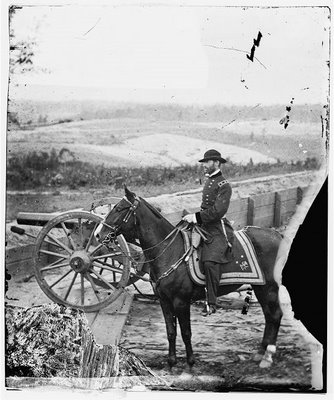
[photo at top left, General Sherman on horseback at Federal Fort No. 7, Atlanta, by George Barnard; top right, General Hood]

Thursday, December 07, 2006

Reenacting and Me


Over at the blog, My Year of Living Rangerously, Manny writes that he has "always been ambivalent about the hobby of reenacting." I know just what he means. I have had mixed feelings about the practice for as long as I've been involved with the larger community of Civil War enthusiasts. With apologies to my reenactor friends, it has always struck me as more than a little bit strange to dress up as 19th century soldiers and engage in mock battle. We've all got our particular pastimes, of course, any of which might make other people scratch their heads. Lots of these activities take up large chunks of our free time and disposable income. According to Dave Barry, "There is a very fine line between "hobby" and "mental illness."

Unlike reenacting, though, most other hobbies don't involve pantomiming horrific scenes of bloody slaughter. We all played war at some point. I recall many times as a child when my brothers, neighborhood friends, and I were called upon to neutralize some particularly stubborn Nazi pillboxes in the backyard, or to mop up the last of the Imperial Army holdouts down the block. We had trouble with the Lakota, too. But there's something fundamentally odd about grown men dressing up to replay the scenes of historic bloodshed, perfecting how they take a hit, mimicking agony, and playing dead.

I did mention that my feelings were "mixed." That is to say, I'm grateful for the opportunity to visualize a Civil War soldierto see a park ranger demonstrate loading and firing, for exampleand I think there's real educational value in so-called "Living History" scenarios as one might see at Colonial Willaimsburg, or Mount Vernon. As Manny said, referring to a grand review, there are moments when reenactors allow us to think, "So that's what it must have looked like." Really, I think he meant that begins to approximate what it must have looked like. But this only goes so far. Often as not, a reenactment may serve most to show you what it didn't look like. The celebrated use of reenactors as extras in Civil War films has failed to prove a boon to cinematic realism. Turner's use of reenactors in the movie Gettysburg was as much a distraction as an asset, projecting America's present-day obesity epidemic back to the summer of 1863. The Romanian extras of Cold Mountain (coached by Pohanka) looked more authentic on the silver screen.

MY FIRST REENACTORS

Admittedly, my first interactions with reenactors colored my views of the hobby in a negative way. I remember the first meeting of the South Bay Civil War Round Table in San Jose, sometime in the late 80s. We had gotten the word out with various flyers, and the inaugural meeting, held in Ted Savas' living room, attracted something like ten people. Half of those were members of the local reenacting association, all impressively decked out in full uniform, portraying members of the 1st Virginia Infantry. Ted gave the talk that evening on, if memory serves, Chancellorsville. After a time, the reenactors were getting antsy, awaiting some mention of how the 1st Virginia contributed to one of Robert E. Lee's most glorious victories. And that was their first question when Ted had finished.

Ted's reply that the 1st was not present for the battle, they being part of Longstreet's command, and Longstreet being detached on his Suffolk expedition, was not received favorably. You'd have thought Ted had pulled a big leather riding glove off one hand and roughly slapped the lead reenactor across the face with it, such was the umbrage taken. The Q&A became a challenge and didn't end till Ted took the ranking living historian upstairs to consult the O.R. Membership in the Round Table took a hard dip in the 2nd month, but recovered nicely, in time.

The point of that long anecdote is that much of my bias toward reenactors initially stemmed from the sense that the time and effort put into learning about uniforms, and maneuvers, didn't leave any time for studying the Civil War (during that same time frame I also met a reenactor who could speak in great detail about CS and US uniform buttonsI think you'd have to say on an expert levelbut who had never heard of Joseph Hooker).

To be fair, part of the problem was that the reenactors I first spent time around were members of fledgling organizations in California. Later, I met a broader spectrum of hobbyists around the country, including many who are more versed on the literature of the war than I will ever be. Brian Pohanka, for example, did lasting scholarship, and more than probably anyone, made people think of reenacting as a noble endeavor.

WHY REENACT?

I would be interested in hearing what it is that motivates people to put the time and money into reenacting. The motivation that makes the most sense to me would be to take the study of the Civil War one step beyond reading and visiting battlefields. But even that, I think, would be a short-lived experiment, not an ongoing hobby.

The principle reason one hears, in my experience, is that reenacting honors the Civil War soldierhis service, his sacrifice. I can see that. But likewise, I can understand those who think it inappropriate. This past Veterans Day brought the widely-published lamentation of a Vietnam vet whose son is now in Iraq. In "Reenacting War," he writes that "I've never dealt well with Veterans Day. Perhaps it's because I knew too many men whose names appear on a black wall in Washington D.C." . . . . I do not believe people should 'play' war. I am upset by children with toy guns or sticksor adults with real guns and mock uniforms who 'pretend.'"

I don't have any right to question others' motivations, but it would be refreshing, for once, to hear someone say they just like to dress up, camp out, and play army.

Helping to educate the public, and children, is another reason given for participating in the hobby, but this rationale is sometimes problematic. The uniform, naturally, and unfortunately, embues the reenactor with an air of authoritysurely someone who goes so far as to dress in the uniform of a Civil War soldier will be an expert on the subject. It's a powerful thing to show kids, and adults, what an authentic uniform looked like, how the accoutrements were worn, and accessed. But they're not all students of the war, and fewer still are in the Pohanka league. I imagine it's fairly common to have "one-book-wonders" standing before classrooms of schoolchildren, pronouncing that slavery had nothing to do with the Civil War, a nugget that may remain with the children through all their days of learning. At the only reenactment I've ever attended, I stood by and listened to a reenactor explain to a spectator that slavery was incidental to the sectional divide, the spectator nodding in wide-eyed wonder at the revelation. An earlier entry in this blog highlighted a reenactor going into classrooms to say pretty much the same thing.

Reenacting is not a new thing. Kevin Levin has an interesting post on reenacting the Crater fight at Petersburg in 1937. But it really hit its stride in the decades since the centennial celebrations (along with Civil War publishing, and the explosion of Civil War Round Tables). I don't feel strongly enough about reenacting to say it's "right" or "wrong," as in the Veteran's Day editorial cited above. I am not a combat veteran, and have no emotional investment. It's just another hobby, except with black powder.

Photo credit: Chicago Daily News negatives collection, DN-0003451. Courtesy of the Chicago Historical Society. Image of a boy standing with rifles and a drum in a room in Chicago, Illinois, as part of Civil War reenactments on the 50th anniversary of the war, with events sponsored by the Chicago Daily News held in Grant Park in Chicago, Illinois.