Thursday, February 28, 2008

Reconciliation


by Walt Whitman

Word over all, beautiful as the sky!

Beautiful that war, and all its deeds of carnage, must in time be utterly lost;
That the hands of the sisters Death and Night, incessantly softly
wash again, and ever again, this soil'd world:
. . . For my enemy is dead—a man divine as myself is dead;
I look where he lies, white-faced and still, in the coffin—I draw near;
I bend down, and touch lightly with my lips the white face in the coffin.

Wednesday, February 27, 2008

Bivouac on a Mountainside


by Walt Whitman

I see before me now a traveling army halting,
Below a fertile valley spread, with barns and the orchards of summer,
Behind, the terraced sides of a mountain, abrupt, in places rising high;
Broken, with rocks, with clinging cedars, with tall shapes dingily seen;
The numerous camp-fires scatter'd near and far, some away up on the mountain;
The shadowy forms of men and horses, looming, large-sized, flickering;
And over all the skythe sky! far, far out of reach, studded, breaking out, the eternal stars.


Thursday, February 21, 2008

WARNING: genealogical ramblings ahead

I saw an article tonight about one of the last three children of a Civil War veteran still collecting VA benefits (more on that below), which prompted a pleasant internet session exploring the place where some of my ancestors first tread on this continent's soil

More than anywhere else (with the possible exception of Salem, NH) Beverly, Massachusetts is the place that held (and may still hold) the greatest concentration of my paternal ancestors in North America. Virtually everyone in this country with the surname Woodbury descends from one of two brothers who first came to Cape Ann in the 1620s looking to make a foothold for the Dorchester Company. The oldest brother, John, was one of the “Old Planters” who settled the first land grant in what would become Beverly.

A couple hundred years after these industrious fellows set down roots in the New World, one descendant, Levi Woodbury (photo at top), became a state governor (NH), a U.S. senator, Secretary of the Navy under Andrew Jackson, Secretary of the Treasury under Jackson and Van Buren, and ultimately a U.S. Supreme Court Justice. According to Wikipedia, “he is one of the few individuals to serve in all three branches of U.S. government and one of two people to have served in all three branches and also served as a U.S. Governor (the other being Salmon P. Chase)." Are you listening, Alex Trabek?

Approximately 360 years after the brothers arrived, my own résumé, by contrast, is significantly lighter than Levi's (to include the delivery of inter-office mail). Some are born to greatness, some have greatness thrust upon them, and the rest of us count it a major victory just to get our kids to school on time.

[As an aside, while I write this, an episode of Star Trek Voyager on Spike TV came on in the background: “The Q and the Gray.” This may be the weirdest Civil War connection I’ve yet seen in a science fiction series. The immortal Q transports Capt. Janeway to a version of the antebellum South, because he wants her to have his baby. Not kidding. See the synopsis here]


I’ve been to Beverly twice, and have a hankering to go back for a long enough sojourn to truly mine the holdings of the local historical society which, like so many New England societies, is a well-organized, long-established repository for some spectacular treasures. In the map above (click to enlarge), John Woodbury’s homestead at the head of the Bass River can be seen just below the word “Balch” in Balch Road. The house of his neighbor, John Balch himself, is the crown jewel of the Beverly Historical Society—well worth a visit. Have a look at it here.

My Beverly digression was prompted by this article (excerpt at the bottom of this post) by the Director of the BHS, writing on possibly the oldest “leap-year day” baby in America, one of the last children of a CW vet receiving benefits, and one of the last living children of a person born into slavery. It's an amazing thing to contemplate.

Her Beverly connection prompted me to spend time at the BHS’s website, eventually leading to the roster of the local GAR, which includes something like nine men with my surname. Can’t wait to send off for their NARA military and pension files. Even though the familial connections are a bit removed, there’s usually something interesting, and unexpected, contained in the records.


Beverly native celebrates a very special birthday
By Stephen P. Hall
Wed Feb 20, 2008

One other amazing discovery occurred as I searched back further into her family tree. I discovered that her father George lied about his age and joined the 54th Massachusetts Volunteer Infantry when he was about 15 years old in July of 1864, and later transferred to the 55th Regiment, and served during the last two years of the American Civil War. The enlistment papers indicate his stature at slight, at 5 foot, 5 inches tall. So add “surviving daughter of a Civil War soldier” to Florence’s list of amazing statistics and you can see we have a very special former Beverly resident celebrating her birthday later this month. I checked on the Internet and according to Veteran’s affairs there are only three children of Civil War veterans collecting VA benefits.

Thursday, February 14, 2008

Edwin C. "3 Rugs" Bearss, High Private 17th Virginia "Wildcat" Cavalry


To prevent the good folks at Civil War Interactive from reporting that I went a week without updating my blog, here are a few random photos from past Civil War Forum battlefield conferences. This first image, above, was from the 2007 gathering at Appomattox, and is an exclusiveI'm confident that I have scooped all other Civil War blogs with this unpublished image of one of Ed Bearss's lesser-known Civil War ancestors. Ed was one of our three guides that day, and at the close of the tour, Appomattox NHP historian Patrick Schroeder surprised us by arranging for this rare photo (and one of historian Ron Wilson's ancestor as well) to be mounted in the exhibit area. It probably was not intended to be committed to the interneteffectively until the end of timebut maybe this exceptional image will lead to the discovery of other fighting rug portraits.


Below, the aforementioned Appomattox historians Ron Wilson, left, and Patrick Schroeder.


Here was fought the Battle of Sutherland's Station, April 2, 1865.
In the photo, Ed Bearss and his backup singers.


Jumping now from Virginia to Tennessee, the grave of Sam Watkins, Company Aytch, Zion Presbyterian Church Cemetery.


The one and only Jim Ogden, historian at Chickamauga & Chattanooga National Military Park, in this instance photographed at Stones River. Non-regulation tie.


My kitchen counter. Did someone say pitchers and catchers will be reporting soon?


Tuesday, February 05, 2008

Answers to the Google Earth Quiz (No. One)

If for one reason or another you're reading this blog entry without having seen the previous one (January 30), you might want to scroll down to that earlier entry first, and have a look at the mystery photos there.

Thanks to everyone who gave it a shot (more in the Civil War Forum, than in the blog). I may need to fine tune future entries—it's obviously very disorienting to see things from this perspective, and difficult to identify out of context, even to people who spend inordinate amounts of time studying maps. Future quizzes may include more distinctive geographic features from the satellite perspective.


In order, the January 30 images depict:


No. 1: Franklin, Tennessee. Pushpin on the left points to the Visitor Center/Museum at the Carter House; pushpin No. 2 (the red roof) points to the Carter House. Scroll down to the bottom of this page to see a map showing the location of the Carter House at the heart of Hood's massive assault.


No. 2: Vicksburg, Mississippi. The visible earthworks in the crook of the road intersection at left are what remains of the Stockade Redan where, during the May 19, 1864 assault, the colors of the 1st Battalion, 13th USI reached the ditch fronting the Confederate defenses, earning that unit the motto, "First at Vicksburg."


No. 3: Lookout Mountain—the northern point, around which the "Battle Above the Clouds" was fought. That water is Moccasin Bend in the Tennessee River, just downstream from downtown Chattanooga.

No. 4: Gettysburg, scenes of the first day's fighting. The white diagonal road is, of course, the Chambersburg Pike. The diagonal line above the Pike is the railroad cut. The road coming out of the bottom of the photo, a little left of center, is Reynolds Avenue along McPherson Ridge. It is more or less the same area seen in this map.


No. 5: Yellow Tavern. The monument barely seen in the trees just below the pushpin is the J.E.B. Stuart monument. From the NPS driving tour: "Confederate artillery near this location goaded Custer into a second attack at 4 p.m. The Federal charge broke through Lomax's line (behind you, as you face the monument), but was turned back by Company K of the First Virginia Cavalry. The action drew J.E.B. Stuart into the fighting, where he received his fatal wound. The monument marks the approximate spot where Stuart was shot. It is now under the care and protection of the United Daughters of the Confederacy."

No. 6: Spotsylvania: the Mule Shoe. Check the map below to see where the angle was (just to the right of the road intersection near the center of the photo). The faint trail across the field in the left center marks Emory Upton's approach. As I followed that trail through the woods, I thought of my mother's great-grandfather, in the 5th Wisconsin, who was shot in the knee during Upton's May 10th assault.


No. 7: Okay -- that was a hard one. Kennesaw Mountain.

No. 8: Pea Ridge. The structure in the clearing a little right of center is the reconstructed Elkhorn Tavern. Look at those woods. You can't begin to imagine how many ticks are out there.


No. 9: Manassas. What else? The Henry House on Henry Hill. Below: Bull Run, Va. Ruins of Mrs. Judith Henry's house, by George Barnard.

Wednesday, January 30, 2008

Google Earth Quiz Number One

Test your Aerial Reconnaissance Skills
Amaze your friends


If you're like me, when there are dishes to be done, or garbage cans waiting to be emptied, it means only one thing: time to sit down at the computer for a nice long session of Google Earth.
This evening I put together a little geography quiz for faithful readers. Can you identify the location or significance of the following Civl War scenes? Name the battle? Identify a few landmarks? Judge the season and time of day based on tree shadows? Click on the images to get a larger view.

A number of them are fairly easy, I think, due to road configurations (and in fact, I forgot to turn off the road names on at least one photo) or distinct features. On a couple photos, I placed push-pins to set-off the the tell-tale extant Civil War clues (a building, or monument) amidst a sea of residential and commercial development. All of the images were the scenes of bloody battles, or at least well-known peripheral fights associated with major campaigns (nothing too obscure).

Four of them are from the Western Theater, four are from the East. One is in the Trans-Mississippi.


In all of the photos, there is some famous battlefield feature in the center of the image, or nearly the center, though you may find something along the edges to help solidify your hunch—the more features you identify, the more impressive your answer will be.
Post your answers as comments to this blog entry, and in a day or two I'll identify each image, and post some maps and other photos to show how the fighting transpired, or how the troops were aligned in these landscapes. I'll also heap plaudits upon the winner, if there is one.

Don't cheat by looking up the coordinates before posting your guesses or answers (use them to check your work, if you're dying to know). I did not notice they were listed until after the fact, and it's way too much trouble to go back and edit those out, then upload again. As the quiz evolves from this trial run, I'll edit out those clues. If you do not have a broadband connection to view this page, please accept my apologies, and also my invitation to join the rest of us in the 21st century.

No. 1


No. 2


No. 3


No. 4


No. 5


No. 6


No. 7


No. 8


No. 9


As if there weren't already a severe shortage of hours in the day

to read all the things that pique one's interest, the editors of The Atlantic.com have opened the flood gates on a treasure trove of reading material from the magazine's archives. This is very exciting, and will cause me no end of trouble (thanks to friend Luke for tipping me off).

From the Editor's Note on January 22: "Beginning today, TheAtlantic.com is dropping its subscriber registration requirement and making the site free to all visitors. Now, in addition to such offerings as blogs, author dispatches, slideshows, interviews, and videos, readers can also browse issues going back to 1995, along with hundreds of articles dating as far back as 1857, the year The Atlantic was founded.


I love all the book reviews, and more access to the annual fiction issue. Check out the 2007 fiction issue here.
Civil War buffs, of course, can mine the archives for snippets going back to the war itself. Look at this "flashback" from February of 1862. And here's a page that contains links to several poems published during or soon after the Civil War years by such authors as Emerson, Whittier, and Longfellow.

I found this provocative essay/review by Christopher Hitchens on John Brown, "The Man Who Ended Slavery." "It was not at all the tear-jerking sentiment of Uncle Tom's Cabin that catalyzed the War Between the States. It was, rather, the blood-spilling intransigence of John Brown, field-tested on the pitiless Kansas prairies and later deployed at Harpers Ferry. And John Brown was a man whom Lincoln assiduously disowned, until the time came when he himself was compelled to adopt the policy of 'war to the knife, and the knife to the hilt,' as partisans of the slaveocracy had hitherto been too proud of saying."


Here is a fascinating piece on "Our Liberian Legacy," a subject that always gives me pause: "This is only the latest development in what has been a troubled and bloody history, and one in which the United States has been inextricably involved. Though Liberia was never a colony in the European sense of the word, it was settled by freed American slaves at the instigation of American slaveholders, and there has long been significant debate about what level of U.S. involvement in Liberian affairs is appropriate. What, indeed, is the United States' legacy in Liberia? And what, if anything, do Americans now owe Liberians? These questions are not new. Atlantic contributors have struggled with America's obligation to Liberia for three quarters of a century."


Did you know about the Colfax Riot, a "forgotten Reconstruction tragedy, in a forgotten corner of Louisiana"? I didn't. Check out this intriguing historically-oriented travel piece by Richard Rubin, who unexpectedly came across this marker:


COLFAX RIOT

On this site occurred the Colfax Riot in which
three white men and 150 negroes were slain.
This event on April 13, 1873 marked the end of
carpetbag misrule in the South.


Erected by the Louisiana Department of Commerce and Industry 1950

The author writes, "now, I'd studied the Civil War and Reconstruction quite extensively, and I'd never even heard of the Colfax Riot. Neither had the half dozen history professors and the dozen Louisianans from New Orleans, Baton Rouge, and Alexandria I'd asked about it since I'd first read that marker."

There's a lot to read. Better get cracking.

Wednesday, January 23, 2008

This and That

I’m guessing 17 days was long enough for regular visitors to grok my last entry, the cartoon I posted in the first week of this month? I’m back in the saddle now, and bursting at the seams with fresh, 2008ish content for the blog. Thanks for your patience.

The year is off to a fine and proper start. Last Thursday my 13-year-old son and I took the train to San Francisco for the annual pilgrimage to MacWorld Expo. I was pleased to discover a souped up Notepad utility that may help mitigate a little problem I have with making lists—to-do lists, book lists, bills to pay, letters to write. I make lots of lists, until I end of with thick wads of them in various pockets, and digital ones scattered across multiple computers. I know I could just consolidate my lists in any old word processor, but I will buy a specific software application for every little quirk and habit if it promises a new, transcendent level of organization. And if it’s OSX native.

After a day with the Cult of Mac acolytes, we hiked over near Portsmouth Square for some lumberjack-sized medium rare cuts at Alfred’s Steakhouse. Nothing tops off a day of uber geekdom like a tender filet mignon and a martini. Sure, we revel in our elegant technology, and the trappings of civilization, but we will jettison it all at sundown to eat a juicy cow, if it's cooked right.

The Civil War connection? I thought you’d never ask.
Hampton's Beefsteak Raid? You might think so. No, I was recalling that this is the part of San Francisco that William T. Sherman describes so colorfully in his Memoirs—the area around Portsmouth Square (what he calls the Plaza), which is today several blocks inland from the Bay, on the edge of Chinatown. Sherman wrote:

At that time (July, 1847), what is now called San Francisco was called Yerba Buena. A naval officer, Lieutenant Washington A. Bartlett, its first alcalde, had caused it to be surveyed and laid out into blocks and lots, which were being sold at sixteen dollars a lot of fifty varas square; the understanding being that no single person could purchase of the alcalde more than one in-lot of fifty varas, and one out-lot of a hundred varas. Folsom, however, had got his clerks, orderlies, etc., to buy lots, and they, for a small consideration, conveyed them to him, so that he was nominally the owner of a good many lots. Lieutenant Halleck had bought one of each kind, and so had Warner. Many naval officers had also invested, and Captain Folsom advised me to buy some, but I felt actually insulted that he should think me such a fool as to pay money for property in such a horrid place as Yerba Buena, especially ridiculing his quarter of the city, then called Happy Valley. At that day Montgomery Street was, as now, the business street, extending from Jackson to Sacramento, the water of the bay leaving barely room for a few houses on its east side, and the public warehouses were on a sandy beach about where the Bank of California now stands, viz., near the intersection of Sansome and California, Streets. Along Montgomery Street were the stores of Howard & Mellus, Frank Ward, Sherman & Ruckel, Ross & Co., and it may be one or two others. Around the Plaza were a few houses, among them the City Hotel and the Custom-House, single-story adobes with tiled roofs, and they were by far the most substantial and best houses in the place. The population was estimated at about four hundred, of whom Kanakas (natives of the Sandwich Islands) formed the bulk.
As Homer Simpson would say, "Mmmm, sandwich islands." One wonders what culinary specialties these majority Hawaiians had established by the time of Sherman's visit. Note that Sherman’s scoffing refusal to invest in San Francisco real estate came one year before the discovery of gold on the American River. "Old Brains" Halleck got in on the action—I wonder if there's a record of when he sold his piece. Sherman's caution was fully justified, no doubt. Still, it's fair to say he had a higher aptitude for real estate seizure and destruction than for real estate speculation (whatever you think of his tactical shortcomings).


Speaking of Seizure and Destruction, I couldn’t be more excited by the upcoming (12th) Civil War Forum Battlefield Conference, March 27-30, as we tackle Sherman’s Campaign for Atlanta (4-day abbreviated version). There are approximately 8-10 seats left on the bus, open to anyone interested. When those are full we’ll cut off registration, because anything more than a busload of 50 people gets unwieldy. The program is coming together nicely, and I’ll announce our headquarters hotel this week (in Marietta). If interested, send me an email at civilwarforum@mac.com, or post a message here and I’ll give you registration information. Or you can go to the Civil War Forum start page and click on the photo of Sherman on his horse for more details.

The Campaign for Atlanta (last best chance to reserve your seat):
We’ll take in Resaca to Kennesaw on the first day (concentrating most on Pickett’s Mill and Kennesaw), and take in some Peachtree Creek and Battle for Atlanta sites on the second full day of tours. We’ll also get a private presentation by Gordon Jones at the Atlanta History Center of the most important and impressive Civil War collections outside of the Museum of the Confederacy. Additionally, we’ll work in sidetrips to some of Francis Shoup’s few remaining Shoupades on Johnston’s Chattahoochee River Line, and visits to “The General” at Big Shanty, and the Atlanta Cyclorama.


I have enlisted three after dinner speakers (Thurs., Fri., Sat.): Dr. Steven Woodworth of TCU, Dr. John Fowler of Kennesaw State, and Atlanta historian Steve Davis. All of that—3 dinner talks, 2 full days of touring (lunch included), and two half-days of touring runs $250 a person. It’s cheap because we aim to get as close to break-even as possible, with anything left over donated to The Civil War Trust, or a local group. Every year about 2/3rds of the attendees are people who have attended all or several of the 12 meetings, and the rest are first-timers and veterans of the last few outings. We come from all over the country, and some from other countries (Canada and the U.K. regularly represented). Besides this notice, I’ll make an announcement in some other online venues until the bus fills up. Alert and faithful readers of this blog will have the first shot at those 8 seats.


Speaking of letters to the editor (see comic in last blog entry), this presidential election cycle—specifically the Republican South Carolina Primary—has seen another flurry of interest in the Confederate battleflag. Mr. Huckabee’s recent comments prompted an incisive essay by favorite intellectual atheist cocktail enthusiast Christopher Hitchens, who takes Huckabee and Ron Paul to task for Civil War related comments. For example,
And not merely racist incitement. So slack is our grasp of history and principle that we seem unable to think of the Confederacy as other than "offensive" to blacks. But there are two Republican candidates in this election—the absurd and sinister Ron Paul being the other—who choose this crucial moment in our time to exalt those who attempted to destroy the Union by force, and those who solicited the help of foreign powers in order to do so, and whose treason led to the violent deaths of hundreds of thousands of Americans. Should their patriotism be questioned? I would say most definitely yes, and questioned repeatedly, at that, perhaps especially if they are seeking the nomination of the party of Lincoln.
Hitchens’s Slate.com essay, in turn, generated the kind of responses that are usually restricted to Civil War discussion groups and publications. As one would expect, these discussions quickly devolved into angry flame wars. Check out Moira Redmond’s “Fraywatch,” a column that monitors the goings-on in various Slate.com discussion areas.

For example:

There were two key, tightly-connected, questions: is that flag racist? Readers went for it here. And, was the Civil War was actually about slavery or not? Battle lines drawn here. Nobody seemed to change anyone else's mind, and it wasn't all that civil. Richmond says "We're beyond the point of asking 'What would Gen. Lee do?' partly because we know the answer ('Surrender and tell the troops to go home.') and partly because he's dead."

Sunday, January 06, 2008

The Truth About Black Confederates


(click on image for larger view)

Thursday, January 03, 2008

North and South

Most of my life, when people ask me where I’m from, I have always said Iowa, because that’s where I spent my formative years, sixth grade through high school graduation, and because it is the state where my parents grew up. At this point, usually, the inquisitive person will say something about potatoes, to which all Iowans reflexively (and politely) say, no, I think that's Idaho.

If someone were to ask “where” in Iowa, I would say a small town in Western Iowa, over toward Omaha. If they persisted, or if it was clear they knew the geography, I would tell them I come from Denison. They painted “It’s a Wonderful Life” on the water tower sometime after I left town. Not because I left town, but to honor a favorite daughter. I still feel a strong connection to the state, though after nearly 25 years in the Wild West (the west coast of Iowa), nearly all of the rest of the country feels foreign to me.

My family occupied a number of abodes in the center of the country. My oldest siblings, my two sisters, were born in Iowa, then my father took a job with Arthur Anderson in Texas, where all three of my brothers and I were born, one in Corpus Christi and the rest of us in Houston. In the early 60's we moved (children of an itinerant CPA) to New Orleans, Joplin, Missouri, and Schuyler, Nebraska before alighting in the Hawkeye State, where I feel fortunate to have received a quality public education.

I didn’t start kindergarten and grade school till we were in Missouri, then had some more grade school in Nebraska, and I honestly cannot remember studying the Civil War at any level of school prior to college. I’m sure we must have read about it (it's not as if I can remember studying other things either). There must have been something about freeing the slaves. On my own, however, I recall at some point in high school reading my first Bruce Catton book. That was inspired by a trip to Gettysburg during junior high (the sort of visit so many people point to as the starting point of a life-long interest). We toured Gettysburg on our first family trip to the East Coast where my sister -- who lived near Hagerstown and was stationed at Fort Ritchie – was getting married. Now all these years later my oldest son, an 8th-grader, is preparing for a class trip to Washington, which will include a sidetrip to Gettysburg.

When I started this little blog entry – fast becoming a sentimental autobiography – I meant only to highlight the fact that I “belong” to two places in the middle of the country: Iowa, where I have roots, and where I spent seven important years, and Arkansas, where my parents moved soon after I left for college in Indiana. They lived in a lovely spot in the north-central part of the state, on Greers Ferry Lake, and are buried there. Two of my brothers live in the area, and one of my sisters is not far off in Memphis. All of that means that every time I've gone “home” since the late 70s, it was to The Natural State.

I am from the North and the South, but view them both as an outsider would, blowing in from the west. I am sort of ashamed to say that, in my seven years in Denison, I never noticed (or can't remember noticing) the Civil War monument on the courthouse lawn [I stole this picture from my friend Mark Knowles’ web site – I’ll try to remember to ask for permission later]. Must have driven by it a thousand times.


That gives you a good idea of the extent of my, and my friends’ Civil War consciousness in small town Iowa of the 1970s.

I've no idea what they teach about the Civil War in the schools of Arkansas, but I do know what they sell at the local five & dime-type market. As I mentioned in some posts last summer, I spent a week down there in July. Who knows what kinds of non-Donna Reed souvenirs they sell in the shops of Denison these days, but such is the enduring legacy of the Civil War in parts of the South that even in tiny Greers Ferry, population 930 as of the last census, you can find, along with extra batteries, sun screen, and flotation devices, a collectible ceramic depiction of the surrender ceremony at Appomattox Court House (signing what appears to be a surrender novel), and battleflag shower curtains (below).


It's been said before, here and elsewhere, that a lot of this overt sectional "nationalism" seems to be a fairly recent phenomenon, perhaps in reaction to the anti-flag publicity of recent decades. I never saw so many battleflags in the 80s or 90s as I did on this last trip. On the other hand, I never saw an Appomattox souvenir down there either, with its message of peace and reconciliation. That last one must be for the tourists and the transplants, as the Ozarks slowly become the retirement capital of the upper Midwest.

More on my Arkansas trip, and my newly kindled interest in Jo Shelby, in the next blog entry.


Thursday, December 27, 2007

When Luck Runs Out. . .

Some survived the war, but not the peace. Emerson Opdycke, at left, overcame a grievous wound at Shilohand was in the thick of things throughout the warbut mortally wounded himself many years later in an unfortunate accident.

There’s no way to know how many rank and file Civil War veterans managed to survive combat and exposure to disease in the Civil War years, only to have their lives cut short in post-war years by something other than natural causes. Or how many succumbed to wounds or war-related ailments many years after the fact. The numbers would be staggering, no doubt.


Not surprisingly, information on the demise of high-ranking officers and other officials is, by and large, easier to come by. I compiled the following lists from John and David Eicher’s, Civil War High Commands (Stanford University Press, 2001). Just by chance, while looking up one individual or another, I came across two or three in short succession who had been murdered after the war, and a couple who drowned. Turns out it was not as common as it was beginning to seem, but it piqued my curiosity enough to do an electronic search of an early Eicher manuscript (my curiosity would not have been piqued enough to flip through 1,000 pages of the published book).


I restricted my search to those members of the “high command” who were murdered, who drowned, or who suffered some other fatal accident. I excluded murders, drownings, and accidents that occurred between April of 1861 and April of 1865, since war certainly made all of those things somewhat more likely. I'm sure I missed a few entries in the Eicher book in which the search terms were not present (though the authors are consistent with the phrasing, for the most part).

Missing from my lists, among others, are such notables as Clement Vallandigham and Allan Pinkerton, who did not fit the Eichers’ criteria for “high command,” but who made the cut on at least one website’s list of the “30 Strangest Deaths in HistoryVallandigham: “Death by Jury Demonstration,” and Pinkerton: “Death from Biting One’s Tongue” (scroll down at the link to find more details).


Some of the deaths listed below are better known, like the mysterious drowning of Thomas Meagher, the subject of many narrative footnotes. Others came as a surprise to me, such as the drowning of George Wright, whose name came up here in discussions about Alcatraz, and McDowell. Didn't realize he died so soon after the war.


Without further adieu, here is my unofficial survey of high commanders who were victims of murder, drowning, or other unhappy accidents.


Murdered:


William Wirt Adams, CS: murdered by John Martin, a newspaper editor, in a quarrel on a street in Jackson, Miss., 1 May 1888; int. Greenwood Cemetery, Jackson.


Joseph Bailey, US: murdered while acting as a sheriff in Nevada, Mo., 21 Mar. 1867; int. Evergreen Cemetery, Fort Scott, Kans.


William Felix Brantley, CS: murdered by a shotgun blast at Winona, Miss., 2 Nov. 1870; int. Old Greensboro Cemetery near Tomnolen, Miss.


James Holt Clanton, CS: murdered by political rival David M. Nelson, who shot Clanton 15 or more times with a double-barreled shotgun, at Knoxville, Tenn., 27 Sept. 1871; int. Oakhill Cemetery, Montgomery, Ala.


Archibald S. Dobbins, CS: believed to have been murdered near Itaituba, Brazil, 1869.


Hiram Duryea, US: murdered by a deranged son, Brooklyn, N.Y., 5 May 1914; int. Woodlawn Cemetery, New York, N.Y.


Bryan Grimes, CS: murdered by William Parker, a hired assassin, Pitt County, N.C., 14 Aug. 1880; int. “Grimesland,” Pitt County; cenotaph in Trinity Churchyard, Pitt City, N.C.


Thomas Carmichael Hindman, Jr., CS: murdered by an assassin or assassins in the face, neck, chest, and hands, supposedly by members of the radical “Loyal League,” at Helena, Ark., 28 Sept. 1868; int. Maple Hill Cemetery, Helena.


William Scott Ketchum, US: died Baltimore, Md., 28 June 1871; int. Rock Creek Cemetery, Washington, D.C. (Ketchum was probably murdered by his landlady, Elizabeth G. Wharton, who presumably gave him poisoned lemonade; she was indicted but acquitted on 24 June 1872 in a disputed trial.)


St. John Richardson Liddell, CS: murdered on the Black River steamboat SS St. Mary by Charles Jones (ex-Lt. Col. 17 La. Inf.), in an action with its roots in the 1852 duels, 14 Feb. 1870; int. Liddell Cemetery, near Jonesville, Catahoula Parish, La.


Edwin Stanton McCook, US: murdered while making a speech at Yankton, Dak. Terr., 12 Sept. 1873; int. Spring Grove Cemetery, Cincinnati, Ohio.


Theodore A. Ripley, US: probably murdered in Emanuel County, Ga., 23 July 1866; int. Evergreen Cemetery, Winchester, Vt.


William Feimster Tucker, CS: murdered at Okolona, Miss., 14 Sept. 1881; int. Odd Fellows Cemetery, Okolona.

Drowned:

Orville Elias Babcock, US: drowned in Mosquito Inlet, Fla., 2 June 1884; int. Arlington National Cemetery, Va.

Charles Gratiot Bartlett, US: died New York, N.Y. by drowning in Staten Island ferry boat collision on 14 June 1901; int. West Point National Cemetery, N.Y.


Henry Haywood Bell, USN: drowned at Osaka, Japan, 11 Jan. 1868; int. Hiogo, Japan.


Samuel Thompson Busey, US: drowned while fishing at Mantrap Lake, Minn., 12 Aug. 1909; int. Woodlawn Cemetery, Urbana, Ill.


Henry Boynton Clitz, US: disappeared and supposed to have drowned at Niagara Falls, N.Y., 30 Oct. 1888; cenotaph in Elmwood Cemetery, Detroit, Mich.


Thomas Francis Meagher, US: died 1 July 1867, during a drinking party aboard the SS Thompson near Fort Benton, Mont. Terr., when he fell into the Missouri River and drowned “under mysterious circumstances;” his body was never recovered.


Samuel Ross, US: died by drowning, Jefferson Valley, N.Y., 11 July 1880; int. Lancaster Cemetery, Lancaster, Pa.


William Terry, CS: drowned in Reed Creek (near Wytheville), Va., 5 Sept. 1888; int. City Cemetery, Wytheville, Va.


Alfred Thomas Archimedes Torbert, US: drowned off Cape Canaveral, Fla. in the sinking of the SS Vera Cruz, 29 Aug. 1880 (his body was recovered 31 Aug. 1880); int. Methodist Episcopal Cemetery, Milford, Del.


James Henry Van Alen, US: missing and presumed drowned when he fell overboard from the SS Umbria, Atlantic Ocean, 22 July 1886.


George Wright, US: drowned off Crescent City, Calif. in the wreck of the SS Brother Jonathan, 30 July 1865 (his body was recovered at Bay Flat, Calif., in Oct. 1865); int. City Cemetery, Sacramento, Calif.


Accidental death, other than by drowning:


Alonzo Granville Draper, US: died from an accidental gunshot wound, Brazos de Santiago, Tex., 3 Sept. 1865; int. Pine Grove Cemetery, Lynn, Mass.


Thomas W. Grosvenor, US: killed by accident by a sentry during the great fire, Chicago, Ill., 21 Oct. 1871; int. Oak Woods Cemetery, Chicago, Ill.


Heber Le Favour, US: killed in carriage accident, Pawtucket, R.I., 25 Feb. or 25 July 1878; int. Swan Point Cemetery, Providence, R.I.


Samuel Emerson Opdycke [photo at top], US: mortally wounded when he accidentally shot himself in the abdomen, 22 Apr. 1884, and died New York, N.Y., 25 Apr. 1884; int. Oakwood Cemetery, Warren, Ohio.


Francis Engle Patterson, US: died when he was accidentally shot or committed suicide at Fairfax Court House or near Occoquan, Va., 22 Nov. 1862; int. Laurel Hill Cemetery, Philadelphia, Pa.


Israel Canton Smith, US: killed accidentally while hunting near Grand Rapids, Mich., 27 Nov. 1899; int. Oak Ridge Cemetery, Grand Rapids.


Frederick Steele, US: died from an injury in a buggy accident, San Mateo, Calif., 12 Jan. 1868; int. Woodlawn Memorial Park, Colma, Calif.


William Warren Stewart, US Commission Agent: killed in a railroad accident, Chicago, Ill., 6 Dec. 1893; int. Marengo Cemetery, Marengo, Ill.

Tuesday, December 18, 2007

Restless Conqueror, part one

There’s something about Civil War veterans who go on to make their mark as explorers that really piques my interest. Two that have been the subject of modern biographies are worthy of mention here. I’m readying a more detailed post on John Wesley Powell, about whom much has been written, he who lost an arm at Shiloh, and who went on to navigate the Colorado River.

And now comes a brand new biography of Henry Morton Stanley, The Restless Conqueror. (photo at top). Holy Johosaphat, what a fascinating story. The Welshman had a rough childhood. Fleeing that, as a young adult he found himself in the South at the beginning of the Civil War. Quoting David Gilmour’s review in a recent NewYork Review of Books:


In 1861, when he was living in Arkansas, Stanley felt obliged to enlist in the Confederate Army because someone had sent him a petticoat, implying he was a coward. Captured the following year at the Battle of Shiloh, he was taken to Chicago to a federal prison camp and subsequently released on condition that he join the Union Army. But while stationed with the artillery in West Virginia, he was prostrated by dysentery and left in the local hospital when his regiment moved on. Although he later claimed he had been discharged, he had actually been told to rejoin his unit when his health improved. His refusal to do so thus turned him into a deserter.


Before the war was over, Stanley returned to America and enlisted in the U. S. Navy, then deserted one more time. His post-war career as a journalist on the Plains was more remarkable yet. Quoting again from Gilmour:


On his return to America in 1867, Henry Stanley finally discovered what he was good at: describing battles and other adventures in the newspapers. During a year in which he reported for the Missouri Democrat on expeditions against the Cheyenne and on negotiations between the Plains Indians and the government, Stanley got to know Wild Bill Hickok, Colonel George A. Custer, and General William Tecumseh Sherman, who later told him that his journey to Livingstone was a greater feat than his own "March to the Sea." His success as a journalist convinced James Gordon Bennett Jr., the proprietor of the New York Herald, to hire him to cover a British expedition to Abyssinia, to write about the 1868 revolution in Spain, and, more famously, to "FIND LIVINGSTONE," an injunction that, as Jeal points out, was much dramatized in Stanley's account of the negotiations.


And all this before the events that made him “famous.” I have to quote one more passage of Gilmour’s review, as it strikes a chord all students of history respond to, even if they don’t want to hear it:


Adult readers of history have to unlearn many of the things they remember from their schooldays. This is especially true of quotations of famous people because before the invention of tape recording virtually anything they said from the Old Testament onward was almost certain to be misquoted unless they wrote it down themselves.

The correction of misquotations is often a relief. It is good to learn that the Duke of Wellington could not have made the foolish remark that "the battle of Waterloo was won on the playing fields of Eton": apart from the absence of evidence, the school's fields were not used for organized sports when he was a schoolboy in the 1780s, and in any case he never played on them. But sometimes it is sad to find that well-remembered sayings—pithy, pungent, and redolent of the speaker—were never uttered, that Oliver Cromwell did not dismiss the Rump Parliament with the words "Take away these baubles," that he never told the painter Peter Lely to depict him "warts and all." These are the historical equivalents to learning that Sherlock Holmes never said "Elementary, my dear Watson," or that Humphrey Bogart in Casablanca does not say "Play it again, Sam."

Now comes an even greater shock. In his impressive, revealing, and well-written biography of the explorer Henry Morton Stanley, Tim Jeal argues that the most famous greeting in history was never delivered. As a child I saw an engraving of the meeting between Stanley and David Livingstone above the caption "Dr Livingstone, I presume." I loved both the greeting and the picture of the two strangers, surrounded by Arabs and Africans, solemnly doffing their hats on the shore of Lake Tanganyika. More impressed than I am now by the virtues of being laconic, hlegmatic, and English, I admired the formality and sangfroid of men who, after long and hazardous journeys, had finally met in "darkest" Africa. The later discovery that Stanley was a Welshman pretending to be an American, and that he had prepared a greeting in the style of an English gentleman, added pathos as well as absurdity. So did the knowledge that the greeting swiftly became a joke in London's music halls.

Yet according to Jeal, nothing memorable was actually said, and Stanley invented the words afterward when he wanted to infuse the occasion with a striking phrase. Thus he was forced to cut out the pages in his diary that described the encounter. But he could not censor Livingstone's letters, which record the meeting in detail to various correspondents, and do not mention any such greeting. One of the many ironies of Stanley's life is that he is remembered more for a remark he did not make than for his career as the greatest explorer of the nineteenth century.

Monday, December 03, 2007

Attorney at Law, Bigfoot Wrestler


I stumbled upon a "huge depository of Unusual Links about Abraham Lincoln" here at the always engaging Grow-a-brain blog (there's a nice list on Nixon as well). It's a grab bag sure to cause you to lose more precious timesome of it is obscure and riveting, like the photo of Abraham Lincoln's business card above. Click on the image to read the small print, which makes mention of Abe's difficulty in "crossing the stream." The Library of Congress source link says this was "probably printed by the Democratic Committee in 1864."

Much of it is irreverent, like the once heavily circulated Gettysburg Address Powerpoint Presentation. For those of us who spend much time in company conference rooms, this Powerpoint parody still retains its power.
Or this attractive T-Shirt: Bigfoot versus Abe Lincoln. For this and other unique apparel, visit the fine folks at Glarkware. I love the sales copy. We're accustomed to researching historic figures and discovering all their flaws. "But wouldn't it be great if scholars peered into the lives of your most beloved historic figures and discovered that they were even cooler than you thought?" Like the time Abe came to blows with a Sasquatch.

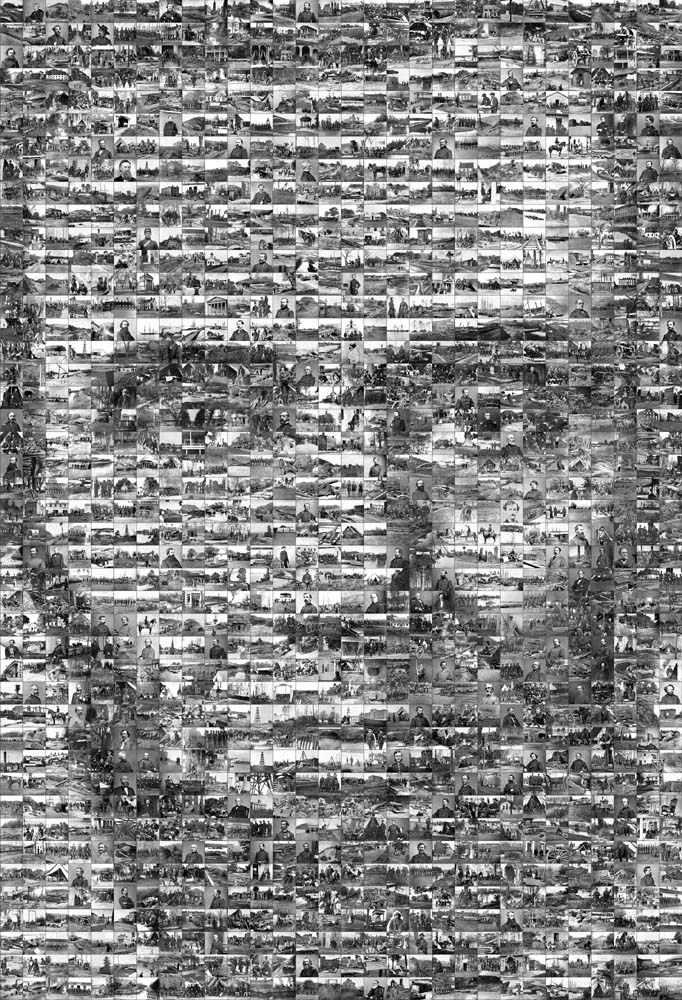
Below is a Lincoln photomosaic using contact prints or just very small Civil War photographs. I bought a copy of this in the gift shop at the Library of Congress many years agoI imagine they still sell it. It's a pretty remarkable effect. Click on it for a larger view—you may be surprised at how many of these miniature images are instantly familiar.


Tuesday, November 27, 2007

Odds and Sods

A number of the Civil War blogs listed in the lower right column covered the interesting discovery of what appear to be glimpses of Abraham Lincoln amidst the crowd in some 1863 Gettysburg photos. Here's one newspaper report of the story (USA Today) with close-ups of the new views, along with the more familiar head shot sifted out of the crowd in 1952.

WHAT THE ?!


Another Lincoln photo caught my eye around the same time while browsing the blogosphere (it wasn't a current news item, and is nothing new to people who study such things). Doctored photos have been around as long as photography has been around, and certainly the Civil War era was fair game for pre-Photoshop photographers looking to spice up or repair a shot.

Apart from staged photos (see William Frassanito's expositions on the movement of corpses at Devil's Den, for example), there is the case of Lincoln's head on Calhoun's body (see here), and some housekeeping with group photos (see here for the complete before and after shots of Sherman's generals, with and without Francis Blair).
To see a parade of digital manipulations from the Civil War era to more modern shenanigans, have a look at this photo essay, "Digital Tampering in the Media, Politics and Law," which includes brief explanations of the two snippets above (click on the images there to see side-by-side comparisons).

All of those pages are from the website of Hany Farid, Professor of Computer Science at Dartmouth, who has an big time interest in digital forensics.


WALKING TOURS

Another neat idea, this one made available free from the folks at Civil War Traveler magazine: podcasts of walking tours, recorded on the battlefield, narrated by National Park Service historianswith accompanying pdf maps you can print out. Ahhh, sweet, sweet technology.

ATLANTA, THE MUSICAL

First, there was the world premiere of the opera Appomattox in San Francisco (see my review here). Now, as if to poke a finger in the other eye of conservative, California-phobic Civil War buffs, the musical "Atlanta" is opening in Los Angeles.

Playbill offers these particulars: "Grammy Award-winning Nashville songwriter Hummonwho has penned hits for Dixie Chicks, Rascal Flatts, Wynonna, Tim McGraw and moreteams with actor, writer and director Pasdar ('Heroes,' 'Desperate Housewives') on the musical, which mixes select prose by William Shakespeare with original bluegrass music and country tunes. Hummon provides the music and co-wrote the book with Pasdar. Set 'toward the end of the Civil War, in the waning days of the Confederacy,' reads a show description, 'a young Yankee, Paul, assumes the persona of a Confederate soldier in order to keep alive behind enemy lines.'"

Shakespeare. Desperate Housewives. Bluegrass. Sounds pretty damn good to me. In all seriousness, the centrality of American roots music to this production, and the subject matter, cause me to reconsider my (opera review) vow that the only current musical I would consider attending is Spamalot. I'm not expecting something so transcendent as Jack White singing "Wayfaring Stranger" on the Cold Mountain soundtrack, or the haunting renditions of "Man of Constant Sorrow" from Oh Brother Where Art Thou, but maybe something along those lines.

Go to the Geffen Playhouse site, and click on the "Preview Atlanta Here" box for sense of what they're trying to deliver.

EASTERN KENTUCKY GRAVEHOUSES

Somehow, even with a life-long near-obsession with cemeteries, and as an earlier subscriber to the on-again off-again Grave Matters newsletter, I came to be in my late 40s without ever hearing anything about "gravehouses"in the style of these structures in Eastern Kentucky. Check out the photos at this site. I am utterly fascinated by this. Out of curiosity, I have queried the photographer about the Union soldier he references in the text. Click on the "Project Home Page" link, and have a look at the whole site, entitled, "Sickness and Death in the Old South."

Monday, November 26, 2007

Nearly Fired and Never Knew It

Readers of the last blog entry here may have noted that the controversy over the Alacatraz photographs really took off in early August of 1864, and that by August 5th, Department of the Pacific commander Irvin McDowell was assuring the War Department that the situation was under control (the prints and negatives seized, and the customers' names obtained). In subsequent correspondence, he was compelled to defend the honor of Capt. Winder, whose loyalty had been called into question.

Little did McDowell know, mid-August of that year also brought an informal performance review of his own position, though not for issues related to loyalty. McDowell's record in Virginia in the early years of the war was indelibly stamped with the defeat at First Bull Run, one of many connected topics intriguingly explored at fellow blogger Harry Smeltzer's Bull Runnings site.


Continuing my browsing of volume 50, part II of the Official Records of the War of the Rebellion, I came across this missive from U.S. Grant down at City Pointbogged down as he was with Robert E. Lee at Petersburgto Secretary of War Stanton (click on the image for a slightly better view):


Ouch. "Unofficially," Grant says, McDowell is a disaster waiting to happen. He is not a good military commander, nor is he suited to deal with civilian authorities. He will do more harm than good. I'm struck by the seemingly casual tone of Grant's recommendation that McDowell be summarily dismissed or demoted from department command. The Secretary of War, to his credit, replies with a solid defense of General McDowell.

Nicely done. Stanton lays it all out: 1) there have been no complaints about him (unlike his predecessor), 2) he works well with the governor, 3) he's a good administrator, and 4) he's scrupulously honest. Yet he defers to Grant on the matter.

At last, to Grant's credit, he backs off the recommendation, reiterating that his poor impressions were based on unofficial sources indeed, based only on something he'd heard [from one or more McDowell detractors]. Good thing, too. From all I can learn, McDowell was an able department head, was a well liked and effective administrator, and the civilian authorities Grant was concerned about were well pleased with his service. His post-war army career took him around the country, but he returned to the West Coast to command the Division of the Pacific before his retirement in 1882. He is regarded highly in San Francisco, where his service as a park commissioner was instrumental in the development of Golden Gate Park, one of the nation's great urban green spaces (photo below: Google Maps).