Historian Harry Pfanz made arguably the greatest contribution to the literature on the greatest battle of the American Civil War, and I was sorry to hear of his passing. I never met him in person, but had the pleasure of speaking to him on the phone once, to conduct a Question and Answer session for the Civil War Forum. He was a gracious interviewee, and generous with his time. I've reprinted that phone conversation below.
Gary Gallagher, one of America's preeminent Civil War historians, shared his memories of Harry Pfanz at this UNC Press site. This brief obituary for Harry was printed in the Gettysburg Times. The bloggers at Emerging Civil War shared some thoughts about the towering Gettysburg historian from the perspective of today's "emerging" set of Civil War enthusiasts.
Civil War Forum transcript. . .
Harry Pfanz
Author of Gettysburg, the First Day, Gettysburg,
the Second Day, and Gettysburg,
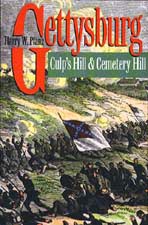
Culp’s Hill and Cemetery Hill.
TOPIC: The Battle of Gettysburg
Tonight
we are especially fortunate to have as our guest Harry Pfanz, author of Gettysburg, the Second Day (University
of North Carolina Press, 1987), and Culp's
Hill and Cemetery Hill (UNC Press, 1993), two of the most important studies
we're ever likely to see on the fighting at Gettysburg. Harry W. Pfanz worked
at Gettysburg as a historian from 1956 to 1966 and was Chief Historian of the National
Park Service. He is a native of Ohio with a life-long interest in the Civil
War, having had three great-grandfathers who served in Ohio regiments (none of
them were at Gettysburg, however, his wife had kin there with the Army of
Northern Virginia). Mr. Pfanz served in the U.S. army as a lieutenant of field
artillery during WW II, which, he acknowledges, has had some influence on how
he reacts to and interprets the Civil

CWF: Thank
you for joining us. Your work on the second day at Gettysburg, and the
follow-up on Culp's Hill and Cemetery Hill, are two of the most important, most
detailed studies of that climactic battle, and first I would thank you for
those contributions. Can you tell us a little bit about how your interest in
the Civil War developed, and specifically how you came to dedicate so many
years of your life to recounting the struggle at Gettysburg?
Harry Pfanz: Well,
I grew up with an interest in the Civil War, back as far as I can recall,
perhaps because I did have three great-grandfathers in it, and one lived until
I was in high school, so the Civil War was very real to me as a boy. After
WWII, I worked for 4 years with the army as a historian, then heard of an opening
at Gettysburg, and I applied for it and got the job. That was in 1956, and
after I retired from the Park Service I thought I would start writing, and
since nothing had been written in a detailed way about the 2nd day and the
Culp's Hill areas, I thought I would give them a try.
CWF: In
the Epilogue to Gettysburg, the Second
Day, you conclude that "General Lee's opportunity to win a decisive
victory at Gettysburg had all but passed when complete success had eluded his
attacking divisions on the afternoon and evening of 2 July." Do you
believe that Lee's plans for July 3rd were doomed to failure?
Harry Pfanz: I
don't know that they were doomed to failure, but it seems likely to me that it
was a high probability. He had suffered perhaps 12,000 casualties in the 2 days
of fighting on the 1st and 2nd. He had lost the services of three division
commanders, Heth, Pender, and Hood, and of course with the casualties and the
losses of these men and other leaders, his organization was not what it had
been when the battle had started. As he had grown weaker, the Union forces,
although they had suffered losses, were growing stronger, and would continue to
grow stronger. The Union position was practically impregnable. He had attacked
on both the left and the right and had been beaten in both places—or was being
beaten at Culp's Hill. The Union army was thoroughly in position. As somebody
said, they had been driven there, and they could afford to await an attack,
whereas Lee, of course, either had to attack to leave.
CWF: It is
ironic, as you pointed out in Gettysburg,
Culp's Hill and Cemetery Hill, that with respect to the latter, "Actions
do not always speak louder than words"—referring to Lincoln's address
later at the cemetery there overshadowing the fierce fighting in that sector. In
fact, you indicate that Cemetery Hill may have held the key to Confederate
fortunes. Was Cemetery Hill the keystone of the Union position?
Harry Pfanz: Yes,
it seems to me ironic that when he said the world will not long remember what
we say here, but it cannot forget what they did here, the Gettysburg Address is
probably much better known, certainly worldwide, than the battle, and as you go
into the National Cemetery there today, of course the Gettysburg Address is the
thing of greatest interest. And yet Cemetery Hill was the principal rallying
point for Union forces on July 1st, and it was a strong point in the Union line—a
bastion in the Union line—and an important artillery position. It was an
anchor, in a sense, of the Union line, at the center of the line, but it seems
to me that as people walk through the cemetery where the gun positions were,
they see the cannon there and they look like decorations, I do not think they
appreciate the significance of where they are, as Lincoln probably did.
CWF: In
your opinion, what factors were involved in the length of time that Longstreet
took to get in position on the second day after the movement began: how much of
it was such things as the requirement of concealment, the route, the guide, and
how much of it, if any, was the intentional "slowness" of which he is
often accused in that movement?
Harry Pfanz: I
doubt that there was intentional slowness as such. He certainly was not pleased
with what he was doing. I think they attempted, of course, to march in a concealed
way, which they could have done just as easily by turning off to the right at
the stopping point and going down toward Willoughby Run. But in any case they
elected not to do that. It seems to me that Longstreet's attitude aside, it
took a lot of time to do things, and it's hard for us to imagine the degree of
slowness that seemed to permeate many things that were done then. For instance,
I have always wondered why they felt obliged . . . to hold to the roads as they
did, when presumably they could have cut across the fields, and save time. Yet they
did turn around, and reverse themselves, and follow these bad farm roads all
the way to the south end of the battlefield. And there, of course, they found
out when they were taking position, that things were not as they planned. And
then of course, instead of Hood going first, Longstreet insisted that McLaws lead
the way, because that was what was planned, and then Hood followed him until he
reached the Wheatfield road area. To recapitulate, I think some of this,
perhaps, resulted from Longstreet's pique, but a lot of it was just that they
took a circuitous route for purposes of concealment over what I think would be
bad roads.
CWF: Tell
me what you think of General Ambrose “Rans” Wright and his reported claims of
breaking through the Union line on Cemetery Ridge, only to fall back. Could
this have made a difference? Was the position significant and defensible?
Harry Pfanz: Wright's
Brigade was able to move across the fields there. The attack was a sweeping
attack, an excellent one. He captured two batteries and was able to reach the
crest of Cemetery Ridge because there was a gap there left by Union troops who
had been sent south along the Ridge. Thus, although he was able to penetrate,
or get onto the Ridge line there, the terrain was flat. He had no defensive
works or anything of that sort, and the probably few men—we don't know how many
he had, or I don't remember how many he had when he was up there—were
relatively easily brushed off the ridge by Union troops on the shoulders of his
penetration. Of course this was made easier by the fact that the brigades—the
Confederate troops on his left flank—did not move forward far enough to support
him. No one did support him. This is where the attack broke down.
CWF: Was
there any strategic importance to Emmitsburg with respect to the dispositions
of the gathering armies before Gettysburg?
Harry Pfanz: Emmitsburg,
of course, was on the route to Gettysburg. The First and Eleventh Corps stopped
there on the 29th of June. The 11th remained there over the 30th, whereas the
1st Corps moved up the road a few miles to the Marsh Creek, a few miles over
the state line. Before General Reynolds, who commanded the left wing of the
Army of the Potomac, before he knew that he was going to move on to Gettysburg
and the Confederates were concentrating in Cashtown, he much feared that they would
move from Cashtown and Fairfield—from that area—down southeast along the
mountains to the Emmitsburg area, perhaps to the Mt. St. Mary's area, and thus
be on the flank or rear of the Union left. And so they made sure even when the
1st and 11th corps moved to Gettysburg on July 1st, the 3rd Corps, which was
east of Emmitsburg, moved to Emmitsburg to guard against any flanking move by
the Confederates. I suppose, therefore, that it had some strategic importance
because it was on the road from Cashtown to Frederick. It is a route the
Confederates might have used if they had been able to.
CWF: What
is your overall opinion of Sickle's movement of his division out into the
cornfield? Was it a profound blunder, as some have suggested; or did it weaken
Longstreet's attack sufficiently enough to prevent a break in the Union line?
Harry Pfanz: I
think that although Sickles movement forward to the Devils Den, Wheatfield,
Peach Orchard area—the high ground along the Emmitsburg road-- set up a breakwater
that slowed the Confederate assault, I think that basically it was a grave
error. He moved from a position that was assigned to him, and took up a position
that he was unable to man with the troops that he had. He left the left flank
of the 2nd Corps in the air, and disrupted Meade's plans. He did it because he said
that the high ground along the Emmitsburg Road dominated a portion of his line,
and because he feared an attack against his left flank if he stayed where he was.
But the fact remains that he did not occupy Little Round Top, as he should have
done, and he moved forward to a position that required his being reinforced,
and upset Meade's plans.
CWF: Who
really deserves credit for Union forces occupying Cemetery Hill on the first
day of the battle?
Harry Pfanz: Cemetery
Hill, the position on Cemetery Hill, was selected by Howard. No question about
that. When Howard arrived with the 11th Corps and took control of the field, he
left one of his divisions, his 2nd division, on the hill, plus a battery
(initially three batteries) as a rallying point in case the Union forces north
and west of town were driven back. Now there was a question back when the
veterans were still alive and writing as to whether or not Reynolds had
selected Cemetery Hill as the fallback position. There is reason to think that
he did, or would have, but the fact remains that he was shot at the opening of
the battle, and did not communicate with Howard, so that Howard made this
decision on his own, without Reynolds' input or orders. Now insofar as Hancock
is concerned, he did not reach Cemetery Hill until the Union forces were
falling back to it and some had reached it. And of course at this time portions
of Steinwehr's division, which Howard had placed on the hill, were in position
and awaiting whatever would happen. So the credit, I believe, must be given to
Howard.
CWF: What's
your read on George Meade’s performance at Gettysburg?
Harry Pfanz: I
should say his leadership was an important factor in the battle and in the
campaign. If you'll remember, Hooker commanded the Army of the Potomac at
Chancellorsville, and did poorly—lost the battle. Lincoln and Halleck then
looked for an opportunity to replace him, but before doing that they had to
find someone who could take his place .General Couch, who was a logical
appointee, refused to take it. It was recommended that Meade be given the post,
but before doing this, they asked Reynolds to take command because Reynolds was
both a fine general, and I think, because he outranked Meade, Reynolds was
allowed to decline the post, but Meade was ordered
to take it, and could not decline it.
I
think that as I have said, few men in our history have had such a heavy burden
cast upon them with so little warning. However, Meade took over the job, he
moved the army north, he planned the defensive position in case that was
needed, and when the meeting engagement at Gettysburg took place, he saw that
the army was rushed to it. He commanded the army, of course, for the 2nd and
3rd days of the battle, and as someone said, I can't give the quote exactly,
for the first time the army's reserves were used in a timely and proper way, so
that he was able to defeat the Confederates there. He showed great character, I
think. Down south of Hagerstown, at the close of the campaign, when he was
pressured to attack the Confederates there, but was not ready to do so, he declined
to attack without being thoroughly prepared, and perhaps saved his army a
defeat there. I think Meade is certainly one of the outstanding heroes of the war.
CWF: How
important was the role of Brig. Gen. George Sears Greene on Culp's Hill to
holding the Union right, and why did he get so little credit for it?
Harry Pfanz: His
role was very important. He did a thing for which he has had too little
recognition. Part of this, I think, is because when the reports of the battle
were turned in by the corps commanders, he was not given credit in Slocum's
report that he might have been given, because, if I remember correctly, Slocum
thought that General Williams would make the report covering Greene's action.
And Meade based his report on Gen. Slocum's report, and did not see William's
report. Now, beyond that, Culp's Hill, the battle on Culp's Hill, perhaps
because it is off to the side, has not received the attention given the
fighting at Little Round Top, and on Cemetery Ridge. I think, therefore, that
Greene's role in the battle has been lessened because the area in which he
fought has not had the attention it deserves.
Brian
Pohanka: Regarding Hancock—it seems that his greatest strength was in his
presence—rather than tactical ability per se. What is your "take" on
his Hancock's role in the battle?
Harry Pfanz: Hancock—I
think his role was paramount under Meade - he was second only to Meade. Hancock
was sent forward to evaluate the situation at Gettysburg on July 1st, and to
take command on the field if need be. His role there was that he, I think, inspired
the troops, his principal role. On July 2nd, after Sickles was wounded, Meade
gave him command of the whole left end of his line, I should say the 3rd Corps and
the 2nd Corps, and of course, on July 3rd, it was his corps, basically, that
repulsed Pickett's Charge. I certainly think Hancock's great importance was in
his being able to inspire the men under him. Certainly at Gettysburg he
exhibited no tactical deficiencies, except perhaps in not allowing his artillery
to cease fire before the attack began, and thus having them run out of
ammunition at a critical time. He was Superb.
CWF: In
your present study of the 1st Day conflicts, you must be doing a good deal of
work with the Iron Brigade.
Harry Pfanz: Yes,
you cannot avoid the Iron Brigade. They obviously played an important role in
the battle in the McPherson's Woods area, and on Seminary Ridge, but also in
one of the most important regimental actions of the battle. It was the 6th
Wisconsin regiment of the Iron Brigade that was primarily responsible for the
capture of the Rebels in the Railroad Cut, and the driving of Davis's Brigade
from that portion of the field.
CWF: In
regards to the tying up of Jeb Stuart's cavalry, how important was the Battle
of Hanover on June 30, 1863?
Harry Pfanz: Hanover's
importance is tied in wholly with Stuart. Obviously we cannot know what would
have happened had the Battle of Hanover not taken place. It in itself was a
small affair, and if it had importance, it was in encouraging Stuart to
continue to move north toward Carlisle.
Brian
Pohanka: Barksdale's charge on July 2 seems to me one of the most hard-hitting
brigade actions of the War. Would you agree?
Harry Pfanz: I
hesitate to compare it with others in the entire war, but there's no doubt,
however, that it was hard-hitting, and probably the hardest-hitting at Gettysburg.
It's hard to compare these things.
CWF: How
critical was the role of Col. Freeman McGilvery and Bigelow's battery in
preventing the Army of Northern Virginia First Corps from penetrating the gap
between the Third and Second Corps created by Sickle's move?
Harry Pfanz: McGilvery,
as an artillery commander, played an exceptionally important role. Had he not
plugged the gap on the left of the 2nd Corps, where Caldwell's Division had
been, we can assume that the 21st Mississippi would have gotten onto the Ridge
there and perhaps Wilcox's Brigade to the north would also have had greater
success. However, we can't be too certain of these things because there were
other troops that could have been brought there. But certainly, McGilvery played
an important part in the battle.
Thank you and good night.


.jpg)
 1.) Harold Holzer, Lincoln in the Times pp. 221-2. [this passage thanks to Vermont Humanities, Civil War Book of Days.


