Thursday, April 26, 2007

It really does take a rocket scientist


References to signal rockets in the Civil War era are not uncommon, and I know the British really did employ rockets (perhaps even causing a red glare) ineffectively at Fort McHenry, but I confess I did not know until recently that the state of rocketry in 1860 was such that both sides in the Civil War formed (relatively short-lived) rocket batteries. They were organized like light artillery, but with new-fangled ordnance, and in the case of a N.Y. battalion at least, with tubes on their gun carriages.

These units renewed service with British-designed rockets first deployed in the Mexican War, mainly the Hale Rocket, or modified variations. Though tail fins caused the weapon to spin in flight, Hale rockets were far too unreliable and inaccurate to supplant more useful projectiles from rifled artillery pieces.
I stumbled upon a fascinating article in Military Affairs journal, by Ralph W. Donnelly: "Rocket Batteries of the Civil War" (vol. 25, No. 2, Civil War Issue. (Summer, 1961), pp. 69-93, available on J-STOR). Donnelly credits men (Pelham's Horse Artillery) under J.E.B. Stuart with the first known case of using rockets in the war. He writes,


The story of the first actual use of war rockets by the Confederate Army has almost been lost in obscurity, the report of Captain John C. Tidball, then lieutenant of Battery A. 2nd U.S. Artillery, of operations between June 27 and July 7 in the Peninsula Campaign contains this revealing statement:

On the morning of July 3 the enemy, taking position with artillery on the high ground (now our front), commenced shelling the low ground which was occupied by our troops. They also threw with great precision a score or so of war rockets.
[O.R. 11, part 2, page 246]


This description is obviously of "Jeb" Stuart's shelling of the Federal encampment on the bank of the James River from Evelington Heights, but only one further reference could be found in either the Union or Confederate reports in confirmation of the use of rockets. Colonel James T. Kirk [he's dead, Jim] 10th Pennsylvania Reserves, also reported that "On Thursday, the 3d instant, while standing in line of battle, I had one man wounded by a missile from a rocket from a rebel battery." [Ibid, 425] One might question the opinion of a volunteer officer this early in the war, but Tidball, a Regular Army officer and a West Point graduate, was too good an officer to summarily dismiss his observations as mere intellectual fulminations. So the search for confirmation went on, and it was found in the remarks of a Confederate eye-witness, Lieut.-Colonel William W. Blackford, then a captain of engineers on the staff of General J.E. B. Stuart, that after shelling the Federal camp for a while with his horse artillery guns. Stuart opened fire with a Congrieve [sic.] rocket battery for the first and last time he ever used this type of field piece. He says it was managed and operated by "some foreign chap" The rockets were described as "huge" with an explosive shell at the end loaded with a liquid combustible nicknamed by the men "liquid damnation."

But what would the story of Civil War rocketry be without an old-fashioned myth. Tonight on the Discovery Channel I saw an old episode of the endlessly entertaining program, Myth Busters:

Episode 40: Confederate Rocket The American Civil War was fought with bayonets, muskets and cannons. But was that all? Not according to the MythBusters. So Adam, Jamie and the build team join forces to find out if the Confederate Army had a secret deadly weapon — the world's first long-range missile, which according to rumor, was launched from Richmond, Va., and aimed at the White House over 100 miles away. Premiere: Oct. 26, 2005

Though Adam and Jamie were able to get a Hale rocket to fly several hundred yards, and a Boxer rocket twice that far (detailed results here), they didn't have much luck reproducing the Great Rebel Missile Attack on Washington.
When I first heard the premise for this episode, I thought to myself, busting a myth would be a whole lot more dramatic if it were a myth you'd ever heard of. This missile attack was a new one on me. Surfing the web, I came across this NASA site, which tells the incredible tale, quoting one of Burke Davis' lesser offerings (in the vein of Ripley's Believe it or Not). Make of it what you will.


According to the author, Jefferson Davis witnessed the event at which a 12-foot-long, solid-fueled rocket, carrying a 10-pound gunpowder warhead in a brass case engraved with the letters C.S.A., was ignited and seen to roar rapidly up and out of sight. No one ever saw the rocket land. It's interesting to speculate whether, almost 100 years before Sputnik, a satellite marked with the initials of the Confederate States of America might have been launched into orbit.

Sunday, April 15, 2007

A Digital Feast


If you're like me, when the O.R. Atlasafter a long stretch out of print
became readily available again about fifteen years ago, you bought two copies: one to thumb through with abandon, and one to keep pristine. After spending $2,500 or so for the 128-volume Official Records, a back-up atlas hardly seemed extravagant.

I've noticed that Barnes & Noble, under its own imprint, still offers a cheap edition of the atlas. I haven't looked to see if the bargain rate is a factor of a massive print run, or subpar reproduction. It may be a little of both.


I can't recall how long it was after I sent my last payment of a years-long subscription to Broadfoot for the printed O.R. set before the whole thing appeared on a single CD-ROM for about $100, but it wasn't long. In rapid succession, of course, many more essential reference works had been digitized, from Fox's Regimental Losses to Dyer's Compendium (my wife bought me the $125 Morningside edition of the latter for Christmas one year, bless her heart).
And while there's nothing finer than kicking back in a comfy chair with a little black volume of the O.R., I have to admit that the convenience of searching and pulling something up online, or off a disk, is irresistible. It's not as if you even have to verify the accuracy of a transcription, since most of the digital versions are straight scans of the original. For years now, I have relied almost exclusively on Cornell's Making of America site to look up citations in the Official Records. But I'll never give up the books. I need to live in a library, and that bookcase full of gold-stamped spines is a member of the family, albeit more dusty than my children.

The Atlas to Accompany the Official Records of the Union and Confederate Armies, best known simply as the O.R. Atlas, has long been available on disk, but has also made its way online, thanks to the University of Alabamasee here
(there are some other online venues featuring it as well, such as this one by Simmons Games. It is somewhat harder to useabsent thumbnailsbut perfectly usable if you know what plates you're looking for). Kudos to the University of Alabama for making these color plates easily accessible (and thanks to Brian Downey for mentioning it in the comments to another blog). As an added bonus, the site includes links to their Historical Map Archive, Contemporary Maps archives, and even a handy tutorial on the difference between Raster and Vector Imagery.

Either With it or Upon it

A long-time link at the Soldiers and Sailor's site bears mentioning. If you haven't seen it already, take a moment to view the flags at this online exhibit: Symbols of Battle: Civil War Flags in NPS Collections. It features photos of some of the banners in the collections of nine different National Park Service sites (Appomattox, Ford's Theater, Ft. Pulaski, Ft. Sumter, Gettysburg, Kennesaw, Manassas, Richmond, Stone's River).

The flag above is at Kennesaw, and interestingly, it is the flip side of a Confederate First National flag. The motto of these Cherokee Dragoons is "Either With it or Upon it," not a phrase in common use today, and not one that lends itself to easy explication.


The United States Treasury Guard's flag at bottom is at Ford's Theater. The caption reads: "Dramatically associated with the close of the war, this flag decorated the front of the Presidential box at Ford Theater, in Washington, D.C. on the night of April 14th, 1865. Booth, President Abraham Lincoln's assassin, caught his spur and tore this flag as he jumped from the Presidential Box to the stage below."

Monday, April 09, 2007

Brogans in Baghdad


It was only a matter of time, I suppose. Once the reserves are exhausted, where does the Commander in Chief drum up fresh recruits for overseas deployment? In the brief video above (following a very short ad for Jamaican beer), four pundits discuss the wisdom of calling up America's beefy, wool-clad warriors for duty in Mesopotamia.

Wednesday, April 04, 2007

Manifesto: The Mad Farmer Liberation Front

Go with your love to the fields.
Lie down in the shade. Rest your head
in her lap. Swear allegiance
to what is nighest your thoughts.
As soon as the generals and the politicos
can predict the motions of your mind,
lose it. Leave it as a sign
to mark the false trail, the way
you didn't go. Be like the fox
who makes more tracks than necessary,
some in the wrong direction.
Practice resurrection.

--Wendell Berry

Does this blog entry have anything to do with the Civil War? Of course it does. Everything has to do with the Civil War. Be patient. I have long been attuned to the sentiments expressed in much of Wendell Berry’s poetry, essays, and novels. His relentlessly green approach to living, his devotion to conservation and sustainable farming, his eloquent disdain for consumerism – all of this appeals to the part of me that wants to live a rural or remote existence. But he’s effectively a Luddite, and that would never do for me. I love technology too much, even the frivolous kind. Not so with Berry.
But that’s not what I wanted to comment on tonight. If I had been anywhere near Chattnooga last weekend, I would have dropped in for some of the AEC 2007 Conference on Southern Literature. “Southern” literature has had a powerful hold on my imagination from early on. People like Faulkner, of course, and Walker Percy, evoke an atmosphere or feeling that you remember for a long time -– and like so many, I’m a big fan of Harper Lee’s book -- but Flannery O’Connor made me want to drop what I was doing and start writing short stories of my own, right now. More recently, as I’ve mentioned elsewhere, authors like T. R. Pearson have refreshed my love of fiction set in the separate world that is the American South. So what do they talk about at the Conference on Southern Literature?
Newsweek managing editor Jon Meacham who had once been a reporter for a local Chattanooga paper, started off the conference with a talk on, “Living History: What the Past Tells Us About the Present.” Got some good quips in, too, or so it was reported: “Madison calling Jefferson a ‘French atheist’ seems sort of redundant,” and “Mississippi—that’s like Tennessee without hardback books.”
But it was the agrarian rebel poet Wendell Berry who wrapped up the presentations portion of the event with the keynote address, “American Imagination and the Civil War.” One can’t help but be struck by the fact that the opening and closing feature presentations at this literature conference sound like maybe they belonged at a history conference. Apparently, it speaks to the fact that Southern Literature and Southern History are inseparable. As Faulkner said, “the past isn’t dead; it isn’t even past.”
Berry, as expected, had some provocative opinions to share. Thanks to Kevin Trumpeter of The Pulse, Chattanooga’s Weekly Alternative, for some summary reporting on the subject.
Wendell Berry’s keynote address on Friday evening, “American Imagination and the Civil War,” also considered historical issues that have a particular resonance with today’s political concerns. As you’d expect from a reputed iconoclast, the poet-farmer’s take on the War Between the States would be classified as “revisionist.” Berry acceded that slavery was certainly one of the important aspects of the conflict, but pointed out a cause that frequently gets overlooked by the textbooks—“People generally don’t like to get invaded.”
Like a latter-day Faulkner, he lamented the lingering “curse” of the Civil War that continues to afflict Southern society and called the supposedly self-evident benefits of the Union victory into question. He referred to the emancipation effort as “botched,” noting that our society still has yet to come to terms with the “money power of the North that replaced the slave power of the South” and that Americans still rely on an subservient group of people (he cited Latino immigrants as the latter-day “Stepin Fetchits” of our society) to perform the menial labor which upper-and middle-class Americans are “too good, too well-educated, and too ignorant to do ourselves.” He suggested that the Northern victory not only imposed the vagaries of industrialization on the bucolic agrarian culture of the antebellum South, it also set the tone of overconfidence and privilege that is the hallmark of a contemporary American attitude that “conflates the American way of life with the will of God.”

Wednesday, March 28, 2007

Everything you know is wrong. . .

Two entries below, I posted a map of the battles for Atlanta (here). I wonder how many die-hard students of that campaign went rushing to their books to challenge or confirm one or more elements in the draft. It finally dawned on me, as I glanced at the map again, that it was an early version. The folks at the Library of Congress sent that version to Ed Bearss for his input, and in case you're wondering, here's what the map looked like when Ed sent it back (click to enlarge).

As you can see, he had a couple problems with my unit designations, and alignment. As I incorporated each change, I crossed it out, which accounts for the large x's. I wasn't too far off, but far enough to skew things had the unedited version gone to press. My initial draft was based on deep reading of the campaign, but still something short of expert. This is why manuscripts, and maps, should be scrutinized by the most authoritative people availablesomeone capable of spotting the problems.


This last map is the revised version that appeared in the published book. Ah, now that's better.

Tuesday, March 20, 2007

A year in the planning, and now it's time to board the airplane for Dulles


and a weekend at Appomattox for the 11th Civil War Forum Battlefield Conference. I'll be back online in a few days with photos and tales of my adventure in rural Virginny.

Friday, February 23, 2007

"Make me a map of the Valley" (as a pdf I can view on my iPhone)

In the comments section of one of the other Civil War blogsI've forgotten how to find my way back to itDrew Wagenhoffer posted a note expressing his curiosity about what software people use for maps (or something to that effect). Maps and map-making are subjects dear to my heart, and I have wanted to make a blog entry on the subject.

I have loved looking at maps for as long as I can rememberancient maps of the known world, modern roadmaps, library floorplans, even those colorful fold-outs that show all the parts of an amusement park. New advances in digital technology, like Google Earth, excite me to no end. I don't know how people get by without at least one globe in the house, and a few maps on the wall. In the kitchen, we keep the nearly 5-1/2 ft. tall Raven map of California, which I enjoy scrutinizing over a bowl of Cheerios. If I ever find myself in a contest to name as many valleys of California as possible in 60 seconds, I'm ready.

And really, what's more fun than settling down with one of those giant National Geographic atlases, discovering mountain ranges and rivers you've never heard of? Doesn't matter how old you are, there's always one more corner of the world with geography so strange and unfamiliar, it's as if you're seeing it for the first time. And maybe you are. Spend a few minutes studying the southern coastline of Chile sometime. How old were you before you noticed Novaya Zemlya on a map, separating the Barents Sea from the Kara? Cold Warriors may know of the nuclear detonations there.

But I digress. When Ted Savasanother map aficionadoand I commenced publishing Civil War Regiments, we were determined to support the articles with plenty of maps. It drove us nuts that long, complicated military narratives lacked maps altogether, or else had maps so useless, you wonder why the publisher bothered. Desktop publishing was pretty much in its infancy when we started out, and yet the transformation in publishing (digital straight-to-plate, electronic transmissions of pages) was well underway. With a handful of friends and family, we did it allacquisitions, editing, design, typesetting, marketing, order fulfillment. It was only natural that we create the maps as well.

Farming out the cartography was not affordable, or reliable. Besides, it was the funnest part of the job. By the time we drafted the maps, we were thoroughly immersed in the article and its sources, and well positioned to tailor specific scenes to augment the narrative. Drafting the maps was the dessertthe reward for weeks of tedious copyediting, proofing, layout. Saved for last, it was very satisfying way to put an issue to bed.

We would start with blank screens, and start building something over untold hours and days. We showed each other drafts along the way, made suggestions, tweaked and tweaked, and sometimes tossed it out and started over. From the start, Ted and I had a multi-platform officehe on his tragically soul-less Windows machine, using Corel Draw (I think, initially), and me on my trusty Mac, using Adobe Illustrator. Over time, we developed distinct styles, and while the maps in an overall issue might look stylistically inconsistent to someone flipping through, they remained consistent within the articles themselves (Ted handled all CSA articles, and I did the USA ones).

As we became more proficient with the software, we got a little fancy at timesas cocky cartographers are wont to do. But in time, we settled into styles that emphasized clarity and readability over bells and whistles (most maps one saw in Civil War books then were useful and perfectly serviceable drawings by people like Blake Magner, George Schoch; later, some other, talented electronic map makers, like Mark A. Moore, arrived on the scene). Ted and I each devised our own way to depict elevations, woods, artillery, and so on. I favor using varying levels of gray scale to set off elevations, for example.

Many times, we worked from an author's hand-drawn map or crude photocopies, but usually we created something from scratch, referring to the O.R. Atlas for landmarks, and scale, and drawing on the text, and our own reading to get the action right. Often, the author's research meant depicting troop locations, and troop movements in a way that was at odds with published maps of the same battlemaking our maps among the first to show it in what we became persuaded was the correct alignment. It was a blast trying to corroborate this information, comparing after-action reports, working up the map scale, discovering what was possible, and what could not have been.

My own favorites from the CWR days involved the Vicksburg issue, with Sherman's assault on the Stockade Redan, and the attack on the Railroad Redoubt, when the 22nd Iowa punctured the line.

It's an amazing experience to draw a map of a place, spending hours reading about the particulars, the descriptions of it by men who were there, studying modern photographs, until you can see it in your mind's eye as if it were the topography of your own backyard, though you've never visited the actual site. Then, on your first visit to the place, how odd it is to feel a wave of recognition. Deja vu all over again, as the great Yogi Berra said.

Also fascinating is the challenge of finding ways to depict lots of actionsometimes multiple daysin a small amount of space. Or, choosing a moment in time to capture the heart of a complex action in a two dimensional drawing. This latter problem led me to habitually add little narrative passages to the map itself, or to use insets to zoom in on something (see Cold Harbor to Petersburg map below). In the map at top, I was tasked with depicting four major battles around Atlanta in a single map that was alloted one-half of a page. It's busy, but somehow it works (Library of Congress Civil War Desk Reference).

Both Ted and I went on to do maps for books in addition to the quarterlysometimes "freelance"a thankless job (sometimes literally a thankless jobI was recruited by one author to do some maps for his Civil War installment in the University Press of Kansas' Modern War Studies series, about 9 years ago. I spent whole weekends on three difficult maps, got them to the publisher on deadline, and never heard from the up-and-coming professor againnot even in response to my email informing him that they were delivered. Eventually the book came out. No mention of maps in the acknowledgments, no credit lines on the maps themselves. No simple "thank you" by email. I had offered to do them for freefor exposure in the university press worldso wasn't looking for payment. Just courtesy. I had to write to the publisher to get a copy of the book. This kind of thing is exceptional, but as you can see, little rudenesses like that are not easily forgotten).

The highlights of my own map making days have to be the 27 or so maps I did for a theme issue of the old Civil War magazine, all depicting action from Fortress Monroe to Richmond in McClellan's 1862 Peninsula Campaign. More recently, I did all 30 or so maps for The Library of Congress Civil War Desk Reference, each of which was reviewed by Richard Sommers and Ed Bearss. It's astonishing what little details and subtle errors those two men marked on the draftsthings like moving one division behind another, redirecting a creek bed, relocating a critical road intersection, etc.

Maps can be notoriously problematic in the manufacturing stages, and a lot of trial and error goes into ensuring that different levels of gray are distinguishable (rather than all black, or all washed out), that thin lines are not too thin for the press, and so on. But it's a lot easier now that you can lock in a perfect pdf that will allow for those kinds of variances in the printing plant.

Here's a few more: click on the image to see it enlarged.


Wednesday, February 21, 2007

"Lincoln and Halleck are traitors and caterpillars..."


Major Henry Abbott, 20th Massachusetts

Caterpillars? All the talk of Harvard recentlyand quite a few bloggers were speaking of it, including Kevin, and Dimitri, and Eric
specifically, the hiring of a Civil War scholar as president, not to mention the first woman to hold that position, got me thinking about the 20th Massachusetts Infantry, sometimes called the "Harvard Regiment," due to the preponderance of Harvard-connected officers in that unit.

Indeed, their blue uniforms were well complemented by their blue blood. Harvard graduate Richard Miller penned a regimental history, Harvard's Civil War, published by the University Press of New England in 2005. UPNE's description of the regiment drops some big names: "Its officers were drawn from elite circles of New England politics, literature, and commerce. This was the regiment of Oliver Wendell Holmes Jr.; of his cousins, William Lowell Putnam and James Jackson Lowell, both nephews of James Russell Lowell; of Paul Joseph Revere and his brother Edward H. R. Revere, both grandsons of Paul Revere; and of Sumner Paine, great-grandson of Declaration of Independence signer Robert Treat Paine."

I haven't read Miller's book, but the subject interests me. A more familiar (to me), and widely-read volume with Harvard/ 20th Mass connections is Fallen Leaves, The Civil War Letters of Major Henry Livermore Abbott, still in print in paperback from Kent State.

[A side note: when I was a Stanford University Press, Helen Trimpi, who I think had both Harvard and Stanford connections, and a steadfast member of the South Bay Civil War Round Table, submitted an in-process manuscript that was a sort of biographical register of Confederate officers with Harvard tiesI hope she's able to get that information out in some published fashion]

One might naturally imagine that a group of aristocratic officers from Boston, ground zero for the abolitionist movement, would be firmly in the anti-slavery camp. Not so. My associations with the 20th Massachusetts track back to the early days of Civil War Regiments journal. In the first issue of our 3rd year, we published a well-researched, well-written article on the 20th Massachusetts, by Anthony J. Milano. Mr. Milano, however, called the unit by its other moniker: "The Copperhead Regiment" (the letters I excerpt below all come from Milano's excellent article in Vol. 3, No. 1 of CWR, and are mainly from the Holmes Manuscript Collection at the Harvard Law School Library, and the Abbott Letter Manuscript Collection, Houghton Library, Harvard).

They were not "copperheads" in the Vallandigham sensethey were not traitors to the Unionbut they were decidedly opposed to a war to end slavery. Indeed, as early as 1861, an anonymous member of the regiment wrote to state's stridently abolitionist governor, John Andrew, to complain that "with but two or three exceptions those of our officers boast of their pro-slavery opinions and purposes. . ." In short, they were pro-Union, anti-abolitionist, McClellan Democrats.

Oliver Wendell Holmes was a Union man, but had no faith in the Union's ability to subdue the South. In a letter to his sister, in November of 1862, he wrote:


I've pretty much made up my mind that the South have achieved their independence & I am almost ready to hope spring will see an endI prefer intervention to save our credit but believe me, we never shall lick 'emThe Army is tired with its hard, & its terrible experience & still more with its mismanagement & I think before long the majority will say that we are vainly working to effect what never happensthe subjugation (for that is it) of a great civilized nation. We shan't do itat least the Army can't. . .

Apparently his father thought such talk sounded like his heart wasn't with the Union, and a month later, Holmes wrote to his father to make the distinction clear: "I never I believe have shown, as you seem to hint, any wavering in my belief in the right of our causeit is my disbelief in our success by arms in wh. I differ from you. . .and I believe I represent the conviction of the Army."

Needless to say, the "copperheads" of the 20th Massachusetts were none too pleased with Lincoln's preliminary Emancipation Proclamation. The prolific letter writer, Major Henry Abbott, wrote to his aunt soon after: ". . .The president's proclamation is of course received with universal disgust, particularly the part which enjoins the officers to see that it is carried out. You may be sure that we shan't look to anything of the king, having decidedly too much reverence for the Constitution. . ."

After the Confederate victory at Chancellorsville, Abbott could not contain his anger that "the miserable Dutchmen, broke & ran all of them at the first shot, as I always reasoned they would," and he railed against "Hooker," and his higher-ups. In a letter to his mother, he wrote, "I should think the whole nation would cry out for McClellan. Lincoln & Halleck are traitors and caterpillars. . . . It certainly seems as if it were impossible for abolitionists to stop lying & doing all they can to injure this army."

Later, at Gettysburg, the 20th Massachusetts was nearly decimated, losing 8 officers and 101 enlisted men killed or wounded out of the 240 men who entered the fray. Among the dead were Colonel Revere, Lt. Sumner Paine, and Lt. Henry Ropes, each a part of the Copperhead clique of Crimson aristocrats. Holmes had been wounded earlier, at Fredericksburg, and his father, Dr. Oliver Wendell Holmes Sr., gave a speech at Boston on the day after the Gettysburg fighting ended, calling on all citizens of the U.S. to get behind President Lincoln, and to reject calls for a negotiated peace.

Major Abbott, on August 7th, 1863, wrote to his mother to say Holmes senior was "a miserable little manikin, dried up morally and physically, & there is certainly nothing more aggravating than to have a little fool make orations & talk about traitors & the man who quarrels with the pilot when the ship is in danger. . ."

But Gettysburg pretty much marked the end of the "Copperhead Regiment" designation. For the balance of the war, all the way to Appomattox, that distinguishing characteristic among its officers was lost. Say what you will about about those pro-slavery, Harvard Copperheads -- they did their duty, as volunteers, amidst all the grumbling. One of the last of them, the angry young Major Henry Abbott, was killed in the Wilderness in May of 1864.

One can only imagine the vitriol that would have issued from his pen had he lived long enough to see Lincoln summarily defeat McClellanwith overwhelming support from the army rank and filethe following November.

Some 20th Massachusetts links:
[image at top: John Harvard Statue, Harvard College]

Manly Men in the Service of the Lord

"The Civil War is our only 'felt' history," wrote Robert Penn Warren, and one can certainly feel that in the element of religious fervor that attends our inherited and adopted interpretations of that cataclysmic era. Though no one today was alive in the 1860s, many there are who have a deep, emotional investment in how the story is told (or remembered, as Kevin at Civil War Memory might say).
Certainly Abraham Lincoln has attained saintly status in the literature, but the Southern Cause, in particular, has become synonymous with righteous struggle. There is something fundamentally strange about the way Confederate icons have all but replaced the apostles in the stained glass of southern history. They were the knights of the Confederate round table (minus Lancelot's adulterous betrayal, of course), and the reasons they fought can never be sullied by incidental, political distractions like free soil versus slave soil. The godliness of men like Lee, and Jackson, is cartoonishly caricatured in films like "Gods and Generals," and in the essays of earnest children (see the With Lee in Virginia paragraph of this one, quoted below). But this business about "biblical manhood" puts a new twist on things (see the 2003 winner of biblical manhood essay contest here). The subject of the essay is a Civil War figure, and I'll give you one hint: it wasn't Benjamin Butler.
I don't have the energy or inclination to speak at length about this phenomenon, but I did need an excuse to use Church Sign Generator.


Another book with powerful lessons of providence is With Lee in Virginia. Set in the South during the War Between the States, it explores causes of the war, happenings during it, and lasting effects of it; in it, Henty shows the divine providence which was continually overarching and undergirding the efforts of His people. G.A. Henty sought to remind readers of the religious causes and ramifications of the war. He told how the great leaders of the Confederacy were godly men fighting for godly principles in areas as broad as Christian culture and as specific as decentralized government. He also told how the Reformed faith was what motivated countless men and boys to rise up to defend the South. Most importantly, he showed the grace and mercy of God in the course of the war. The Reverend J.L. Underwood, who also wrote about the war, said in reference to the purpose of the Confederates: “there is a thing better than peace: liberty.” This idea is a recurring theme throughout With Lee in Virginia. Henty explores how God strengthened them to fight what they called the Second War of Independence in a Christian manner and for Christian principles. He gave them resolve to continue in their cause; He gave them strength to act in accordance with their faith throughout the war. Though we still mourn the loss of so many godly men, and though we see that many of the principles for which they fought vanished from society as they died, we can thank God fervently for His providence in preserving their honor and strengthening their faith in the following generations.

Is it just me, or is there something deeply bizarre about groups like "The Vision Forum" assigning Victorian adventure novels (such as G. A. Henty's With Lee in Virginia) to give children today a notion of devout manliness in the antebellum South?

With all due respect to our young essayist and Henty aficionado, and not having read the book, I'm going to take reviewer
Catherine Hood's word for it (from the first critique of With Lee at Amazon): "This book was not exciting, nor is it realistic of antebellum life in Virginia. From the title, you would think that the book would be about the War Between the States and about Robert E. Lee. It is neither. It is what an Englishman thinks it might have been like to be in the South before the war begins, but he doesn't know. The research, if there was any research, was not done well. . . . it is a very tedious, boring, and painful book to read."

That said, after a Google search, I did find a copy of the book online here. I haven't had a chance to go through much of it, but will give an overview in a subsequent post. Our hero, Vincent Wingfield, is an Englishman in Virginia. A slaveowner himself, and sympathetic to the South, he's not above pummeling a plantation owner for whipping a slave:


"You are a coward and a blackguard, Andrew Jackson!"
Vincent exclaimed, white with anger. "You are a disgrace to Virginia, you ruffian!"


Without a word the young planter, mad with rage at this interference, rushed at Vincent; but the latter had learned the use of his fists at his English school, and riding exercises had strengthened his muscles, and as his opponent rushed at him, he met him with a blow from the shoulder which sent him staggering back with the blood streaming from his lips. He again rushed forward, and heavy blows were exchanged; then they closed and grappled. For a minute they swayed to and from but although much taller, the young planter was no stronger than Vincent, and at last they came to the ground with a crash, Vincent uppermost, Jackson's head as he fell coming with such force against a low stump that he lay insensible.

Those riding exercises and schoolyard fisticuffs really paid off.


Saturday, February 10, 2007

Civil War Historian Boots Boring Economist From Ivory Tower

Harvard set to name first female president.
Noted historian, a Radcliffe dean, will succeed Summers
Valerie Strauss, Susan Kinzie, Washington Post Saturday, February 10, 2007

"Harvard University is about to name its first female president since its founding in 1636, tapping a Civil War historian to succeed Lawrence Summers, whose tenure was marked by controversial remarks about women and clashes with faculty members.

Drew Gilpin Faust, 59, dean of the Radcliffe Institute for Advanced Study and a leading historian on the American South, will be formally appointed president as early as this weekend, according to a source.
With Faust's selection, half of the eight Ivy League schools will be run by women: Harvard, the University of Pennsylvania, Princeton University and Brown University."

[from Washington Post, via San Francisco Chronicle]

Thursday, February 08, 2007

More Lies Across America, Civil War category

About one year ago, I posted some comments on James W. Loewen's sequel to Lies My Teacher Told Me (see that post here).

I've got Appomattox on my mind a lot lately, as I finalize plans for a visit there in six weeks. This tripfor the 11th Civil War Forum reunionwill be my first visit to the scene of Lee's surrender. Loewen has an entry on Appomattox, the opening paragraph of which reads:


At Appomattox cemetery, where the Civil War for the Army of Northern Virginia ended, the United Daughters of the Confederacy put up a marker with the words, "Here on Sunday, April 9, 1865 after four years of heroic struggle in defense of principles believed fundamental to the existence of our government Lee surrendered 9,000 men, the remnant of an army still unconquered in spirit, to 118,000 men under Grant." The marker gets the date right, and the Confederacy did put up "four years of heroic struggle." Otherwise, like most markers and monuments put up by the Daughters, it cannot be relied on for accuracy.

The title of that particular chapter is "Getting Even the Numbers Wrong," but if you've read other Civil War-related entries in Loewen's books, you can guess his immediate complaint here. It is about the "principles believed fundamental to the existence of our government." I'll pass on that CSA skewering for now, but highlight something that rings silly to anyone with more than passing familiarity with events following Lee's abandonment of his Petersburg and Richmond lines, and his westward retreat.

The opposed by overwhelming numbers argument as a rationalization for Lee's defeat has a basis
in fact, but is in full bloom, and exaggerated, with the Daughter's marker. Lee's army had become dramatically reduced by this time, but something like three times the 9,000 marker figure received paroles. And while Grant did have an army of nearly 120,000 investing Petersburg, and Richmond, only about half that number were in the vicinity of Appomattox in the lead up to the surrender. Lee was outnumbered, to be sure, but not by 13-1.

COMING SOON, Patrick Schroeder, NPS historian at Appomattox Court House National Historic Park, author of a book on the cemetery there, and on myths related to the surrender, weighs in on some of the issues I've raised here.

Tuesday, January 23, 2007

A Stillness at the War Memorial Opera House


People needing to get that Civil War opera fix may want to travel to San Francisco this October for the premiere of "Appomattox," by Philip Glass.

Today's San Francisco Chronicle breaks the news:

"Appomattox," which will feature baritone Dwayne Croft as Robert E. Lee and bass-baritone Andrew Shore as Ulysses S. Grant, is [David] Gockley's first San Francisco commission. Conductor Dennis Russell Davies, who led the 1984 premiere of Glass' "Akhnaten," and director George C. Wolfe will make their company debuts.

"This is an opera about men and events," Glass said. "There is hardly a person in public life today with the moral and intellectual stature of these two men, and I wanted towell, honor them isn't the right wordbut put them on the stage and see what they were about."

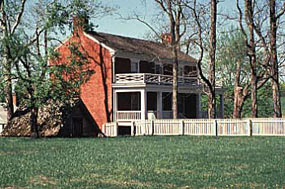
[photo at top: McClean House, NPS, Appomattox Court House National Historic Park]

Tuesday, January 16, 2007

Sometimes heroes sire scoundrels

Federal artillery captain and Medal of Honor-winner Hubert "Leatherbreeches" Dilger died on May 4, 1911 (scroll down on this page for a photo of Captain Dilger). Good thing he didn't live long enough to see his son waging chemical warfare on America during this country's lead-up to and participation in World War I. One naturally assumes Dilger would have been appalled at the prospect of his offspring conniving against the adopted homeland Capt. Dilger so bravely served. But who can say? Perhaps, somehow, Hubert Dilger would have understood his son's devotion to the Fatherland. What a difference a generation makes. Once I finish The Fourth Horseman (great title!), I hope the traitorous son's actions will have been put into the context of an era, and a family, that I know precious little about.

The German immigrants of the 11th Corps took the brunt of the blame for the collapse of the Federal right at Chancellorsville, when Stonewall Jackson's celebrated flanking maneuver caught the Federals off-guard and rolled up Hooker's line. But there was courage and honor amidst the otherwise wholesale Federal flight. Bob Krick, in a
wonderful series of essays archived by the Fredericksburg Free Lance-Star, described the heroics that earned Dilger the MoH at Chancellorsville:


The most famous and dramatic Federal resistance on that afternoon came from a German-immigrant artillery officer, Capt. Hubert Dilger. The captain had turned an Ohio battery into a well-tuned unit, despite what he called "the intrigues & petit jealousies of the different german cliques" in the 11th Corps, and had become recognizable by the doeskin German-style britches he wore. When the Federal right collapsed on May 2, "Leatherbreeches" Dilger retired methodically down the Orange Turnpike (modern State Route 3), firing a single cannon in the road, then falling back and doing it again.

The Medal of Honor (usually miscalled the Congressional Medal of Honor), meant appreciably less during the Civil War than it came to signify for a time during the mid-20th century. Four New Englanders who won the medal for actions near Fredericksburg, for instance, received them three decades later--immediately after (to suggest coincidence strains credulity) one of them became his state's adjutant general, and a second of them became his assistant. It is impossible, however, to doubt that Capt. Dilger richly deserved the honor, by the standards of any era. "Fought his guns until the enemy were upon him," the citation read, "then with one gun hauled in the road by hand he formed the rear guard and kept the enemy at bay by the rapidity of his fire and was the last man in the retreat." The devoutly Virginian historian who chronicled the history of Robert E. Lee's artillery admiringly described Dilger's feat as "an example of almost superhuman courage and energy."

Virginian scenery and people apparently fetched Hubert Dilger. In 1881, having grown rich by inheritance, he bought a large stock farm near Front Royal and began raising pure-bred cattle. Two years later a prize bull, perhaps unconvinced of Dilger's credentials as a freshly converted Virginian, gored him badly, but the old warrior survived and lived into the new century.

Dilger's son, Anton, was born on that Shenandoah Valley farm, but removed to Germany at age 10. Decades later, still a U.S. citizen, he could not enlist in the German army, but as an American loyal to Berlin, he was ideally suited for undercover operations against his homeland. Robert Koenig's new book on Anton Dilger looks to be a good read on an intriguing topic. According to this review in the San Francisco Chronicle:

"Anton Dilger, an American saboteur working for the German government, rented lodgings not 6 miles from the White House. In his basement, he set up a small laboratory and, on behalf of the General Staff in Berlin, he began a highly secret campaign to wage biological warfare on U.S. soil. His target would be the horses and cattle supplied to the Allied armies by the then-neutral United States, and Dilger set about cultivating anthrax bacteria and Pseudomonas mallei, the germ that causes glanders, a crippling equine disease. But who was Dilger, and how did the son of a Union Army captain become a German secret agent?"

Later, Anton Dilger approached the Mexican government to foster an alliance with Germany, tempting the Mexicans with the prospect of reclaiming the American Southwest. As it turned out, the sins of the son failed to eclipse the valor of the father. Anton Dilger, the Shenandoah Valley saboteur with a keen interest in biological warfare, died young (34) at the hands of a common virus, the Spanish Flu. No medals for him.

Thursday, January 11, 2007

My mailbox is regularly crammed with catalogs from several of the university presses that still do Civil War titles, Plains Wars and western history


I look forward to seeing some of them more than others. I like to scan them to discover who's written one more of the books I forgot to write. And I like to make note of those interesting-looking new titles about subjects that weren't on anyone's radar. So many presses are quietly doing solid work in the Civil War arena, like Tennessee, UNC, Fordham, LSU, Kentucky, Kansas.

Two of the catalogs that often hold the most promisefor my particular interestsare those of The University of Arkansas Press (lately), and University of Nebraska Press (always). Arkansas' Spring 2007 catalog announces the latest in their phenomenal "Portraits of Conflict" series, A Photographic History of Tennessee in the Civil War, by Univ. of North Texas associate professor Richard B. McCaslin. Previously, the series has covered Georgia, South Carolina, North Carolina, Mississippi, Louisiana, Texas, and Arkansas. All are stunningly attractive works, expensive to manufacture, and expensive to buybut thank goodness someone is putting these out. I don't actually own any of the volumes of this series, because they cost as much as an iPod Shuffle, and I don't have an iPod yet, even though my collection of unheard KQED Forum Podcasts is burgeoning. But I have seen and examined several books in the Portraits series. I may buy one someday. After I get an iPod.

Another Arkansas series that I like is "The Civil War in the West." The spring catalog has a promising addition to it: Confederate Guerrilla, The Civil War Memoir of Joseph M. Bailey, edited by T. Lindsay BakerI tried to link to a description, but their web site is maddeningly difficult to navigate.

And Nebraska Press, well, what can you say? Here's what you can say: their history list, and their Bison Books imprint, are the best. Their catalog is, without fail, chock-full of intriguing new titles in all subject areas. I like their history books so much, I've twice applied for jobs there (just a little bit afraid that I might actually get an interview, since I love Californianot that I don't have fond memories of Lincoln, where my big sisters went to college, and where once, the Big Red machine was an unstoppable powerhouse). Bison has the masterfully assembled series, "This Hallowed Ground: Guides to Civil War Battlefields" (Brooks Simpson, Mark Grimsley, and Steven Woodworth, series editors).

It's the perfect series: fresh, attractive, well-written, useful. The Spring/Summer 2007 catalog presents The Peninsula & Seven Days, A Battlefield Guide, by Brian K. Burton. He's not a historian most of us would associate with that campaign, but I trust the editors' judgment.

I see over at Civil Warriors, the Wilson's Creek, Pea Ridge, and Prairie Grove guide is out, and there's no one you would want to put together a guide like that besides Earl J. Hess, Richard W. Hatcher III, William Garrett Piston, and William L. Shea. That's as perfect a marriage as you'll find on any one string of battles in the war.


Also in Nebraska's Spring/Summer catalog: Jeb Stuart and the Confederate Defeat at Gettysburg, by Warren C. Robinson, professor emeritus at Penn State (thank you, Nebraska, for paying someone to build a beautiful, easy-to-use web site). I know nothing about this book, and if it came out under any of a half dozen other imprints, I wouldn't consider for one minute buying a book on this subjectI would just go to the Gettysburg Discussion Group archives and read 30 or 40 month-long threads, searching for entries by Licensed Battlefield Guides like the inimitable Wayne Wachsmuth. But because Nebraska published it, my curiosity is piqued.


Nebraska has also brought out Scott Patchan's Shenandoah Summer: The 1864 Valley Campaign. This looks great, and my interest is colored by having spent a couple days with Scott as tour guide on the battlefields of Manassas (Civil War Forum Reunion in 2005). He was impressive. The catalog gives a quote by Bill Miller, saying that Scott "is a 'boots-on-the-ground' historian, who works not just in the archives but also in the sun and the rain and tall grass. Patchan's mastery of the topography and the battlefields of the Valley is what sets him apart and, together with his deep research, gives his analysis of the campaign an unimpeachable authority."

Now, I know Bill Miller, and he doesn't lie. He might even tell you you look fat in those pants, if you ask him, so don't ask if you don't want to know. He doesn't speak well of bad books. Good enough for mecan't wait to read this one.

Wednesday, January 03, 2007

Eicher and Eicher POD? I Say Nay


Like everyone else in our little corner of the Civil War blogworld, I'm a regular reader of Dimitri Rotov's Civil War Bookshelf. I enjoy the periodic, genuinely intriguing flashes of insight that come from really smart history junkies. Likewise, I tune in for Dimitri's gratuitously provocative potshots (comments disabled for good reason), and the mesmerizingly inscrutable diatribes that are becoming something of a signature entry at CWB.

I do want to respond to one of Dimitri's January 2nd posts, since it is directed toward something I worked on. First, he outlined what qualities or circumstances make a work ideal for print-on-demand: "Multi-year, complex research projects, rich in data; Total authorial control over production and design; Aimed at a pre-existing audiences."
And to close the snippet, regarding John and David Eicher's magisterial (I've been waiting to use that word) Civil War High Commands. Dimitri wrote, "For this, therefore, to be brought out by a conventional publisher is preposterous." I read that and wondered if "preposterous" was used in the same sense that a crew member of the Starship Enterprise might regard the archaic notion of currency preposterous when no currency was required, and when the sum total of human knowledge could be had for the asking from the ship's computer.

I have opinions on the subject. I worked on that book at Stanford University Press from start to finish, and even selected the printer. And since I had responsibility for reprints, I was also the person at SUP most involved with the then-fledgling print-on-demand programs that all university presses were beginning to embrace in earnest.
At Stanford, we started out with Ingram's POD outfit, Lightning Source, but eventually transferred everything to the efficient and convenient service offered by the University of Chicago Press, who served as distributors for about 20 university presses at the time. Edwards Brothers, one of the first printers to get a true digital program off the ground, set up a print-on-demand service inside Chicago's distribution facility, and before long they had the ability to fulfill even the smallest bookstore orders for backlist titles that would otherwise have gone out of print. An exciting and dramatic shift. The unit costs are high, but it still pays to keep certain steady sellers available.

Print-on-demand technology is ever-changing, but it only makes sense economically within certain parameters, governed mainly by page length and print run, or demand. Aesthetic considerations went out the window once the technology improved enough to approximate the original.
There are thousands of great candidates for print-on-demand, but the Eicher reference work was not one of them. For starters, when Civil War High Commands came out, there was no POD provider capable of producing a book of more than 1,000 pages, and I'm guessing that hasn't changed (the cut-off used to be around 848pp). But here's the kicker, and why it's "preposterous" to think for even one second that a large reference work like the Eicher & Eicher book could be brought out POD in its first printing. Producing a massive reference work is astonishingly expensive. To then release it as print-on-demand volume would mean trying to recoup those costs by exponentially multiplying the unit cost. As opposed to printing 1,000's of copies conventionally for a fraction of the cost. Dimitri spoke of a "pre-existing audience," but if that audience can be expected to be up over 500 and into the thousands, it would be silly to publish the book at the highest unit cost possible.

I think I do know what he's trying to say—that compilations of data like the Eicher and Eicher book are short-shrifted by conventional publishing, that organic databases like that should be allowed to breathe, and grow with the digital flexibility of frequent updates, and corrections (something happening now with online journals). That's all well and good, if people like David Eicher and his dad are willing to simply make their decades of work available on-line in the spirit of advancing knowledge. We're just not there yet.

A book like Civil War High Commands is, by definition, a labor of love. But it's too costly and impractical for print-on-demand.
If not for a conventional publisher, I would argue, this work would not be published at all. In fact, I would make another distinction. If a university press, devoted to scholarship for scholarship's sake, had not taken on this project, it would not exist in book form.

Hmmm. Didn't realize I felt so defensive about this subject. In truth, I am really into print-on-demandan enthusiastic student of that technologybut I just love that Eicher book, in all its conventional, smyth sewn, acid-free glory.

[cover design at top by Janet Wood, who I think was laid off the same day I was. . .]


Tuesday, January 02, 2007

The Battle of Santa Clara


One hundred and sixty years ago today, men chose sides and squared off to determine the fate of Alta California. There's no trace of the "battlefield" today, just a corroded and forgotten E. Clampus Vitus plaque along the historic King's HighwayEl Camino Realin the old town of Santa Clara. The warriors of 1847 would not recognize the site today. Concrete, discount stores, non-indigenous palm trees (what is with all the palm trees?), and top-flight Vietnamese noodle houses have claimed his hallowed ground, while the barely readable monument momentarily delays Jack in the Box burger wrappers drifting from the nearby bus stop on their way toward San Jose.

I make note of the Battle of Santa Clara today so that effete Eastern readers will come to understand that not all of our nation's storied military history occurred on their side of the Rockies.


ON JANUARY 2, 1847, SOMEWHERE
HEREABOUTS WAS FOUGHT THE LAST
NORTHERN BATTLE OF THE MEXICAN WAR.
THE OFFICIAL CASUALTY REPORT: "DEAD:
NONE, WOUNDED: NONE, MISSING BUT ONE ON
THE AMERICAN SIDE AND HE CAME UP
SHORTLY AFTERWARDS STATING THAT HE
HAD BEEN SEARCHING FOR HIS RAMROD
WHICH IN THE EXCITEMENT, HE HAD
FORGOTTEN TO DRAW FROM HIS GUN AND FIRED
AT THE ENEMY."
DEDICATED OCTOBER 14, 1978,

MOUNTAIN CHARLIE CHAPTER No. 1850
E CLAMPUS VITUS

"RIGHT WRONGS NOBODY"