Friday, September 23, 2011

Remembering some Civil War Forum Battlefield Tours

Bob Krick at Chancellorsville stylishly sporting
a SF Giants ballcap and a 49ers logo shirt (2003)


 Bob Krick at Fredericksburg (2003) 


 With Krick at the Muleshoe, Spotsylvania (2003)


 Gordon Brown, Atlanta History Center (2008)


 Some prized kepis in the Atlanta History Center collection (2008)


 Logbook of the CSS Shenandoah, Atlanta History Center (2008)


 Richmond's Hollywood Cemetery.
Matthew Fontaine Maury in the foreground.
President James Monroe in the background (2011)


 State Historian James Wooten, Pickett's Mill (2008)


 Bobby Krick at Beaver Dam Creek (2011)


 Scene of "The Crime at Pickett's Mill" (2008)


 Author Russell Bonds on Pine Mountain
site of the death of General Leonidas Polk (2008)


 Russ Bonds at Big Shanty, with The General (2008)


At right, Professor Nystrom, New Orleans (2010)


 Atop Malvern Hill (2011)


 Johnston's Chattahoochee River Line (2008)


 Stuart monument at Yellow Tavern (2011)


 Fort Pike, New Orleans (2010)


 Atlanta tour guides: Russell Bonds, Charlie Crawford,
Gordon Jones, Stephen Davis, Greg Biggs (2008)


 Detail from a Scaife map at the Atlanta Cyclorama (2008)


 My youngest son, bored to death, but patient
at the Laura Plantation in Louisiana (2010)


 Slave cabin at Laura Plantation (2010)


 Oak Alley Plantation (2010)


 Historian Jim Ogden, Stones River (1998)

 Ewell's grave in Nashville (2006)


 Ed Bearss at Appomattox (2007)


 Historians Ron Wilson and Patrick Schroeder
at Appomattox (2007)


 Bearss and Wilson on Lee's Retreat (2007)


 Lee's Retreat Tour (2007)


 McClean Parlor (2007)


 William Garrett Piston, on right, at Wilson's Creek (2004)

Ed Bearss and the late Brian Pohanka on the
bank of the Mississippi River at Vicksburg (2000)
[photo by Rudy Perini]

Thursday, September 22, 2011

Horace Porter and John Paul Jones

John Paul Jones was one of my first heroes. I loved the very sound of his name. I loved the images it evokedall of the excitement and tension of "Master and Commander" before Hollywood had the technical ability to make those images seem real.

I read a biography of John Paul Jones when I was a child, but can't remember the name of the book or much else about it, other than that it left me with a life-long impression of a virtuous and brave naval giant taking on the all but invincible Royal Navy, and prevailing. Where ordinary men would accept defeat, he had not yet begun to fight!

Living in the land lubber states of Nebraska and Iowa at the time, I had a great love of tales from the Age of Sail, particularly the stories of great explorers, and of desperate battles at sea by great wooden ships. I built crude models of early American warships, and dreamed of one day visiting Old Ironsides in Boston, the flagship of the United States Navy. I was 29- or 30-years-old before I managed to do that, though a visit to her sister ship Constellation in Baltimore, when I was in junior high, helped tide me over as I went on to build models that covered the long lineage of American ships of war and exploration, through WWII iterations, and extending even to vessels with those same names among the fleet of Federation starships. Oh how I wished the Bonhomme Richard had survived the war. But she may turn up yet. At least five major expeditions, most recently in 2005, have failed to locate the wreck, believed to be off the coast of Yorkshire, but the search is not over. 

In time I came to learn that there may be a little residual sea salt in my blood. I was gratified to discover that some of my earliest ancestors in this country "went down to the sea in ships," settling the area around Salem, and homesteading at the head of the Bass River (today's Beverly, Massachusetts). They had taken up residence on Cape Ann initially to harvest cod for the Dorchester Company, which founded Gloucester of "Perfect Storm" famesome of the very first settlers of the Massachusetts Bay Colony.  Continuing the maritime theme, one of my distant New England ancestorsLevi Woodburywent on to become the Secretary of the Navy under President Andrew Jackson. [He is, incidentally, reported to be one of a small group of people to have served in all three branches of the Federal government: in addition to Secretary, he was a senator from New Hampshire, and a Supreme Court Justiceand according to an unknown Wikipedia author, one of only three people to complete the Federal trifecta who also served as a state governor]. Sadly, the one bona fide warship named for him, the destroyer USS Woodbury (DD-309) did not fare well, crashing into the rocks off California's Point Honda in 1923 with six other destroyers in a spectacular and tragic accident.

But I digress. I've never lost my interest in tales of the sea, and now, in 2011, I finally got around to reading another biography of John Paul Jones. But this time it was a modern treatment, Evan Thomas's, John Paul Jones: Sailor, Hero, Father of the American Navy.  This summer, as I read it, I was about six years older than Jones was when he died (an increasingly dismaying fact when studying historic figures is that we today are world-class slackers). He's still a towering figure to me, but oh so human now.

Thomas's portrait of Jones provided one revelation after another. I did not ever consider that Jones might be a petulant, vainglorious egotist, whose incessant whining caused even his closest supporters to scold or avoid him.  But there it is, well documented in his letters.

I didn't know his name was really just John Paul, and that the Jones was added later, probably due to his wanting to distance himself from an unfortunate incident resulting in the death of a crewman. I didn't even know, because I don't speak French, that the Bonhomme Richard was a tribute to Ben Franklin's famous publication.
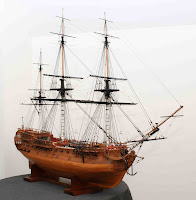
Model on view at the Jones cottage in Scotland.

Nor did I know that Jones was largely forgotten in the United States after his death in Paris in 1792 (even citizenship was bestowed upon him posthumously). The American minister to France, Gouverneur Morris, couldn't be bothered to attend his funeral, or to appropriate funds for a burial befitting the "Father of the United States Navy." 

ENTER HORACE PORTER

Horace Porter is well known to most students of the Civil War. A well-heeled West Point graduate, third in the class of 1860, he began his war service on the southeastern seaboard, at Fort Pulaski, and Secessionville, and by the summer of 1862 was on the staff of Maj. Gen. George McClellan with the Army of the Potomac. After Antietam, he went to the West, to General Rosecrans's staff, was at Chickamaugawhere he earned a Congressional Medal of Honorand Chattanooga, where he eventually became attached to the headquarters of Ulysses S. Grant.
Horace Porter
Porter, whose successive brevet promotions took him all the way to brigadier-general by war's end, served on and off with Ulysses S. Grant for the next 11 years, from the summer of 1864 to 1873, and remained close to Grant for the rest of Grant's life. After the war, he was Assistant Secretary of War under interim Secretary Grant (1867-1868), and President Grant's Executive Secretary (1869-1873) during the White House years. His 1897 memoir, Campaigning with Grant, is a mainstay in Civil War studies, being first published serially in "The Century." It is accurate in the main, but, typical of the genre, contains many post-war embellishments. Shortcomings aside, Porter's glimpse's of Grant behind the scenes, and his recollections of the wind down-to Appomattox, should be read by anyone interested in primary accounts of some of the most dramatic moments in the Civil War.

I knew all about Porter's Civil War service, but being so long preoccupied by the Civil War years in my reading, Porter's life for me pretty much began in 1860 and ended at Appomattox. I don't know why that is, but it's often a revelation to learn that someone you thought little about in the Civil War era had a long and interesting life, with achievements wholly unrelated to "the Late Unpleasantness." That reminds me. Back in 2007 I did a blog post about officers who survived the war, but died of something other than natural causes after the war, by surveying entries in Eicher & Eicher's, Civil War High Command. Have a look: "When Luck Runs Out."

Back to the story. Porter's service to his country did not end with the Grant administration. For eight years beginning in 1897, he was the United States Ambassador to France. For the last six of those years, of his own accord, he oversaw an exhaustive search for the long lost grave of the American naval hero John Paul Jones. After an ill-fated stint in the Russian Navy, Jones had returned to France in slowly declining health, finally succumbing to multiple health issues in his Paris apartment on July 18, 1792, nearly 13 years after the Bonhomme Richard slipped beneath the waves of the North Sea.

Through the generosity of a French aristocrat, he was buried in an more costly, tightly-sealed lead coffin, and preserved in alcohol, should the Americans ever come looking for their great seaman. But the Americans never came. In time, the cemetery land where Jones was buried was put to other uses in the ever-growing City of Lights, mostly built over, and even the names of the surrounding streets had been changed between Jones's death and Porter's eventual discovery of the site in 1905.
Map of the St. Louis Cemetery showing the 1792 street names and the 1905 names. The cemetery itself is about 120 feet long on Rue de la Grange aux Belles and 130 wide. The oblong mark shows Jones' coffin. The higher courtyard was not used for burials. By 1905 both were built upon. —Sons of the American Revolution site:
Porter, who himself was descended from an officer in the Continental Army (his grandfather was Andrew Porter), launched the search for Jones's remains without any prompting from his government, and at his own expense. By the time he discovered the cemetery and began negotiations with landowners for access, then-president Theodore Roosevelt asked Congress to appropriate funds for the excavation, but the money was not forthcoming for many years. Porter lamented the treatment Jones had received after death, writing, 
After having studied the manner and place of his burial and contemplated the circumstances connected with the strange neglect of his grave, one could not help feeling pained beyond expression and overcome by a sense of profound mortification. Here was presented the spectacle of a hero whose fame once covered two continents and whose name is still an inspiration to a world-famed navy, lying for more than a century in a forgotten grave like an obscure outcast, relegated to oblivion in a squalid corner of a distant foreign city, buried in ground once consecrated, but since desecrated by having been used at times as a garden, with the moldering bodies of the dead fertilizing its market vegetables, by having been covered later by a common dump pile, where dogs and horses had been buried, and the soil was still soaked with polluted waters from undrained laundries; and as a culmination of degradation, by having been occupied by a contractor for removing night-soil.
Amazingly, Jones's lead coffin was located, and his remains were remarkably well preserved. For an interesting account of "The Two Burials of John Paul Jones," see this website with its many worthwhile links.

President Roosevelt, eager to make the United States into a naval power second to none and cognizant of the patriotic fervor that could be built up around the repatriation of Jones, was eager to bring home the remains of the naval icon. After much pomp and circumstance in Paris, Jones's body was shipped to his adopted home on a 13-day voyage ending with a parade of naval vessels up the Chesapeake Bay to Annapolis. Horace Porter, as he had done at the dedication of Grant's tomb, gave a speech in an elaborate ceremony at the United States Naval Academy on April 24, 1906, welcoming the hero home. It would be another seven years before Congress settled on Annapolis as Jones's final resting place, and there, beneath the chapel, his sepulchre was built. Information on visiting Jones's crypt can be found here.  At the base of the tomb, his epitaph reads:
JOHN PAUL JONES, 1747-1792

U.S. NAVY, 1775-1783
HE GAVE OUR NAVY ITS EARLIEST TRADITIONS
OF HEROISM AND VICTORY

ERECTED BY THE CONGRESS, A.D. 1912


Now, having read a sampling of Jones's own writing, reported in Thomas's biography, I know that Jones was not larger than life, but he was certainly full of life, a fierce, proud warrior, fearless on the open sea. He's still my hero.

Monday, September 19, 2011

Letterman on the Civil War


Thursday, May 15, 2008

TOP TEN SIGNS YOUR TEACHER IS DRUNK

Number 9:
  Insists the Civil War was fought between Jack Daniel and Jim Beam

Thursday, April 8, 1999
TOP TEN WAYS TO MAKE GOLF MORE EXCITING

Number 3:
  New hazard: Civil War re-enactments. 

Monday, May 2, 1994
TOP TEN SIGNS YOU'RE NOT GOING TO GRADUATE

Number 9: 
In essay on Civil War you wrote about Tom and Roseanne break-up
 
(for complete listings, click on the title of each top ten list) 

Was Nicolas Cage a vampire during the Civil War?

This imaginative eBay listing has since been removed. Perhaps the item was sold. The original auction was entitled, "Nicolas Cage is a Vampire / Photo from 1870 / Tennessee," with an asking price of $1,000,000. Imagine what it would be worth if you could get Cage to sign it. (Thanks to my brother for bringing this supernatural item to my attention.)
Original c.1870 carte de visite showing a man who looks exactly like Nick Cage. Personally, I believe it's him and that he is some sort of walking undead / vampire, et cetera, who quickens / reinvents himself once every 75 years or so. 150 years from now, he might be a politician, the leader of a cult, or a talk show host.
This is not a trick photo of any kind and has not been manipulated in Photoshop or any other graphics program. It's an original photo of a man who lived in Bristol, TN sometime around the Civil War.

I've had a lot of questions asking where I purchased this. As followers of
my website know, I collect antique memorial photography - images of dead people - from the 1800s. This photo was found in the very back of album that contained an unusual number of Civil War era death portraits (which is why I purchased it). All of the other people in the album, living and dead, were identified by name - this man was not.

Saturday, September 17, 2011

Reviews Forthcoming

George Crook: From the Redwoods to Appomattox, Paul Magid (University of Oklahoma Press, 2011).

Shooting Soldiers: Civil War Medical Photography by R.B. Bontecou, Stanley B. Burns, M.D. (Burns Archive Press, 2011)

Dakota Dawn: The Decisive First Week of the Sioux Uprising, August 17-24, 1862,
Gregory F. Michno (Savas Beatie, 2011).

Sunday, September 04, 2011

Friday, August 26, 2011

Yes Virginia, you can produce regular, lengthy blog entries and still find time to write a book

There are too many Civil War books to keep up with (or catch up with) these days, so one has to be fairly discerning about how to fill those precious few hours available for reading (it's hard enough to keep up with all the blogs). But even though his Facebook entries evince a startlingly pronounced and deeply disconcerting [New York] Yankee bias, I'm going to take time to read Brooks Simpson's newest work from Praeger's, "Reflections on the Civil War Era" series. Reflections should always be characterized by well-informed and well-considered opinions, and I'm confident Simpson won't disappoint on that score, whether or not you concur with his observations. 

P.S. I can see what the dust jacket designer was going for with the Grant image on top, and the Gettysburg map below, the Civil War in the East, of course, but you just know some reviewer is going to count coup by pointing out Grant wasn't at Gettysburg.

Tuesday, August 23, 2011

Georgia Adds Swastika, Middle Finger To State Flag

I don't know how I missed this controversial story from the late 1990s. It must have gotten lost in a busy news cycle.


Tuesday, August 16, 2011

Ed Bearss' favorite Civil War books

No, Ed did not mention a book on Glorieta Pass in his top five, but I'll bet you he read this one, and thought highly of it. On his tours of Glorieta and Valverde, no doubt he crossed paths with the late historian Don Alberts, who sadly passed away from Parkinson's in November of 2010. I love the New Mexico desert, and I love Don's book on Glorieta (read Don's account of the battle at the Civil War Trust website).

I started thinking about Don's book when I stumbled upon this link over at the fine "Past in the Present" blog, a Billings Gazette article that asked Ed Bearss to list his five favorite Civil War books. I was very curious to see what Ed would list, since these kinds of things are so subjective, and imagining what any one person would say after a lifetime of study is difficult. Battle Cry of Freedom and Grant's memoirs are unassailable choices. I imagine a great many people would list them as a "must" for any top five ranking. I do.

I was interested to see the Sears' book on Gettysburgwhich I have not readmake the list for best book on a single battle. Now I feel like I have to read it, though before today my chances of getting around to it were less than 50-50. Still waiting on my metaphorical nightstand is Steven Woodworth's single volume Gettysburg history, Beneath a Northern Sky (about which Jeffrey Hall wrote a fairly penetrating review).

Invariably at some point when reading a book by Sears, I find myself distracted by the author's emotional reaction to one thing or another, one officer or another. Since McClellan was not at Gettysburg, perhaps the distractions of his book on that subject are more fleeting. I should say that Sears' book on Antietam, Landscape Turned Red, was one of the truly seminal books in my own Civil War reading. Powerful stuff. I might have included it in my own top five had I re-read it any time in the last 15 years. I can't really remember it that well now. His Seven Days book is a great contribution.

For personal gratification, I was hoping Bearss would name Mark Bradley's book on Bentonville, Last Stand in the Carolinas, which I assembled in Quark on my Mac in the dining room of our then Santa Clara apartment. Ed did make it known he considers Mark's tome a landmark work. I won't take issue with Ed's choice of Killer Angels, only say that it's a gripping story the first time you read it, but harder to revisit the more you learn about the Civil War. At least that was my experience.

Of course picking five "favorite" books from a list of literally thousands of titles is pretty impossible, like naming your favorite five novels of the 20 century, or favorite five movies of the last 40 years. But like Rob in Nick Hornby's brilliant novel (later movie) High Fidelity, ranking items in lists is something we are inclined to do as a way to get a handle on things.

My five favorite Civil War books (not counting reference works, for which I have an inordinate fondness)? I thought you'd never ask. One has to distinguish between "favorite" and "indispensable." Edward Porter Alexander's, Fighting for the Confederacy is indispensable, and a good read, but I guess I wouldn't rank it among my top five favorites. Likewise, Charles Roland's, The American Illiad is my favorite concise single-volume history, but you can't have two single-volume histories in your top five, can you? Isn't there a rule about that? Anyway, if it's Monday, then the list must read this way:

1. Battle Cry of Freedom, by James McPherson
2. Memoirs of Ulysses S. Grant
3. Decision in the West, the Atlanta Campaign of 1864, by Albert Castel
4. A Stillness at Appomattox, by Bruce Catton
5. The Battle of Glorieta, Union Victory in the West, by Don E. Alberts

What's your top five, just off the top of your head?

Friday, August 12, 2011

The Civil War Documentary - A Documentary

"We were about one hour into the Civil War, we all figured things were going pretty well, but naturally we wondered how much longer it would all last. Some of us thought an hour. Some thought two. We little suspected the Civil War would drag on for more than 11 hours"

Wednesday, August 10, 2011

The Hunley is Upright

"The first submarine in history to sink an enemy warship is upright for the first time in almost 150 years, revealing a side of its hull not seen since it sank off the South Carolina coast during the Civil War." (AP) Read about it here. 

Photo gallery is here (AP Photos: Bruce Smith).

Meanwhile, progress continues on preserving remnants of the U.S.S. Monitor.

Friday, July 29, 2011

Mary's life didn't end when John was hanged

Mary Brown with daughters Annie (left) and Sarah (right)
in 1853, Vernon, New York (Library of Congress)


John Brown's son, Salmon
I was surprised, some years ago, to learn that Mary Brownthe 2nd wife of John Brown of Bloody Kansas and Harpers Ferry fame, and his wife at the time of his executionwas buried in my "back yard," in the South [San Francisco] Bay town of Saratoga, in the hills southwest of San Jose. Surprised, too, to learn that she taught English to Japanese migrant workers in the Santa Clara Valley (today more often referred to as Silicon Valley, where remnants of the once-endless orchards still survive as isolated fruit trees in fenced-off back yards).

I wasn't surprised that she had made her way to the western end of the continent in the years after her husband was hanged in Charles Town, West Virginia. According to a direct descendant, Mary Brown and her childrenand a stepson, Salmon, from John's first wifemoved to California to let their families experience a life "out of the shadow of John Brown."

I was surprised because I'd never heard about it beforesurprised that in an area so enamored of its history, not many people beyond the local historical society know that the widow and other family members of the man author Tony Horwitz describes as "the most successful terrorist in American history" is resting peacefully in this beautiful and affluent Northern California suburb.

It wasn't always thus, of course. As is the way with history, things are forgotten over time. Her presence in Californiafirst in Red Bluff, then up amongst the giant coastal redwoods in Rohnerville with daughters Annie, Sarah, and Ellen, and next door to Salmon Brown and his familywas well known and widely reported in her day. Daughter Annie reportedly served as her father's secretary during at least part of his anti-slavery campaigns. During the centennial of the Harpers Ferry raid, on October 18, 1959, the San Francisco Chronicle wrote that Annie "had, when but 16, assisted Martha Brown, wife of John Brown's son, Oliver, with the cooking at the Kennedy farm, where the daring maneuver was prepared" (this from Jessie Faulkner at the Humboldt County Historical Society).

In 1881, about three years before her death, Mary Brown relocated to Saratoga, in the foothills of the Santa Cruz mountains, and is buried in Madronia Cemetery along with her daughters Sarah and Ellen.

To the end of her days, it seems, she was both harassed by enemies of her late husband (even having to outrun southern vigilantes on the Oregon Trail, by one account) and warmly embraced by his supporters (supported financially to some degree by well-heeled abolitionist literary figures like Thoreau and Emerson), wherever she went. The latter outnumbered the former in this Far West Union state. Check out this blog entry about John Brown's great-great-great-granddaughter, Alice Keesey Mecoy, speaking about her famous ancestor. "'I didn't know I was related to him until I was 16,' Alice Keesey Mecoy said Sunday to a packed room at the Saratoga History Museum. 'I said, What? I'm related to this crazy man?'"

In 2009, dirt from Mary's grave in California and John's in North Elba, New York, were commingled. 

I enjoyed a number of hours reading material at this excellent John Brown blog, which includes considerable information on Mary Brown.

This Allies for Freedom website has lots of interesting information on Mary Brown and her family in California.

Wednesday, July 13, 2011

The 9/11 of 1859

Vivenne Flesher and Ward Schumaker
Author Tony Horwitz wrote this NYT Op-Ed piece in December of 2009, on the subject of his forthcoming book about John Brown's raid on Harpers Ferry (Midnight Rising, John Brown and the Raid That Sparked the Civil War, coming from Henry Holt in October of 2011).

The "9/11 of 1859" essay can be read in its entirety here. Scroll down at this page of the publisher's site to hear a five-minute audio from Horwitz discussing what he was trying to accomplish in writing the book.

Here's an earlier (October 2010) Horwitz Op-Ed piece on the enduring Civil War, "The 150-Year War."

Charles Town, W. Va.
ONE hundred and fifty years ago today, the most successful terrorist in American history was hanged at the edge of this Shenandoah Valley town. Before climbing atop his coffin for the wagon ride to the gallows, he handed a note to one of his jailers: “I, John Brown, am now quite certain that the crimes of this guilty land will never be purged away but with blood.”
-- from "The 9/11 of 1959"

Thursday, July 07, 2011

Midnight Rising: John Brown and the Raid That Sparked the Civil War


I extend a hearty thank-you to my history-major neice Susan for bringing this forthcoming Horwitz volume to my attention. First, let me say how gratified I am that there are still history majors, and that I am related to one of them. Second, let me say how excited I am that Horwitz took on the John Brown raid. Like many a Civil War buff, I enjoyed his Confederates in the Attic, and his talent as a writer and a journalist caused me to follow his efforts afterwardshis chronicling of Captain Cook's adventures (Blue Laditudes), and I did download, on the advice of the aforementioned Susan, his most recent book, A Voyage Long and Strange.

Not everyone cares for Horwitz's style, but I like it. I love the conflation of serious journalist, history enthusiast, and travel writer in his narrative voice. I don't even care if he turned to John Brown to capitalize on the sesquicetennial fervor (even if he's behind the date on the John Brown raid). I'm going to give him the benefit of the doubt, having never been disappointed thus far. It's also a perfect segue to my forthcoming blog post on John Brown's wife, Mary.

Wednesday, July 06, 2011

Google Earthing the Civil War


Look at the neat things Andy Hall has done with Google Earth over at his consistently interesting Dead Confederates blog. Through "image overlay," and careful scaling of the original to align with the Google image (when will someone come up with an App that scales these images for you?), one can get a reasonably accurate look at how a historic image fits into today's satellite view. Pretty damn cool. Have at look at what he did with the location of Henry Wirz's gallows (at the Old Capitol Prison -- see the full essay on the Wirz Execution photos here) in relation to today's U.S. Supreme Court building. Likewise, the overlay of 1865 Galveston
with the modern view. The application of Google Earth tools to historic documents is as unlimited as our nearly infinite capacity for avoiding doing any real work (or as Andy put it, the functionality is limited only by the imagination of the user). 

Thus far, with respect to Google Earth, my imagination was limited to creating three Civil War quizes in which participants view an overhead view of a part of a battlefield or significant landmark -- just out of context enough to be disorienting for some -- and try to guess the Civil War location. If you haven't given it a shot yet, links to the quizes and answers are given below. Quiz #1 centers on fairly famous battlefield features, without clues, while the subsequent two quizes include more-or-less useful clues. 

Google Earth Quiz Number One is here -- Answers to Quiz One are here
Google Earth Quiz Number Two is here -- (the answers for Quiz Two are found in the last of the 3 comments attached to that post).
Google Earth Quiz Number Three is here -- Answers to Quiz Three are here