Thursday, May 19, 2011

Five Myths About Why the South Seceded

ALEXANDER GARDNER/ AP - A photograph of Abraham Lincoln taken
by Alexander Gardner in Washington in August of 1863.
Lies Across America author, James W. Loewen, dispenses with some enduring misconceptions about secession in this piece for the Washington Post. 
As the nation begins to commemorate the anniversaries of the war’s various battles — from Fort Sumter to Appomattox — let’s first dispense with some of the more prevalent myths about why it all began.
(1) The South seceded over states’ rights.  (2) Secession was about tariffs and taxes.  (3) Most white Southerners didn’t own slaves, so they wouldn’t secede for slavery.  (4) Abraham Lincoln went to war to end slavery.  (5) The South couldn’t have made it long as a slave society.
Loewen's offers up his reasons for each point.  


Tuesday, May 10, 2011

"The Foolishness of Civil War Reenactors," by Glenn W. LaFantasie

Though I'm a regular reader at Salon.com, I just learned of this article by visiting Andy Hall's excellent Dead Confederates blog. 


Monday, May 09, 2011

The Battle of Bentonville, North Carolina

The people have spoken. Every year a dedicated contingent of long-time members of the Civil War Forumalong with a handful of welcome newcomers to the groupmeet at a different battlefield for three days of battlefield tramping, good food, and good company. Next year, the group has voted to visit North Carolina. Mark your calendars.

16th Civil War Forum Battlefield Conference
The Battle of Bentonville
Wilmington & Fort Fisher
March 29 to April 1, 2012
Headquarters: Dunn, NC

Mark Bradley, author of the definitive campaign study, The Battle of Bentonville: Last Stand in the Carolinas, will guide us through Averasboro and Bentonville, and Chris Fonvielle, author of The Wilmington Campaign: Last Rays of Departing Hope, will handle the Forts Fisher and Anderson tours. Additionally, we'll visit the Monroe's Crossroads battlefield on the grounds of Fort Bragg.

Check out the Civil War Trust's Bentonville and Fort Fisher pages for maps, articles, and other resources.
We'll do things a little bit differently next year, in that I'll most likely book the bus for three full days, reserving the last day for the long ride to Wilmington and back (Sunday, April 1st). For that trip, we'll put on a Civil War movie and pull out the refreshments, to include copious amounts of adult beverages.

We'll be headquartered at a hotel in Dunn, North Carolina, which is about an hour from the biggest airport in the region (Raleigh), and close to the battlefields. Stay tuned for hotel info and final itinerary. Let me know if you'd like to receive registration information by email.

Friday, May 06, 2011

End of the line for Lincoln

Dockworkers prepare to receive the Lincoln
as it arrives at the Mare Island shipyard in Vallejo.
----------
A gray old ship, the Lincoln, that is part of San Francisco's maritime past was towed up the bay Thursday on a final voyage to be scrapped at Mare Island in Vallejo. . . .

The trip was part of an unusual nautical swap in which the government traded the Lincoln for its identical sister ship, the President. Both vessels will be scrapped: one of them in Texas, the other in Vallejo. 

The two ships - originally named President Lincoln and President Tyler- were built in San Francisco in 1961 and sailed out of the city on voyages all over the world for years. They were general cargo ships, operated by American President Lines, a company that traces its roots to the Gold Rush of 1849.
----------
Read the full article here.

Sunday, May 01, 2011

How the "Lost Cause" poisoned our history books


Ulysses S. Grant, the commanding general of the Union Army and the 18th president of the United States, would have been 189 years old last week--not long after the "official" opening of the Civil War Sesquicentennial, which will run through 2015.
Grant -- like George Washington and Dwight D. Eisenhower -- was both a professional warrior of a defining war and a twice-elected president. And like Washington and Eisenhower he dominated his era, which in his case encompassed both the Civil War and its aftermath, called Reconstruction, from 1862 (when he rocketed to fame with his defeat of Confederate forces at Fort Donelson) to 1876.
 Read full article here

Thursday, April 28, 2011

Was one of your ancestors lost on the U.S.S. Monitor?

The skeleton to the left, victim “Monitor 2,” is shown
by digital overlay where it was uncovered after the photo
of the first victim was taken. (Monitor Collection, NOAA)
The United States Navy would like to identify the remains of two men found in the turret of the U.S.S. Monitor -- two of the 16 officers and crew who went down with the ship on New Year's Eve, 1862. If you think you might be a descendant and are willing to produce some DNA, contact  Jeff Johnston at (757) 591-7351, Jeff.Johnston@noaa.gov. Thanks to Robert Moore for highlighting this article at Civil War News

List of Monitor casualties:

OFFICERS:
Attwater, Norman Knox: Acting Ensign
Frederickson, George: Acting Ensign
Hands, Robinson Woollen: 2nd Asst. Engineer
Lewis, Samuel Augee: 3rd Asst. Engineer

ENLISTED AFRICAN-AMERICAN:
Cook, Robert: 1st Class Boy (b. Gloucester County, VA)
Howard, Robert H: Officers’ Cook (b. Howard County, VA)
Moore, Daniel: Landsman (b. Prince William or Loudoun County, VA)

ENLISTED WHITE:
Allen, William: Landsman (b. England) 24 yrs.
Bryan, William: Yeoman (b. New York City) 31 yrs.
Eagan, William H: Landsman (b. Ireland) 21 yrs.
Fenwick, James R: Quarter Gunner (b. Scotland) 23 yrs.
Joyce (Joice), Thomas: 1st Class Fireman (b. Ireland) 23 yrs.
Littlefield, George: Coal Heaver (b. Saco, ME) 25 yrs.
Nicklis (Nickles), Jacob: Seaman (b. Buffalo (?), NY) 21 yrs.
Stocking, John: Boatswain’s Mate (b. Binghampton, NY) 27 yrs.
Williams, Robert: 1st Class Fireman (b. Wales) 30 yrs.

Monday, April 25, 2011

The Civil War: 1861 (Forever)

Get these nifty Civil War postage stamps (commemorating Ft. Sumter and First Bull Run) while they last. Avoid long lines and surly civil servants by ordering them online.

Wednesday, April 20, 2011

"The Apostle of Liberty" and The Gipper

Thomas Starr King

Ronald Reagan
under the rotunda
For most of the 20th century, California was represented in the United States Capitol's National Statuary Hall by the likenesses of Father Junipero Serra, and the Unitarian preacher Thomas Starr King. King, as much as any one figure and much more than most, helped keep California in the Union (the state's popular vote totals were close among the top three candidates in 1860: Lincoln: 38,733, Douglas: 37,999; Breckinridge: 33,969). Thomas Starr King was a dedicated anti-slavery campaigner who helped put Leland Stanford in the governor's office, and who traveled the state giving fiery orations in defense of the Union. According to one source, "King covered his pulpit with an American flag and ended all his sermons with 'God bless the president of the United States and all who serve with him the cause of a common country.'" 

Alas, King's contributions to the state of California, and to the maintenance of the union, are no longer celebrated as they once were (though you can follow the Thomas Starr King Appreciation Society on Facebook, with its 110 members, hike two mountains named for him, and admire his namesake tree at Yosemite). In 2006 the California state legislature voted to recall King's statue from the National Statuary Hall and replace it with one of Ronald Reagan, a former Des Moines radio broadcaster. There was no public discussion about such a monumental change. No debate about whether John Muir, or Joe DiMaggio, or Earl Warren, or Jerry Garcia might have been more appropriate.  

The statue of "the orator who saved the nation" eventually found a new home in the Civil War Memorial Grove of Sacramento's Capitol Park. According to the Capitol Museum, the grove was planted
beginning in 1896 to the east of the capitol with saplings collected from Manassas, Harpers Ferry, Savannah, Five Forks, Yellow Tavern, and Vicksburg, and ultimately 34 other battlefields. The brainchild of GAR ladies from California and Nevada, the grove was intended to honor soldiers from both sides of the conflict, and was the first monument on the capitol grounds. 

Thomas Starr King's tomb, Starr King Way and Franklin, San Francisco
If it were up to me, I would have recalled Serra's statue from Washington (even if he is one miracle away from sainthood), and left King's -- Serra died in 1784, 66 years before California statehood. I was not consulted. Interestingly, the Californians of 1927 who voted to include King as one of the two most notable representatives chose a man who only lived in the state for four years. He arrived in San Francisco on the eve of the war in 1860, and died in March of 1864. 

King Statue, Sacramento


Monday, April 18, 2011

1861: The Civil War Awakening

Unidentified soldier in Union officer's uniform at Point Lookout,
Tennessee. (Liljenquist Family Collection, Library of Congress)


Slate published an interesting interview with Adam Goodheart on Friday. He is the author of the brand-new 1861: The Civil War Awakening, and is a main contributor to the New York Times Disunion blog. Go to the Slate article and launch the slide slow for some select images from the Liljenquist collection that was recently donated to the Library of Congress. 

Slate: Americans have a sense of the whole scope of the Civil War, but what is it about the year 1861 that we miss when we look back and see the Civil War as a single complete event?

Goodheart: We tend to think of the Civil War in a very fatalistic way, as a sort of vast national martyrdom. It's hard to recover the fact that things could have turned out very, very differently. It's also hard to grasp the idea that Americans at the beginning of the war had no sense of the way that things were going to unfold. When I wrote the book, I really wanted to recover that moment of uncertainty and change – to convey how people, then and now, experience history not as seen from 30,000 feet as the History Channel might, but as a barrage of individual events coming at them, alternately thrilling and terrifying.

Wednesday, April 13, 2011

Seven Days Travelogue, part two

History is all explained by geography.
— Robert Penn Warren

Dateline: Princeton-by-the-Sea, California

So this is what a blog post from an iPad looks like in Blogspot. If there's an app out there that allows one to compose with more sophisticated formatting, I've not found it yet. Might have to go back and format this after the fact. For now, I'm just happy to be able to dock the iPad on a full size keyboard.

The last two days of the 15th Civil War Forum Battlefield Conference transpired without a hitch. It was a beautiful thing to walk out into the heart of the Glendale battlefield and listen to Bobby Krick read personal accounts related to the particular plot of protected land we were standing upon.

After a spectacular lunch of fried chicken at the Elko Community Center, done up only as country church ladies can do, the balance of the afternoon was spent at Malvern Hill. Revelations abounded as we walked the Confederate assault route to the "high water" mark near the site of the slave cabins, and ultimately moved into a swale on the Confederate left to experience first-hand how two separate and parallel fights occurred out of sight of each other. Reading a description of that phenomenon is fine, but seeing it is to understand it.

At the close of the day, we stopped at the Jeb Stuart monument at Yellow Tavern, mere yards from our hotel, for a short talk on the 1864 fighting there. Sunday morning was warm and sunny, with great visibility, just perfect for our visit to Drewry's Bluff and Battery Dantzler. For decades I've pictured that stretch of the river below the guns at Drewry's Bluff, images evoked from countless written accounts, but this was the first time I was able to commit the actual view to memory.

Now I'm 3,000 miles away again, in a small fishing village overlooking the old Romeo Pier and planning next year's conference. The votes are in, and we're headed to Bentonville and Fort Fisher in 2012. Invitations are already out to guides Mark Bradley and Chris Fonvielle.

Friday, April 01, 2011

Seven Days Travelogue, part one


[CONFERENCE] Day One -- twenty or twenty-five of us met up with author and researcher Chris Ferguson at the South Cherry Street entrance to Hollywood Cemetery, and spent the next three hours hiking and driving through the graveyard with numerous stops to hear Chris relate the history of the cemetery, and stories about individuals buried there. Best quotes came from the records of the Old Soldiers Home, regarding the antics of a spritely and heavily-armed 80-year-old. 

[CONFERENCEDay Two
-- Mechanicsville through Gaines's Mill with Bobby Krick, the best tour guide we've had in 15 years of conferences, and we've had many of the best that Civil War battlefield touring has to offer, including his father. I don't say that lightly. He's the consummate pro -- aware of his audience, able to distill an exceedingly complex campaign into a comprehendable narrative, with a perfectly engaging delivery and an absolute command of the subject matter. But it's more than that. There's a long list of qualities, some intangible, that I would highlight in recommending him to anyone else. 


Highlight of the day: the Civil War Forum, thanks to the brand-new acquisition by the Richmond Battlefields Association, became the first group to traverse the Gaines's Mill battlefield in the tracks of the 4th Texas Infantry, starting on the Confederate side of the creek, descending into the creek bottom and crossing on a rudimentary "Krick bridge," before scaling the slope to the site of the Confederate break-through. The yellow box on this Richmond Battlefields Association map shows the new parcel acquired by RBA, the first preservation success at Gaines's Mill since Douglas Southall Freeman and friends purchased a small part of the battlefield in the 1920s (and the first piece on the CSA side of Boatswain's Creek to be locked off from development). 


Friday night Bobby gave a fascinating talk on "Drewry's Bluff, Gibraltar of the Confederacy," making us all realize how little we actually knew about that otherwise commonly known story.


Tomorrow: all the way to Malvern Hill, and beyond.

Friday, March 25, 2011

Kunta Kinte's worst nightmare

Thanks to Kevin Levin at Civil War Memory for bringing this series of  collectibles to our attention. Buy the courthouse and get the R. E. Lee figurine for free. Buy Confederate Station and they'll throw in Stonewall Jackson. 


It's not as realistic as this photo of Richmond in ruins, but then I don't suppose the intended audience wants a free figurine of Presdient Lincoln, surrounded by joyous slaves, strolling over to the White House of the Confederacy to rummage through Jeff Davis's desk. 


Thursday, March 03, 2011

One of last 2 WWI veterans turns 110 in Australia

By ROHAN SULLIVAN  The Associated Press
Wednesday, March 2, 2011; 10:50 PM


SYDNEY -- One of the last two known veterans of World War I celebrated his 110th birthday Thursday with at least three generations of family and a contingent of navy officers in dress uniform. His daughter said he didn't want a fuss. Claude "Chuckles" Choules, who sneaked into the British navy in 1915 aged just 14, has lived quietly in Australia for more than 80 years, though his longevity has brought him closer to history with the passing of each comrade who fought the war that was meant to end all others.

They say the last Civil War veteran died around 1959, the year I was born. Now, a mere half century later, my grandfather's generation of WWI veterans are down to two (that we know of). History is a work in progress. Every day we watch it unfold, and the events of today are profound even if we cannot discern the ramifications. The nightly news is nothing short of astonishing. Not the Charlie Sheen part. The medical and technological advances part. The revolutions in the Middle East part.

Thursday, February 10, 2011

Tour of the Seven Days Battlefields

The Seven Days Battles
with Richmond National Battlefields Historian
Robert E. L. Krick
The 15th Civil War Forum
Battlefield Conference
Richmond, Virginia
March 31-April 3, 2011

There's still room to join us on a spectacular weekend of battlefield tramping with the most authoritative guide on the Seven Days battles, the culmination of the Peninsula Campaign of 1862 and a major turning point in the war. We have 40-some souls signed up so far, and will cut off registration when we fill our coach (either a 44- or a slightly larger coach).

ITINERARY:
Thursday afternoon, March 31st:
WALKING TOUR: 1:00-4:30 p.m.
a guided stroll with narrative interpretation through Hollywood Cemetery with historian Chris Ferguson (see bio below)we'll carpool from the hotel. Gather in the hotel lobby at 12:30 p.m. prepared to leave by 12:45 p.m.
No evening event scheduled for Thursday night.

Friday: April 1st:
BUS TOUR: 8:30 a.m. to 4:30 p.m.
Dabbs House (Lee's HQ); Meadow Bridges; Mechanicsville battlefield; lunch at Cold Harbor County Park; Gaines's Mill battlefield (extensive walking here); to close the day, we'll take the opportunity to stop at Yellow Tavern, since our hotel is on the edge of the battlefield, and the Stuart monument is less than a mile away and hard to find for most folks on their own.
RECEPTION: 6:00 p.m. to 7:00 p.m. (Yellow Tavern Bar, in the hotel)
DINNER: 7:15 p.m. (Glen Restaurant -- in our reserved seating area)
AFTER-DINNER SPEAKER: 8:00 p.m. (York Room)
Robert E. L. Krick, on "Drewry's Bluff:  Gibraltar on the James"

Saturday: April 2nd:
BUS TOUR: 8:30 a.m. to 4:30 p.m.
Savage's Station; White Oak Swamp; lunch at Elko Community Center, Frayser's Farm/Glendale (only recently accessible thanks to CWPT); and Malvern Hill (extensive walking here).
RECEPTION: 6:00 p.m. to 7:00 p.m. (Yellow Tavern Bar)
DINNER: 7:15 p.m. (Glen Restaurant -- in our reserved seating area)
AFTER-DINNER SPEAKER: 8:00 p.m. (York Room)
John Coski, "After the Seventh Day They Rested"
John is the Historian and Director of Library & Research,
Museum of the Confederacy, Richmond, Virginia

Sunday: April 3rd:
OPTIONAL car pool tour: 9:00 a.m. to noon:
Drewry's Bluff and Battery Dantzler (the two best sites between Richmond and Petersburg)
Gather in the hotel lobby at 8:30 a.m. for 8:45 a.m. departure.

REGISTRATION:
$295
includes Thursday, Friday, Saturday, and Sunday tours
—includes box lunches on Friday and Saturday
—includes buffet dinner and after dinner speakers on Friday and Saturday evenings
Breakfast is not included, but you'll receive a discount voucher when you check in. No formal meeting is scheduled for breakfast, but we will still have a reserved seating area from 7:00-8:00 a.m. for anyone who has breakfast in the restaurant]
[Registration does not include lodging]
Pay by check or money order, or credit card via PayPal (request a PayPal invoice)
Mail checks or money orders (made out to David Woodbury)
to: Civil War Forum
P.O. Box 19130
Stanford, CA 94309


HOTEL ACCOMMODATIONS
Wyndham Virginia Crossings hotel and conference center
1000 Virginia Center Parkway
Glen Allen (Richmond), Virginia 23059
http://www.wyndhamvirginiacrossings.com/
Cost: $99 (with tax, it comes to 111.87 per night)

Most attendees will check into the hotel Wednesday evening (3/30/11) and check out Sunday morning (4/3/11).

RESERVATIONS: Individuals will be responsible for their own reservations. Reservations will be accepted over the telephone by calling (804) 727-1400 or (888) 444-6553 and referencing “15th Civil War Forum Battlefield Conference.” Book your rooms!

 Our Tour Guides:

Robert E. Lee Krick is a historian at the Richmond National Battlefield, and is recognized as one of the nation’s leading authorities on the Peninsula Campaign of 1862, and the Seven Days battles, as well as many other aspects of the Civil War in the East. He is the author many articles, as well as a regimental history of the 40th Virginia Infantry.

Bobby Krick is also author of a well-regarded reference work, Staff Officers in Gray: A Biographical Register of the Staff Officers in the Army of Northern Virginia, which profiles over 2,000 officersa fine companion on your bookshelf to his father’s Lee’s Colonels. Check out this interview with Bobby Krick at the Civil War Preservation Trust website. More Malvern Hill videos, maps, and other resources from the same site.


Chris Ferguson is a native of Atlanta, Ga., currently residing in Winchester, Va. with his wife of 30 years and their beloved cat Romeo. He's a graduate of Georgia State University, BS: Criminal Justice, 1977, and is presently Vice President with Zwicker & Assoc., P.C., a national law firm based on Andover, MA. He is the author of two books covering the Confederate dead in Hollywood Cemetery, and co-author, with Robert K. Krick, of the Gettysburg Death Roster. He is also the author of numerous articles covering Confederate dead removed from Virginia battlefields.

Wednesday, January 26, 2011

This just in (from Civil War Preservation Trust)


WALMART DROPS WILDERNESS PLAN


In an unexpected development on the day that a trial was scheduled to begin in the case, Walmart announced that it has abandoned plans to pursue a special use permit previously awarded to the retail giant for construction of a supercenter on the Wilderness Battlefield. 
“We are pleased with Walmart’s decision to abandon plans to build a supercenter on the Wilderness battlefield,” remarked James Lighthizer, president of the Civil War Trust.  “We have long believed that Walmart would ultimately recognize that it is in the best interests of all concerned to move their intended store away from the battlefield.  We applaud Walmart officials for putting the interests of historic preservation first.  Sam Walton would be proud of this decision.”

Monday, January 24, 2011

Tarnished Reputations


Five years ago, I posted a blog entry entitled “Eagles, Scalpels, Reputations – all tarnished,” as a clever way to discuss three of Dr. Thomas Lowry’s books, The Story the Soldiers Wouldn’t Tell, Tarnished Eagles, and Tarnished Scalpels. These three and other titles are the product of his prodigious research into Civil War-era courts martial records at the National Archives.

Today, Dr. Lowry stands accused of altering a historic document in order to be the one to make a prominent discovery, about which he wrote and gave talks for ten years. 
==========
UPDATE: Since originally reporting this strange story, it has been the subject of much commentary in the blogosphere -- nowhere more than at Brooks Simpson's blog -- and Lowry himself has created a blog in which he denied the allegations and vigorously defended himself.  This Civil War Times article explains that Lowry passed a polygraph test. He has also submitted a sample for handwriting analysis. It appears this strange story may not be as cut-and-dried as it first appeared.
==========
After reading the 1863 court-martial report of Pvt. Patrick Murphy of California, who had been characterized as “idiotic and insane,” Lincoln pardoned him and released him from the military. The otherwise-obscure pardon became part of a National Archives exhibit in 1998, leading Dr. Lowry to conclude in his book: “Fame comes to men in many strange ways.”

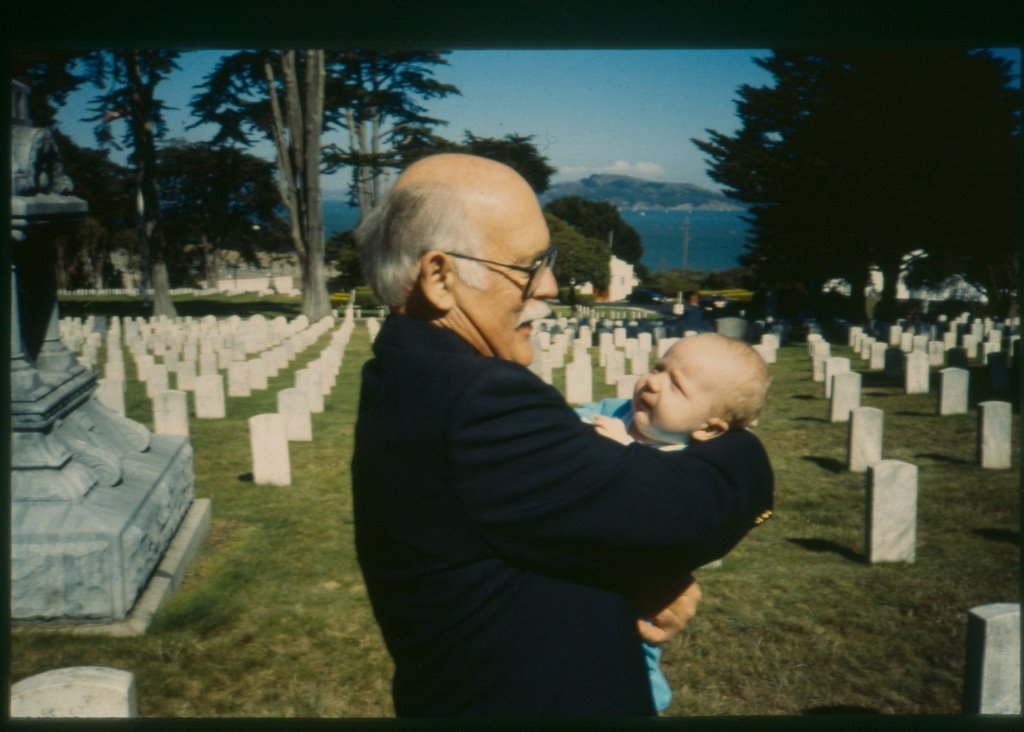
Dr. Lowry with my newborn son Atticus, Presidio National
Cemetery, San Francisco, circa 1994.

Saturday, January 15, 2011

Oldest living African-American dies at 113

Mississippi Winn
. . .Winn was one of two known people left in the United States whose parents both were almost certainly born into slavery because documents show they were born before the end of the Civil War, though her great-niece Mary C. Hollins says Winn never acknowledged that.

"I don't know much about that," Hollins recalled Winn saying when asked about her parents' early years.

[from the Associated Press]

Friday, January 14, 2011

Sunday, January 09, 2011

Ben McCulloch

Brigadier General Benjamin McCulloch,
McCulloch's Division, Army of the West

This song by Steve Earle is my favorite Civil War-themed tune, of which he's written a few. I love that he takes the perspective of a southern soldier in the Trans-Mississippi, not really knowing what he's gotten himself into. And I like the references to Wilson's Creek and the Boston Mountains, a part of the country for which I have a great fondness, and a battlefieldPea Ridge in particularthat is among my favorites to visit. I also appreciate that Earle chooses not to glorify the war in some cliched manner, or to present a sentimental ditty about the rightness of one side's cause.

As long as the link works, you can hear the original Steve Earle version here. Otherwise, you may need to listen to one of many covers on YouTube. Better yet, you can buy it on iTunes for a buck.

We signed up in San Antone my brother Paul and me
To fight with Ben McCulloch and the Texas infantry
Well the poster said we'd get a uniform and seven bucks a week
The best rations in the army and a rifle we could keep
When I first laid eyes on the general I knew he was a fightin' man
He was every inch a soldier every word was his command
Well his eyes were cold as the lead and steel forged into tools of war
He took the lives of many and the souls of many more

Well they marched us to Missouri and we hardly stopped for rest
Then he made this speech and said we're comin' to the test
Well we've got to take Saint Louie boys before the yankees do
If we control the Mississippi then the Federals are through

Well they told us that our enemy would all be dressed in blue
They forgot about the winter's cold and the cursed fever too
My brother died at Wilson's creek and Lord I seen him fall
We fell back to the Boston Mountains in the North of Arkansas

CHORUS
Goddamn you Ben McCulloch
I hate you more than any other man alive
And when you die you'll be a foot soldier just like me
In the devil's infantry

And on the way to Fayetteville we cursed McCulloch`s name
And mourned the dead that we'd left behind and we was carrying the lame
I killed a boy the other night who'd never even shaved
I don't even know what I'm fightin' for I ain't never owned a slave

So I snuck out of camp and then I heard the news next night
The Yankees won the battle and McCulloch lost his life

Steve Earle


Tuesday, January 04, 2011

The United States Constitution: Read it and Weep

The problem with the Tea Party's new Constitution fetish is that it's hopelessly selective. As Robert Parry notes, the folks who will be reading the Constitution aloud this week can't read the parts permitting slavery or prohibiting cruel and unusual punishment using only their inside voices, while shouting their support for the 10th Amendment. They don't get to support Madison and renounce Jefferson, then claim to be restoring the vision of "the Framers." Either the Founders got it right the first time they calibrated the balance of power between the federal government and the states, or they got it so wrong that we need to pass a "Repeal Amendment" to fix it. And unless Tea Party Republicans are willing to stand proud and announce that they adore and revere the whole Constitution as written, except for the First, 14, 16th, and 17th amendments, which totally blow, they should admit right now that they are in the same conundrum as everyone else: This document no more commands the specific policies they espouse than it commands the specific policies their opponents support.
From "Read it and Weep, How the Tea Party's fetish for the Constitution as written may get it into trouble,"by Dahlia Lithwick. Slate. January 4, 2011. Read the entire essay here.

Tuesday, December 28, 2010

Don't Spin the Civil War

. . .and another timely essay, for good measure. This one from Washington Post columnist E. J. Dionne, Jr., well worth a read. Full article here
My neighborhood friend Jon Udis got a subscription to Civil War Times Illustrated, and our regular discussions of sports heroes Bill Russell, Johnny Unitas and Carl Yastrzemski were briefly interrupted by talk about Grant and Lee, Sherman and "Stonewall" Jackson.
But our conversations, like so many about the war, focused on people and battles, not on why the confrontation happened in the first place. There remains enormous denial over the fact that the central cause of the war was our national disagreement about race and slavery, not states' rights or anything else.

Saturday, December 25, 2010

Civil War message opened, decoded: No help coming

This Jan. 14, 2009 image shows a Civil War bottle with a message that was tucked inside at the Museum of the Confederacy in Richmond, Va. The message to Lt. Gen. John C. Pemberton says reinforcements will not be arriving. The encrypted dispatch was dated July 4, 1863—the date of Pemberton's surrender to Union forces led by Ulysses S. Grant in what historians say was a turning point in the war. (AP Photo/Museum of the Confederacy) (AP)
The bottle, less than 2 inches in length, had sat undisturbed at the museum since 1896. It was a gift from Capt. William A. Smith, of King George County, who served during the Vicksburg siege.

It was Wright who decided to investigate the contents of the strange little bottle containing a tightly wrapped note, a .38-caliber bullet and a white thread.

But the coded message, which appears to be a random collection of letters, did not reveal itself immediately.  . . .The code is called the "Vigenere cipher," a centuries-old encryption in which letters of the alphabet are shifted a set number of places so an "a" would become a "d"—essentially, creating words with different letter combinations.  

Read full article here.

By STEVE SZKOTAK, Associated Press, Saturday, December 25, 2010
 

Tuesday, December 21, 2010

Timely essays on secession and the War of Southern Aggression

BY PAUL FINKELMAN
...for South Carolina, slavery and states’ rights were not mutually exclusive; in fact, they were the same thing. Today too few people understand the intricate legal history that connects slavery to states’ rightsand as a result a needless debate continues, 150 years after secession began.

BY EDWARD BALL
The next five years will include an all-you-can-eat special of national remembrance. Yet even after 150 years full of grief and pride and anger, we greet the sesquicentennial wondering, why did the South secede? I can testify about the South under oath. I was born and raised there, and 12 men in my family fought for the Confederacy; two of them were killed.

BY GLENN W. LAFANTASIE
In April 2009, Rick Perry, the Republican governor of Texas, suggested that his state might ponder secession if "Washington continues to thumb their nose at the American people." In response, the audience began to chant, "Secede, secede," hoping, one assumes, that everyone there would soon begin to party like it was 1860.

BY BROOKS SIMPSON
It’s clearly a tough time for those people who are enamored of the Confederacy and who work hard to downplay slavery, one way or another.  One of those groups embraces the slogan, “Heritage not Hate,” but frankly I don’t see it that way.

BY ADAM GOODHEART
A new phrase was coined to describe Rhett and his political cohorts: “the fire-eaters.” Their constant theme was that white Southerners, rather than black slaves, were America’s true oppressed class. “I am a Traitor,” he said in 1850, “in the great cause of liberty, fighting against tyranny and oppression.”

BY JIM LEPORE
On Dec. 2, 1859, the day John Brown was hanged, Longfellow wrote in his diary, “This will be a great day in our history, the date of a new Revolution quite as much needed as the old one.”

BY CAROLYN CLICK
On a foggy day near Christmas 1860, a delegation of South’s Carolina wealthiest, most powerful citizensplanters, judges, legislators and clergy, all white menassembled at Columbia’s stately red brick-columned First Baptist Church to contemplate smashing the Palmetto State’s bond with the United States of America.


Wednesday, December 01, 2010

Civil War blogging at its best

I was thinking of doing a year-end roundup of Civil War blogs, mainly as a vehicle for highlighting the five or ten favorites to which I am regularly drawn. I suppose I’ve avoided that in the past, because the Civil War blogosphere is a pretty small place, and I don’t want to have to explain why some blogs pique my personal interests and others do not. It’s all about the content.

For now, however, I want to take a moment to draw your attention to Mysteries and Conundrums, an unofficial blog maintained by NPS staffers at Fredericksburg and Spotsylvania National MilitaryPark, born of discussions about the string of battlefields in their jurisdiction, to include Chancellorsville and the Wilderness. The blog began just this past March, but the authors have made it chock full of meaty content. It is intended that readers accept the open invitation to join in those discussions, to better understand what happened in those historic venues, and to participate in the ongoing challenges of preservation. 

This post by historian John Hennessy is a masterpiece -- The legacy of misplaced assumptions -- and really highlights the value of blogs as a living resource for students of American history. Preservation strategies have necessarily evolved over the years, and this brief history explains a lot about the present state of four major battlefields, including how their close proximity to each other ultimately short-shrifted each of them in terms of total park acreage.

The bulk of the entries come from resource managers Eric Mink and Noel G. Harrison, and chief historian John Hennessy, whose published works are well regarded in the Civil War community. In entry after entry, the contributors to Mysteries and Conundrums draw the reader into an intriguing discussion, and enrich their offerings with period photographs and useful maps. Look at Mr. Harrison's labor-intensive offering in another recent post, Finally Found: the Location of Waud's Fredericksburg Pontoon-Laying Sketch? 

Take a gander at their sister blog as well,
Fredericksburg Remembered.

Nicely done.

Shouldn't the Culbertson Guidon from the Little Bighorn be in the Smithsonian?

It's said to be worth $2 to $5 million, but an upcoming Sotheby's auction will tell the tale.  Would that this ragged flag could reveal the story that occurred beneath it in June of 1876.

I have been deeply fascinated with the Battle of the Little Bighorn since at least the time I first heard Johnny Horton singing "Commanche" on our old hi-fi in Schuyler, Nebraska, Sometime later, I read the Mari Sandoz books on the battle, and on Crazy Horse, and was hooked (in another nod to Johnny Horton, that same LP had "Sink the Bismarck," and I managed to find a copy of a book on that subject in our school library. I was in fifth grade when Horton turned me on to the Bismark, circa 1969 . The other night I saved the movie of the same name in my Netflix queue – I don’t remember ever seeing it). 

The fight at the Little Bighorn has taken on an iconic stature in American memory far out of proportion to the size and scope of the battle itself, and its cultural legacy transcends the initial shockwaves that sped west and east from the remote interior, en route to the population centers of the then 100-year-old nation (Happy Birthday, America!). I have not read everything I could find on the battle, but quite a lot, and have been lucky to come of age at a time when great historians began to systematically clear away the murky cloud of mythology and popular history. Today, it may be the most written about battle in North America after the Battle of Gettysburg.

For over 100 years, the narrative description of the Battle of the Little Bighorn relied principally on the recollections and testimony of surviving members of Reno's command, a hodgepodge of incomplete and often confusing recollections translated in some fashion from Indians long after the fact, and the suppositions offered by burial parties and other early visitors to the battlefield.

Then, in 1983, a massive wildfire cleared the battlefield and presented irresistible opportunities for an exhaustive archaeological investigation of the field. What a stroke of luck, as it turned out. The resulting studies in the intervening years have produced the most compelling, and most complete story to date. It wasn’t exactly a case of "everything you know is wrong," but some traditional interpretations took a beating.

How did they figure all this stuff out? This NPS page sums it up:
The project archeologists chose to view the battlefield as a crime scene and by using a combination of forensic techniques such as studies of firing pin marks on cartridge cases and rifling marks on bullets, and standard archeological field, laboratory, and analytical techniques they have been able to determine the variety of weapons used by the various participants.
By combining crime lab methods with the archeological constructs of spatial patterning and individual artifact analysis, they have been able to discover evidence for the movement of individual firearms over the field of battle, verify cavalry positions, and define previously unknown Indian fighting areas. 
Not everybody is happy with the changing story, of course. The traditional stories of a glorious "last stand" do not hold up very well under the new evidence. That is not to say that the soldiers under Custer's command were not brave, or that they did not die in heroic fashion, but the evidence on the ground suggests they were quickly overwhelmed in a rout, and were running for their lives before getting cut down. Whatever you conclude, much mystery remains, and for that reason the Little Bighorn will always excite the imagination. For Native Americans, of course, their greatest victory was also the death knell, making the fight along the Greasy Grass the proverbial beginning of the end.
 

Archaeology, History, and Custer's Last Battle: The Little Big Horn Re-examined, by Richard Allan Fox, is an essential read about what insights we've gained from the post-fire digs. Fox is of the opinion that it wasn't so much a "last stand" as a last chase, or a series of abortive running stands (as in pausing long enough to get a shot off at the people chasing you). Fox's marriage of archaeology, "combat modeling," and the documentary record sets a new standard for examination of the battle. Future authors may disagree with his analysis, but they cannot ignore it. 

Likewise, Archaeological Perspectives on the Battle of Little Bighorn, by Douglas D. Scott, Richard A. Fox, Melissa A. Connor, and Dick Harmon.  

Where Custer Fell, Photographs of the Little Bighorn Battlefield Then and Now, by James S. Brust, Brian C. Pohanka, and Sandy Barnard, is a beautiful work. Yes, that's the same (late) Brian Pohanka so highly regarded for his work as a Civil War historian. He loved studying this battle, and I believe this was one of the last major projects he saw to completion before his untimely death.
 

Check out this article by Thomas Powers, "How the Battle of Little Bighorn was Won," adapted from his book, The Killing of Crazy Horse, for a perspective built upon Indian recollections of the battle.

My most recent purchase is The Last Stand: Custer, Sitting Bull, and the Battle of the Little Bighorn, by Nathaniel Philbrick. I have high hopes for it, given the reception some of his other books have received (it’s shelved next to another Philbrick book, The Mayflower, also unread as yet. Can't wait to get to these two.

A great resource: Friends of the Little Bighorn Battlefield.

If you have a hankering to own a piece of this history, you need only place your bid with Sotheby's. This video explains the significance of the Culbertson Guidon. Answering my own question at top, I say "yes." Were I independently wealthy, I'm sure I would enjoy owning such amazing pieces of American history, but shouldn't things this delicate be entrusted to the care of museum professionals? Hopefully some rich guy will buy it and donate it to the nation.

As for the Bismarck, I couldn't have been more thrilled when Robert Ballard turned his attention to the German  battleship, and actually discovered the wreck in 1989. Too bad Johnny Horton wasn't around to see it. 


Bismarck's bow. Photo taken in 2002 (courtesy of the Discovery Channel).