Sunday, July 23, 2006

Something Old, Something New, Something Gray, Something Blue. . .


Many of my fellow Civil War bloggers have weighed in on the idea of a "New Military History," and the tension that some perceive exists between those who treat Civil War subjects with a strictly military narrative, and those who broaden the examination to include political and social themes. Kevin Levin weighs in at Civil War Memory with, "Why do Civil War Military Historians Hate Social History? Mark Grimsley has often commented on the institutional denigration of military history in the academy. Eric Wittenberg has made it known that nothing outside the military events of a campaign or battle hold any interest for him. My own feelings tend to align with the sentiments expressed by Sean Dail—there isn't really a discernible "New Military History." At least not one that will have the effect of supplanting the release of straight campaign and battle studies (and none of the best of these can really avoid political and social questions, since the war exists in relation to those things).

One thing about this New Military History discussion that strikes me as odd is the underlying assumption that there is an old, archaic history on the way out, while the NMH represents an evolving form naturally displacing the first. In truth, the approaches needn't be mutually exclusive, or even get in each other's way.

There is a steady, if small, market for blow-by-blow accounts of the armies in the field, and why not? Many of us find them fascinating. An annual ritual for me—with The Civil War Forum—is to read, or re-read, the best-regarded studies of a given battle in advance of a few days of tramping the battlefield with a NPS historian.

All that said, a straight military narrative can make for some dry, tedious reading, and it takes a talented author to mold it into a story worth reading. That's true of all history writing, of course, but particularly true of the kind of narratives found on the overflowing Civil War bookshelf.

I would also mention that, in my experience, strictly military accounts are more likely to be written by amateur historians than more complex efforts to place those events in a larger context (outside the vacuum). There are probably many reasons for this, and I'm not going to try to sort it out in tonight's posting. I will mention that the modern regimental history is a favorite of amateur historians, since it's too narrow for the academic, and is often inspired by a familial relationship to a member of the regiment. Most of the very best campaign and battle studies have been written by historians outside of academia—no doubt about that. Authors like Gordon Rhea, Wiley Sword, Bob Krick, Mark Bradley, and many NPS historians, have done work that may never be improved upon. I'm not sure if that's an especially Civil War-related phenomenon, but there it is.

And some of the most mediocre, or worst studies have also been written by non-academics (needless to say, obversely, a PhD degree is far from a guarantee that someone can produce a readable or worthwhile study). For one thing, it may be easier to compile the pieces of the military story when pursued as an avocation. The Official Records serve as the backbone, and from there it's a question of how authoritative one wants to make the bibliography—certain repositories, certain sources, are a must (else one risks damning reviews). The narrative is further enhanced by access to diaries and letters not commonly utilized. The savvy author, amateur or professional, will not skimp on citations, since the ranks of book reviewers may contain even more amateurs than the ranks of authors writing battle narratives. It's not uncommon to see a glowing review of a crappy book based, apparently, on nothing more than a massive bibliography and copious footnotes. The thinking is that it must be worthwhile if the author went to all that trouble.

Research is one thing, but the book still has to be written. One can string things together into a coherent, chronological report, but absent the ability to distill the research and create the story, the resulting recitation is notable less for any talent for research or writing than for the luxury of time it to assemble it all. That shortcoming is why many campaign and battle studies are treated like reference works. People use the index to zero in on a favorite regiment, or to find tidbits about certain officers, or to find an account of one part of a battle, but the balance of the book goes unread. Civil War buffs will buy a book about Stones River, for example, because their great-grandfather's regiment fought there, and whatever passing references the author devoted to that regiment are worth the price of the book. Saves the reader a trip to NARA, or to some state archives.

Getting back to the New Military History / Old Military History discussion, because I work with undergraduate college textbooks, I often peruse the history texts to see what they're saying about the Civil War. I was recently looking at the chapter-ending recommended reading section of American Passages, A History of the United States, by Ayers, Gould, Oshinsky, and Soderlund, a popular college textbook at the moment. In that section that dealt with the heart of the Civil War (in the 3rd edition), students are directed to nine books for further reading, each of which has bibliographic info and a one-line summary.

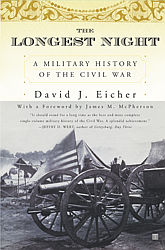
I expected to see James McPherson's classic Battle Cry of Freedom: the Civil War Era (1988) —that's as good as it gets. And naturally, there it was. But I was surprised to see the non-academic David J. Eicher's, The Longest Night: A Military History of the Civil War (2001). Readers of this blog know how highly I regard the work of David Eicher, but he's a relative newcomer on the scene, and his one-volume history of the war—while critically well received, as far as I have seen, would seem to be a redundant entry for one-book histories in a very short list of recommended texts.

Ayers, et. al. break it down this way. The editorial commentary on Eicher's book is that it "is the best one-volume military history of the war." By contrast, McPherson's Pulitzer-prize winning tome, "stands as the best one volume account of the war."

Two massive one-volume histories—one a military history, and one an account of the Civil War era—both, the best of their kind, Kevin Levin's reservations notwithstanding. I'm not sure what conclusions to draw from that, precisely (maybe an email to Ayers would prompt an illuminating reply). But one thing it says is that both approaches offer something of value to the student, and undergraduate texts are still pointing students to the "old" military history as well.


Thursday, July 13, 2006

Don't know much about a science book / Don't know much about the French I took

I watched Jeopardy the last two nights. How is it that the people who win so many thousands of dollars know everything about everything, except the things that YOU know? One of life's mysteries. 

This evening, the Final Jeopardy category was U. S. History. The "answer" was something along the lines of, "He was the Union commander at Bentonville, site of the last major Confederate offensive of the Civil War." The biggest surprise was that one of the three contestants actually got it right. The reigning champ wrote, "Who was Grant?" The next contestant wrote, "Who was Lee?" [groan] Finally, the last guy went with Sherman and earned a return trip.


This had me wondering whether the program staff steers clear of topics their contestants might specialize in, or whether it's just random. Occasionally, there will be a sports-related category, and invariably, only one of the three is comfortable with it, and runs the board by naming NBA teams, or famous Hockey players. But for some reason, contestants never seem to do well with Civil War clues. Often, none of them will even hit the buzzer. And these are people who have heads full of the most arcane science facts imaginable, can identify obscure composers without pausing to think, and remember the characters in novels they read in junior high.

Granted, naming the respective commanders at Bentonville is something even a lot of Civil War buffs could not do, but you'd think everyone would know Lee fought for the South. His birthday is still a holiday in some parts of the old Confederacy, for crying out loud.

Both nights, surprisingly, the final Jeopardy category was right in my wheelhouse. Tonight, it was the aforementioned Civil War question, and last night it was a combo clue involving geography and the NFL. The clue was (paraphrasing), "Of those states that have two NFL teams, this is the only one bordering on the Mississippi River."
It doesn't take a football fan long to bring up a mental map of the Mississippi River and immediately see flashing lights indicating Kansas City and St. Louis. I got that one faster than it would taken me to recall the pin number on my debit card. BUT, there was that little geographical twist -- you have to know where the Mississippi River is.

The two female contestants both guessed, "What is Minnesota." That's not unreasonable, if you're not a fan of pro football. There is a team there, on the Mississippi, and maybe they were thinking the Twin Cities each had a franchise. Then the lone male contestant's guess was revealed, on national television, taped for posterity: "What is Florida?"


Ouch! Come on, man! The Mississippi River? Florida? I can understand how people might get through all of their school years without committing to memory the na
mes of Civil War generals, other than two or three. Or how someone could be so focused on one period of history at the expense of others. But how does someone get to adulthood without a basic grasp of—at least—the geography of their native land?

It's a personal mission of mine to ensure that my children will never be the ones who, in those horrifying surveys that make the news every so often, can't find Mexico on the map, or think Cuba is that island across the channel from Calais. I realize it's silly to project one's own interests onto the world at large, wondering why they don't share your enthusiasm for something (I don't get how someone can have no interest in history). And as long as I can remember, I have loved to scrutinize maps, globes, atlases. Really, what's better than
standing before a Raven Maps masterpiece on the wall, a cocktail in one hand, a magnifying glass in the other, and an hour to kill before kickoff?

I phoned James McPherson to ask what caused the war


Fondly do we hope, fervently do we pray, that this mighty scourge of war may speedily pass away. Yet, if God wills that it continue until all the wealth piled by the bondsman's two hundred and fifty years of unrequited toil shall be sunk, and until every drop of blood drawn with the lash shall be paid by another drawn with the sword, as was said three thousand years ago, so still it must be said "the judgments of the Lord are true and righteous altogether."
—Lincoln's Second Inaugural Address

Ten years ago, the Civil War Forum inaugurated its online, author Q&A series with an hour-long chat with James McPherson, George Henry Davis Professor of American History at Princeton University. This was not long after the publication of his book of essays, Drawn With The Sword: Reflections on the American Civil War (Oxford University Press, 1996). That’s a great book, a strong collection of finely-tuned essays that show McPherson at his reflective best. In the immaturity of youth, back when I took (more) pleasure in needling neo-Confederate types in various online venues, I adopted the title of one of McPherson’s essays, “The War of Southern Aggression,” to refer to that era. Couple that with some high praise for Sherman, and, well, my 300-baud modem could barely keep up with the digitally streaming profanity.

But back to McPherson (pronounced McFURson, if the old saying is true, “there’s no Fear in McPherson”). On May 9, 1996, while I was living in Santa Clara, California, I telephoned Dr. McPherson at a preselected time. If memory serves, he was on sabbatical at the Huntington Library in San Marino, about 400 miles south, down Pasadena way. I had him on one line, while I was logged on to the Civil War Forum with another. I relayed questions to him from members in the chat room, and typed in his responses under his name.

For me, the Q&A session after a Round Table or conference presentation is often the best part of the evening. It’s when the guest departs from prepared remarks, and really reveals their command of (hopefully), and fascination with history. These online Q&A sessions were much the same. I always started out with a few pointed questions of my own, and the rest came randomly from those in attendance. McPherson handled some fairly difficult questions with the ease and confidence of someone fluent in all aspects of the subject. I invoked the “s” word in the very first question—no sense in leaving the causes of the war till last.


Civil War Forum: While you acknowledge that the North and South had developed into distinctly different societies—with the most profound changes occurring in the North—your writings (including many essays in this book) are unequivocal on the point that slavery was the fundamental cause of the war. How do you reconcile that with a statement in "Why the Confederacy Lost" that most Confederates did not feel they were fighting for slavery, and what do you say to those who regard slavery as just one more item on a long list of issues contributing to sectional strife?

James McPherson: Slavery was not only the most important single difference between North and South, but also the basis for most of the other differences in social structure, economy, and political ideology. By 1860, each section saw the expansion of the other's social and economic institutions as a threat to the survival of its own. Technically, slavery was not the cause of the war, but of the South's secession, because the slave states saw Lincoln's election as the handwriting on the wall that doomed slavery and every thing that was associated with it in the Union. There would have been no war, however, without some such trigger as the firing on Ft. Sumter. When Confederate soldiers said they were fighting for independence and not for slavery, what they meant was that they were fighting not explicitly for slavery, but for a society of which slavery was an essential part, but one taken for granted.

Civil War Forum: Are there any credible works that, in your opinion, argue successfully that slavery was not the major cause of the war?

James McPherson: No, I don't think so. There was a school of historians known as the "Revisionists" that flourished in the 1930s and 1940s, and tried to portray inept politicians and over-stimulated public emotions as the main reason for the breakdown of compromise and the coming of the war. What that overlooks is that the issues over which politicians failed to work out a rational compromise and that stimulated public passions were all related to slavery in one way or another. The issue went too deep for compromise, and the emotions that it provoked were real and not artificial, and that is what the Revisionists failed to understand.

Civil War Forum: In your essay, "Lee Dissected," you take Alan Nolan to task somewhat for being overzealous in his critique of Lee in Lee Considered, but you conclude that Nolan probably was closer to the truth than the Marble Man mythology on the other end of the spectrum. Have any modern historians found that middle ground? Does Emory Thomas new biography break new ground in that regard?

James McPherson: Emory Thomas's biography is as close to a balanced appraisal of Lee's strengths and weaknesses as we are likely to get. But it is not accurate to say that he broke new ground so much as that he has absorbed scholarship on Lee written in recent years, including Joe Glatthaar's study of command relationships, Gary Gallagher's essays on various battles in the Eastern Theater, and Steven Woodworth's new study of the relationship between Davis and Lee. With all of these studies, we now have a solid and incisive body of writing on Lee.

Civil War Forum: In "How the Confederacy Almost Won," you state your belief that, contrary to some traditional interpretations, a Northern victory in the war was not inevitable, and was based ultimately on how the fortunes of war played out on the battlefield. You speak of some critical turning points, but do you identify any specific period or campaign as the true "high water mark" of the Confederacy?

James McPherson: There were two potential high water marks, and neither was at Gettysburg. The first came in September 1862 when two Confederate armies invaded Union territory and seemed poised for victories which, if they had occurred, would have brought European diplomatic recognition of the Confederacy and would probably have given anti-war Democrats control of the House in the fall Congressional elections. The other high water mark came nearly two years later in August 1864 when it appeared that the Northern electorate would repudiate Lincoln and his war policies in the presidential election. If that had happened the consequence might well have been Confederate independence. The traditional "high water mark" at Gettysburg overlooks the simultaneous situation at Vicksburg, whose fall probably would have canceled the benefits of a Confederate victory at Gettysburg.

Civil War Forum: In "What's the Matter With History," you allude to the distinction made by many professional historians between popular history and professional scholarship. You pointed out that although Battle Cry of Freedom won the Pulitzer, it did not garner awards from professional associations of historians. Do you think the immense popularity of Battle Cry of Freedom, which sold over 600,000 copies, is eroding the idea that professional scholarship and widely accessible history are not compatible?

James McPherson: I would hope so. That was one of my purposes in writing the book, and I think that it succeeded in bringing the findings of professional scholarship to a broader audience. At the same time, while academic historians give lip service to that purpose, the reward system within academia often is inconsistent with that lip service so that writing for a popular audience is still sometimes looked down on.

Civil War Forum: Recalling your statement, "two potential high water marks, neither at Gettysburg," J.F.C. Fuller has stated that "the Drums of Champion Hill sounded the Doom of Richmond," meaning that if Pemberton had defeated Grant there—and he had his chances—Grant would likely have been removed, and the history of the last years of the war would have been quite different.

James McPherson: Let me respond briefly. I think that is quite likely, and if Grant had not come east and become General in Chief there is a strong possibility that the Confederates could have held long enough to defeat Lincoln for reelection and thereby win the war.

Civil War Forum: Have your views on the War changed significantly over the years? And if so, what are some of those shifts?

James McPherson: When I first began studying the war, I shared the view of abolitionists and Radical Republicans that Lincoln was a conservative on the slavery issue and moved too slowly to make emancipation a war aim. But the more I study Lincoln, and the enormous pressures brought to bear on him from all sides, the more I appreciate his skillful leadership in keeping several factions working together in behalf of the principal war aim: preservation of the Union. Had he not done this so well, the North could never have won the war and slavery would obviously have survived. Therefore his leadership, focusing on the principal goal of Union, accomplished, eventually, the abolition of slavery more surely than a radical policy would have done.

Civil War Forum: As modern students, it's very easy for us to read all the debates leading up to secession. Did the average person in the South before the war have as clear a picture of the issues that were being debated?

James McPherson: No, probably not, because they lacked access to many of the Northern newspapers and other forms of expression that we can read today. But it should be remembered that Americans then were avid newspaper readers and the principal content of newspapers focused on politics. The political interest of the average citizen was much higher than it is today because it was one of the principal forms of popular entertainment, as well as of information. Thus voter participation was extremely high, and political meetings, speeches, rallies and the like attracted huge crowds and stirred up a great deal of popular interest. Therefore the level of political knowledge and commitment was high and people had a good grasp of the issues.

Civil War Forum: What is the major lesson to be learned from a study of the civil war?

James McPherson: Probably that deep-rooted and controversial social problems should be addressed before they become so huge and so divisive that they polarize the society. If some kind of gradual program to deal with economic and social problems associated with slavery had been undertaken in 1789, or even in 1820, the issue would not have become so huge and the positions so uncompromising as to cause a war. But saying that Americans should have done this is easy for us today. It may not have been possible for them to do it given the circumstances of their own time. That is why many historians have come to the conclusion that some kind of showdown between free and slave states was inevitable—so perhaps another lesson we might draw from the war is that some problems are so great that they cannot be resolved short of a social cataclysm. I don't know which is the right answer.

Civil War Forum: Before and during the war, Southerners were quite open about slavery being the issue dividing the North and South. In post-war writings, however, the issues mentioned were nebulous states' rights (rather than the specific one of slavery), tariffs, and so on. When did this change occur? And why?

James McPherson: The change occurred immediately with the end of the war. Slavery was gone, and more to the point, it was discredited. What had seemed like a proud and rational stand in favor of the institution in 1861, when Alexander Stephens called slavery "the Cornerstone of the Confederacy," now seemed in 1865 like a discredited and even an evil institution. Therefore, Southerners who were proud of their Confederate heritage sought an alternative justification and settled quickly on the issue of states rights, which was the central theme of Stephens's book, published in 1868, The War Between the States (that's where that phrase comes from—nobody to my knowledge used that phrase during the war itself).

Civil War Forum: One can reasonably argue that proponents of the Lost Cause look at the antebellum South nostalgically. Without falling into the Lost Cause mindset, do you find anything "good" or "noble" about the pre-War South?

James McPherson: Yes, I think there are many admirable things about the antebellum South: the strong sense of family; the tradition of hospitality and generosity; the ideals of noblesse oblige that stood for a sense of responsibility toward those less fortunate or weaker than one's self. The problem was that many of these admirable qualities were extended only toward those who refrained from criticizing or disagreeing with the South's social institutions and ideas.

Civil War Forum: Your response, please, to the following from Richard A. McLemore's A History of Mississippi: "The traditional view has been that Mississippi was carried out of the Union by ambitious young men who were engaged in accumulating slaves and broad acres and that the chief opposition they encountered came not from poor whites, but from wealthy planters (Whigs in many cases) who had already 'arrived' and did not wish to risk the loss of their status in a war whose outcome would be doubtful."

James McPherson: There is some truth in this argument. The wealthiest planters not only in Mississippi but in other states were in many cases Whigs and Conservatives who initially opposed secession because they feared the disruptive impact of such a radical move. Once secession became a reality, however, most of them went along with the Confederacy and some became prominent leaders in it. Nevertheless, Lincoln, among others, looked to these old Whigs when he issued a proclamation of amnesty in December 1863 inviting them to take the oath of allegiance and return to the Union. In states like Louisiana and Mississippi some of them did just that.

Civil War Forum: Do you have a favorite Civil War site you like to visit, and why?

James McPherson: My two favorite battlefields are Shiloh and Antietam. Mainly because they are today very similar in terrain and vegetation to the way they were in 1862. One can walk these battlefields and transport himself back 134 years in a way that is scarcely possible in many other battlefields where the modern world intrudes in many ways, both obvious and subtle.

Thank you everyone. Good night.

Friday, June 16, 2006

Grant and Lincoln are Big, Sherman is Bigger

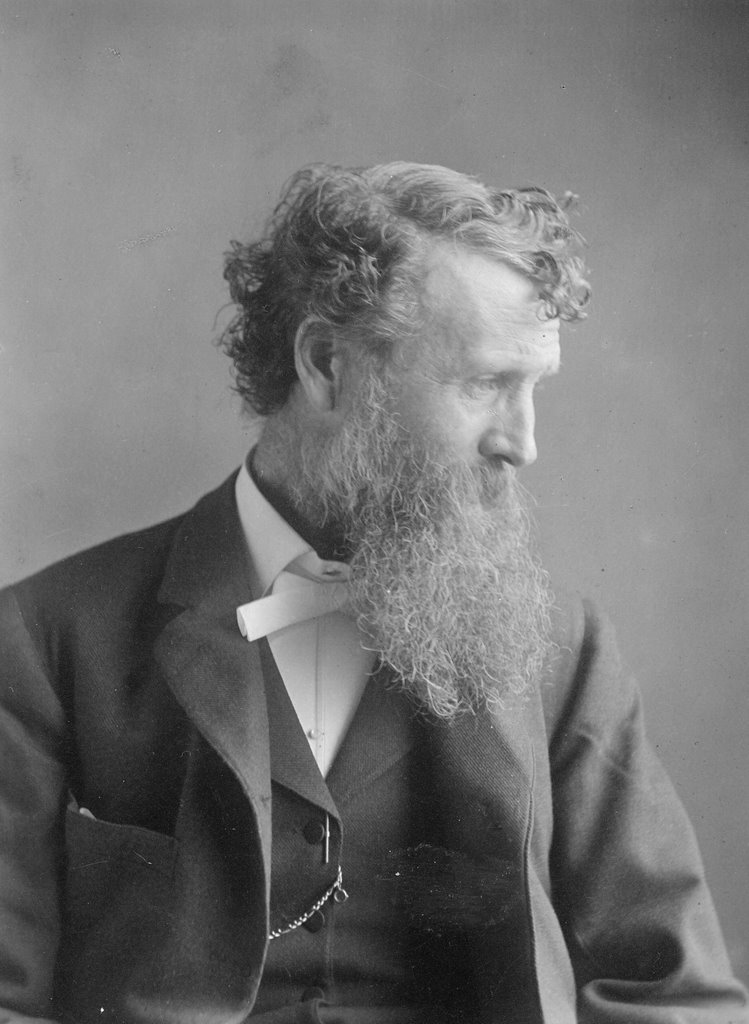
I keep thinking I'm ready to move on from the Sierra Nevada, John Muir, and the big trees, but yet another Civil War connection presents itself. Just goes to show that, to some degree, the Civil War touched every corner of the fledgling nation, and the young Union state of California was populated—much as it is now—by transplants from other states. There were many geographical features still to be named, and so it is that we have today the Alabama Hills (best known as the backdrop for Hollywood westerns), named by Southern-leaning miners to celebrate the Confederate commerce raider. And the nearby Mt. Kearsarge (among other things), named by rival miners from Northern states, after the USS Kearsarge sank the Alabama.

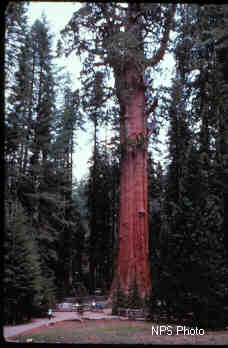
According to the National Park Service, the General Sherman tree is the largest tree in the world (though not the tallest).


By contrast, the General Grant comes in 3rd just ahead of the Lincoln tree.
But Grant's tree has other distinctions. For one, it's the National Christmas Tree. Bet you didn't know that. For another thing, it's a shrine to service men and women. Quoting the NPS web site linked above, "the General Grant Tree is a living memorial to the men and women of the United States who have given their lives in service to their country. It was proclaimed a National Shrine on March 29, 1956 by President Dwight D. Eisenhower. The official dedication was made that year on Veterans Day, November 11, by the president's personal representative, Fleet Admiral Chester Nimitz."

The Robert E. Lee tree, on the list of the 30 largest Giant Sequoia, ranks a respectable 12th (named during Reconstruction, five years after Lee's death). See a photo here.

As an aside, the General Sherman apparently started out as a Communist tree. Quoting Wikipedia (at my peril), "The utopian socialist community Kaweah Colony first identified it as the largest giant sequoia and named it after Karl Marx. The National Park Service later renamed it."
To those miners who named the Alabama Hills, I'm sure it hardly seemed an improvement.

Thursday, June 08, 2006

Honest Abe, Tree Hugger


While the Muir-related theme of environmentalism and conservation still echoes through the blog, it bears mentioning that Abraham Lincoln himself signed the Congressional Act that gave protection to Yosemite Valley, and the Mariposa Big Tree Grove of giant sequoia, "upon the express conditions that the premises shall be held for public use, resort, and recreation [and] shall be inalienable for all time. . ."

Though the Yosemite Act granted "the 'cleft' or 'gorge' in the granite peak of the Sierra Nevada Mountains" to the state of California, it in effect created the first national park, predating Yellowstone and the NPS, and preserving the land in perpetuity.
I need to query Brian Dirck of the perfectly named A. Lincoln Blog about whether any record exists of Lincoln commenting on "Yo-Semite Valley." Lincoln signed the Yosemite Act on June 30, 1864, but this radical, wartime expression of federal power is hardly mentioned in Civil War histories, or Lincoln biographies. Well, I'm not actually sure about that. Let's just say that if you restricted yourself to most Civil War histories, to David Herbert Donald's biography of Lincoln, to E. B. and Barbara Long's The Civil War Day by Day, and even to the phenomenal Morningside tome, Lincoln Day by Day, A Chronology, 1809-1865, you'd never know that during the midst of the endlessly bloody summer of 1864, Lincoln signed off on a precedent-setting bill that would set the stage for a system of national parks ("half empty" types may point out that the armies under his command consecrated quite a number of national battlefields and monuments).

What else happened on that momentous day? The big news, in both the Long Day by Day, and Morningside's Lincoln chronology, was Lincoln's acceptance of Salmon Chase's resignation from his Treasury cabinet position. Out in the field, Jubal Early's troops, advancing northward, arrived at New Market.

Lincoln Day by Day includes some other tidbits for June 30, 1864: [Lincoln] "assents to use of grounds between White House and War Dept. by St. Matthew's Colored Sunday School for Fourth of July celebration. . . .Abandons (Chiriqui) colonization idea. [Plan to send 500 able-bodied Negroes as first colony on Isthmus of Chiriqui was opposed by Honduras, Nicaragua, and Costa Rica."

Happily, he found time during a busy summer day to enact the preservation of Yosemite, and the Mariposa grove. Git thee behind me, Pombo!

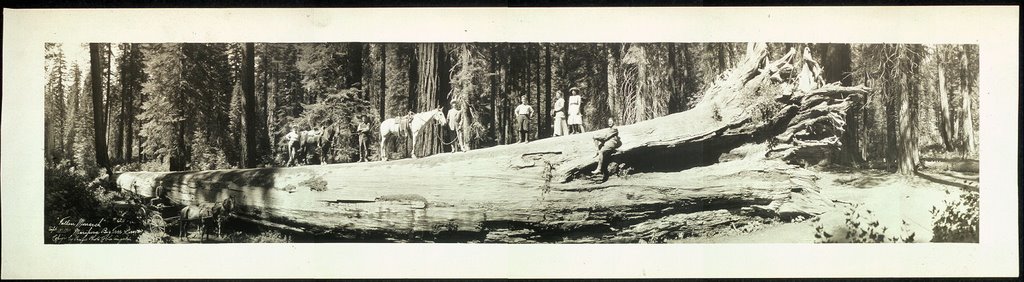
photo at top: "Fallen Monarch", Sept. 15, 1911, Mariposa Big Tree Grove.
c1911. "People and horses posed with tree." LoC

Wednesday, May 24, 2006

The Walk to the Sea


I was slow to come to appreciate the magnitude of John Muir's contribution to conservation, his role in the early establishment of the national park system, his stature as naturalist par excellence. Until I moved to San Francisco in my early 20s, Muir had not even been on my radar. Later, as I came to be captivated by the history and geography of the Sierra Nevada Mountains, Muir became such a towering figure, he was unavoidable. Reading of his adventures as a mountain man — tales of solitary sojourns in the high country expressing unabashed, poetic reverence for sacred wilderness — always makes me itch to break out the tent, gather the Coleman products, and head for the woods.

I was also slow to get around to Muir's early writings. Imagine my delight, then, when I finally came across the unpolished notes of his 1867 walk across the South, from Louisville, Kentucky to Savannah, Georgia, and on into Florida — A Thousand-Mile Walk to the Gulf (Boston and New York: Houghton Mifflin Company, 1916). Muir embarked on his journey to look at the plants — "grass, weeds, flowers, trees, mosses, ferns," and he comments on them passionately, and at length. But he also gives a sense of the ravaged, post-war South. Muir speaks to many freedmen along the way, enjoys the hospitality of residents in the heart of the old Confederacy, and encounters highwaymen in a largely lawless landscape where every person met on the road is a potential threat.


Happily, the entire book can be read at the Sierra Club site, here (follow links to "Books by John Muir"). I've excerpted a number of interesting passages that present observations of the Civil War South, two and a half years after the end of hostilities.


September 6. Started at the earliest bird song in hopes of seeing the great Mammoth Cave before evening. Overtook an old negro driving an ox team. Rode with him a few miles and had some interesting chat concerning war, wild fruits of the woods, et cetera. "Right heah," said he, "is where the Rebs was a-tearin' up the track, and they all a sudden thought they seed the Yankees a-comin', obah dem big hills dar, and Lo'd, how dey run." I asked him if he would like a renewal of these sad war times, when his flexible face suddenly calmed, and he said with intense earnestness, "Oh, Lo'd, want no mo wa, Lo'd no." Many of these Kentucky negroes are shrewd and intelligent, and when warmed upon a subject that interests them, are eloquent in no mean degree.

September 7. Left the hospitable Kentuckians with their sincere good wishes and bore away southward again through the deep green woods. In noble forests all day. Saw mistletoe for the first time. Part of the day I traveled with a Kentuckian from near Burkesville. He spoke to all the negroes he met with familiar kindly greetings, addressing them always as "Uncles" and "Aunts." All travelers one meets on these roads, white and black, male and female, travel on horseback. Glasgow is one of the few Southern towns that shows ordinary American life. At night with a well-to-do farmer.

As I turned to leave, after bidding her good-bye, she, evidently pitying me for my tired looks, called me back and asked me if I would like a drink of milk. This I gladly accepted, thinking that perhaps I might not be successful in getting any other nourishment for a day or two. Then I inquired whether there were any more houses on the road, nearer than North Carolina, forty or fifty miles away. "Yes," she said, "it's only two miles to the next house, but beyond that there are no houses that I know of except empty ones whose owners have been killed or driven away during the war."

Met a young African with whom I had a long talk. was amused with his eloquent narrative of coon hunting, alligators, and many superstitions. He showed me a place where a railroad train had run off the track, and assured me that the ghosts of the killed may be seen every dark night.

Had a long walk after sundown. At last was received at the house of Dr. Perkins. Saw Cape Jasmine [ Gardenia florida ] in the garden. Heard long recitals of war happenings, discussion of the slave question, and Northern politics; a thoroughly characteristic Southern family, refined in manners and kind, but immovably prejudiced on everything connected with slavery.

The family table was unlike any I ever saw before. It was circular, and the central part of it revolved. When any one wished to be helped, he placed his plate on the revolving part, which was whirled around to the host, and then whirled back with its new load. Thus every plate was revolved into place, without the assistance of any of the family.

Toward evening I arrived at the home of Mr. Cameron, a wealthy planter, who had large bands of slaves at work in his cotton fields. They still call him "Massa." He tells me that labor costs him less now than it did before the emancipation of the negroes. When I arrived I found him busily engaged in scouring the rust off some cotton-gin saws which had been lying for months at the bottom of his mill-pond to prevent Sherman's "bummers" from destroying them. The most valuable parts of the grist-mill and cotton-press were hidden in the same way. "If Bill Sherman," he said, "should come down now without his army, he would never go back."


On no subject are our ideas more warped and pitiable than on death. Instead of the sympathy, the friendly union, of life and death so apparent in Nature, we are taught that death is an accident, a deplorable punishment for the oldest sin, the arch-enemy of life, etc. Town children, especially, are steeped in this death orthodoxy, for the natural beauties of death are seldom seen or taught in towns.


Of the people of the States that I have now passed, I best like the Georgians. They have charming manners, and their dwellings are mostly larger and better than those of adjacent States. However costly or ornamental their homes or their manners, they do not, like those of the New Englander, appear as the fruits of intense and painful sacrifice and training, but are entirely divested of artificial weights and measures, and seem to pervade and twine about their characters as spontaneous growths with the durability and charm of living nature. In particular, Georgians, even the commonest, have a most charmingly cordial way of saying to strangers, as they proceed on their journey, "I wish you well, sir." The negroes of Georgia, too, are extremely mannerly and polite, and appear always to be delighted to find opportunity for obliging anybody.

The traces of war are not only apparent on the broken fields, burnt fences, mills, and woods ruthlessly slaughtered, but also on the countenances of the people. A few years after a forest has been burned another generation of bright and happy trees arises, in purest, freshest vigor; only the old trees, wholly or half dead, bear marks of the calamity. So with the people of this war-field. Happy, unscarred, and unclouded youth is growing up around the aged, half-consumed, and fallen parents, who bear in sad measure the ineffaceable marks of the farthest-reaching and most infernal of all civilized calamities.

Thursday, May 18, 2006

Go West, Young Monitor!


[Naval Trivia, #1]

The U.S.S. Camanche, Passaic class monitor, was built in Jersey City, New Jersey, in 1863. Come November of that same year, she sat on the bottom of San Francisco Bay.


Duel with a Confederate ironclad? No, the Camanche
—at least the disassembled kit—fared well on the long journey from New Jersey, even rounding Cape Horn in the hull of the Aquila without incident. She made it all the way to a dock in San Francisco Bay, before going to the bottom with the Aquila, which sank at her berth during a storm.

The pieces of the well-traveled Camanche were salvaged, and she was assembled and launched i
n 1864, commissioned in 1865. For a year or so, she was the only U.S. ironclad plying Pacific waters [photo at top: U.S.S. Camanche in 1889, and 1898 below, offshore from Mare Island Navy Yard, where forty-four submarines were built between 1930 and 1970. U.S. Navy Historical Center].

Thursday, April 27, 2006

“The sight of 2,000 ghostly, pallid faces upturned in the chilling waters of the Mississippi, as I looked down on them from the boat, is a picture that haunts me in my dreams.”

– J. Walter Elliott, 10th Indiana, 44th USCT

"The horrors of that night will never be effaced from my memory—such swearing, praying, shouting and crying I had never heard; and much of it from the same throat—imprecations followed by petitions to the Almighty, denunciations by bitter weeping.”
– Chester Berry (photo at top from Harpers Weekly)

Imagine it. Upwards of 2,200 former prisoners of war, only recently released from the Confederate prison pens at Andersonville, Georgia, and Cahaba, Alabama, crowded onto a riverboat built to accommodate 300-some, steaming up the Mississippi River, headed for Cairo, Illinois, and points home. Emaciated, broken, scarred—these men were survivors. They survived camp life in Federal armies, a disease-ridden experience that killed more men in the Civil War than did bullets. They survived battle, too, before being captured. Then, they survived the obscene death rates attendant to Civil War POW camps, including Andersonville, the deadliest of all.

The war finally ended, and POWs North and South were released. The ragged survivors of Andersonville and Cahaba made their way by boat, on foot, and by rail, to Vicksburg, where the government promised private steamboat operators a per-person rate to transport the freed soldiers upriver to rail connections in Illinois' Little Egypt.
When the Sultana got underway, every surface, every nook and cranny, was occupied by a soldier. Looking at the last known photo of the boat, taken at Helena, Arkansas on a coaling stop, the crowded conditions on the boat are clearly discernable.

(Sultana at Helena, Arkansas, loaded with former Union POWs. Library of Congress)

In the early morning hours of April 27, 1865, the Sultana's passengers were mostly asleep—at least those who could find a patch of deck, or a wall to lean against. When the recently-patched boilers exploded, many men were killed outright and dozens, or hundreds, were thrown into the water. Hundreds more quickly abandoned the boat as fire ravaged the wreckage. Untold numbers perished in the panicked mass of men clutching at anything and everything in the immediate vicinity of the burning vessel, where swimmers and non-swimmers alike struggled in keep their heads above the swift, freezing current.
Even many of those who were strong, who were good swimmers, and who managed to separate from the pack, surely succumbed to the current and the elements at a time when the Mississippi was out of its banks for miles, flooding the lowlands in both directions. The lucky ones found a snag, or a half-submerged treeline, and managed to hold on till morning. Other fortunate soldiers were plucked from the river by rescue boats.

The toll was staggering. Of the roughly 2,200 men and civilians on board, only about 586 were pulled from the water alive. Of those, another 200 or so perished soon after, leaving about 300 men to tell the tale.
It's hard to know why the largest, most costly maritime disaster in our nation's history remains so obscure. No doubt it's a combination of things, like the fact that it occurred on western waters, and overriding focus of the print media on other big stories, like the surrender of Confederate armies, the end of hostilities, and the assassination of President Lincoln.

Chester Berry of the 20th Michigan Infantry sought to memorialize the event, and the dead, by collecting as many firsthand accounts as possible. His book, Loss of the Sultana and Reminiscences of Survivors, was published in 1892, and included 134 testimonials (remarkably, nearly ½ of the survivors). The University of Tennessee Press just released a facsimile reprint of Berry's book, along with a meaty new introduction by David Madden. In a couple days I'll post a link here to my review of that book.


One survivor whose story does not appear in Berry's book is Romulus Tolbert, my wife's great-grandfather, whose gene pool continues to thrive in my three children.
Romulus was a survivor extraordinaire. He joined the 39th Indiana infantry early in the war and saw action at Shiloh, and Stones River. In Sherman's Atlanta Campaign, on September 10th, 1864, Romulus—now veteranized with the 8th Indiana Cavalry—ran into an ambush near Campbellton, Georgia, suffering two gunshot wounds, one through the neck and jaw. He was carried to a private home in Alabama and nursed until well enough to be transferred to Cahaba prison, near Selma. People familiar with accounts of Cahaba will think of the time the Alabama River flooded, causing the prisoners to live on platforms, amidst thigh-deep water, for days. Rom was there for that, and survived it to. He had four brothers in other Indiana regiments, three of them in the famed 22nd. His oldest brother died at Perryville.

(Romulus Tolbert)

No one in my wife's family knew about Romulus's Sultana adventure, or even that he had been wounded, or taken prisoner. We found that in his pension files, in the mid-80s, when I first started getting obsessive about Civil War connections. Details are scant. All that is known about his Sultana experience is that he lived, was taken to Adams hospital in Memphis, and was treated for "chills." He returned to Indiana and farmed until his death at age 77.
Whether because of stoicism, or the bad memories it stirred, it wasn't a story that got handed down. We don't know if Chester Berry located Romulus and solicited his tale. Perhaps he simply declined to respond. Some that did respond had nothing more to say about that night than Abraham Cassel of the 21st Ohio, “At the time of the explosion I swam about three miles and was rescued at 10 a.m., more dead than alive.” On this day, 141 years after Romulus took to the water, and somehow managed to find dry land, I honor all those who perished, and I honor those who survived. We can take inspiration from the near-death tales of those who’ve walked away from calamity. Mostly, our problems just aren't that big.

If I start to fret too much, I'll endeavor to remember A. C. Brown's entry in Berry's book. A member of the 2nd Ohio Infantry, captured at Chickamauga, he spent time in numerous POW camps from Belle Isle to Andersonville before catching a ride on the Sultana. Stripped clean in desperate struggles with drowning men in the icy water, Brown swam for miles until catching hold of some branches above a submerged island. "I climbed a tree," he recalled, "and the water surrounding it was about ten feet deep. Now, when I hear persons talking about being hard up, I think of my condition at that time—up in a tree in the middle of the Mississippi river, a thousand miles from home, not one cent to my name, nor a pocket to put it in. . ."

Tuesday, April 11, 2006

A Horse Named Fly

I've seen a few Civil War horses in my time, all stuffed. Winchester, for one (nie Rienzi), — in the Smithsonian, and Stonewall Jackson's Little Sorrel at the museum of the Virginia Military Institute (and, as an equestrian aside, I've stood over Traveller's grave at Washington and Lee. What would possess someone to toss coins onto the grave of Robert E. Lee's horse?).

The non-Civil War stuffed horse I've wanted to see since childhood, but still have not seen, is Comanche, of Little Bighorn fame. I hope Commanche will be there for me when I find the time, but lately, ever since about 1977, Kansas has not been along the routes I've traveled.

But I digress. This post is about a horse named Fly. Bridgette Savage of Stanford, Indiana — which looks to be in the vicinity of Bloomington — has penned, and illustrated, a true-to-life tale based on the service of George Barrett and his horse, Fly, of the 1st Indiana Cavalry (formed from the 28th IN Volunteer Infantry). It's a book for young people, but based on the two articles I've read, here, and here, I cannot tell how young. The Christian Science Monitor piece shows some of Savage's illustrations, and I may pick up the book for the artwork alone.

But Fly is not stuffed. Fly can be seen at the skeletal level in New Harmony, Indiana (again, photo of author and subject can be seen here). In all my years in Evansville — where the 1st Cavalry was raised, and where I met my Hoosier wife — I never heard of Fly's bones. And in my two or three visits to nearby New Harmony, home to not one, but two full-fledged efforts at creating a utopian community, still, I saw no dead horses, stuffed or otherwise. But that's another story.

Monday, April 10, 2006

Comments Enabled

What the hey. I've decided to diverge from the Dimitri model and allow comments on this blog. I've gotten some worthwhile feedback via email, and by way of The Civil War Forum, and thought it would be interesting to allow that kind of response to be grouped with the actual post.

Replies will be reviewed before they're published, so most of the garbage will be filtered out. But I promise to allow an occasional angry, illiterate zinger (the "cost of doing business" in Civil War circles). One of my favorite parts of the Al Franken show on Air America is the "hatemail" segment, when he reads a featured email.


What if there was a war and nobody came?

This just in — the 141st anniversary reenactment of the Battle of Selma is officially cancelled. After peaking with upwards of 2,000 registered reenactors at the 130th anniversary, this year's organizers could barely muster a couple hundred participants.

I have no idea if this is a larger trend throughout the "Living History" hobby. One reason given for the poor Selma registration was the high cost of fuel. I suspect that after general interest in the Civil War was rekindled during the centennial years of the early 1960s, leading to exponential growth of book sales, reenacting groups, and Civil War Round Tables over the next couple decades, interest is beginning to ebb. Certainly that's the case with Civil War-specific book sales. I've also read somewhere that interest in historic wars, which for some has an uncomfortably naive element of nostalgia about it, wanes during times of actual war.

Of course the Selma event has some other things going against it. For one thing, the historic event there was not a momentous battle so much as confirmation that by April of 1865, Federal cavalry columns could effectively operate with impunity throughout the Confederate heartland.

For another thing, the immediate base of paying spectators in Selma is 69% African American, not generally considered the target audience for mock battles featuring overweight white guys, many in Confederate uniforms, fighting for their "rights."

Not that fighting for one's rights isn't of interest to the people of Selma. According to the Los Angeles Times article I read today (registration required), the hottest-selling item at the Selma Visitor Information Center is a shirt commemorating the Edmund Pettus Bridge, where marchers, 100 years after the Battle of Selma, faced down Alabama State Troopers.


Counting, Remembering, U.S.C.T.


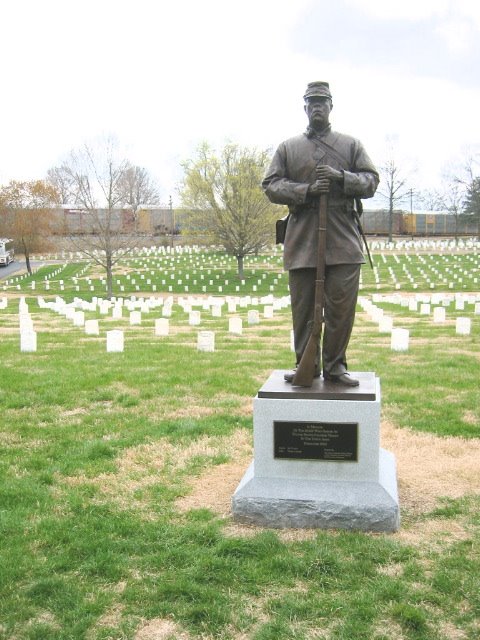
A couple of weeks ago, when the Civil War Forum visited Nashville, our first stop was the Nashville National Cemetery to see the new monument to United States Colored Troops. This moving memorial, set as it is among row after row of USCT gravestones, was in notable contrast to a little wartime cemetery we had visited two days earlier on the Stones River battlefield, near the Hazen Monument (pictured on their start page). There, a single USCT grave stands segregated just outside the brick wall of the proper burial ground.

Our guide at Nashville, if I heard him correctly, mentioned that the Nashville monument was one of only four in the nation memorializing USCT in this country. That sounded unlikely to me, and after digging around a bit I found reference to a number of plaques, monuments, and memorials to black Union troops. One report, I should say, asserts that there are only four Veterans Affairs-operated national cemeteries that boast some sort of monument to USCT. Most likely, that's how our guide settled on the figure "four."
The most famous monument to black Civil War troops is probably the Robert Gould Shaw / 54th Massachusetts sculpture in Boston. Far more interesting, I think, is the African American Civil War Memorial in Washington D.C., captured in various angles at this site.

The Nashville statue is beautifully done. But more than a few people in our group had trouble making sense of the ambiguous phrasing on the plaque. It's hard for me to imagine how something so long in the making, something meant to last for generations, and for which the precise wording presumably required the input and oversight of numerous individuals, could result in a monument that causes
even casual students of the war to mutter, "huh?"

The head scratching, of course, is due to the fact that the commonly published figures for USCT serving in Union armies during the Civil War is between 180,000 and 200,000. Back at home, I searched out some articles on the monument and discovered that the 20,133 refers to the number of USCT who hailed from Tennessee.

Strange that on a monument to United States troops, in a national cemetery, such a grammatically critical qualification was left off. As it is, untold numbers of visitors will now leave with the solid impression that United States Colored Troops, who fought so heroically on many a battlefield, numbered only about one-tenth of what we know to be case.
Whether the plaque is ever edited or replaced, it remains a noble statue, standing sentry among the nearly 2,000 USCT buried here. Couldn't help but notice, though, in the Knoxville newspaper article linked to above, the comments of one Kwame Leo Lillard whose multiple masters degrees failed to touch upon black soldiers — largely escaped slaves — who fought against the Confederacy in Union regiments. Mr. Lillard's group apparently originated the idea for the statue, and launched the ultimately successful fundraising.

"There were black soldiers in the Confederate army too," Lillard is quoted as saying, "and we need to erect a monument to them."
Hate to break it to him, but using the afore-mentioned formula for composing memorial plaques — listing just one-tenth of the total, or only those from Tennessee — the number of men honored by a Black Confederates statue would be less men than it takes to build the statue.
Good luck raising funds for that one.

141 Years Ago, at Appomattox

General R.E. Lee, Commanding C.S.A
5 P.M., April 7th, 1865
The results of the last week must convince you of the hopelessness of further resistance on the part of the Army of Northern Virginia in this struggle. I feel that it is so, and regard it as my duty to shift from myself the responsibility of any further effusion of blood by asking of you the surrender of that portion of the Confederate States army known as the Army of Northern Virginia.
U.S. Grant, Lieutenant-General

April 7th, 1865
General: I have received your note of this date. Though not entertaining the opinion you express of the hopelessness of further resistance on the part of the Army of Northern Virginia, I reciprocate your desire to avoid useless effusion of blood, and therefore, before considering your proposition, ask the terms you will offer on condition of its surrender.
R.E. Lee, General

April 8th, 1865
General R.E. Lee, Commanding C.S.A.
Your note of last evening in reply to mine of the same date, asking the conditions on which I will accept the surrender of the Army of Northern Virginia, is just received. In reply I would say that, peace being my great desire, there is but one condition I would insist upon, — namely, that the men and officers surrendered shall be disqualified for taking up arms against the Government of the United States until properly exchanged. I will meet you, or will designate officers to meet any officers you may name for the same purpose, at any point agreeable to you, for the purpose of arranging definitely the terms upon which the surrender of the Army of Northern Virginia will be received.
U.S. Grant, Lieutenant-General

April 8th, 1865
General: I received at a late hour your note of today. In mine of yesterday I did not intend to propose the surrender of the Army of Northern Virginia, but to ask the terms of your proposition. To be frank, I do not think the emergency has arisen to call for the surrender of this army, but, as the restoration of peace should be the sole object of all, I desired to know whether your proposals would lead to that end. I cannot, therefore, meet you with a view to surrender the Army of Northern Virginia; but as far as your proposal may affect the Confederate States forces under my command, and tend to the restoration of peace, I should be pleased to meet you at 10 A.M. to-morrow on the old state road to Richmond, between the picket-lines of the two armies.
R.E. Lee, General

April 9th, 1865
General: Your note of yesterday is received. I have not authority to treat on the subject of peace. The meeting proposed for 10 A.M. today could lead to no good. I will state, however, that I am equally desirous for peace with yourself, and the whole North entertains the same feeling. The terms upon which peace can be had are well understood. By the South laying down their arms, they would hasten that most desirable event, save thousands of human lives, and hundreds of millions of property not yet destroyed. Seriously hoping that all our difficulties may be settled without the loss of another life,
I subscribe myself, etc.,
U.S. Grant, Lieutenant-General

April 9th, 1865
General: I received your note of this morning on the picket-line, whither I had come to meet you and ascertain definitely what terms were embraced in your proposal of yesterday with reference to the surrender of this army. I now ask an interview, in accordance with the offer contained in your letter of yesterday, for that purpose.
R.E. Lee, General

April 9th, 1865
General R. E. Lee Commanding C. S. Army
Your note of this date is but this moment (11:50 A.M.) received, in consequence of my having passed from the Richmond and Lynchburg road to the Farmville and Lynchburg road. I am at this writing about four miles west of Walker's Church, and will push forward to the front for the purpose of meeting you. Notice sent to me on this road where you wish the interview to take place will meet me.
U. S. Grant, Lieutenant-General


Friday, March 31, 2006

Crescent City Gentrification

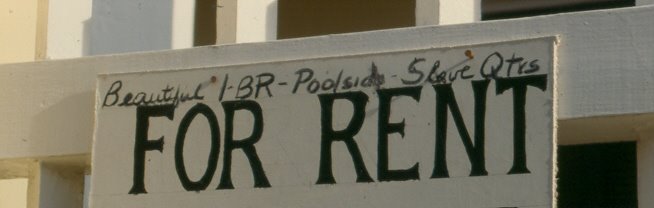
Poolside slave quarters. And "beautiful" to boot.

I took this photo in 1988 on my one and only visit to New Orleans, where my sister was living at the time. First visit, I should say, since our family moved away from New Orleans when I was very small.

What an intriguing city ― and what a heart-rending tragedy that befell her in 2005. Among other things, I took in some Civil War sites: Confederate Memorial Hall (just reopened) which claims to have "the second largest collection of Confederate memorabilia in the world in the oldest continually operating museum in Louisiana"; Metairie Cemetery; a house once belonging to Pierre Gustave Toutant Beauregard. . .

New Orleans is so infused with its own unique history ― its own original culture ― one can't help but be fascinated, or seduced. The religion, food, music, language, none of it reminds you of Dubuque. Same river, different feedcaps.


The city has seen some changes since slaves lived in this now-desirable, 1-bedroom unit in the French Quarter. Fewer slaves, more pools, for one thing. Thank goodness the Quarter was spared. New Orleans is a city apart, a melting pot unto itself. The soul of the city will be revived, in time.


The river rose all day
The river rose all night
Some people got lost in the flood
Some people got away alright
The river have busted through cleard down to Plaquemines
Six feet of water in the streets of Evangeline
(Randy Newman, Louisiana 1927)

Wednesday, March 22, 2006

"The dead are heroes, the living are but men compelled to do the drudgery and suffer the privations incident to the thing called 'glorious war.'"


—quote by Sam Watkins
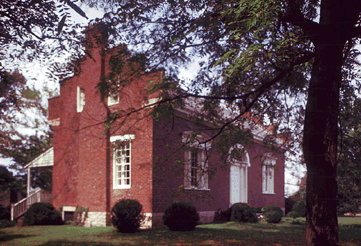
Photo: Carter House, Franklin, Tennessee


Turns out our tour guide on Saturday has fit in a stop for our group at the Tennessee State Museum to see the Old Glory exhibit (I'm still on my own for Old Hickory's crib). Getting ready to leave town, even for a few days, is a stressful time for disorganized people. First, there's making sure your work is covered in the office, anticipating and averting crises, and catching up on all the stuff you failed to get done in weeks past. And for crying out loud, don't forget to roll out the recycle bins. Good feeling, though, to finally shut down the system and head out, knowing there are four days of battlefield tramping ahead. Zeus knows the carpal tunnels can use the time off.

This week about 40 people from 16 states and two countries are gathering in Tennessee to see some things we've never seen, hear some things we've never heard, see and hear familiar things in a new way, and catch up on things since we last assembled one year ago in Manassas. This Thursday is given to Stones River, with Jim Ogden, historian at Chick-Chatt, doing the honors. Friday, Tom Cartwright, Curator at the Carter House, will take us on a full-day tour of Spring Hill and Franklin, and

Saturday, author Mark Zimmerman will guide us all day around Battle of Nashville sites. Finally, Sunday morning, Carter House historian David Fraley will give a presentation at Sam Watkins's grave near Mt. Pleasant.

Monday morning I'll be back at my desk, just over the Santa Cruz Mountains from Half Moon Bay, scanning 100s of unread emails and explaining to my coworkers why some people use vacation days to travel to Tennessee in winter (technically spring), to stand in the cold and photograph muddy fields. We've got room in Brentwood if you want to join us, but you'd better act fast. Leave a message at the Brentwood Suites, and I'll call you back.

Thursday, March 09, 2006

Tennessee, Tennessee / There ain't no place I'd rather be / Baby won't you carry me / Back to Tennessee

"Tennessee Jed," words by Robert Hunter;
music by Jerry Garcia
, copyright Ice Nine Publishing


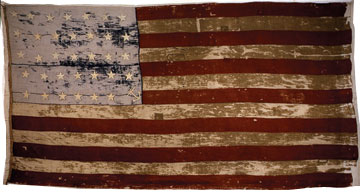
Old Glory is back in town. What is purported to be the original "Old Glory" flag from the 1820s — the first U.S. flag to fly over a recaptured secessionist state capitol building — has returned to Nashville after a century. It's about time.

Intrepid battlefield trampers from The Civil War Forum will be descending upon Tennessee two weeks from now to cover Stones River, Spring Hill, Franklin, and Nashville (and there are still a few seats available on the tour bus). We don't have the Tennessee State Museum on the itinerary, but I hope to find time to take it in between the close of the conference on Sunday and my flight back to the Left Coast, but I need to be realistic. I have a bad habit — whenever I have occasion to fly into a city I don't know or rarely visit — of trying to fit in one-too-many stops at some local historic site. Two times I have had occasion to fly into and out of Nashville, and both times I overreached and tried to take in Andrew Jackson's Hermitage before returning the rental car. Both times I made it as far as the Hermitage parking lot, where I studied my watch and made precise risk/reward calculations before deciding I was cutting it too close, and shot off in a high-speed trail of tears to the airport. Either the third time will be a charm, or I'm writing off Old Hickory for good.

And maybe there will be time for Old Glory, too. She's on loan from the Smithsonian Institution in Washington, the flag will be on exhibit at the Tennessee State Museum from March 17 to November 12. More information from the museum's website:


The nickname for the United States flag, Old Glory, was originally attached to a flag made in 1824 for a young sea captain, William Driver (1803-1886) from Salem, Massachusetts . When first gazing at the flag, Driver was supposedly moved to call it "Old Glory," a name he used to describe the flag throughout his lifetime.

Old Glory gained its notoriety during the Civil War when Driver, who had moved to Nashville in 1837 after his wife died, raised the flag at the State Capitol after Nashville was captured by the Union Army.

"We are extraordinarily proud to have Old Glory return to Nashville where its fame originated before spreading across America ," said Lois Riggins-Ezzell, executive director of the Tennessee State Museum . "This is a singular opportunity to see a treasured artifact of Tennessee and U.S. history, and we hope the people of Tennessee and surrounding states will take advantage of this rare chance."

Old Glory was originally flown from Driver's merchant ship in the 1820s/1830s. When in Nashville , he hoisted it across the street at each national holiday and on his birthday of March 17. As the Civil War drew near and sentiment for the Confederacy grew in Nashville.

Driver, a staunch Unionist, reportedly hid Old Glory by having it sewn into a quilt. The war divided Driver's family as his two sons fought for the Confederacy and one son was killed at the Battle of Perryville.

In 1862 Nashville became the first state capital in the Confederacy to fall to Union troops. Upon the arrival of Union soldiers, Driver removed Old Glory from its hiding place and flew it from the State Capitol.

The newspapers of the time ran stories of Old Glory being brought out of hiding. Before long, people began referring to all U.S. flags as Old Glory.

Originally a 24-star flag when it was created for Driver, Old Glory was re-sewn around 1860, adding 10 more stars for the states that had joined the Union after the flag was originally constructed. An anchor was also added on the canton of the flag, which referred to Driver's experiences as a sea captain.

Old Glory remained in the Driver family until 1922 when it was presented by his daughter, Mary Jane Roland, to President Warren G. Harding. The flag was in a very delicate condition, and it essentially remained in storage until 1981 when Tennesseans raised the funds necessary to begin conservation efforts.


Wednesday, March 08, 2006

Claude of the Turbervilles


Saw mention of this article over at Kevin Levin's Civil War Memory site — perfect fodder for examining the "memory" of that defining era in American history. Claude Turberville, quoted in The Mississippi Press, is a reenactor, which is to say he engages in "combat karaoke" (a phrase I first saw used by, I think, Prof. Wolfgang Hochbruck).


These days I'm more or less desensitized to assertions, like that attributed to Turberville, that "many people believe the Civil War was fought over slavery. It was not. It was initially about states' rights and taxes." This kind of thing is not going away, no matter what. It's an article of faith in some quarters, like the idea that you'll catch a cold if you go outside with wet hair in winter. It's easy to see the connections. People who go outside with wet hair do frequently catch a cold — albeit from rhinoviruses unrelated to hair. And the Civil War was about state rights — specifically the "right" to perpetuate slavery and to expand it into the vast territories of the growing nation before free soilers got the upper hand to an extent that could never be overcome.


One can make a coherent proposition that places the concept of state rights at the core of the sectional rift. It has to be phrased carefully, and not overreach, lest it expose the unavoidable underpinning that is slavery — not everyone has the stomach for The Apostles of Disunion, or Alexander Stephens's "Cornerstone Speech." But one can at least build an argument about state rights without making things up out of whole cloth. An argument can be offered that allows one to retain a modicum of dignity, and to avoid sounding like a Borg drone parroting a neo-Confederate bible.


But this business about "black Confederates" drives me nuts. As Turberville tells it, "Black soldiers fought alongside white soldiers in the Confederate Army." Sigh. Now, most everyone with a passing interest in the subject of black men under arms for the Confederacy — everyone who's ever argued the point — is well-acquainted with the documentary evidence and anecdotes alike: the pensions, the body servants who picked up a gun, the slaves who rode with Forrest, the teamsters in Lee's retreat from Gettysburg. We've read Richard Rollins's expositions on familial bonds between black and white Southerners, and Art Bergeron's solid accounts of some individuals from Louisiana. We know about the short-lived Native Guard in New Orleans, the phantom black regiment on the Peninsula, the illusive black cannoneers at First Manassas. Likewise, we know about the abortive attempts to field black CS regiments in the waning days of the war. We've seen Walter Williams's column, and the numbers attributed to Dr. Smith of American University. And yes, we realize Williams and Smith are African Americans — that qualification is always included, as if it somehow obviated the need for actual substantiation. 


When we lay all the evidence out neatly, and scrutinize it closely, there is one incontrovertible fact that cannot be denied: except in the rarest of instances, black soldiers did not fight alongside white soldiers in the Confederate Army. As a matter of fact, blacks were not allowed in the ranks of Southern armies. That's why, when it did occur, the occurrence was isolated and exceptional. What blacks did do was flee to the protection of Union arms by the 100s of thousands (is that part of Turberville's classroom presentation?). Some 180,000 of them donned Union uniforms and fought against Confederate armies. The idea that blacks in any significant numbers fought in CS armies is a myth designed to disassociate slavery from secession and war. It is an enduring tenet for latter-day proponents of the Lost Cause apologia launched long ago by folks like Edward Pollard, and Jubal Early.

Notice how, in Turberville's telling (or at least in the way he was quoted), it's an important distinction that blacks were segregated in Union armies, but fought side-by-side with whites in Confederate forces. Lost Cause apologists and neo-Confederate fictioneers invariably seek to seal the deal by highlighting racism in the North, as if the near-universal conviction of white supremacy among white Americans of that time had some bearing on the question. Slaves and free blacks fighting for the Confederacy is an extension of the ultimate irony, in keeping with secessionist Fire-eater rationalizations that theirs was a fight for "liberty" (the liberty to enslave others).

And yes, I think I did just make up the word "fictioneer." I kind of like it. I hope it's original.

Let us all humble ourselves. We don't have to make stuff up to honor our ancestors' memories, or to enjoy studying the past (though of course, we do — I don't know why Lost Cause mythology troubles me more than tried and true myths from the American Revolution, or other staples). Still, we don't need to pretend that Lincoln thought blacks were the equal of whites. He didn't. We don't have to pretend the war was one glorious effort at emancipation from start to finish. It wasn't. And likewise, there's no sense in pretending that the future of slavery wasn't the very crux of the sectional conflict — the issue that required difficult compromises between free soil and slave soil to forestall hostilities for decades, the issue, more than any other, that ultimately precipitated secession, and war. Because it was. That's what the historical record tells us. It's what the architects of secession themselves tell us.


If it were only Mr. Turberville and his weekend warriors validating each other's beliefs around a friendly campfire, where's the harm? Or testing their positions against the beliefs of other adults in various forums — who could complain? But going into elementary schools and dressing up fraudulent declarations as the considered conclusions of honest research, that's something else. I'm guessing that when the gentleman in question talks to school groups, and tells them about the mythological integrated armies of the South, he stops short of telling them that as late as 1864 — 1864! — General Patrick Cleburne was nearly run out of the Confederacy on a rail for daring to suggest the South begin enlisting slaves into the army in return for emancipation. I'm confident that Mr. Turberville neglects to tell the children that when the Confederacy had its back to the wall before the spring campaigns of '64, the CS leadership would not consider for a moment giving up slavery to gain the one ingredient it most needed to ensure independence: manpower. Without slavery, what was the point of independence?

You can be assured that, standing before impressionable school children — where his uniform imbues him, in the eyes of the kids, with the authority of someone who knows what he's talking about — Turberville stops short of quoting Confederate Congressman Robert Toombs, who denounced efforts to create slave regiments even with the CSA in its death throes, worrying that if blacks could be soldiers "our whole theory of slavery is wrong."

Again, if it were just Turberville, his buddies and their families, regaling each other with tales of black Confederates, I'd say, "knock yourselves out." But unfortunately, thanks to his casually inane myth-making in classrooms of young children, there will always be new standard bearers to step up and take his place whenever the Lost Cause flame starts to flicker.