Thursday, September 29, 2016

From the Lab: Civil War Blood (NYHS)


 From the Lab: Civil War Blood


The Story . . .
While processing the records of the Military Order of the Loyal Legion of the United States, New York Commandery, we came across a poignant relic of the Civil War: a note passed between the lines at the Battle of Antietam, one of the bloodiest battles in the history of the nation.
The note was sent to the Loyal Legion by Union Captain William J. Carlton, who explains in an accompanying letter that while he was posted “in front of the little Dunker church” – the site of some of the sharpest fighting of the battle – a Confederate soldier approached with a flag of truce and handed over a note asking for the body of confederate Lieutenant Paul Newton.  The note, signed by Colonel A.H. Colquitt – a Georgian who after the war was elected to the U.S. Senate — describes Newton as “tall and well proportioned, has … blond hair and mustaches, with 2 stars on the collar of his coat.”
Carlton took the note to Union Generals William B. Franklin and Henry Warner Slocum, who agreed to comply with the request, and the body was sent across the lines.
The story doesn’t end there, though.  In a sad postscript, Carlton notes that the following morning, after the Confederates retreated into Virginia, he saw the body of Paul Newton with a number of other dead Confederate officers left abandoned on the field: “evidently they had not the means of transportation and had to leave their fallen comrades to be found in unknown graves.”
Click here to read the full article

Sunday, September 11, 2016

Remembering Rick Rescorla, an American soldier, on September 11


"You see, for Rick Rescorla, this was a natural death. People like Rick, they don’t die old men. They aren’t destined for that and it isn’t right for them to do so. It just isn’t right, by God, for them to become feeble, old, and helpless sons of bitches. There are certain men born in this world, and they’re supposed to die setting an example for the rest of the weak bastards we’re surrounded with."

Quoted from this New Yorker article from 2002, featuring Rescorla: "The Real Heroes are Dead, A Love Story," by James B. Stewart. Rescorla died on September 11, 2001 in the terrorist attack on the World Trade Center towers, while helping others to safety.

He is the soldier pictured in the foreground of the dust jacket photo on the Moore and Gallagher book, We Were Soldiers Once and Young. 
In this 8-minute video, Rescorla discusses the Ia Drang battle (Vietnam War), and the future of warfare (terrorists).  

Tuesday, August 30, 2016

"Last photograph of Gen. Grant, four days before death"


Ulysses S. Grant, by John D. Gilman, 1885. National Portrait Gallery

Sunday, August 28, 2016

Medals of Honor — fathers and sons

Arthur MacArthur, Jr.
Arthur MacArthur, Jr., and his son, Douglas MacArthur, became the first father and son Medal of Honor recipients. Arthur MacArthur, 19-year-old first lieutenant of the 24th Wisconsin Infantry in the American Civil War, was awarded the Medal for actions in the Battle of Missionary Ridge, east of Chattanooga. In the stunning Union assault on November 25, 1863, MacArthur led his men with a shout of "On Wisconsin," and planted the regimental colors atop the ridge.

General Douglas MacArthur, 1940s,
by John Florea, Life Photo Collection
Douglas, 62-years-old when he was awarded the Medal, may be the oldest recipient. George Marshall penned his citation which read, in part:

"For conspicuous leadership in preparing the Philippine Islands to resist conquest. . . . He mobilized, trained, and led an army which has received world acclaim for its gallant defense against a tremendous superiority of enemy forces in men and arms. His utter disregard of personal danger under heavy fire and aerial bombardment, his calm judgment in each crisis, inspired his troops, galvanized the spirit of resistance of the Filipino people, and confirmed the faith of the American people in their Armed Forces.” 

"Eisenhower pointed out that MacArthur had not actually performed any acts of valor as required by law, but Marshall cited the 1927 award of the medal to Charles Lindbergh as a precedent" [Wikipedia].

Theodore Roosevelt, Jr.
The next father and son recipients were President Theodore Roosevelt and his son, Theodore Roosevelt, Jr. While junior received the award posthumously for valor at Utah Beach, Normandy, in June, 1944 (Roosevelt died of a heart attack just over a month after D-Day), it wasn’t until 2001 that Teddy Roosevelt (likewise posthumously) received the award for actions at San Juan Hill in 1898. Read a fascinating four-part article on Roosevelt’s persistent efforts to receive the award here (note: the article was written a few years before 2001).

Teddy Roosevelt
Library of Congress


Saturday, August 20, 2016

Captain Jack's Stronghold (Modoc War of 1872-1873)

The Modoc War of 1872-73 

The Medicine Flag today, and 143 years ago. 

Captain Jack's Stronghold. 


From Modoc War, by Erwin N. Thompson, after the soldiers had driven the Modoc band from the stronghold:

"Among the bones, rags, and wickiups there was little of the loot of war that appealed to the collector instinct among soldiers. However there was one trophy that assumed importance in their minds — the "medicine flag." At three different high points in the Stronghold the Modocs had erected these emblems, the guarantors of victory. One in particular, standing on one of the highest rocks, had long been visible to the soldiers, and to them it had become a symbol of Modoc defiance, the enemy's regimental colors as it were.


The troops captured this medicine flag on the last day of the fight. It was no star-spangled eagle embroidered on a field of blazing color. Simpson, realizing its importance as a symbol, drew and described it as consisting of a "mink's skin and hawk's feathers with medicine bead." These were fastened to the end of a stick "about four feet long, and is just as it was cut from the tree." He said that the small white bead had been placed among the feathers, and the pole "stood on a heap of stones during the fighting." After the battle, a photographer took a picture of two soldiers standing on the "medicine rock." This rock may still be identified today toward the northeastern end of the Stronghold. It is quite possible that the medicine flag fluttered from here during the battle. Its capture and removal symbolized the soldiers' success in taking the Stronghold. But that was all it symbolized. The Modocs were still their own masters, somewhere in the lava beds to the south."

More images of Captain Jack's Stronghold from my recent visit to the Lava Beds National Monument (what happens in Siskiyou County, stays in Siskiyou County).


Captain's Jack's Cave


Friday, August 19, 2016

Men Go to Battle (film)

Still from Men Go to Battle

Men Go to Battle

August 19, 2016 | by 
A small-budget film dramatizes the passive motives of Civil War enlistees.
Men Go to Battle, currently playing in a small number of theaters, is unusual among Civil War movies in that it dares to dramatize the established truth that the war was fought largely by people who harbored no particular ideology whatsoever. Civil War movies are typically about people like Abraham Lincoln (Lincoln), Robert Gould Shaw (Glory), Robert E. Lee (Gettysburg), the founders of the Ku Klux Klan (Birth of a Nation), and principled Southern defectors (this summer’s pedantic Free State of Jones), that is, people who cherish strong beliefs of one kind or another and take a stand. Henry Mellon stands for nothing. But he fights in the Battle of Perryville, at once panicked and sleepy-eyed, marching into artillery fire, shooting his rifle at Braxton Bragg’s line of gray, which must be somewhere out there on the far side of the cloudy explosions...
Read the full article here


Sunday, July 24, 2016

The Cassius Clay Battalion


Protecting Washington, D.C. became a priority for Union forces when the Civil War began in April 1861. Northern military units convened in the nation’s capital to protect Washington and form a national army. One of the first to defend the White House was the Cassius Clay Battalion.
Cassius Marcellus Clay had been recently selected by President Abraham Lincoln, a fellow Kentucky native, to serve as Minister to Russia. When conflict first arose he quickly raised volunteers of various professions and backgrounds willing to defend the White House.

Although they were soon replaced by more experienced troops, the Cassius Clay Battalion’s spirit proved invaluable at a time when the defense of D.C. was imperative.
This image shows them assembled on the White House’s South Lawn.

Tuesday, June 28, 2016

June 27 -- U.S. Grant at Mt. McGregor, New York

Saturday, June 25, 2016

140th anniversary of the Battle of the Little Bighorn

June 25 is the 140th anniversary of the Battle of the Little Bighorn. These images are by photographer Richard Throssel [University of Wyoming American Heritage Center, Richard Throssel Papers], including two from the 50th anniversary, and one photo (headstone) I took myself. Sunrise on Custer Battlefield, the Three Scouts on Last Stand Hill, and anniversary ceremonies. The man in the headdress is White Man Runs Him, one of Custer's Crow scouts, who lies buried in the National Cemetery down the hill.


Friday, June 24, 2016

"This research presents a crucial corrective to the Lost Cause version of history"

With Free State of Jones, Hollywood’s Civil War
Comes Closer to History’s

Pop Culture May Finally Be Ready to Surrender the Myth of a Noble,
Confederate Lost Cause . . .
by Victoria Bynum, June, 23, 2016

The events in Jones County demonstrate a larger truth of dissent and violence that erupted throughout the South during the Civil War. This research presents a crucial corrective to the Lost Cause version of history that afflicts us still—not simply in movies and novels, but also in the classroom, where even my college students have frequently assured me that “Granny said our slaves were treated just like family in the old days,” or on internet message boards and chat rooms, where self-proclaimed authorities insist the Civil War was never really about slavery. 
Scholars like myself have long struggled against this version of Civil War history. It was created only around the turn of the 20th century, when a few influential Northern and Southern historians strove to heal the war-damaged United States by creating a more conciliatory vision of the Civil War and Reconstruction. 
Denouncing the war as a needless slaughter brought on by politicians, historians such as William Archibald Dunning and his followers portrayed the Reconstruction that followed as a tragic era of “Negro rule,” carpetbagger corruption, and scalawag treason. The Dunning School soft-peddled slavery’s role as the major cause of war. The myth of a Civil War fought over “states’ rights” hardened into orthodoxy, providing a “noble cause” for white Southerners seeking to sanctify the sacrifices and deaths of their ancestors.
read the full article here 

Sunday, June 19, 2016

Steve Adelson on the Battle of the Little Bighorn

As we approach the 140 anniversary, let's review. Park Ranger Steve Adelson gave a spirited talk on the Visitor Center back patio in August of 2014, captured for posterity by C-SPAN. 

I like this talk a lot. Condensing such a big story into such a small talk—all of the background information, the biographies, the infinitely complicated context—for a diverse crowd of mostly first-time visitors, is an art form. Some do it better than others. Steve Adelson does it very well, I think. 

[My only (nitpicking) gripe about the presentation has to do with the video editing. There is no known photograph of Crazy Horse, but this film seems to suggest that's what you're looking at on a couple of occasions.]


http://www.c-span.org/video/?c4605326/battle-little-bighorn


Friday, June 10, 2016

"The Bombing of Fort Point (Battle of San Francisco)"

 "The Bombing of Fort Point (Battle of San Francisco)"  Oil on Canvas, 43" x 54", 1996 

In Smog and Thunder: The Great War of the Californias
    Sandow Birk

A series of artworks depicting an imaginary war between San Francisco and Los Angeles, incorporating more than 120 artworks, including paintings, drawings, prints, faux war posters, maps, diagrams, models, and video documentary. 
The project was exhibited at the Laguna Art Museum in Southern California in 2000, and at the Sonoma Art Museum in Northern California in 2001. 
A 45 min. documentary film about the war, inspired by Ken Burns' PBS series "The Civil War", was completed in 2001 and is now available. It was directed by Sean Meredith and made in collaboration with Paul Zaloom. View other images in the series here

Wednesday, June 08, 2016

Dr. John H. Eicher, 1921–2016

"The world has lost a great and a good man with the passing on Tuesday, June 7, of Dr. John H. Eicher, organic chemist, Manhattan Project scientist, mineralogist, historian, philosopher of science, and promoter of sharing the joy of knowledge with his fellow human beings."
Read more about Dr. Eicher in this Astronomy magazine tribute

John Eicher made lasting contributions in many areas of study. He and his son David collaborated on several Civil War book projects, including the magisterial reference work, Civil War High Commands (Stanford University Press, 2002).  


http://www.sup.org/books/title/?id=988

Sunday, June 05, 2016

Matthew McConaughey on "Free State of Jones"


Congratulations to Victoria Bynum on the forthcoming release of a major movie based on her book, "The Free State of Jones: Mississippi's Longest Civil War." It promises to be a great film about an amazing, deeply American story. Official trailer.
I was promoting the story of the Free State of Jones (glorified book review) way back when Matthew McConaughey was still fighting dragons ( Reign of Fire, 2002).


Sunday, May 22, 2016

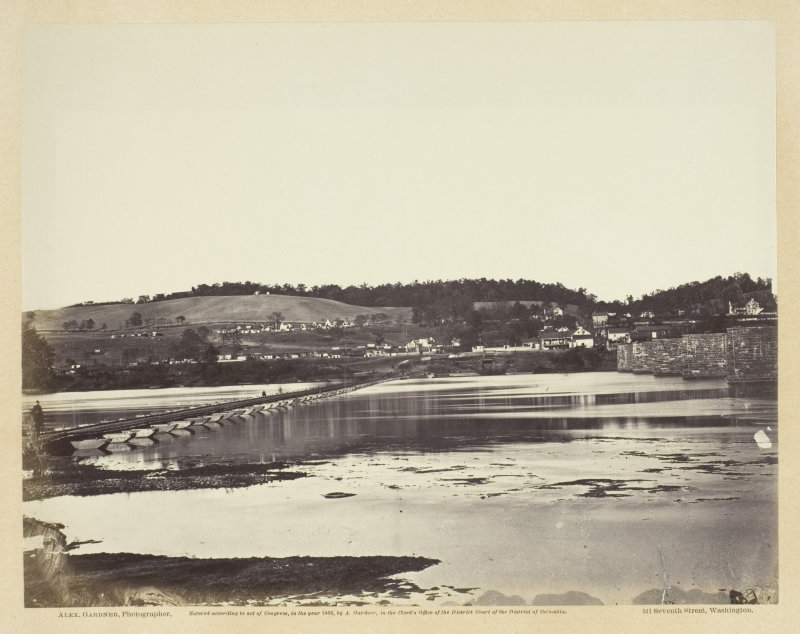
Pontoon bridge across the Potomac at Berlin.

Alexander Gardner, November 1862, Berlin, Maryland

Art Institute of Chicago
New York Public Library


The "Weehawken" sinking, Dec. 6th, 1863

From Sketches for Frank Leslie's Illustrated Newspaper
New York Public Library

THE MONITOR DISASTER; Particulars of the Sinking of the Weehawken
Correspondence of the Boston Traveler.
Published: December 14, 1863

SOUTH ATLANTIC SQUADRON, MORRIS ISLAND, S.C., Dec. 7, 1863.
For some time past nothing of interest has occurred at this point. We have had a few days of cold and nights of freezing weather. Yesterday, however, there occurred to the fleet the worst disaster of the siege. The famous iron-clad Weehawken, so gallantly fought by Capt. JOHN ROGERS, and recently by Commander CALHOUN, has sunk off Morris Island.

On Saturday, the 5th inst., we had a calm Summer's day. About midnight the breeze sprung up from the northeast, and blew a gale. The vessels that rode at their anchors so quietly on Saturday now plunged fearfully. The Ironsides lay about two miles from Sumter, the Montauk was on picket, the Nahant was to the northeast about two hundred yards, and the Weehawken to the southwest about a hundred yards. Commander CALHOUN had been sent home, unfit for duty, a short time previously. Commander DUNCAN, of the Paul Jones, took charge of the Weehawken on Saturday, the 5th inst.

During the forenoon of Sunday, Commander DUNCAN visited the flagship, and while there the Weehawken shipped a heavy sea, which entered the forward hatch and filled the anchor-room. This anchor-room is a water-tight compartment with a valve under the cabin door to let aft the water to the pumps, but at this time it must have been out of order, as the water could not get aft. The cabin door was closed, yet the bars that were to hold it in its place, (so as to keep the water in the anchor-room,) could not be found. The officers and men, inured to dangers of this kind, seemed to care but little for what was going on.

They went below and quietly partook of their dinner, but soon after they were astonished at the rapidity with which the water was gaining upon them. The executive officer commenced to pay out chain, but the hawse-pipe was soon under water and a six-inch stream came pouring in. The paying out of the chain did not relieve the ill-fated vessel. JOHN ROGERS was not there. Presently the cry "She sinks!" resounded through the vessel, and signals of distress were made to the flagship; boats were lowered from all vessels knowing the signals, but before they could reach her she sunk how first in five fathoms water, carrying with her twenty-six men and four engineers, including men in irons and men sick; also men at work in the engine-room—supposed the whole watch on duty at the time.

It is presumed that when the water reached the forward part of the boilers it made steam so suddenly as to suffocate all hands in the engine-room, as not one who was there escaped. The yeoman was picked up, but died soon afterward. Much credit is due Capts. AMMEN and BRADFORD of the navy for their great exertions made to save the perishing sailors. A charge of want of proper care would seem to rest upon the officers of the Weehawken. Some, however. have advanced the idea that the forward overhang of the lost vessel has broken off, but Mr. HUGHES, Inspector of Iron-clads, thinks that cannot be the case.

If the Weehawken is ever raised, it will then be known where the blame, if any, rests. The Weehawken had but recently returned from Port Royal, and had an unusual quantity of shot and shell on board, which probably settled her too far in the water. It is calculated that when these vessels are under water but fifteen inches, that two hundred tons would sink them bodily, consequently a much less weight would carry them down bow first.

Tuesday, May 17, 2016

Major General John A. "Black Jack" Logan, from the Library of Congress.

Civil War Trust's biography of John Logan is here

Photos:
(1) Monument of Gen. John A. Logan, Chicago, Ill. (on horseback, with group of people, mostly seated on lawn, in foreground), c1900; (2) Logan, wartime portrait; (3) Washington, District of Columbia. The Grand Review of the Army. Gen. John A. Logan's 15th Army Corps passing on Pennsylvania Avenue near the Treasury, May 1865, Mathew Brady.


Wednesday, April 27, 2016

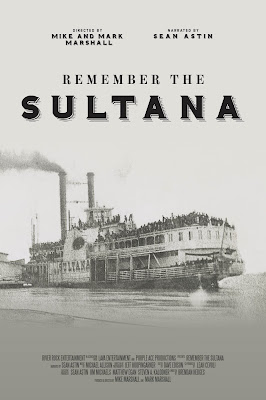
Remember the Sultana


From The Sultana Documentary page on Facebook today comes this intriguing tidbit:

"Pat Jennings, Hartford Steam Boiler's principal boiler engineer, recently released new research finally explaining what caused this historic event over 150 years ago": 

The Sultana – Part 5: What caused the Sultana disaster?