Read the full article here.
Using the cemetery's own burial records, plus government, military and privately owned documents available online, Green-Wood's project has identified the graves of about 4,600 Civil War veterans. Green-Wood historian Jeffrey Richman estimates 3,000 to 4,000 more are scattered among the cemetery's more than 560,000 total interments.
The Civil War dead buried at Green-Wood include unknown privates and famous officers, buglers and Medal of Honor recipients, Yankees from Maine to Iowa, fathers, sons and brothers, and even 75 Confederates, including two generals. None of the original gravestones for the Confederates gave any indication they had fought for the South, an intentional omission being rectified by the installation of new granite markers provided by Veterans Affairs.
Reflections, observations, random thoughts and bon mots, relating to the literary and geographic landscapes of American history. And book reviews too.
Friday, May 27, 2011
Over 4,000 Civil War graves identified in a Brooklyn cemetery
Monday, May 23, 2011
Solarium: A novella
I just finished reading a pretty amazing short work of fiction called, "Solarium: A novella," by Josh Weil. It was published in the journal, "American Short Fiction," vol. 13, issue 50 (Winter 2010/11). I had subscribed to the journal because the previous issue featured a short story by a friend of mine (great job, Rob!), and because I was curious what this resurrected literary journal was doing these days.
I was surprised to find a story set during the Civil War—"Solarium" takes place on a Virginia plantation in 1865, beginning some time before Richmond falls and continuing beyond. But I was really surprised that the author boldly told the tale in the first-person vernacular of mid-19th century master and slave. Generally speaking, I'm of the opinion that if your name is not William Faulkner, the practice should be avoided, but author Josh Weil did an admirable job. So I will modify my recommendation to say don't do it unless you're good enough to pull it off. Seriously, who are you trying to kid?
The story is told in six overlapping narratives—each headlined simply by the narrator's name (As I Lay Dying)—mainly giving alternating perspectives from a cotton farmer and certain of his slaves. I so want Civil War historical fiction to be as engaging and powerful as the material itself, and I am so regularly disappointed, that I started reading this novella with trepidation.
But I was soon caught up in the strange story centered on the discovery one day of an errant hot air balloon that lands on the farm. Weil skillfully gives us characters to care about (which is to say believable and compelling), and builds an ever-rising tension about the coming of the end for some, and the promise of a new beginning for others.
It's hard to review a 90-page story without giving away elements that would otherwise contribute to the reader's pleasure of discovery, but suffice it to say I found it impressive in its construction, unpredictable, and exciting. What more do you want from historical fiction, other than a reasonable faithfulness to accuracy? It has that, too.
One of the best things you can say about a work of art is that it causes you to reflect on it long after you've moved on. I've been thinking a lot about "Solarium," puzzling out some things I moved over too quickly, suddenly recognizing a larger image that I was too close to discern while reading, or replaying in my head a powerful scene, as if I had seen it acted out. Damn it, I'm going to have to read it again, and life is already too short to read all the books I own once.
I had never heard of Josh Weil, but his biography in the journal indicates he's off to a good start—many prizes and many prestigious fellowships. His 2010 triptych of novellas, The New Valley, is described in some detail on Amazon.
You can read "Solarium" by buying the current issue of "American Short Fiction" at the publisher's website—"Solarium" and three other short stories—for five bucks. Unless I'm mistaken.
I was surprised to find a story set during the Civil War—"Solarium" takes place on a Virginia plantation in 1865, beginning some time before Richmond falls and continuing beyond. But I was really surprised that the author boldly told the tale in the first-person vernacular of mid-19th century master and slave. Generally speaking, I'm of the opinion that if your name is not William Faulkner, the practice should be avoided, but author Josh Weil did an admirable job. So I will modify my recommendation to say don't do it unless you're good enough to pull it off. Seriously, who are you trying to kid?
The story is told in six overlapping narratives—each headlined simply by the narrator's name (As I Lay Dying)—mainly giving alternating perspectives from a cotton farmer and certain of his slaves. I so want Civil War historical fiction to be as engaging and powerful as the material itself, and I am so regularly disappointed, that I started reading this novella with trepidation.
But I was soon caught up in the strange story centered on the discovery one day of an errant hot air balloon that lands on the farm. Weil skillfully gives us characters to care about (which is to say believable and compelling), and builds an ever-rising tension about the coming of the end for some, and the promise of a new beginning for others.
It's hard to review a 90-page story without giving away elements that would otherwise contribute to the reader's pleasure of discovery, but suffice it to say I found it impressive in its construction, unpredictable, and exciting. What more do you want from historical fiction, other than a reasonable faithfulness to accuracy? It has that, too.
One of the best things you can say about a work of art is that it causes you to reflect on it long after you've moved on. I've been thinking a lot about "Solarium," puzzling out some things I moved over too quickly, suddenly recognizing a larger image that I was too close to discern while reading, or replaying in my head a powerful scene, as if I had seen it acted out. Damn it, I'm going to have to read it again, and life is already too short to read all the books I own once.
I had never heard of Josh Weil, but his biography in the journal indicates he's off to a good start—many prizes and many prestigious fellowships. His 2010 triptych of novellas, The New Valley, is described in some detail on Amazon.
You can read "Solarium" by buying the current issue of "American Short Fiction" at the publisher's website—"Solarium" and three other short stories—for five bucks. Unless I'm mistaken.
Sunday, May 22, 2011
the Wire, to Treme, to Lincoln Assassination?
![]() |
| Steve Earle, May 20, 2001 at Kepler's in Menlo Park, CA |
Earle has also had some roles in David Simon's highly acclaimed HBO series, The Wire, and more recently in Simon's newer series, Treme. During the Q&A Friday night, I got the opportunity to ask Earle if he reads a lot of Civil War history. He said he has in the past, but not lately. The question, however, caused him to relate the story that David Simon told him not to cut his beard, because he had him in mind for a particular cavalry officer who participated in the pursuit and capture of John Wilkes Booth. Earle said Simon, who is a crime reporter at heart (was, in fact, a crime reporter for the Baltimore Sun) had no interest in Lincoln or Booth so much as the other characters involved. It occurred to me that Robert Redford recently addressed this very subject, but undoubtedly Simon would take it in another direction.
I hope it comes to fruition. Might be a nice counterbalance to all of the other assassination-related dramas we're going to see in the next few years.
Friday, May 20, 2011
"I was wearing the name of Lewis Smith"
![]() |
| Portrait of Dick Barnett and his wife, date unknown. (Records of the Department of Veterans Affairs, RG 15) |
A fascinating article. . .
Winter 2005, Vol. 37, No. 4
Voices of Emancipation:
Union Pension Files Giving Voice to Former Slaves
By Donald R. Shaffer and Elizabeth Regosin
© 2005 by Donald R. Shaffer and Elizabeth Regosin
Union Pension Files Giving Voice to Former Slaves
By Donald R. Shaffer and Elizabeth Regosin
© 2005 by Donald R. Shaffer and Elizabeth Regosin
Civil War pension files have the potential to rival the more famous WPA narratives of ex-slaves in offering evidence on the experiences of 19th-century African Americans from a black point of view. In fact, based on when the information was collected—mainly between the 1880s and 1910s—they are arguably superior. Civil War pension files are much more contemporaneous to the experiences of slavery, the Civil War, and their aftermath than the WPA narratives, which were not gathered until the mid-to-late 1930s. Many pension files include in-depth interviews of former slaves by special examiners for the purpose of clarifying information on such issues as military service, identity, health and disability, marital and family relationships, employment, economic circumstances, and previous ownership. The depositions are often quite effective in giving a voice to former slaves, allowing them the opportunity to talk about their lives and provide important clues about how they saw the world.
Read the full article here.
Thursday, May 19, 2011
Five Myths About Why the South Seceded
| ALEXANDER GARDNER/ AP - A photograph of Abraham Lincoln taken by Alexander Gardner in Washington in August of 1863. |
Lies Across America author, James W. Loewen, dispenses with some enduring misconceptions about secession in this piece for the Washington Post.
As the nation begins to commemorate the anniversaries of the war’s various battles — from Fort Sumter to Appomattox — let’s first dispense with some of the more prevalent myths about why it all began.
(1) The South seceded over states’ rights. (2) Secession was about tariffs and taxes. (3) Most white Southerners didn’t own slaves, so they wouldn’t secede for slavery. (4) Abraham Lincoln went to war to end slavery. (5) The South couldn’t have made it long as a slave society.Loewen's offers up his reasons for each point.
Tuesday, May 10, 2011
"The Foolishness of Civil War Reenactors," by Glenn W. LaFantasie
Though I'm a regular reader at Salon.com, I just learned of this article by visiting Andy Hall's excellent Dead Confederates blog. Monday, May 09, 2011
The Battle of Bentonville, North Carolina
The people have spoken. Every year a dedicated contingent of long-time members of the Civil War Forum—along with a handful of welcome newcomers to the group—meet at a different battlefield for three days of battlefield tramping, good food, and good company. Next year, the group has voted to visit North Carolina. Mark your calendars.
16th Civil War Forum Battlefield Conference
The Battle of Bentonville
Wilmington & Fort Fisher
March 29 to April 1, 2012
Headquarters: Dunn, NC
The Battle of Bentonville
Wilmington & Fort Fisher
March 29 to April 1, 2012
Headquarters: Dunn, NC
Mark Bradley, author of the definitive campaign study, The Battle of Bentonville: Last Stand in the Carolinas, will guide us through Averasboro and Bentonville, and Chris Fonvielle, author of The Wilmington Campaign: Last Rays of Departing Hope, will handle the Forts Fisher and Anderson tours. Additionally, we'll visit the Monroe's Crossroads battlefield on the grounds of Fort Bragg.
Check out the Civil War Trust's Bentonville and Fort Fisher pages for maps, articles, and other resources.
We'll do things a little bit differently next year, in that I'll most likely book the bus for three full days, reserving the last day for the long ride to Wilmington and back (Sunday, April 1st). For that trip, we'll put on a Civil War movie and pull out the refreshments, to include copious amounts of adult beverages.
We'll be headquartered at a hotel in Dunn, North Carolina, which is about an hour from the biggest airport in the region (Raleigh), and close to the battlefields. Stay tuned for hotel info and final itinerary. Let me know if you'd like to receive registration information by email.
Friday, May 06, 2011
End of the line for Lincoln
Paul Chinn / The ChronicleDockworkers prepare to receive the Lincoln
as it arrives at the Mare Island shipyard in Vallejo.----------
A gray old ship, the Lincoln, that is part of San Francisco's maritime past was towed up the bay Thursday on a final voyage to be scrapped at Mare Island in Vallejo. . . .
Read the full article here.
The trip was part of an unusual nautical swap in which the government traded the Lincoln for its identical sister ship, the President. Both vessels will be scrapped: one of them in Texas, the other in Vallejo.
The two ships - originally named President Lincoln and President Tyler- were built in San Francisco in 1961 and sailed out of the city on voyages all over the world for years. They were general cargo ships, operated by American President Lines, a company that traces its roots to the Gold Rush of 1849.
----------
Sunday, May 01, 2011
How the "Lost Cause" poisoned our history books
Ulysses S. Grant, the commanding general of the Union Army and the 18th president of the United States, would have been 189 years old last week--not long after the "official" opening of the Civil War Sesquicentennial, which will run through 2015.
Grant -- like George Washington and Dwight D. Eisenhower -- was both a professional warrior of a defining war and a twice-elected president. And like Washington and Eisenhower he dominated his era, which in his case encompassed both the Civil War and its aftermath, called Reconstruction, from 1862 (when he rocketed to fame with his defeat of Confederate forces at Fort Donelson) to 1876.Read full article here.
Thursday, April 28, 2011
Was one of your ancestors lost on the U.S.S. Monitor?
![]() |
| The skeleton to the left, victim “Monitor 2,” is shown by digital overlay where it was uncovered after the photo of the first victim was taken. (Monitor Collection, NOAA) |
The United States Navy would like to identify the remains of two men found in the turret of the U.S.S. Monitor -- two of the 16 officers and crew who went down with the ship on New Year's Eve, 1862. If you think you might be a descendant and are willing to produce some DNA, contact Jeff Johnston at (757) 591-7351, Jeff.Johnston@noaa.gov. Thanks to Robert Moore for highlighting this article at Civil War News.
List of Monitor casualties:
OFFICERS:
Attwater, Norman Knox: Acting Ensign
Frederickson, George: Acting Ensign
Hands, Robinson Woollen: 2nd Asst. Engineer
Lewis, Samuel Augee: 3rd Asst. Engineer
Attwater, Norman Knox: Acting Ensign
Frederickson, George: Acting Ensign
Hands, Robinson Woollen: 2nd Asst. Engineer
Lewis, Samuel Augee: 3rd Asst. Engineer
ENLISTED AFRICAN-AMERICAN:
Cook, Robert: 1st Class Boy (b. Gloucester County, VA)
Howard, Robert H: Officers’ Cook (b. Howard County, VA)
Moore, Daniel: Landsman (b. Prince William or Loudoun County, VA)
Cook, Robert: 1st Class Boy (b. Gloucester County, VA)
Howard, Robert H: Officers’ Cook (b. Howard County, VA)
Moore, Daniel: Landsman (b. Prince William or Loudoun County, VA)
ENLISTED WHITE:
Allen, William: Landsman (b. England) 24 yrs.
Bryan, William: Yeoman (b. New York City) 31 yrs.
Eagan, William H: Landsman (b. Ireland) 21 yrs.
Fenwick, James R: Quarter Gunner (b. Scotland) 23 yrs.
Joyce (Joice), Thomas: 1st Class Fireman (b. Ireland) 23 yrs.
Littlefield, George: Coal Heaver (b. Saco, ME) 25 yrs.
Nicklis (Nickles), Jacob: Seaman (b. Buffalo (?), NY) 21 yrs.
Stocking, John: Boatswain’s Mate (b. Binghampton, NY) 27 yrs.
Williams, Robert: 1st Class Fireman (b. Wales) 30 yrs.
Allen, William: Landsman (b. England) 24 yrs.
Bryan, William: Yeoman (b. New York City) 31 yrs.
Eagan, William H: Landsman (b. Ireland) 21 yrs.
Fenwick, James R: Quarter Gunner (b. Scotland) 23 yrs.
Joyce (Joice), Thomas: 1st Class Fireman (b. Ireland) 23 yrs.
Littlefield, George: Coal Heaver (b. Saco, ME) 25 yrs.
Nicklis (Nickles), Jacob: Seaman (b. Buffalo (?), NY) 21 yrs.
Stocking, John: Boatswain’s Mate (b. Binghampton, NY) 27 yrs.
Williams, Robert: 1st Class Fireman (b. Wales) 30 yrs.
Monday, April 25, 2011
The Civil War: 1861 (Forever)
Get these nifty Civil War postage stamps (commemorating Ft. Sumter and First Bull Run) while they last. Avoid long lines and surly civil servants by ordering them online.
Wednesday, April 20, 2011
"The Apostle of Liberty" and The Gipper
![]() |
| Thomas Starr King |
![]() |
| Ronald Reagan under the rotunda |
Alas, King's contributions to the state of California, and to the maintenance of the union, are no longer celebrated as they once were (though you can follow the Thomas Starr King Appreciation Society on Facebook, with its 110 members, hike two mountains named for him, and admire his namesake tree at Yosemite). In 2006 the California state legislature voted to recall King's statue from the National Statuary Hall and replace it with one of Ronald Reagan, a former Des Moines radio broadcaster. There was no public discussion about such a monumental change. No debate about whether John Muir, or Joe DiMaggio, or Earl Warren, or Jerry Garcia might have been more appropriate.
The statue of "the orator who saved the nation" eventually found a new home in the Civil War Memorial Grove of Sacramento's Capitol Park. According to the Capitol Museum, the grove was planted beginning in 1896 to the east of the capitol with saplings collected from Manassas, Harpers Ferry, Savannah, Five Forks, Yellow Tavern, and Vicksburg, and ultimately 34 other battlefields. The brainchild of GAR ladies from California and Nevada, the grove was intended to honor soldiers from both sides of the conflict, and was the first monument on the capitol grounds.
![]() |
| Thomas Starr King's tomb, Starr King Way and Franklin, San Francisco |
If it were up to me, I would have recalled Serra's statue from Washington (even if he is one miracle away from sainthood), and left King's -- Serra died in 1784, 66 years before California statehood. I was not consulted. Interestingly, the Californians of 1927 who voted to include King as one of the two most notable representatives chose a man who only lived in the state for four years. He arrived in San Francisco on the eve of the war in 1860, and died in March of 1864.
![]() |
| King Statue, Sacramento |
Monday, April 18, 2011
1861: The Civil War Awakening
![]() | |||
| Unidentified soldier in Union officer's uniform at Point Lookout, Tennessee. (Liljenquist Family Collection, Library of Congress) |
Slate published an interesting interview with Adam Goodheart on Friday. He is the author of the brand-new 1861: The Civil War Awakening, and is a main contributor to the New York Times Disunion blog. Go to the Slate article and launch the slide slow for some select images from the Liljenquist collection that was recently donated to the Library of Congress.
Slate: Americans have a sense of the whole scope of the Civil War, but what is it about the year 1861 that we miss when we look back and see the Civil War as a single complete event?
Goodheart: We tend to think of the Civil War in a very fatalistic way, as a sort of vast national martyrdom. It's hard to recover the fact that things could have turned out very, very differently. It's also hard to grasp the idea that Americans at the beginning of the war had no sense of the way that things were going to unfold. When I wrote the book, I really wanted to recover that moment of uncertainty and change – to convey how people, then and now, experience history not as seen from 30,000 feet as the History Channel might, but as a barrage of individual events coming at them, alternately thrilling and terrifying.
Wednesday, April 13, 2011
Seven Days Travelogue, part two
History is all explained by geography.
— Robert Penn Warren
Dateline: Princeton-by-the-Sea, California
So this is what a blog post from an iPad looks like in Blogspot. If there's an app out there that allows one to compose with more sophisticated formatting, I've not found it yet. Might have to go back and format this after the fact. For now, I'm just happy to be able to dock the iPad on a full size keyboard.
The last two days of the 15th Civil War Forum Battlefield Conference transpired without a hitch. It was a beautiful thing to walk out into the heart of the Glendale battlefield and listen to Bobby Krick read personal accounts related to the particular plot of protected land we were standing upon.
After a spectacular lunch of fried chicken at the Elko Community Center, done up only as country church ladies can do, the balance of the afternoon was spent at Malvern Hill. Revelations abounded as we walked the Confederate assault route to the "high water" mark near the site of the slave cabins, and ultimately moved into a swale on the Confederate left to experience first-hand how two separate and parallel fights occurred out of sight of each other. Reading a description of that phenomenon is fine, but seeing it is to understand it.
At the close of the day, we stopped at the Jeb Stuart monument at Yellow Tavern, mere yards from our hotel, for a short talk on the 1864 fighting there. Sunday morning was warm and sunny, with great visibility, just perfect for our visit to Drewry's Bluff and Battery Dantzler. For decades I've pictured that stretch of the river below the guns at Drewry's Bluff, images evoked from countless written accounts, but this was the first time I was able to commit the actual view to memory.
Now I'm 3,000 miles away again, in a small fishing village overlooking the old Romeo Pier and planning next year's conference. The votes are in, and we're headed to Bentonville and Fort Fisher in 2012. Invitations are already out to guides Mark Bradley and Chris Fonvielle.
Friday, April 01, 2011
Seven Days Travelogue, part one
[CONFERENCE] Day Two -- Mechanicsville through Gaines's Mill with Bobby Krick, the best tour guide we've had in 15 years of conferences, and we've had many of the best that Civil War battlefield touring has to offer, including his father. I don't say that lightly. He's the consummate pro -- aware of his audience, able to distill an exceedingly complex campaign into a comprehendable narrative, with a perfectly engaging delivery and an absolute command of the subject matter. But it's more than that. There's a long list of qualities, some intangible, that I would highlight in recommending him to anyone else.
Highlight of the day: the Civil War Forum, thanks to the brand-new acquisition by the Richmond Battlefields Association, became the first group to traverse the Gaines's Mill battlefield in the tracks of the 4th Texas Infantry, starting on the Confederate side of the creek, descending into the creek bottom and crossing on a rudimentary "Krick bridge," before scaling the slope to the site of the Confederate break-through. The yellow box on this Richmond Battlefields Association map shows the new parcel acquired by RBA, the first preservation success at Gaines's Mill since Douglas Southall Freeman and friends purchased a small part of the battlefield in the 1920s (and the first piece on the CSA side of Boatswain's Creek to be locked off from development).
Friday night Bobby gave a fascinating talk on "Drewry's Bluff, Gibraltar of the Confederacy," making us all realize how little we actually knew about that otherwise commonly known story.
Tomorrow: all the way to Malvern Hill, and beyond.
Friday, March 25, 2011
Kunta Kinte's worst nightmare
Thanks to Kevin Levin at Civil War Memory for bringing this series of collectibles to our attention. Buy the courthouse and get the R. E. Lee figurine for free. Buy Confederate Station and they'll throw in Stonewall Jackson.
It's not as realistic as this photo of Richmond in ruins, but then I don't suppose the intended audience wants a free figurine of Presdient Lincoln, surrounded by joyous slaves, strolling over to the White House of the Confederacy to rummage through Jeff Davis's desk.
Thursday, March 03, 2011
One of last 2 WWI veterans turns 110 in Australia
By ROHAN SULLIVAN The Associated Press
Wednesday, March 2, 2011; 10:50 PM
SYDNEY -- One of the last two known veterans of World War I celebrated his 110th birthday Thursday with at least three generations of family and a contingent of navy officers in dress uniform. His daughter said he didn't want a fuss. Claude "Chuckles" Choules, who sneaked into the British navy in 1915 aged just 14, has lived quietly in Australia for more than 80 years, though his longevity has brought him closer to history with the passing of each comrade who fought the war that was meant to end all others.
They say the last Civil War veteran died around 1959, the year I was born. Now, a mere half century later, my grandfather's generation of WWI veterans are down to two (that we know of). History is a work in progress. Every day we watch it unfold, and the events of today are profound even if we cannot discern the ramifications. The nightly news is nothing short of astonishing. Not the Charlie Sheen part. The medical and technological advances part. The revolutions in the Middle East part.
Thursday, February 10, 2011
Tour of the Seven Days Battlefields
The Seven Days Battles
with Richmond National Battlefields Historian
Robert E. L. Krick
with Richmond National Battlefields Historian
Robert E. L. Krick
The 15th Civil War Forum
Battlefield Conference
Richmond, Virginia
March 31-April 3, 2011
Battlefield Conference
Richmond, Virginia
March 31-April 3, 2011
There's still room to join us on a spectacular weekend of battlefield tramping with the most authoritative guide on the Seven Days battles, the culmination of the Peninsula Campaign of 1862 and a major turning point in the war. We have 40-some souls signed up so far, and will cut off registration when we fill our coach (either a 44- or a slightly larger coach).
ITINERARY:
Thursday afternoon, March 31st:
WALKING TOUR: 1:00-4:30 p.m.
a guided stroll with narrative interpretation through Hollywood Cemetery with historian Chris Ferguson (see bio below)—we'll carpool from the hotel. Gather in the hotel lobby at 12:30 p.m. prepared to leave by 12:45 p.m.
No evening event scheduled for Thursday night.
Friday: April 1st:
BUS TOUR: 8:30 a.m. to 4:30 p.m.
Dabbs House (Lee's HQ); Meadow Bridges; Mechanicsville battlefield; lunch at Cold Harbor County Park; Gaines's Mill battlefield (extensive walking here); to close the day, we'll take the opportunity to stop at Yellow Tavern, since our hotel is on the edge of the battlefield, and the Stuart monument is less than a mile away and hard to find for most folks on their own.
RECEPTION: 6:00 p.m. to 7:00 p.m. (Yellow Tavern Bar, in the hotel)
DINNER: 7:15 p.m. (Glen Restaurant -- in our reserved seating area)
AFTER-DINNER SPEAKER: 8:00 p.m. (York Room)
Robert E. L. Krick, on "Drewry's Bluff: Gibraltar on the James"
Saturday: April 2nd:
BUS TOUR: 8:30 a.m. to 4:30 p.m.
Savage's Station; White Oak Swamp; lunch at Elko Community Center, Frayser's Farm/Glendale (only recently accessible thanks to CWPT); and Malvern Hill (extensive walking here).
RECEPTION: 6:00 p.m. to 7:00 p.m. (Yellow Tavern Bar)
DINNER: 7:15 p.m. (Glen Restaurant -- in our reserved seating area)
AFTER-DINNER SPEAKER: 8:00 p.m. (York Room)
John Coski, "After the Seventh Day They Rested"
John is the Historian and Director of Library & Research,
Museum of the Confederacy, Richmond, Virginia
Sunday: April 3rd:
OPTIONAL car pool tour: 9:00 a.m. to noon:
Drewry's Bluff and Battery Dantzler (the two best sites between Richmond and Petersburg)
Gather in the hotel lobby at 8:30 a.m. for 8:45 a.m. departure.
REGISTRATION:
$295
—includes Thursday, Friday, Saturday, and Sunday tours
—includes box lunches on Friday and Saturday
—includes buffet dinner and after dinner speakers on Friday and Saturday evenings
Breakfast is not included, but you'll receive a discount voucher when you check in. No formal meeting is scheduled for breakfast, but we will still have a reserved seating area from 7:00-8:00 a.m. for anyone who has breakfast in the restaurant]
[Registration does not include lodging]
Pay by check or money order, or credit card via PayPal (request a PayPal invoice)
Mail checks or money orders (made out to David Woodbury)
to: Civil War Forum
P.O. Box 19130
Stanford, CA 94309
HOTEL ACCOMMODATIONS
Wyndham Virginia Crossings hotel and conference center
1000 Virginia Center Parkway
Glen Allen (Richmond), Virginia 23059
http://www.wyndhamvirginiacrossings.com/
Cost: $99 (with tax, it comes to 111.87 per night)
Most attendees will check into the hotel Wednesday evening (3/30/11) and check out Sunday morning (4/3/11).
RESERVATIONS: Individuals will be responsible for their own reservations. Reservations will be accepted over the telephone by calling (804) 727-1400 or (888) 444-6553 and referencing “15th Civil War Forum Battlefield Conference.” Book your rooms!
Our Tour Guides:
Robert E. Lee Krick is a historian at the Richmond National Battlefield, and is recognized as one of the nation’s leading authorities on the Peninsula Campaign of 1862, and the Seven Days battles, as well as many other aspects of the Civil War in the East. He is the author many articles, as well as a regimental history of the 40th Virginia Infantry.
Bobby Krick is also author of a well-regarded reference work, Staff Officers in Gray: A Biographical Register of the Staff Officers in the Army of Northern Virginia, which profiles over 2,000 officers—a fine companion on your bookshelf to his father’s Lee’s Colonels. Check out this interview with Bobby Krick at the Civil War Preservation Trust website. More Malvern Hill videos, maps, and other resources from the same site.
Chris Ferguson is a native of Atlanta, Ga., currently residing in Winchester, Va. with his wife of 30 years and their beloved cat Romeo. He's a graduate of Georgia State University, BS: Criminal Justice, 1977, and is presently Vice President with Zwicker & Assoc., P.C., a national law firm based on Andover, MA. He is the author of two books covering the Confederate dead in Hollywood Cemetery, and co-author, with Robert K. Krick, of the Gettysburg Death Roster. He is also the author of numerous articles covering Confederate dead removed from Virginia battlefields.
WALKING TOUR: 1:00-4:30 p.m.
a guided stroll with narrative interpretation through Hollywood Cemetery with historian Chris Ferguson (see bio below)—we'll carpool from the hotel. Gather in the hotel lobby at 12:30 p.m. prepared to leave by 12:45 p.m.
No evening event scheduled for Thursday night.
Friday: April 1st:
BUS TOUR: 8:30 a.m. to 4:30 p.m.
Dabbs House (Lee's HQ); Meadow Bridges; Mechanicsville battlefield; lunch at Cold Harbor County Park; Gaines's Mill battlefield (extensive walking here); to close the day, we'll take the opportunity to stop at Yellow Tavern, since our hotel is on the edge of the battlefield, and the Stuart monument is less than a mile away and hard to find for most folks on their own.
RECEPTION: 6:00 p.m. to 7:00 p.m. (Yellow Tavern Bar, in the hotel)
DINNER: 7:15 p.m. (Glen Restaurant -- in our reserved seating area)
AFTER-DINNER SPEAKER: 8:00 p.m. (York Room)
Robert E. L. Krick, on "Drewry's Bluff: Gibraltar on the James"
Saturday: April 2nd:
BUS TOUR: 8:30 a.m. to 4:30 p.m.
Savage's Station; White Oak Swamp; lunch at Elko Community Center, Frayser's Farm/Glendale (only recently accessible thanks to CWPT); and Malvern Hill (extensive walking here).
RECEPTION: 6:00 p.m. to 7:00 p.m. (Yellow Tavern Bar)
DINNER: 7:15 p.m. (Glen Restaurant -- in our reserved seating area)
AFTER-DINNER SPEAKER: 8:00 p.m. (York Room)
John Coski, "After the Seventh Day They Rested"
John is the Historian and Director of Library & Research,
Museum of the Confederacy, Richmond, Virginia
Sunday: April 3rd:
OPTIONAL car pool tour: 9:00 a.m. to noon:
Drewry's Bluff and Battery Dantzler (the two best sites between Richmond and Petersburg)
Gather in the hotel lobby at 8:30 a.m. for 8:45 a.m. departure.
REGISTRATION:
$295
—includes Thursday, Friday, Saturday, and Sunday tours
—includes box lunches on Friday and Saturday
—includes buffet dinner and after dinner speakers on Friday and Saturday evenings
Breakfast is not included, but you'll receive a discount voucher when you check in. No formal meeting is scheduled for breakfast, but we will still have a reserved seating area from 7:00-8:00 a.m. for anyone who has breakfast in the restaurant]
[Registration does not include lodging]
Pay by check or money order, or credit card via PayPal (request a PayPal invoice)
Mail checks or money orders (made out to David Woodbury)
to: Civil War Forum
P.O. Box 19130
Stanford, CA 94309
HOTEL ACCOMMODATIONS
Wyndham Virginia Crossings hotel and conference center
1000 Virginia Center Parkway
Glen Allen (Richmond), Virginia 23059
http://www.wyndhamvirginiacrossings.com/
Cost: $99 (with tax, it comes to 111.87 per night)
Most attendees will check into the hotel Wednesday evening (3/30/11) and check out Sunday morning (4/3/11).
RESERVATIONS: Individuals will be responsible for their own reservations. Reservations will be accepted over the telephone by calling (804) 727-1400 or (888) 444-6553 and referencing “15th Civil War Forum Battlefield Conference.” Book your rooms!
Our Tour Guides:
Robert E. Lee Krick is a historian at the Richmond National Battlefield, and is recognized as one of the nation’s leading authorities on the Peninsula Campaign of 1862, and the Seven Days battles, as well as many other aspects of the Civil War in the East. He is the author many articles, as well as a regimental history of the 40th Virginia Infantry.
Bobby Krick is also author of a well-regarded reference work, Staff Officers in Gray: A Biographical Register of the Staff Officers in the Army of Northern Virginia, which profiles over 2,000 officers—a fine companion on your bookshelf to his father’s Lee’s Colonels. Check out this interview with Bobby Krick at the Civil War Preservation Trust website. More Malvern Hill videos, maps, and other resources from the same site.
Chris Ferguson is a native of Atlanta, Ga., currently residing in Winchester, Va. with his wife of 30 years and their beloved cat Romeo. He's a graduate of Georgia State University, BS: Criminal Justice, 1977, and is presently Vice President with Zwicker & Assoc., P.C., a national law firm based on Andover, MA. He is the author of two books covering the Confederate dead in Hollywood Cemetery, and co-author, with Robert K. Krick, of the Gettysburg Death Roster. He is also the author of numerous articles covering Confederate dead removed from Virginia battlefields.
Wednesday, January 26, 2011
This just in (from Civil War Preservation Trust)
WALMART DROPS WILDERNESS PLAN
In an unexpected development on the day that a trial was scheduled to begin in the case, Walmart announced that it has abandoned plans to pursue a special use permit previously awarded to the retail giant for construction of a supercenter on the Wilderness Battlefield.
“We are pleased with Walmart’s decision to abandon plans to build a supercenter on the Wilderness battlefield,” remarked James Lighthizer, president of the Civil War Trust. “We have long believed that Walmart would ultimately recognize that it is in the best interests of all concerned to move their intended store away from the battlefield. We applaud Walmart officials for putting the interests of historic preservation first. Sam Walton would be proud of this decision.”
Monday, January 24, 2011
Tarnished Reputations
Five years ago, I posted a blog entry entitled “Eagles, Scalpels, Reputations – all tarnished,” as a clever way to discuss three of Dr. Thomas Lowry’s books, The Story the Soldiers Wouldn’t Tell, Tarnished Eagles, and Tarnished Scalpels. These three and other titles are the product of his prodigious research into Civil War-era courts martial records at the National Archives.
Today, Dr. Lowry stands accused of altering a historic document in order to be the one to make a prominent discovery, about which he wrote and gave talks for ten years.
- The National Archives offered this press release, complete with embedded video
- Lowry maintains his innocence in this Washington Post article.
- Historian Brooks Simpson presents some interesting commentary on the subject on his “Crossroads” blog.
- The New York Times weighs in as well.
==========
UPDATE: Since originally reporting this strange story, it has been the subject of much commentary in the blogosphere -- nowhere more than at Brooks Simpson's blog -- and Lowry himself has created a blog in which he denied the allegations and vigorously defended himself. This Civil War Times article explains that Lowry passed a polygraph test. He has also submitted a sample for handwriting analysis. It appears this strange story may not be as cut-and-dried as it first appeared.
==========
After reading the 1863 court-martial report of Pvt. Patrick Murphy of California, who had been characterized as “idiotic and insane,” Lincoln pardoned him and released him from the military. The otherwise-obscure pardon became part of a National Archives exhibit in 1998, leading Dr. Lowry to conclude in his book: “Fame comes to men in many strange ways.”
![]() |
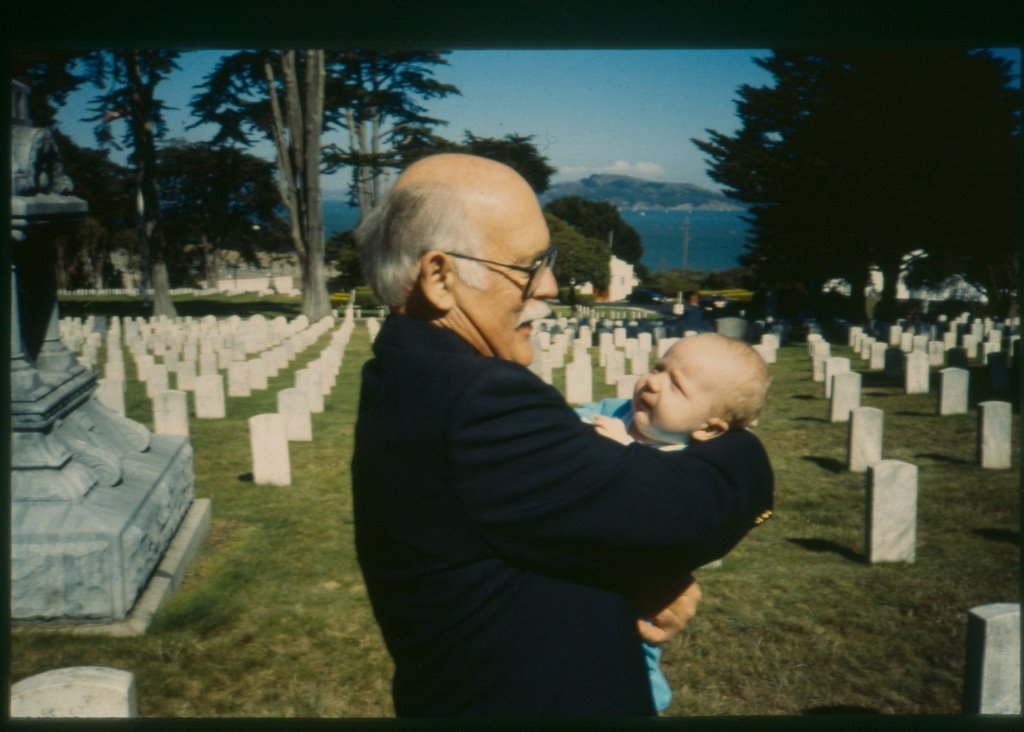
| Dr. Lowry with my newborn son Atticus, Presidio National Cemetery, San Francisco, circa 1994. |
Subscribe to:
Posts (Atom)