Monday, October 30, 2006

Potatoes in the Wheatfield?


Two potatoes, one in Union blue, one in Confederate gray, pause from the fighting long enough to endorse the culinary standards at Gettysburg's Hunt's cafe. [posted with permission].

Some think of commercial exploitation like this as sacrilege, but if that's the case, the student of American culture can hardly avoid acknowledging that blasphemy is as American as apple pie. If there's a dollar to be madeif it will cause curious travelers to take THIS EXITthen it is fair game, even if it involves an event most notable for unspeakable carnage and suffering. Civil War themes are a big draw, bolstering the kepi industry. Cha-Ching!

No one does the Roadside Attraction like American
s do. We may not have invented it, but certainly we were able to broaden the definition of "attraction"and unselfconsciouslyto include everything from 2-story outhouses to the World's Largest Rubber Stamp (for the record, in recent years the world's largest rubber stamp title has moved here).

To amuse myself, I recently searched the ever-interesting Roadside America site for some Civil War-specific destinations. We've all been appalled at the state of Civil War-era medicine. For those of you whose imaginations are lacking, you may want to take in a reenactment of the first reported Civil War amputation, in Philippi, West Virginia, assuming they're still putting on the "show."

If you're passing by Elberton, Georgia, make time for a visit to see "Dutchy," the Yankee Confederate, one of those ubiquitous, town square memorials that was torn down in disgust after only two years. Might have been the unfortunate Federal overcoat.

If your family vacation checklist reads somet
hing like this: 1) Grand Canyon, 2) Yellowstone, 3) Mount Rushmore, 4) Replica Head of William Quantrill, you're in luck. The first three, you can find on your own. The fourth one is here. Is that a bottle of catsup?

This image from a vintage postcard shows the "Lincoln Oak"
in Albany, GA. Maybe some local reader will weigh in on whether the tree is still there, or has subsequently been trimmed to resemble Jimmy Carter.

Georgia has its odd-shaped trees, but truly, Illinois remains the land of Lincoln. Where else would you expect to find the "World's Largest and Ugliest Abe Lincoln Statue"?
One astute observer commented that, "from the highway it appears that Abe is making an obscene gesture with his finger." For my money, the Charleston, Illinois Lincoln statue has the same essential, frighten-the-children quality as the cartoonish Nathan Bedford Forrest statue alongside I-65 south of Nashville.


Happy trails.

Monday, October 23, 2006

"People don't ask you questions like that about your wife"

—John Y. Simon's response to my first question. . .

Lately I have been mining the transcripts of various author Q&A sessions held in the Civil War Forum over the past ten years, featuring 40-some guests, as I collect the material together into some web-friendly format. Here are a few juicy tidbits I came across this weekend.


One thing that I asked of nearly everyone, often the first question, was whether there was anything in their studies that surprised them, or caused them to rethink their understanding of a person, a battle, or event. I love the idea of a scholar or researcher making discoveries, or experiencing revelations, or epiphanies. Here are a few examples of answers to that question by Jeffry Wert, William Marvel, Scott Harwig, and John Simon. And for the fun of it, I've tagged a couple more quotes onto the end, by Terry Winschel and Richard McMurry, just to tweak the sensibilities of those students hopelessly stuck in the Eastern Theater.


Jeffry Wert
, author, among other things, of books on Custer, and Longstreet, spoke with us on January 30. 1997.


Q. We'll start off with a question about Custer. Did you have any preconceived notions about George A. Custer that your research on the man caused you to rethink?

A. (Jeffry Wert): I probably had most of the preconceived ideas that most people had about Custer, and dealt with him in my first book, but now three things strike mereally changed with my research on Custer: 1) was his zest for life; 2) was the regard that his men held for him during the Civil War. I was surprised by the depth and the breath of it; and 3) was Little Big Horn, but that resulted from my lack of knowledge prior to it. My ideas on how it unfolded, and why he did certain things, changed considerably. We don't know all the answers, but his actions make sense -- not all of them, but numbers of them do.

Q. I would like to ask a similar question about James Longstreet, Lee's "Old
Warhorse." How did your understanding of the man evolve during the course of your research?

A. (Jeffry Wert): I wish there had been more personal material, first of all, but they seem to have been destroyed in the fire that consumed his house after the war. But with that said, I found him to be a better general than I thought he would be. I think he was very much of a realist about war, far more than other Southern generals. Despite his post-war politics, most of the men who served under him never lost their respect or admiration for the man. And, finally, I was surprised at the dissension among the Army of Northern Virginia officer ranks, particularly among 1st Corps officers, in their perception of alleged favoritism towards Virginians.

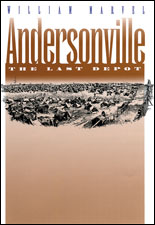
William Marvel, author of Andersonville, The Last Depot, and many other titles.

Q. During the course of your research on Andersonville, were there any
discoveries or realizations that substantially changed your understanding of Civil War-era prisons, and prisoners?

A. (William Marvel): Yes. Specifically, the degree to which the suffering on the Southern side was much less as a result of deliberate maltreatment than was originally thought. And also how much worse the treatment of Confederate prisoners by Union soldiers was, than was originally believednot that the Union guards were particularly malicious, but they were much more stern and tended to shoot much more frequently for minor infractions than I was led to believe by the rather cursory secondary works on the subject.

And at Andersonville in particular I was impressed by the efforts that
were made to meet the needs of the prisoners. It was generally believed that the Confederates tended to force the Union prisoners into such actions as crossing the dead line so they could be shotfor sport, virtuallyand that the prisoners were starved deliberately. In fact, only on a few occasions was food deliberately withheld from them, and most of their suffering resulted from the general poverty of the Confederate government. The only administration policy to withhold food from prisoners was actually exercised by Union prison authorities, in retaliation for the perceived deliberate starvation of their own prisoners in Confederate hands.

D. Scott Hartwig
, then chief historian at Gettysburg National Military Park, joined us on Thursday, July 18, 1996:


Q. In your capacity as historian at the Gettysburg battlefield, I imagine
you've had the opportunity to tramp all over that hallowed ground. Can you think of any discoveries you've made, or revelations you've had, which resulted from a more intimate knowledge of the topography of the battlefield?

A. (Scott Hartwig): Sure, lots of themthis would be the case with any battlefield that you're able to spend a lot of time on. When you can walk a field from many different angles and approaches, you learn the subtleties of the ground. When you start to understand those, the battle begins to become understandable, and you can fill in details that the soldiers who were there may not have mentioned. Last year I did a program on the attack of Laws' brigade on Little Round Top, and the Confederates all mentioned that Union sharpshooters were posted behind a stone wall, near the Slyder Farm, and I couldn't find the stone wall. There wasn't one, and I looked and looked and looked, and I kept walking down the line where the wall would have been, and there it was. I found the remnants of it. So there was confirmation, to me, that there had been a wall there, and that the wall had been removed after the warfor unknown reasons. That's just one example.

John Y. Simon
, speaking on September 29, 2000, is the editor of the The Papers of U.S. Grant.


Q. Dr. Simon, welcome. You've been editing "The Papers" since 1962. Are you getting tired of Grant yet, or still finding new information, or new sides to the man?


A. (John Simon)
I've never thought that I understood the man fully, and for that reason I've never become tired of him. People don't ask you questions like that about your wife, and I've been married to her for a long time. Grant's a very real person, and one with many dimensions to him. There's still more to learn and I'm eager to do it. We're into the presidential years now, but I'm still fascinated by the Civil War period. And there are documents that we haven't found yet, but those that are coming to light, almost daily, cast new perspectives on Grant.

Q. What do you think, based on your readings of his correspondence, may be the biggest misconceptions about Grant? Was there anything that you were surprised to learn, or which slowly changed your perception of him?


A. (John Simon)
Well I've been increasingly impressed by what a good writer he is. He has the capacity to express what he's thinking in the clearest possible form. He's a maker of memorable phrases. One of our interesting discoveries many years ago was when he wrote the famous line about fighting it out on this line if it takes all summer, he originally wrote, "If it takes me all summer." Then he went back and crossed out the word "me." He's conscious of just who's doing that fighting, and knows that that word "me" is inappropriate. Normally, the words just flow out as they did in the celebrated letter that he wrote at Appomattox, but when necessary he revised what he was writing.

Bonus Stonewall had nothing on Grant question:

Terry Winschel
, chief historian at Vicksburg National Military Park, joined us on December 5, 1996.


Q. How do you think Grant's movements from the time that he crossed the
Mississippi till he invested Vicksburg compare with Stonewall Jackson's Valley campaign?

A. (Terry Winschel): Grant's movements after he crossed the Mississippi River were bold, decisive, and kept his opponent unbalanced, and in that regard compare quite favorable with Stonewall Jackson's movements in the Valley. They demonstrate that Grant was master of the situation, and was a bold and aggressive officer. In a 17-day period, Grant's army would push deep into Mississippi, encounter and defeat Confederate forces in five engagements, and drive Pemberton's army back into the city's fortifications.

It is a brilliant campaign that is studied by professional soldiers to this date, and Grant's campaign for Vicksburg is highlighted in the chapter on offensive operations in the army's current field manual FM100-5.

Bonus
Gettysburg is fascinating-but-irrelevant question:


Richard McMurry
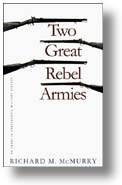
, author of Two Great Rebel Armies: An Essay in Confederate Military History, speaking with us on Thursday, August 1, 1996


Q. Thank you for being with us tonight. In your book Two Great Rebel Armies, and elsewhere, you have made the pointconvincingly, I thinkthat the war was won and lost in the West. I wonder if you would start us off this evening with a summary of that argument, for the benefit of any Virginia-centric members who may be in attendance.


A. (Richard McMurry): I think the best way to answer that is just to ask people to look at a map, and to ask where the armies were in 1861, 1862 1863, 1864, 1865. If you do that you will see that the armies that started out in 1861 in Missouri and Kentucky were in Tennessee, Mississippi in 1862 and 1863. They were in Georgia in 1864. They were in the Carolinas in 1865. And where were the armies that started out in Virginia in 1861? Or to put it another way, the Federal armies captured, if memory serves me correctly, 9 of the 11 Confederate state capitals. The western armies captured 8 of them, including Columbia, South Carolina and Raleigh, North Carolina, which means that at the end of the war, the western Union armies were about 160 to 170 miles from Richmond. What it amounts to is that Western battles and campaigns produced results. Eastern battles and campaigns produced stalemates. And I would just summarize it all by saying that no battle fought east of the Appalachian Mountains had any military impact on the outcome of the war.


Sunday, October 22, 2006

Behind every great caricature, there's a great caricature


"Many say, they would almost worship you, if you would put a fighting General, in the place of McClellanThis would be splendid weather, for an engagement. . ."
Would-be National Security Advisor Mary Todd Lincoln to Abraham Lincoln, Nov. 2, 1862.

Some good advice from the First Lady (though I don't imagine Ambrose Burnside is who "they" had in mind). Full transcript of the letter is here; an image of the letter itself is here: Mary Todd Lincoln remains something of an enigma, or a caricature, in a way that's rarely challenged. Her eccentricities and illnesses later in life are, I think, often projected on her personality retroactively, as if she were always that way. As if the unspeakable losses she suffered wouldn't have put anyone's sanity or daily demeanor to the test.

Civil War history offers many caricaturesthe hero, the scapegoat, the scoundrel, the marble mansome so comfortable we never question them, others are so well embraced, they have achieved the status of assumed truth. But the truth is never so simple, and not surprisingly, the people who have studied particular individuals in any depth invariably paint a more complex picture. So it is with Mary Todd Lincoln, and her relationship to the president, which is sometimes seen as one in which the president is merely tolerating an unstable spouse, while privately reflecting on his lost love, Ann Rutledge (John Y. Simon wrote a thorough essay on the subject of Lincoln and Rutledge that can be read here).

When Jean Baker, a biographer of Mary Todd Lincoln, participated in a Q&A in the Civil War Forum on June 9, 1998, I asked her what the biggest misconceptions are today regarding Mrs. Lincoln. She replied:

certainly the biggest misconception is that Mary Todd Lincoln was a terrible wife and mother, which was a devastating criticism of a 19th century woman. It's a hard stereotype to beat down, even though there's a lot of evidence to the contrary. Certainly Mary Todd Lincoln had a temper, and she was very strong-minded, and had a lot of independent ideas, and when she got to the White House, tried to arrange things in a way that few of her predecessors had done. So, I think this is the image that the American people have of her, as undermining her husband, often embarrassing him, because she spent a lot of money.

But I think that's the wrong way to think about her, and I think that's what my research certainly indicated to me. I found her forceful, interesting, intelligent, and to turn the stereotypes upside down, a very supportive wife, and an excellent mother. The evidence for this is clearit exists in the relationship that Lincoln had with his wife. There are not a lot of surviving letters between the two, but the ones that we do have are clear evidence of a very warm, loving, and certainly sometimes tempestuous relationship.


As far as a mother, Mary Lincoln was totally engaged with her children. She played games with them, she dressed up as characters from Sir Walter Scott's Ivanhoe. She gave parties for them, and we're all familiar with birthday parties today for kids, but in the 19th century, and especially in the small provincial capital of Springfield, Illinois, mothers were mostly much less engaged than Mary Lincoln.


So, to sum all this up, I think that we need to get beyond the image of Mary Lincoln that was promoted by her arch enemy, William Herndon, whom many of you will remember was [Lincoln's] law partner in Springfieldwe need to get beyond his view of her, as he once called her the "hellcat of all time." And it's his image of her in a biography of Lincoln that he wrote that has really stamped her reputation as an impossible mother and wife. And that's something that I think is wrong.

Likewise, when Harold Holzer, who has written much highly-regarded material on Lincoln, fielded questions in the Forum on August 26, 2000, he commented on the damage done to Mary's reputation by this same arch enemy, saying Herndon was


an invaluable source on their law practice together, but less reliable on his controversial 'interviews,' which were probably skewed to shine positive light on the people he liked, and do harm to those he didn't. For example, he hated Mary Lincoln (though she probably hated him first). [He was] presumptuous in that he gave the ridiculous public lecture after the assassination claiming Ann Rutledge was the only woman Lincoln ever loved, brutally hurting the widow. Even if we believe (and I'm not sure) that Lincoln did once love Ann, he certainly loved Mary later, and ardently.

Another participant in the session queried Holzer about Lincoln as suitorwhat it was about him that appealed to Maryasking "what attracted her to him? As you say, he was marrying upto her family, certainly, he could well have appeared as 'undesirable' from a marrying standpoint." I interjected that it must have been the hat, but Holzer offered more:
That's a very good question indeed. The answer must be that Mary deserves lots of credit (she doesn't often get) for seeing something in Lincoln that few, maybe none, of his contemporaries perceived in 1840: that he could 'go places.' He was brilliant, he probably wrote her great letters (they didn't survive, of course), and she was after a big future, and saw it, wisely, in him. Then there's the hat, as David says.

Tuesday, October 17, 2006

When Jenny Reb Shipped Out for the Front

Earnest defenders of the cause busy themselves in blurring the distinction between slaves impressed into labor for the army, and so-called black Confederate soldiers in the ranks, but no one seems willing to celebrate the honor of the truly forgotten, and curviest, Confederates. While perusing transcriptions of wartime Southern newspapers tonight, I came across this intriguing item from the New Orleans True Delta by way of a Natchez paper:

NATCHEZ DAILY COURIER, April 1, 1862, page 1, column 2


Women in for the War. We find the following dispatch in the New Orleans True Delta of last Saturday evening. We publish it for the information of our readers: Natchez, March 29. The girls, one hundred and three rank and file, each in herself a Joan of Arc or a Maid of Saragossa, have completed their military organization, and are in for the war. They will leave here by steamer for New Orleans on Monday morning. Give them a warm embrace. Hurra for Mississippi!

Imagine that, a full company of fighting women heading off to war, fully 58 years before they had the right to vote. I ran across this particular snippet while scrolling the addictive web site maintained by Vicki Betts, University of Texas at Tyler, the URL for which was posted on one of the history lists. Ms. Betts describes here website, found here, as "Beyond the usual commercial online newspaper databases . . . which includes articles from less frequently cited Southern papers. These transcribed articles, searchable by word, focus primarily on the Southern homefront, although there are some Northern papers and some military letters home, etc."

Alas, the saga of the female company was short lived. One week later, the day after the folks of Natchez turned out down at the landing "under the hill," the Daily Courier offered a correction to its April 1st article, this time citing the New Orleans Bee:


NATCHEZ DAILY COURIER, April 9, 1862, p. 2, c. 2

All Fool's Day. A large number of persons took a stroll yesterday afternoon on the steamboat landing, with the fond hope of witnessing the arrival of the young female Mississippi volunteers. But they saw nothing of the kind, though there were at that time on the levee many a Miss Volunteer of another sort. It was soon whispered in the crowd that they had been badly sold it being All Fool's Day, and then one by one they all retired, very much excited against the newspapers, and more particularly the True Delta, which published on Sunday, with a flaming heading, a telegram from Natchez, "from a respectable party," in which it was announced the girls would leave that place for this city on Monday. The female company turns out to be a military canard. N. O.
Bee, April 2.


Well, it was fun while it lasted, but rest assured that discrediting the account will not impede someone among today's serial memorialists from ordering a governent tombstone for a member of this phantom unit (quick, someone get the word "memorialist" into the dictionary).


There are some fascinating tidbits at Betts' site, which is particularly enjoyable for the convenient access and searchable text (though heed her warning about double-checking the transcription before you get serious with citations). I found a number of items about slaves joining in the attack on the Yankees, which was interesting. There was also an item about the "Preacher's Regiment," an Arkansas unit with "no less than eight preachers in the regimentone of whom is over seventy years of age!" There is an indignant editorial about "Negro parties," which sound, frankly, like they must have been the best parties in town, but the editorialist is suspicious about where the party-goers were finding the provisions for such general feasts.


There was this strange snippet:


TEXAS BAPTIST [Anderson, TX], April 6, 1860, p. 2, c. 4

During the past session of our court, nineteen negroes chose masters for themselves and were made slaves for life. Wise choice, far better than to sink to the level with the free blacks of Canada and the North."

Not sure what to make of that. I will indulge myself here and include several full excerpts from my casual reading tonight. You can dig out some highlights of your own. It's always striking to recognize how much the people of the past sound like the people of today, just with different trappings. We're no smarter today, and less hearty—that much seems plain.


Most interesting, to me, were the helpful hints for health, and hearth. A couple of letters to the editor offered detailed instructions on making homemade salt from the dirt of the smokehouse—not as white as you'd like, but just as good as imported. Other helpful entries told how to clear a room of bedbugs, which, disgustingly, are enjoying a resurgence in hotels and motels today. I can't tell you how disappointed I was to learn that this archaic bug of the past—something I thought would always be relegated to books, and quaint "goodnights" about sleeping tight—is still with us, as tenacious as the Taliban (if you travel a lot for work, you might not want to read this at the NYTimes, or this at the LATimes (subscription required for both). But I digress.


Lastly, I'll paste in a bit of an editorial from a no-nonsense author in Fort Smith, Arkansas that sums up the centrality of slavery in the secession crisis as succinctly as possible.

AUSTIN STATE GAZETTE, June 22, 1861, p. 4, c. 1

Interesting to Housewives.—Fly time is now fairly upon us, and these troublesome little insects are as much of a nuisance as the Black Republican army in St. Louis. The weapon wherewith to repel this invasion may be found in the following, which we find in an exchange: Take three or four onions and boil them well in a pint of water, and then brush the liquid over your glasses and frames, and the flies will not light in smelling distance of them. The receipt is a safe one, and will do no injury to your furniture.


CHARLESTON MERCURY, May 24, 1861, p. 4, c. 2

How to Take Care of the Hair.--As to men, we say, when the hair begins to fall out, the best plan is to have it cut short; give it a good brushing with a moderately stiff brush, while the hair is dry; then wash it well with warm soap suds; then rub into the scalp, about the roots of the hair, a little bay rum, brandy, or camphor water. Do these things twice a month--the brushing of the scalp may be profitably done twice a week. Damp the hair with water every time the toilet is made. Nothing ever made is better for the hair than pure soft water, if the scalp is kept clean in the way we have named. The use of the oils or pomatums, or grease of any kind, is ruinous to the hair of man or woman. We consider it a filthy practice, almost universal though it be, for it gathers dust and dirt, and soils whenever it touches. Nothing but pure soft water should ever be allowed on the heads of children. It is a different practice that robs our women of their most beautiful ornament long before their prime; the hair of our daughters should be kept within two inches, until their twelfth year. —Hall's Journal of Health.


SAVANNAH [GA] REPUBLICAN, August 20, 1861, p. 1, c. 5

A Remedy for Killing Bed Bugs.—When the crevices are large enough, insert gum camphor, or make a solution of two ounces of camphor and one pint of alcohol, and apply in the cracks with a feather. Follow up the application a few days and you will exterminate your disagreeable visitors. In warm weather musquitoes [sic] may be kept at bay by keeping a cloth wet with camphor near the person.


DALLAS HERALD, May 22, 1861, p. 2, c. 5

The Rusk Enquirer says that a number of young ladies of Cherokee County have formed themselves into a corps of sharpshooters, for rifle practice. At their first practice, they had an effigy of Old Abe, for a target, which they completely riddled with bullets. The Enquirer adds: "Talk about wiping out a people whose women and children are expert rifle and pistol shooters! The idea is absurd."


FORT SMITH NEW ERA, August 20, 1864, p. 3, c. 2

No man ever yet saw an American who hated slavery, yet upheld the rebellion; and no one ever saw an American who justified and wished to perpetuate slavery who had not at least a sneaking tenderness for the rebel cause. For all practical purposes, the rebellion and slavery are related as mother and child.

Thursday, October 12, 2006

Mad Freak of Heroic Incompetence

"The dense forests wholly or partly in which were fought so many battles of the Civil War, lay upon the earth in each autumn a thick deposit of dead leaves and stems, the decay of which forms a soil of surprising depth and richness. In dry weather the upper stratum is as inflammable as tinder. A fire once kindled in it will spread with a slow, persistent advance as far as local conditions permit, leaving a bed of light ashes beneath which the less combustible accretions of previous years will smolder until extinguished by rains. In many of the engagements of the war the fallen leaves took fire and roasted the fallen men. At Shiloh, during the first day's fighting, wide tracts of woodland were burned over in this way and scores of wounded who might have recovered perished in slow torture. I remember a deep ravine a little to the left and rear of the field I have described, in which, by some mad freak of heroic incompetence, a part of an Illinois regiment had been surrounded, and refusing to surrender was destroyed, as it very well deserved. My regiment having at last been relieved at the guns and moved over to the heights above this ravine for no obvious purpose, I obtained leave to go down into the valley of death and gratify a reprehensible curiosity."

from "What I Saw of Shiloh," by Ambrose Bierce


Shiloh is among my favorite Civil War battlefields to visit, for a number of reasons. There are familial connections, on my wife's side; the Western Theater aspect, involving troops from states in which I lived (North and South); and perhaps most of all, the pristine condition of the battlefield, situated as it is far from urban en
croachment (not that it isn't threatened by development, particularly in the area of power production on the Tennessee River).

On my first visit to Shiloh, I drove several hours to fit it in to the one free day of a business trip to Little Rock. I arrived around noon, and had four or five hours to tour the field before my return trip. For most of the afternoon, there were no other visitors in sight. My second visit was with the Civil War Forum, a two-day, intensive tour with Stacy Allen, and talks by Larry Daniel and Wiley Sword (who laid out his theory of where A. S. Johnston really fell, outlined in the revised edition of his Morningside classic, Shiloh, Bloody April).

Even then, the field was empty, and peaceful.
It's a complicated battle, and the Park Service has done an admirable job of delineating, with coded markers, two days of overlapping action on the same ground. Even so, the movement of opposing troops over the battlefield is a confusing morass.

As a Civil War buff, and someone intimately involved in Civil War publishing, I have taken a particular interest in battlefield guides, whether NPS brochures, USMA staff rides, or the "General's Tour" feature of Blue & Gray magazine. And I was especially excited to see the publication of modern guides written by some of our best Civil War historians today, Shiloh, A Battlefield Guide, by Mark Grimsley and Steven Woodworth, and Gettysburg, A Battlefield Guide, by Grimsley, and Brooks Simpson.


Mark Grimsley will be the guest in the next live Q&A session in The Civil War Forum, October 21, at 4:00 p.m. EST, to discuss what goes in to creating a worthwhile battlefield
guide, how to "read a battlefield" (the subject of one of his presentations), and to field questions about his other books, and his ground-breaking military history blogs, Blog Them Out of the Stone Age, and Civil Warriors.

Above: top of Iowa monument at Shiloh; at right, Professor Grimsley, and Jethro.


Thursday, October 05, 2006

I'm just about the only person I know who has an abiding interest in the American Civil War, and yet has never taken the time to read Charles Frazier's spectacularly successful first novel, Cold Mountain (even as I typed this, I had to go back and change "Harbor" to "Mountain," a mistake I make every time I reference the book or movie).


I can't satisfactorily explain why I haven't read it yetI still plan to. Really. It's a little odd that I've put it off, because I very much enjoy artfully done, authentic, historical fiction. And I love the atypical story line of Cold Mountain (atypical for Civil War fiction, but, in fact, something of a classic quest story as old as Gilgamesh), and from what I've skimmed, the prose looks beautifully wrought, and mesmerizing. It is interesting to me that Inman is an actual ancestor in the author's life. I like the fact that the narrative is a journey, that it isn't, at heart, a tale of battle, or a fictionalized portrayal of great generals. Frazier stands as a kind of anti-Shaara, and that appeals to me in a big way. Okay, that settles it. Tonight I'm moving Cold Mountain into the nightstand rotation.

I suspect, but try not to admit it, that my avoidance of the novel initially had to do with the fact that it was so immensely populareven outside of Civil War circlescausing the inner-elitist in me to momentarily stall any deep interest. I should also say that I'm a relatively slow (deliberate) reader with a ridiculous backlog of books. By the time I had an opening on the active stack for Cold Mountain, I had read untold numbers of reviews, had skated around the periphery of 100s of online discussions about the book, and had even stood transfixed at parties where people who would not read a nonfiction Civil War book to save their lives, enthusiastically summarized Frazier's story. Not long after that, I was seeing trailers for the movie. I did eventually rent the film, thought it was great, and was quick to purchase the soundtrack (I am not ordinarily a big customer of sound tracks, but Jack White's renditions of some essential American sounds was irresistible, like the "Oh Brother Where Art Thou" soundtrack, or Ry Cooder's work on numerous films).

Charles Frazier is a true inspiration to those of us who know, deep down, we have at least one good novel in us, and hope we, too, can buck the lottery-like odds of getting a novel published, and noticed. Frazier went from underpaid English teacher, to stay at home dad hanging with the other moms on field trips (driving for elementary school field trips has been a great source of enjoyment for me, in this, my 2nd childhoodwhere we live, my kids go to places like NASA Ames Research Center, or Pacific tidepools, a stark contrast to the only field trip I can remember taking as a kid, out to the local water treatment plant in small town Iowa (not that it wasn't interestingin fact, it answered many unspoken questions). I just did a Google search out of curiositykudos to the 8th grade faculty for creating a virtual tour of the very same water treatment plant that so impressed me in the early 70s.

I digress, but only barely. Frazier came out of nowhere, quit his job, finished his book and got Atlantic Monthly Press to buy it for $100,000. The success of that novel led Random House to pay something on the order of $8 million for his 2nd novel, based on a one-page synopsis. In the new book, Thirteen Moons, the Civil War is only incidental to the larger, decades-long timeline, and focuses on the Eastern band of Cherokee who managed to avoid removal to the Indian Territory.

I was excited to learn that Frazier has again incorporated subjects of great interest to me, specifically Native Americans, and Indian participation in the Civil War (way back when, I managed to get two embarrassingly amateurish articles published in an old Civil War glossy on Stand Watie, and Ely Parker). Making an appearance in Thirteen Moons is the endlessly intriguing William H. Thomas, of the Thomas Legion, memorialized in Vernon H. Crow's out-of-print (I think) Storm in the Mountains: Thomas' Confederate Legion of Cherokee Indians & Mountaineers. What a fascinating story. Thomas, who was not himself a Cherokee, formed a Civil War command that remains one of the most unique and colorful outfits in the annals of the Late Unpleasantness.

The saga of the Eastern band of Cherokee is a bigger story than Thomas's Legion, of course, and I'm anxious to see how Frazier treats the subject in Thirteen Moons. He wrote a little essay in 1997, at Salon.com (subscription required, probably), under the title, "How the Author Found the Inspiration for his Civil War-era Novel Among the Secrets Buried in the Backwoods of the Smoky Mountains." Inman's trek, and the Cherokee, it becomes clear, are just different stories about the same place:


Last year, when I was nearly finished with the book, I went looking for yet another grave. I climbed up the hill where my father says the real Inman is buried. There's nothing to tell exactly where he lies. Just a bunch of sunken oblongs with wooden markers rotted down to stubs or flat stones with unreadable scratching on them. All anonymous. If he's there he has a fine view to the forks of the Pigeon River, where once stood a Cherokee town called Kanuga, not a trace of it left but potsherds in the river sand. His long view is up toward Cold Mountain. I am in his debt and I wish him peace.


Monday, September 25, 2006

Behind the smokehouse we had a kind of map.

Vicksburg was a handful of chips from the woodpile and the river was a trench we had scraped in the packed ground with a hoe, that drank water almost faster than we could fetch it from the well. This afternoon it looked like we would never get it filled, because it hadn’t rained in three weeks. But at last it was damp-colored enough at least, and we were just about to begin, when all of a sudden Loosh was standing there watching us. And then I saw Philadelphy over at the woodpile, watching Loosh.
“What’s that?” Loosh said.
“ Vicksburg,” I said.
Then Loosh laughed. He stood there laughing, not loud, not looking
at me.
“Come on here, Loosh,” Philadelphy said. There was something queer about her voice too. “If you wants any supper, you better tote me some wood.” But Loosh just stood there laughing, looking down at Vicksburg. Then he stooped, and with his hand he swept the chips flat.
“There’s your Vicksburg,” he said.
“Loosh!” Philadelphy said. But Loosh squatted there, looking down at me with that look on his face. I was twelve then; I didn’t know triumph; I didn’t even know the word.

--------------------------------------


In honor of William Faulkner’s birthday, September 25, I read a few pages this morning, recalling the tale of the two boys who take a potshot at one of the leading horsemen in the approaching Yankee army, then seek refuge under the skirts of one boy's grandmother during a tense exchange with a Federal colonel.

Faulkner is not always easy to read, but he is one-of-a-kind, and evokes a place and timeand a people—in such a powerful and enduring way, the images and atmosphere of his fictional Mississippi time capsules remain with the reader long after the details of a particular story are forgotten.

One might assume, or have the impression, that Faulkner would naturally have incorporated the Civil War directly into his narratives, but the war is rarely used as a setting so much as it is part of the larger landscape. If the Civil War and the South are inseparable, if black and white make up the essence of southern identity and, as Faulkner wrote, “the past is not dead,” then the tension leading to, and the fallout resulting from the Civil War are unspoken if not explicit threads in his Yoknapatawpha County novels.

Most anyone with an interest in Faulkner has discovered that the Old Colonel, John Sartoris, in The Unvanquished and other writings, is inspired by William Clark Falkner, the larger-than-life great-grandfather of the famous author who served with Mississippi troops at First Manassas and elsewhere (various accounts explain when the “u” in the surname was dropped, and later added again).


Back in the spring when father was home before, he sat in his chair in front of the fire and Ringo and I lying on our stomachs on the floor. Then we listened. We heard: The names—Chickamauga and Lookout Mountain—the words, names like Gap and Run that we didn’t have in this country; but mostly the cannon and the flags and the charges and the yelling. Ringo was waiting for me in the hall; we waited until father was settled. Then I said, “How can you fight in mountains, father?” He looked at me. “You can’t. You just have to. Now you boys run on to bed.”
Faulkner, the American icon, son of old Mississippi, was one of the great inspirations for another novelist from Mississippi, Shelby Foote, who himself became an icon in the world of Civil War historiography. There are various accounts of the time Foote and his friend, the unsung Walker Percy, made a visit to William Faulkner in Oxford, Mississippi. Foote’s Washington Post obituary put it this way:

He said the peak of his college career was a surprise visit he made to Faulkner with his close friend, the future novelist Walker Percy. Pulling up to Faulkner's home in Oxford, Miss., Percy was too shy to enter the house, but Foote knocked on the door, stayed several hours and apparently never bothered to tell Faulkner of his friend in the car.

An account from Foote’s presentation at the New York State Writers Institute's Visiting Writers Series, March 20, 1997, goes in to more detail:
-------------------
Foote was at his most captivating when answering audience questions or spinning impromptu yarns in response to comments. How did he meet the great Faulkner, for instance? Foote was 19 years old and he and Walker Percy were planning to drive from Foote’s hometown, Greenville, Miss., through Faulkner’s town, Oxford, Miss.

Foote: “Let’s stop in Oxford and meet William Faulkner.”
Percy: “I’m not going to just knock on his door.”
Foote: “I will then.”
Percy: “Go ahead. I’m staying in the car.”

Foote recalled the walkway to Faulkner’s house was lined with cedar trees and he was greeted by three hounds, two fox terriers and a Dalmatian in the yard. Soon, a small man, shirtless and barefoot, naked save for a pair of shorts, and seemingly drunk, appeared and asked Foote what he wanted. “Could you tell me where to find a copy of Marble Faun, Mr. Faulkner?” Faulkner grunted for Foote to contact his agent. Faulkner was gruff and abrupt during that unannounced visit, but later befriended Foote, who walked Faulkner around the Civil War battlefields of Shiloh.
-------------------

Shelby Foote and William Faulkner strolling the still-pristine battleground of Shiloh. I would not have minded tagging along for that walk.

-------------------

Postscript: also on this day, in 1789, about 108 years before Faulkner was born, the very first Congress passed a series of 12 amendments outlining the most basic and essential rights that—eventually—all American citizens would come to enjoy. Ten of the 12 were ratified as the Bill of Rights. Ah, those were the days.

both excerpts, top and middle, are from “Ambuscade,” under Stories Revised for Later Books (The Unvanquished), in Uncollected Stories of William Faulkner, ed. by Joseph Blotner.


Thursday, August 31, 2006

"It is not hard to have mixed feelings about the American South."


So goes the opening line to the preface of Edward L. Ayers book, What Caused the Civil War? Reflections on the South and Southern History. What follows is a thoughtfuland readable!—series of essays by a "professional historian who is both a native and a longtime resident of the South" endeavoring to understand the region. The opening passage of the essay of the same name (minus the subtitle) gets to the heart of the matter in a language we can understand, which is to say the language of Matt Groening:


On The Simpsons, a popular animated satire of American life, Apu Nahasapeemapetilan, an industrious South Asian immigrant in Springfield, U.S.A., has studied hard for his citizenship test. "What was the cause of the Civil War?" is the final question on the oral quiz. "Actually, there were numerous causes," says Apu. "Aside from the obvious schism between the abolitionists and the anti-abolitionists, there were economic factors, both domestic and inter" The official, clearly bored with such superfluous erudition, intones flatly: "Just say slavery." Apu eagerly concedes the point: "Slavery it is, sir." With this declaration Apu wins his citizenship. Why is this funny? It's not because slavery was not the cause of the Civil War, but because the bureaucrat demands a rote answer to explain a profoundly complex problem at the center of the nation's experience.

Professor Ayers will be the guest in the next Civil War Forum Conference Series, a one-hour Q&A session on October 7 at 4:00 p.m. EST in the Forum's "Room 1." He'll be on hand to discuss his various Civil War-related titles, and innovative work with the Valley of the Shadow web site. He is the Dean of the College and Graduate School of Arts and Sciences at the University of Virginia. Whenever I want a reminder of how little I accomplished in my squandered youth, I'll take a glance at Ayers's biblio, C.V., etc., at the university's web site.

Mark your calendars.


Wednesday, August 30, 2006

From Bloody Island to Bloody Hell, I mean Hill

tracing the Far West footprints of Civil Warriors

A couple of weeks ago we returned from another glorious camping trip in secesh country. No, not THAT secesh country, the other one, the lava-strewn State of Jefferson. Also known as the 51st state. I caught a brown trout for the first time in my life, though in truth, it more or less caught itself, as I found it on the end of the line after leaving my pole unattended for an hour or two. That counts.

My very first entry in this blog made mention of last summer's camping trip up near the Lava Beds National Monument, where one can see the site of the death of E. R. S. Canby, the first and only U.S. Army general officer killed in the nation's various Indian wars. He was murderedshot and killed at close range during a peace conference. It never occurred to me until I was typing this, but ironically, Jefferson C. Davis who, during the Civil War, likewise put a general in his graveeventually took command of the troops after the demise of Canby.

Alex Trabek, take noteI have a good one for you: “Indian Wars for a $1,000: At one point in this war, opposing forces were each commanded by a leader who had personally shot and killed a general in the United States Army.” . . . “What is The Modoc War of 1873?” [a Jeff Davis aside: on one of my first visits to the Presidio Officer's Club in San Francisco, now a jewel in the National Park Service, I was studying a post-Civil War group photo of officers stationed there, and a docent or secretary pointed to one of the figures in the photo, drawing my attention to Jefferson C. Davisone of Uncle Billy's corps commanderswhom she identified, in the proud way that curators discuss historic connections, as "the president of the Confederacy, Jefferson Davis." I had long had an interest in this Hoosier officer, as my wife had ancestors in Jefferson C. Davis's 22nd Indianahis imposing visage is unmistakable. But I was raised too well by my mother to correct my host, who had a better story than the one I would have told. No harm, no foul.]

But enough of Jefferson Davis, and the State of Jefferson. Departing the wilds of Northern California, we split up the long drive back to the Bay Area with a stopover in Clear Lake, down in Lake County. I've mentioned before that a Civil War buff living in the Far West is forever crossing pre- and post-war paths with Civil War notables, something that helps flesh out one's perspective of those whom we too often think of only in the context of their brief Civil War careers.

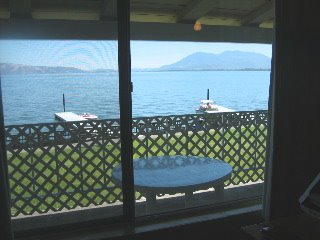
Photo at right: Clear Lake from our hotel balcony.

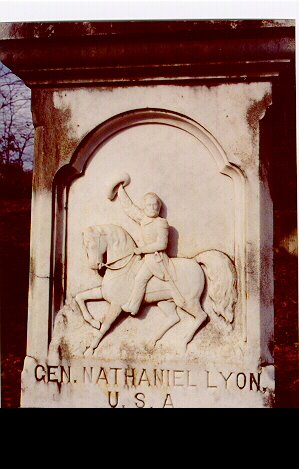
One of those well-traveled officers, Capt. Nathaniel Lyon of the 1st Dragoons, marched to the Clear Lake area in May of 1850, just months before California was admitted to the Union as the 31st state. He stayed in the vicinity long enough to cause an otherwise non-descript eminence to be forever after referred to as "Bloody Island." I had never heard of it before, but everything I've been able to turn up in the weeks since describes the "Battle of Bloody Island," or the Bloody Island/Clear Lake Massacre in horrific termsa bad day for the Pomo however you reconcile the widely varying casualty counts. Another description, and photo of the "island" is here.

One thing's for sure, in official army parlance Nathaniel Lyon was one mean S.O.B. His righteous fervor in defense of the Union bordered on fanaticism. I have not read any biographies of the man, but his raging temper is legendary, and frequently mentioned in secondary material. Friend and foe alike knew his wrath at one time or another, from Mexico to Bleeding Kansas, and we’re left to debate whether the volatile West Pointer was the right man for the jobwhen the secession crisis reached full bloomof keeping the border state of Missouri in the Union. In a place where people were choosing sides, Lyon was destined to be a hero, or a madman, depending on where one’s sympathies lay.

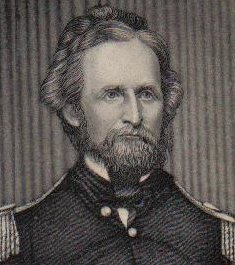
Portrait of General Lyon


If Sherman exhibited a soldier's passion for order, Lyon embodied a passion for retribution. Undoubtedly the most quoted words from the diminutive firebrand come from the abortive peace parley of June, 1861, between Lyonthen a brigadier general in command of federal troops at the St. Louis arsenaland pro-Confederate Missouri governor Claiborne Fox Jackson. Lyon, apparently not in the mood for compromise, abruptly and angrily ended the tête-à-tête with the declaration that "Rather than concede to the State of Missouri for one single instant the right to dictate to my Government in any manner . . . I would see you . . . and every man, woman, and child in the State, dead and buried. This means war" [quoted from McPherson's, Battle Cry of Freedom]. That’s pretty harsh, even by the standards of the day. A more talented negotiator would have stopped short of threatening genocide. Children? This comment, and Lyon’s history of unrelenting physical violence against those who would do wrong, lends credence to the dark accounts of bayoneted babies at Bloody Island.


The hot-headed Lyon did not survive the first summer of the war. Only a month after the firing on Fort Sumter in Charleston Harbor, while thwarting Confederate designs in Missouri, he added another "massacre" to his future index entries (the so-called "St. Louis Massacre"). Three months after that he was killed in action on what came to be called "Bloody Hill" at the Battle of Wilson's Creek.


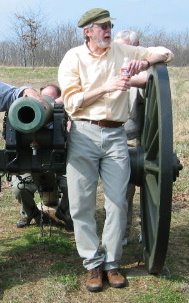
Photo: William Garrett Piston, coauthor of Wilson's Creek: The Second Battle of the Civil War and the Men Who Fought It, leading Civil War Forum Reunion, Wilson's Creek, March 2004.

No doubt the fates decree that you can only be associated with so many "massacres," and so many landforms renamed as Bloody-something or other, before you're the one getting massacred, or whose blood is coloring the ground. Lyon was the first Union general killed during the war, and there were more than a few Confederates and Pomo Indians who thought he had it coming.

Soon after Lyon’s death, he was memorialized in 1861 when the army renamed a Colorado fort in his honor (a connection I was reminded of at the David Long site referenced earlier). It seems bitterly ironic that in 1864, Fort Lyon would serve as the staging and launch point for an expedition under Colonel John Chivington, hero of the Battle of Glorieta Pass. Chivington’s Fort Lyon volunteers gave history the Sand Creek Massacre, a misguided punitive slaughter so merciless and cruel, Lyon himself might have found it satisfactory.

Wednesday, August 23, 2006

Talk thus to the marines, but not to me. . .


There's nothing like a gang of vigilantes, scornful of the sheriff's office and taking the law into their own hands to begin to stir "a soldier's passion for order." That quoted clause is the subtitle of Mississippi State University professor James Marszalek's 1993 biography of William T. Sherman. I thought of that book again, and Sherman, this past week when a local paper reported on the 150th anniversary of the disbanding of the 2nd Committee of Vigilance in San Francisco.

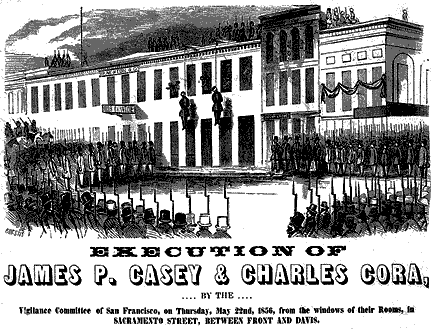
Sherman was in San Francisco during those volatile days, working at a bank. The bank is still there (see #36), on the corner of Montgomery and Jackson, in the Jackson Square area of the Financial Districtone historic pocket downtown that survived the destruction of 1906. When, for reasons you can read about in the Chronicle article, the 2nd vigilante organization formed, lynched a corrupt city supervisor, James Casey, and one Charles Cora, who is reputed to have murdered a U.S. Marshall, Governor Johnson commissioned Sherman as a general officer of the militia to put down the lawless faction.

Sherman was equal to the task, and disdainful of those who would usurp legal authority (if unsympathetic to their victims). All he required, more even than volunteerswhich were easily hadwas arms. These were promised to him by General Wool of Mexican War fame, from the armory at Benicia (weaponry that Sherman himself had earlier accompanied around the Cape). Future Civil War admiral David Farragut at Mare Island, a naval installation that would one day serve our nations nuclear submarine fleet, promised to station a sloop off the city's shoreline as a show of strength. But Wool, for reasons we can only speculate about, not only reneged on his offer, according to Sherman he denied ever having agreed to supply the militia with rifled muskets.

It's not a scenario that would be familiar to us today: the only inventory of muskets in the state were in the Federal armory at Benecia, and the ranking U.S. army officer refused the governor's request to arm volunteer militia who had been organized to challenge a well-armed vigilante force (only 150 years later, the governor of California refused a president's request for an additional 1,500 National Guardsmen to secure the border). It was the Wild West then, and some of the spirit of the Wild West persists.

Sherman soon after resigned his militia commission, and "never afterward had any thing to do with politics in California, perfectly satisfied with that short experience." Wool, whose wartime service began in the War of 1812, retired in 1863, and died in 1869. With Wool long buried, Sherman, in his memoirs, summed up the late general's role in the abortive attempt to suppress the Committee of Vigilance: "[Governor] Johnson and Wool fought out their quarrel of veracity in the newspaper and on paper. But, in my opinion, there is not a shadow of doubt that General Wool did deliberately deceive us; that he had authority to issue arms, and that, had he adhered to his promise, we could have checked the committee before it became a fixed institution, and a part of the common law of California."

Marszalek says the episode had a strong impact on Sherman. "It was this experience with the vigilantes in California," he writes, "that helped persuade him in 1860-1861 to take a stand against Southern secessionists in order to avoid anarchy of a far greater magnitude than that which occurred in San Francisco" (108). Now I am curious to see if Michael Fellman's more recent and more personal interpretations of Sherman's character bear these things out in Citizen Sherman.

Whatever the case, Sherman certainly was fervent in his prosecution of the war to restore the Union, and law and order. When Sherman told John Bell Hood to begin evacuating civilians from Atlanta, the Confederate general replied that "the unprecedented measure you propose transcends, in studied and ingenious cruelty, all acts ever before brought to my attention in the dark history of war." That's strong stuff.

"Talk thus to the marines, but not to me," Sherman retorted, in one of the great lines in all the Official Records (look for a custom reader's guide to the Sherman-Hood Atlanta exchange later this week).

Along with the Marszalek book, the vigilante anniversary story in the Chronicle caused me to dip into Sherman's memoirs once more, one of the classics of the war that should be on everyone's Union bookshelf alongside Grant's. Sherman's recollections are not always reliable (see Albert Castel's article in Civil War History treating the Atlanta portion of Sherman's account, memorably named, "Prevaricating Through Georgia, Sherman's Memoirs as a Source on the Atlanta Campaign"), but it's a great read by a major player.

At top: Execution of Casey and Cora from The Virtual Museum of the City of San Francisco.

Monday, July 31, 2006

The thing that hath been, it is that which shall be; and that which is done is that which shall be done: and there is no new [military history] under the sun.

Of course, that's not to say it can't be told in a more interesting, and accurate fashion. A couple of entries ago, I mentioned that in perusing the Ayers, et. al., textbook, American Passages, I noticed that some Civil War-era, chapter ending recommendations for further reading included both James McPherson's expansive Battle Cry of Freedom, and David Eicher's strictly military narrative, The Longest Night. I see that Professor Grimsley weighed in on the subject again today as well.

I queried Professor Ayers, Dean of the College and Graduate School of Arts and Sciences at the University of Virginia, about these recommendations, and the value of military accounts. He was gracious enough to reply, and gave permission to post his comments in the blogosphere. He wrote:


To answer your question about narratives (and your eagle-eyed analysis of the bibliographical notes in Passages!): I do think there is a need for close analysis of military history AS military history. Just as we cannot understand law or literature without specialists' knowledge, so we cannot understand actions on a battlefield. I have enormous respect for those who can comprehend the complexity of armies and battles, a respect only increased by working with my colleague Gary Gallagher. That said, my own particular passion in all my work is seeing how the various parts of life connect. I approach military history from the perspective of someone who is very much a social and cultural historian but who recognizes the centrality of warfare in a war. In Presence I did my best to do justice to military events within a larger context. I'm not sure there is a new military history, but people do seem more interested in bridging, from both directions, long-standing divisions in the writing of history. And that can only be welcome.

Dr. Ayers will be our guest in The Civil War Forum on October 7th, 4:00 p.m. E.S.T., to field questions for an hour on all manner of things, from his booksincluding In the Presence of Mine Enemies, and What Caused the Civil War? Reflections on the South and Southern History, to his work on the fascinating digital venue, The Valley of the Shadow: Two Communities in the American Civil War.

Saturday, July 29, 2006

"Before leaving Washington I had been authorized to promote officers on the field for special acts of gallantry. By this authority I conferred the rank of brigadier-general upon Upton on the spot, and this act was confirmed by the president."

U. S. Grant, Memoirs

For people fascinated by historyand I would hope a couple readers of this blog fit that billvisiting the sites and scenes of historic events, the ground where historic figures trod, or any place where the connection to "What's Gone Before" is still palpable, sparks at least a low grade giddiness. You can feel it in your chest, if you're not too jadeda sort of breathless awewhile standing in Philadelphia's Independence Hall. Or while walking amidst Anasazi ruins, or the outbuildings of Mount Vernon. Not so much at the Petrified Wood Gas Station, though that's pretty cool, too.


For those of us especially captivated by the history of the American Civil War, visiting a battlefield from that era can engender a dreamy sense of detachment from the here and now. Sometimes you have to use your imagination to try to filter out the billboards, traffic sounds, and power lines, and it's not uncommon to have to imagine an open field where 2nd- or 3rd-growth forest now covers the ground. But it's better than nothing, and some places are so pristine, and so infrequently visited that you may find you have a corner of it all to yourself. On a few occasions I've had the pleasure of being more or less alone on a battlefield, making every stop, walking through fields and woods with nothing but the sounds of my own footfalls and the wind in the trees as soundtrack to my contemplation.

Equally moving is following in the footsteps of an ancestor, on a battlefield where they were known to be present. That's a powerful thing. The very last paper I wrote in college was on the Battle of Spotsylvania Court House, not knowing enough about the Civil War to realize I had bitten off a lengthy, busy, complicated mouthful of the Overland Campaign (lazy as I am, and knowing what I know now, I might have chosen to write on something more compact and manageable, like the Battle of Corydon.

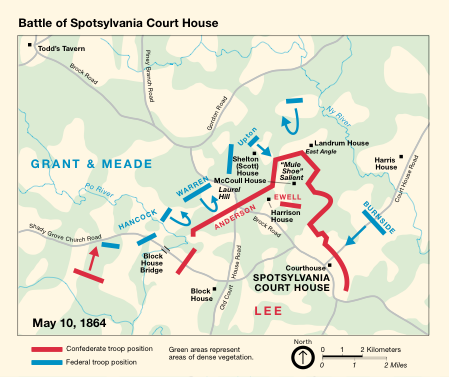
It was years later when I learned of a great-great-grandfather in the 5th Wisconsin, whose record shows him shot in the knee on May 10th, 1864. Since that was one of the 12 regiments in Emory Upton's attack on the Mule Shoe on that day, odds seem good he sustained his injury in that momentous action. I've since walked the trail through the woods that Upton's men followed as they got into position for their ultimately ill-fated assault, and strolled about the remnants of the massive works the Confederates erected there [here's a 30-second video of Robert K. Krick at the Mule Shoe with stalwart members of the Civil War Forum, on a Sunday morning in the snow, explaining why a salient in the line is not recommendedyou may need to turn up the volume to catch the audio from my little camera. The small group pictured includes descendants of soldiers on both sides of the fighting on this spot]. Colonel Upton was wounded that day as well, but survived the war. The house where he shot himself nearly 17 years later, putting an end to unbearable migraines, still stands in the Presidio of San Francisco. I drive by it whenever there's time, and I wonder if the people who live there now know about the Civil War exploits of that bold and innovative officer.

Trodding today on the now-bucolic scenes of desperate carnage can be a transcendent experience. That may sound overly dramatic to those friends, neighbors, and coworkers who furrow their brows, mystified, at "vacation" photos of empty fields, ravines, and farm lanes. Nevermind themwhen was the last time you saw one of them with a book in their hands, anyway?


Map at top from Fredericksburg and Spotsylvania National Military Park web site; photo of Emory Upton from the Library of Congress.