Monday, October 28, 2013

Strolling down memory lane: South Bay Civil War Roundtable

DW, left, and TPS, August 24, 2013
Way back in 1988, my wife and I flew from San Francisco to San Diego where I was excited to attend the Annual West Coast Civil War Conference, then organized by Jerry Russell of Civil War Round Table Associates. I had just finished reading McPherson’s, Battle Cry of Freedom, and relished the prospects of listening to some authors hold forth on a variety of subjects. The featured historian was William C. “Jack” Davis, a tremendously knowledgeable and entertaining speaker. He told a story that had the audience laughing so hard, I remember it to this day (maybe some of you have heard it at other events – it involved him traipsing around his house with a Civil War saber, looking for a possible intruder). Bob Younger of Morningside Books was also there, and so I dropped a lot of cash on new reading material.

That conference was also where I met Ted Savas, who was then living in San Jose. He and his wife Carol, and Anne and I, gravitated together -- some of the only people in attendance who were still in their 20’s -- and the only four who had come down from Northern California (or so it seems to me now). We soon learned we had other things in common, such as Ted and I both hailing from Iowa (my mother grew up in his home town, and my father grew up nearby).

Not long after returning to the Bay Area, we got together at the Winchester Brewpub – just down the street from the legendary Winchester Mystery House – and started planning the creation of the South Bay Civil War Roundtable (at that time, there were roundtables in San Francisco, and on the Peninsula, one in the East Bay, but nothing in the area of San Jose, the most populous city in the area).

Our first meeting was held at Ted’s house with about 14 people in attendance. Ted became the first president, and I took up duties as the newsletter editor (and eventually became the 2nd president). At the first meeting, Zoyd Luce spoke on Benjamin “The Beast” Butler. Ted spoke the following month on Longstreet’s Suffolk Campaign, and I spoke at the third meeting on John Hunt Morgan’s Indiana/Ohio Raid. And just like that, we were off to the races, eventually finding a regular meeting place and steadily increasing the membership.

Within the next couple years, our group hosted the West Coast Conference after it had devolved into a moribund affair, and Jerry Russell was imploring the round tables themselves to take turns organizing it. The year after San Diego it was held in a dingy motel in Burbank, with very low attendance. It was in its death throes, and Russell was ready to give up. The following year we hosted the event near Fisherman’s Wharf in San Francisco, got the word out far and wide, and saw a great crowd turn out to hear a roster of speakers topped by Robert K. Krick, whose compensation included two tickets to the next 49ers game. That San Francisco conference was also where Ted and I debuted volume 1, number 1 of Civil War Regiments journal, which, along with a number of stand-alone campaign studies, would consume so much of our lives for years to come. After San Francisco, the Long Beach CWRT held a large, well-attended conference with James McPherson, and the meeting has been a rollicking success ever since.

It’s no exaggeration to say that the South Bay CWRT revived and re-energized the West Coast Conference, which today routinely sees 100+ in attendance, in nice venues, and with top-flight historians and authors (Richard Hatcher and Craig Symonds will be on hand next month).

At some point, I don’t remember when exactly, I stopped attending meetings of the South Bay CWRT in favor of the CompuServe forum I have administered for nearly 20 years, effectively an online CWRT whose members discuss the Civil War era all year long, and meet in person every spring to tour a battlefield. I eventually moved on to work at Stanford University Press, and Savas Woodbury Publishers became Savas Publishing, then Savas Beatie, and anyone who loves books on the Civil War knows what a strong presence Savas has been in that arena all these years later.

I’m pleased to say the South Bay CWRT is still going strong as well, compiling over the years a long record of generous donations to Civil War preservation organizations. When I saw that they were celebrating their 25th anniversary (which I calculate to be March of 2014), and that Ted was the guest speaker at the annual summer picnic, I decided to surprise him. We had not seen each other in over 10 years. I wish I could describe the look on his face when he glanced my way for the first time after arriving.

It was a lot of fun, and many memories were refreshed. Ted gave a masterful, no-notes talk on “The Battle of Payne’s Farm, November 27, 1863: Command & Competency During the Mine Run Campaign.” That, in itself, caused many more memories to surface, as I was with Ted at Payne’s Farm when he first began researching that fight, and when, using metal detectors, he established an artillery position by finding canister balls in the woods right where he surmised they would be found. He found the remnants of canister. My metal detector was so poor it literally could not detect a quarter sitting on the surface. I know because I tried. 

Tuesday, October 15, 2013

Indians and Braves, but no 7th Cavalry

from the Times-Georgian. . .
. . . the Heard County High School football team is hoping to rebound from a frustrating opener this week when it travels to Chattanooga for a powwow with the Indians at 7:30 on Friday night at Little Big Horn Stadium in Summerville.

Sunday, October 13, 2013

Review: Smithsonian Civil War


Smithsonian Civil War, Inside the National Collection, edited by Neil Kagan and Stephen G. Hyslop (Smithsonian Books, 2013).

Establishment of the Smithsonian predates the Civil War by 15 years. The iconic "Castle" on Washington's National Mall was completed in 1855, and became home to the institution's first secretary, Joseph Henry, and his family, who witnessed some of the opening scenes of the war. Young Mary Henry, Joseph's daughter, recorded in her diary on July 16, 1861, "We went up into the high tower to see the troops pass over into Virginia." Today, the Smithsonian has grown to nineteen museums and nine research facilities, which together preserve tens of thousands of objects related to the American Civil War, including Mary Henry's diary. 

Smithsonian Civil War is the only book of its kind, that I know of, to present together in a single volume some of the most important and representative Civil War artifacts from 13 separate Smithsonian entities (the press release mentions 12 museums and research centers). According to the introduction, curators, archivists, historians, interns, and volunteers (more than 100 staff members) "spent hours in locked vaults, storage rooms, and cabinets, researching and evaluating items" for inclusion, after which the Civil War 150 Editorial Committee debated which items held the "greatest historical value or the most compelling stories attached to them." The results of that exhaustive selection process are positively spectacular. 

This lavishly illustrated, brilliantly assembled coffee table book couldn’t have come at a better time, presenting an "exhibit between hard covers" at a time when the dysfunctional government of the United States has shuttered its doors. 

Commemorating the Civil War Sesquicentennial, Smithsonian Civil War offers 150 thematic essays written by a large number of Smithsonian contributors. Though organized chronologically, the entries amount to stand-alone articles covering a broad spectrum of topics—pre-war through Reconstruction.

The 550 full-color photographs constitute the volume's real strength—highlighting, with high production values, some of the most rare and fascinating objects in the Smithsonian holdings. A number of items will be familiar, such as Lincoln's top hat or the bullet-riddled tree stump from Spotsylvania, but many other objects pictured here have never been on public exhibit. 

Of particular interest are the instances where related objects from different repositories are brought together for the first time. For instance, a portrait of J.E.B. Stuart from the National Portrait Gallery, sits opposite an image of a pistol from the National Museum of American History, a present to Stuart from Major Heros von Borke. Likewise, from the same museums, a portrait of John Brown is featured together with images of weapons Brown and his followers carried in Kansas, and Virginia, including one of the hundreds of pikes Brown stockpiled at Harpers Ferry.

The collections at the NPG and NMAH are most represented, but this eclectic assemblage also features contributions from the Air and Space Museum (Civil War-era aircraft designs), the Postal Museum (printing plate for Confederate stamps), the Museum of Natural History (ornithological specimens), the Museum of African American History and Culture (slave tags), and others.

As impressive as this work is, some of the narrative will raise eyebrows among critical readers. A few examples: the entry on Harriet Beecher Stowe perpetuates the legend that when Lincoln met Stowe, "he reportedly said to her, 'So you're the little woman who wrote the book [Uncle Tom's Cabin] that started this great war!'" While the author did at least use the qualifier "reportedly," it's surprising to see the anecdote given passing credence in a Smithsonian publication. The story is entirely apocryphal, a product of Stowe family lore, and did not appear in print until 34 years after the fact by a Stowe biographer.


In the essay, "Sherman Moves South," we read that after capturing Atlanta, "Sherman ordered Atlanta evacuated and then burned everything he considered of military significance. Nearly one-third of the city went up in flames. Enraged, Hood wrote that his actions surpassed 'in studied and ingenious cruelty, all acts ever before brought to my attention in the dark history of war.'" Students of the Atlanta Campaign, however, will note that the correspondence in question dates to September 7, about the order to evacuate civilians. The burning of Atlanta did not occur until mid-November, when Sherman left on his March to the Sea.

More surprising, perhaps, is the entry entitled, "Searching for Shoes at Gettysburg," which begins with, "A search for shoes has often been cited as the spark that ignited a blistering three-day battle in the bucolic fields around Gettysburg, Pennsylvania, on July 1, 1863." General A.P. Hill is pictured in the article, across from a full-page photo of brogans, with the caption explaining that Hill unwittingly launched the battle by "sending in Henry Heth's division to 'get those shoes. . .'" This essay goes so far as to quote Heth's 1877 letter to the Southern Historical Society, in which he fleshes out the shoe story. Heth's after-action report, written two months after the battle, makes one mention of shoes (among other supplies he was seeking), but the consensus among historians is that the shoe story was concocted by Heth to excuse the fact that he brought on a general engagement despite explicit orders not to do so. I'm fairly certain that the National Park Service considers the shoe story as officially debunked. 

These examples are not terribly significant flaws since, as mentioned, the great power of this work are the photographs, and the 150 articles are generally succinct and spot-on, chock-full of useful information on a rich constellation of subjects. The barcode lists this book at $40, but I see it can be purchased in any number of places online for around $24 -- a good price for such a pretty book.

Wednesday, October 09, 2013

Gettysburg Magazine acquired by University of Nebraska Press


The University of Nebraska Press will take over publication of Gettysburg Magazine in 2014. They're looking for a new editor. 

Saturday, October 05, 2013

Review: Decided on the Battlefield, Grant, Sherman, Lincoln and the Election of 1864

Decided on the Battlefield: Grant, Sherman, Lincoln and the Election of 1864, by David Alan Johnson (Prometheus Books, 2012).

Judged solely by its cover, this Prometheus release promised to be an interesting and insightful examination of the critical 1864 presidential election – how it came to unfold the way it did, and the possible ramifications to the nation had Abraham Lincoln lost his bid for re-election. Unfortunately, there is very little new introduced that could not have been gleaned from a general history of the war, and the author’s almost complete reliance on secondary sources (Bruce Catton is cited 43 times, Carl Sandburg 21, and so on), makes for a shallow treatment of a deep subject. Both the seasoned student and the well-read buff are likely to be dissatisfied with what, in the end, amounts to a simple affirmation of what many have long understood to be a Civil War truism—that the ascendancy of Grant and Sherman, and their slow-but-steady battlefield successes, particularly the capture of Atlanta in the run-up to the election—assured the reelection of Lincoln, and ended any hope of an independent Confederacy.

Decided on the Battlefield is not without merit. It is an easy read with a serviceable account of military events. Informed as it is by the popular histories of Catton, Shelby Foote, Doris Kearns Goodwin, et. al., the story is held together by an efficient, quick-moving narrative adorned with some of the literature’s most familiar anecdotes. Most interesting, to me, was the author’s discussion of the main party’s respective national conventions, and for those topics—at least—official proceedings were liberally consulted.  

Whatever the book’s shortcomings in the main text, it goes completely off the rails in the Epilogue. To ram home his point about the over-arching importance of Lincoln’s victory, the author devotes 18 pages to a bizarre and thoroughly pointless reverie about how things would have been different had Lincoln gone down to defeat. He doesn’t merely speculate about the Balkanization of North America, but paints an elaborate alternate history up through the Cold War and into the 1980s, even imagining, by name, the presidents of five separate American countries (the U.S., the C.S.A., Texas, Utah, and California, the last governed by President Ronald Reagan). In this fantasy, the C.S.A. (eventually the Confederate Commonwealth after annexing Cuba) did not send troops overseas in WWI, but since Tennessee seceded from the C.S.A. and rejoined the U.S. in 1866, U.S. troops in the First World War do include men from the Volunteer State. Thus, we’re told, Lincoln’s election loss in 1864 would have had no bearing on Tennessean Alvin York winning the Medal of Honor for actions in the Argonne Forest. I’m pretty sure the author didn’t get that last part from Bruce Catton.


Thursday, September 19, 2013

150 Years Ago: Chickamauga

150 years ago today:
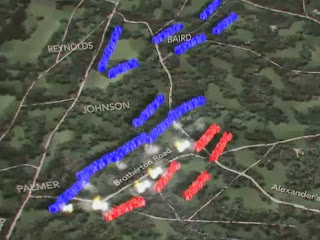
The Battle of Chickamauga. Click on the photo below to visit Chickamauga resources at The Civil War Trust, including an outstanding animated map. One veteran of that battle, James A. Garfield -- Chief-of-Staff to Union commander William Starke Rosecrans, went on to become the 20th president of the United States.

132 years ago today:
President Garfield died, 80 days after having been shot twice in the old Baltimore and Potomac railroad terminal (southwest corner of present day Sixth Street and Constitution Avenue, Washington, D.C.). He was two months shy of his 50th birthday.

Frank Leslie's Illustrated Newspaper, July 11, 1881


Friday, September 13, 2013

Smithsonian article on George Henry Thomas

 (Rudy Ayordoa / David Perry Collection) 

Catching Up With "Old Slow Trot"

by Ernest B. Furgurson
Stubborn and deliberate, General George Henry Thomas was one of the Union's most brilliant strategists. So why was he cheated by history?

Read the full article here: 

Monday, September 02, 2013

Lee was a traitor, Thomas a man of honor -- thoughts from an unreconstructed Yankee


“I think that Robert E. Lee, as a traitor and betrayer of his solemn oath before God and the Constitution, was a much greater terrorist than Osama Bin Ladin… after all, Lee killed many more Americans than Bin Ladin, and almost destroyed the United States. What do you think?”

So wrote Lt. Col. Robert Bateman in an August 14, 2013 Esquire essay entitled, The Meaning of Oaths and a Forgotten Man. You can read the full essay here. 


Monday, August 19, 2013

"Articulating the unspeakable: Art-making during wartime"

This undated handout image provided by the Smithsonian American Art Museum shows Frederic Edwin Church's 1861 oil on paper "Our Banner in the Sky."
        (Credit: AP/Smithsonian American Art Museum)
From a worthwhile article at Salon.com yesterday: "Two exhibitions of Civil War-era art and photography ask if images can truly convey the horrors of the battlefield." Read the full article here.

Sunday, August 18, 2013

Meanwhile, some good reading from Smithsonian.com

Sneden Collection, Virginia Historical Society
==========
The map, which shows in rich detail not only the engagement, but the layout of Civil War-era Washington, is part of one of the more remarkable compilations of Civil War maps and artwork in existence: the Sneden Collection at the Virginia Historical Society. “It’s an incredible body of visual information about the Civil War,” says the Society’s head of program development, Andrew Talkov. The collection includes his wartime diary, and the so-called “Sneden Scrapbook,” a loosely organized compendium of maps and drawings that he compiled after the war, documenting not only his own experience, but other battles as well. Often known as “Jubal’s Raid” because it bore the stamp of one of Robert E. Lee’s boldest and ablest generals, the attack on Washington was part of an effort to relieve pressure on Lee’s army in Petersburg, Virginia.
==========
     Read the full article here.

And if you have a few more minutes, check out this slide show on Gettysburg Artifacts from the Smithsonian Collection.

U.S. Army Canteen (Armed Forces History, NAMH)

Back from the Mountain Top

View of the Rocky Mountains from atop Crested Butte Mountain,
Gunnison County, Colorodo. 
It's been a busy summer, involving much traveling, including a return trip to the Little Bighorn Battlefield in June, and a two-week adventure in Colorado in July. Now we're back in the groove again, amidst the redwoods and oaks midway down the San Francisco Peninsula. The kids are back in school, and I find myself renewed and eager to turn attention again to the stacks of books that fill my apartment like dusty, literary stalagmites. Time, too, to jump back into blogging and the Civil War Forum with both feet.

Speaking of cave features, on our way through Colorado Springs we stopped to tour Cave of the Winds, a place I had once visited as a 17-year-old. This time I was interested to learn that inside, near the original entrance, are three stone memorials to Abraham Lincoln, Ulysses S. Grant, and Robert E. Lee. Reportedly, 19th century visitors were asked to stack a stone on the memorial of the man they admired most, and Grant's pile grew the largest. At some point Lee's stone pile collapsed, and has resisted efforts to restore it. Make of that what you will. And there you have a Civil War connection under the very earth and rocks of a Colorado mountain.

Cave of the Winds stone memorials, left to right: Lincoln, Grant, Lee.


Wednesday, July 03, 2013

Jimmy Carter -- first president from the Deep South since the Civil War

Back in April I spent a day at the Andersonville prison site, near Americus, Georgia, as reported in this blog post. The next morning, a Sunday, my wife Anne and I had to drive the nearly three hours back to the Atlanta airport to return to the Left Coast. More or less at the last minute, we decided to make a short detour from Americus over to nearby Plains, to see the Jimmy Carter National Historic Site. The two or three hours we spent looking around Plains turned out to be one of the highlights of the weekend.

I have always liked Jimmy Carter. He may have been an ineffective president in many ways—and he faced some pretty complicated issues—but I have considered him to be the most genuinely principled man to hold that office in my lifetime. I don't want to start a debate here about the Shah, Nicaragua, the hostage crisis, thermostats, or the Panama Canal, but anyone who looks at Carter's life to-date must come away with the impression of a good and decent man. The work he's done post-presidency, through the Carter Center, through Habitat for Humanity, has transformed untold lives here, and abroad.

Plains, Georgia is quaint, and the National Historic Site is scattered in and around the town. There's the train depot, which was campaign headquarters in 1976. There's Billy's gas station. Outside of town is the boyhood farm, where you can peer into young Jimmy's bedroom. The old high school is the Visitor Center. A film is shown in the classic auditorium, where Jimmy and future wife Rosalynn were called to daily assemblies (assemblies including prayer in those days). The hallways and classrooms of the high school are devoted to exhibits of the Carters' lives, from childhood, to the White House, and beyond.
Jimmy feeding a colt on the farm [from the NPS website]
In the bookstore, I picked up a copy of An Hour Before Daylight, Memories of a Rural Boyhood, and I started reading it on the plane ride home. I wasn't expecting to find it so engaging, but over the next week or so I couldn't wait to crack it open in every leisure moment. It was a fascinating account of life on a big farm in Depression-era Georgia, with candid discussions about race relations in a Deep South community only six decades removed from the Civil War (by the time Jimmy was born). One of Carter's great-grandfathers served with the Sumter Flying Artillery, Plains being in Sumter County.

The early lives of our presidents have always fascinated me, and Carter's story is uniquely, quintessentially American. I was so moved by the book, and a life well lived, that when I finished reading I penned a letter to the former president. It's the very first time I've written to an erstwhile Leader of the Free World, and I naturally had no expectation that he would ever read it. I complimented him on his book, and the important work he's done.

One thing in particular I was curious about was whether people growing up in Plains, and Americus, in the 20's and 30's—particularly school children—ever heard about the notorious Civil War prison down the road at Andersonville (MacKinlay Kantor's Pulitzer Prize-winning novel, Andersonville, was not published till 1955). Was it spoken of in polite company? Was there a local version of events to account for it? I mailed my letter to Jimmy Carter on May 14.

Astonishingly, on July 2 I received a letter back, the original of mine in the margin of which Mr. Carter scribbled a note. I got my answer and I'm satisfied with it.


Saturday, June 29, 2013

When I think baseball, I think Custer bobblehead


The first 1,000 fans through the turnstile at tonight's Hagerstown, Maryland Suns game (Class A farm team for the Washington Nationals), get to take home a George Custer bobblehead. It seems a peculiar choice, but not to Hagerstown Visitor's Bureau president Thomas Riford, who calls Custer a "folk hero" in those parts. The promotion is not being well received by the staff and readers of Indian Country Today.


Tuesday, June 25, 2013

Prison Times, volume one, number one

From Slate.com's, "The Vault," comes this rare gem:

"Confederate prisoners of war confined at Fort Delaware produced this newspaper by hand in 1865. The New York Historical Society holds one of four surviving copies, each of which was likely passed around and read by multiple prisoners. The paper numbers four pages in total."


Saturday, June 22, 2013

Pilgrimage to the Greasy Grass


Friday night, with the Friends of the Little Bighorn Battlefield, we had the amazing opportunity to get off the trails and walk cross-country with Dr. Douglas Scott, one of the principal archaeologists who worked the field beginning in 1984 and on and off again until about 2011. We traversed much of Greasy Grass Ridge, followed Calhoun Coulee for a good distance, and then climbed down into Deep Ravine. Back at the hotel, Anne found three ticks on her person, but I lucked out in that department. In the photo above, Scott is discussing the remains discovered at marker 128—named "Trooper Mike" because he was in section M of the archeological grid. His was the most complete skeleton found on this part of the field, and he died a very violent death.


Two days before I had just finished reading Scott's newest book, a more reader-friendly summary of previous dig reports (published by the University of Oklahoma Press and funded by the Friends), so this expedition was especially fascinating. 

The weather during this year's visit was dramatically different than it was in June of 2012. Then it was broiling hot, and the landscape brown (similar to what I imagine it was in June of 1876). This weekend, temperatures were pleasant, even a little cold, with occasional showers and lush green the world over. 

Whatever the weather, the Little Bighorn is one of the most beautiful, haunting, and somber battlegrounds in America. I'll post a 2013 photo gallery shortly.


Wednesday, June 19, 2013

============== 
Shortly after the D-Day invasion on June 6, 1944, two Frenchmen on bicycles managed to cross the perimeter of the United States Army’s 23rd Headquarters Special Troops and what they saw astounded them. Four American soldiers had picked up a 40-ton Sherman tank and were turning it in place. Soldier Arthur Shilstone says, “They looked at me, and they were looking for answers, and I finally said: ‘The Americans are very strong.’”
===============
The passage above is the opening paragraph of an interesting article at Smithsonian.com, discussing the recently broadcast documentary, The Ghost Army. You can read the article here: When an Army of Artists Fooled Hitler. 

The show aired on May 21, and DVDs are for sale, but it doesn't appear to be available for streaming yet. Here's the documentary website.

Of course the first thing I thought of  upon reading this were the so-called "Quaker Guns" of the Civil War era, though the WWII subterfuge is exponentially more elaborate. Civil War Quaker Guns were logs painted black to resemble artillery pieces, intended to fool the enemy into thinking fortifications were still occupied. Most famous, perhaps, was Joe Johnston's use of Quaker Guns at Centreville in March, 1862, to help mask his army's movement toward the Rappahannock River. The use of Quaker Guns in this country predates the Civil War, however. Lieutenant Colonel William Washington, George Washington's 2nd cousin once removed, used the trick to good effect against Loyalists in South Carolina in 1780.

[Below: Quaker Gun, Centreville, Virginia. Library of Congress Civil War glass negative collection.]


Monday, June 17, 2013

High-tech methods used to conserve big guns that fired on Fort Sumter, opening US Civil War

(Photo: AP/Bruce Smith)
"Ten massive guns from Fort Moultrie on Sullivans Island, which is part of the Fort Sumter National Monument, were recently conserved as part of an ongoing program to protect the historic pieces from the salty, humid air. The guns were cast in foundries both in the North and South a century and a half ago. 
The last of the guns, a 7-ton Union rifled Parrott gun suspended in a yellow sling held by a crane, was slowly jockeyed into place onto a new concrete base last week. It completes what the fort refers to as Cannon Row, where seven of the heavy guns are lined up next to each other."
Read the full Montreal Gazette story here. 

Thursday, May 30, 2013

Book Review: Shiloh, 1862, by Winston Groom

Though Winston Groom’s latest contribution to the Civil War bookshelf is well written and engaging, I am hard-pressed to think of a reader to whom I would recommend it. I hope my critique doesn’t come across as nitpicking—I’ve seen other reviews of this book that found it perfectly satisfactory. When one jumps into the Civil War arena, there is a lot of literature that one must necessarily stack up against, whatever the particular subject. I promised to review this book and am finally making good.

Groom, best known as the author of Forrest Gump, is a skilled story-teller, and the clash of armies in southwestern Tennessee in April, 1862—officered by a host of major figures in the Civil War—provides much fodder to tell a tale. But the audience for this type of work is difficult for me to pin down.

Many students of the Civil War began to develop their interests in the subject matter through exposure to the captivating prose of amateur historians Bruce Catton and Shelby Foote. Those two icons of Civil War historiography are given a pass for writing "popular" history—particularly Foote, when it comes to the lack of citations—because their contribution to the literature is historic and pervasive, and beautifully written (that’s how I rationalize it). Groom, who has also written on the Vicksburg Campaign, Hood’s final campaign in Tennessee, and other American history topics (none of which I have or will now read), has chosen, like Foote, to forego citations as well, and though his work appears to be generally accurate, and his research not inconsiderable, the lack of sources takes away the book’s usefulness. I guess I’m saying that Catton and Foote got the last two passes on the popular history front.

To many readers, that quality of usefulness is the only reason to invest time in reading another book on Shiloh. Compounding the problem is the author’s decision to remove ellipses and alter punctuation from certain direct quotes in order to make the language more “readable” (which specific quotes and what specific punctuation is unknown). I’m sure these were harmless changes, and he assures us that he did not change the meaning of any quote, but in nonfiction, can’t we just agree to stick to accepted conventions? Aren’t you obligated to do so when you put quotation marks in your text?

Groom’s effort to place the battle of Shiloh in context is admirable, but overreaching. Background on the war and secession, and biographies of major players, takes up the first 200 pages of the book before the battle is joined. The first day’s fighting is then detailed in about 140 pages, while the second day is dispatched in under 10 (all Shiloh authors seem to hurry through the second day, but Groom treats it like a footnote. Or he would, if he used footnotes). 

There are some quirky aspects to the text that I would describe as editorial lapses. For instance, in summarizing the combat significance of Shiloh, Groom tells us of men such as Grant, Sherman, McPherson, and Forrest, “each got his start at Shiloh” (p. 12), yet the book's biographical sketches of those same officers outline their earlier exposures to combat, Sherman at First Bull Run, the rest at Fort Donelson and other battles. Virtually all authors writing on Shiloh will point out the shocking fact that the casualties in that battle alone exceeded the total of all previous American wars combined, going back to the Revolution. Groom likes that observation so much he offered it twice—at the beginning, and at the end—both times italicizing the word “combined” for emphasis. In one instance Groom proclaims that the Union scored victories at Vicksburg and Gettysburg on the same "day" [emphasis by Groom], July 4, while later pointing out, correctly, that Gettysburg ended on July 3.

Of Grant, Groom comments that Shiloh was the “first, and essentially, the last time Grant was ever surprised in battle,” but I would argue that the earlier Confederate counterattack at Belmont counts. Likewise, I’d wager that Grant was a little surprised by the initial assault in the Wilderness in May of 1864, and at Fort Stedman a year later.

Distractions like that—passing comments that caused me to pause and think, “huh?”—made this book disappointing and difficult to finish. After the 9-page accounting of the April 7 fighting, Groom tackles the April 8 Battle of Fallen Timbers (the other Battle of Fallen Timbers), really a skirmish, when Sherman made a reconnaissance to determine whether the Confederates had really retreated, or were reassembling to continue the fight. The way Groom relates the story, after the fighting at Shiloh, Grant was “content to pant and bleed and lick his wounds,” and happy to “let the loser slink off. . .” But Sherman, he says, “wasn’t buying it,” and put together a force to pursue the enemy. Groom seems unaware that Sherman was acting under orders from Grant. Or, if aware, made misleading intimations for dramatic effect. [Fascinating interview with Shiloh historian Stacy Allen on Fallen Timbers] It also bears mentioning that Grant was under orders from Halleck not to bring on another general engagement, but rather to stand pat and await instructions.

Groom wrote about Grant being called east by Lincoln, saying that after that, “It took nearly two more bloodstained years, but Grant finally laid siege to and subdued the Rebel army near Richmond.” Of course, in actuality, Grant wasn’t called east until March of 1864 and laid siege to Lee’s army around three months later. Lee surrendered barely more than one year after Grant’s arrival in Virginia.

In a peculiar admission, the author tells us that a description of Grant that he published in his Vicksburg book was so apt, he recycled it word-for-word in his Shiloh book. I suppose that kind of self-plagiarism would be considered Fair Use, though he’s not quoting his earlier work, he’s literally reusing a sentence from another publisher’s book. [A quick glance at the biographical passages on Grant and Sherman in Groom’s Vicksburg book reveals that Groom borrowed liberally from that earlier work when introducing some of the same figures, with some rearranging or minor modification of phrases.]

Happily, Groom included an Order of Battle, and a bibliography, making it seem like a book that wants to be taken seriously. The bibliography is respectable, though lacking in manuscript collections, and in his “Notes on Sources”, Groom rightfully holds up the Official Records as the backbone of his research. I was surprised to see a couple books that one wouldn’t ordinarily find listed in a Civil War bibliography (padding?): Burke Davis’s, The Civil War: Strange and Fascinating Facts, and Web Garrison’s, Curiosities of the Civil War: Strange Stories, Infamous Characters, and Bizarre Events. And though Groom lists works by Tim Smith, including an “America’s Civil War” article on “Battle of Shiloh: Shattering Myths,” it doesn’t appear that he consulted it, or took it to heart. One of the foremost Shiloh “myths” dispelled by Smith, a historian and former staff member at Shiloh National Military Park, is the notion that when Grant first arrived at Pittsburg Landing, having steamed up river from his Savannah headquarters, thousands of Union troops—routed on the battlefield—were seeking refuge under the banks of the river (according to Smith, Prentiss's and Sherman's divisions frontline divisions did not break until after 9:00 a.m., around the time Grant arrived at the landing—read about that and other Shiloh "myths" here). Groom perpetuates that idea: “the entire slope from brow to basin was thronged with thousands of panic-stricken shirkers and stragglers who were cowering beneath the cover of the bluff. . .” Groom even muses that Grant “seemed to exhibit a rare sort of sympathy toward them. . .” Would love to see the cite for that one. [Historian Larry Daniel reports in his history of Shiloh that around 3,000 routed soldiers were at the landing when Grant arrived; Wiley Sword makes no mention of it. Both Daniel and Sword estimate Grant arrived at Pittsburg Landing around 9:00 a.m., while Grant's Chief-of-Staff John Rawlins, wrote that he arrived at 8:00 a.m. General Prentiss reported that his division did not begin to fall back from its initial position until 9:05, which squares with Sherman's report as well.]

Near the end of Groom's Shiloh study, he indulges in a few counterfactual musings just as, he oddly asserts, most professional historians do: "it is interesting to play the 'what-if' game, which most trained historians scoff at as a nonhistorical pursuit, usually just before they indulge in it themselves." For Groom, Shiloh may be most significant because if Beauregard had won the battle, Grant and Sherman would not have ascended as they did, and Lincoln would have had to find someone else to oppose Robert E. Lee in the East, someone who would invariably make a colossal mistake, leading to Lincoln's defeat in the 1864 election. I'm trying to think of some trained historians who go to such lengths. This kind of conjecture is utterly pointless, of course, but perhaps the natural domain of a novelist.  

One thing I do appreciate about Groom is his focus on the Western Theatre. The wide distribution of his published works may serve to inform the public at-large that the war didn’t just occur in Virginia and Pennsylvania. For readers with a serious interest, however, it’s best to stick with the more reliable books on the subject, all thoroughly documented: Wiley Sword’s, Shiloh: Bloody April (Groom lists the 1974 first edition, not Sword's revised and improved 2001 edition), Larry Daniel’s, Shiloh: The Battle that Changed the Civil War, Cunningham’s, Shiloh and the Western Campaign of 1862, Tim Smith’s, The Untold Story of Shiloh: the Battle and the Battlefield, D. W. Reed’s, The Battle of Shiloh and the Organizations Engaged, and Mark Grimsley’s and Steven Woodworth’s, Shiloh, A Battlefield Guide—to name a handful.