
John Paul Jones was one of my first heroes. I loved the very sound of his name. I loved the images it evoked
—all of the excitement and tension of "
Master and Commander" before Hollywood had the technical ability to make those images seem real.
I read a biography of John Paul Jones when I was a child, but can't remember the name of the book or much else about it, other than that it left me with a life-long impression of a virtuous and brave naval giant taking on the all but invincible Royal Navy, and prevailing. Where ordinary men would accept defeat, he had not yet begun to fight!
Living in the land lubber states of Nebraska and Iowa at the time, I had a great love of tales from the Age of Sail, particularly the stories of great explorers, and of desperate battles at sea by great wooden ships. I built crude models of early American warships, and dreamed of one day visiting
Old Ironsides in Boston, the flagship of the United States Navy. I was 29- or 30-years-old before I managed to do that, though a visit to her sister ship
Constellation in Baltimore, when I was in junior high, helped tide me over as I went on to build models that covered the long lineage of American ships of war and exploration, through WWII iterations, and extending even to vessels with those same names among the fleet of
Federation starships. Oh how I wished the
Bonhomme Richard had survived the war. But she may turn up yet. At least
five major expeditions, most recently in 2005, have failed to locate the wreck, believed to be off the coast of Yorkshire, but the search is not over.
In time I came to learn that there may be a little residual sea salt in my blood. I was gratified to discover that some of my earliest ancestors in this country "went down to the sea in ships," settling the area around Salem, and homesteading at the head of the Bass River (today's Beverly, Massachusetts). They had taken up residence on Cape Ann initially to harvest cod for the Dorchester Company, which founded Gloucester of "Perfect Storm" fame
—some of the very first settlers of the Massachusetts Bay Colony. Continuing the maritime theme, one of my distant New England ancestors
—Levi Woodbury
—went on to become the Secretary of the Navy under President Andrew Jackson. [He is, incidentally, reported to be one of a small group of people to have served in all three branches of the Federal government: in addition to Secretary, he was a senator from New Hampshire, and a Supreme Court Justice
—and according to an unknown Wikipedia author, one of only three people to complete the Federal trifecta who also served as a state governor]. Sadly, the one bona fide warship named for him, the destroyer
USS Woodbury (DD-309) did not fare well, crashing into the rocks off California's Point Honda in 1923 with six other destroyers in
a spectacular and tragic accident.

But I digress. I've never lost my interest in tales of the sea, and now, in 2011, I finally got around to reading another biography of John Paul Jones. But this time it was a modern treatment, Evan Thomas's,
John Paul Jones: Sailor, Hero, Father of the American Navy. This summer, as I read it, I was about six years older than Jones was when he died (an increasingly dismaying fact when studying historic figures is that we today are world-class slackers). He's still a towering figure to me, but oh so human now.
Thomas's portrait of Jones provided one revelation after another. I did not ever consider that Jones might be a petulant, vainglorious egotist, whose incessant whining caused even his closest supporters to scold or avoid him. But there it is, well documented in his letters.
I didn't know his name was really just John Paul, and that the Jones was added later, probably due to his wanting to distance himself from an unfortunate incident resulting in the death of a crewman. I didn't even know, because I don't speak French, that the
Bonhomme Richard was a tribute to Ben Franklin's famous publication.
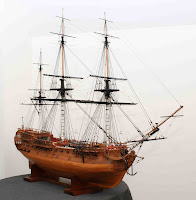 |
| Model on view at the Jones cottage in Scotland. |
Nor did I know that Jones was largely forgotten in the United States after his death in Paris in 1792 (even citizenship was bestowed upon him posthumously). The American minister to France, Gouverneur Morris, couldn't be bothered to attend his funeral, or to appropriate funds for a burial befitting the "Father of the United States Navy."
ENTER HORACE PORTER
Horace Porter is well known to most students of the Civil War. A well-heeled West Point graduate, third in the class of 1860, he began his war service on the southeastern seaboard, at Fort Pulaski, and Secessionville, and by the summer of 1862 was on the staff of Maj. Gen. George McClellan with the Army of the Potomac. After Antietam, he went to the West, to General Rosecrans's staff, was at Chickamauga
—where he earned a Congressional Medal of Honor
—and Chattanooga, where he eventually became attached to the headquarters of Ulysses S. Grant.
 |
| Horace Porter |
Porter, whose successive brevet promotions took him all the way to brigadier-general by war's end, served on and off with Ulysses S. Grant for the next 11 years, from the summer of 1864 to 1873, and remained close to Grant for the rest of Grant's life. After the war, he was Assistant Secretary of War under interim Secretary Grant (1867-1868), and President Grant's Executive Secretary (1869-1873) during the White House years. His 1897 memoir,
Campaigning with Grant, is a mainstay in Civil War studies, being first published serially in "The Century." It is accurate in the main, but, typical of the genre, contains many post-war embellishments. Shortcomings aside, Porter's glimpse's of Grant behind the scenes, and his recollections of the wind down-to Appomattox, should be read by anyone interested in primary accounts of some of the most dramatic moments in the Civil War.
I knew all about Porter's Civil War service, but being so long preoccupied by the Civil War years in my reading, Porter's life for me pretty much began in 1860 and ended at Appomattox. I don't know why that is, but it's often a revelation to learn that someone you thought little about in the Civil War era had a long and interesting life, with achievements wholly unrelated to "the Late Unpleasantness." That reminds me. Back in 2007 I did a blog post about officers who survived the war, but died of something other than natural causes after the war, by surveying entries in Eicher & Eicher's,
Civil War High Command. Have a look:
"When Luck Runs Out."
Back to the story. Porter's service to his country did not end with the Grant administration. For eight years beginning in 1897, he was the United States Ambassador to France. For the last six of those years, of his own accord, he oversaw an exhaustive search for the long lost grave of the American naval hero John Paul Jones. After an ill-fated stint in the Russian Navy, Jones had returned to France in slowly declining health, finally succumbing to multiple health issues in his Paris apartment on July 18, 1792, nearly 13 years after the
Bonhomme Richard slipped beneath the waves of the North Sea.
Through the generosity of a French aristocrat, he was buried in an more costly, tightly-sealed lead coffin, and preserved in alcohol, should the Americans ever come looking for their great seaman. But the Americans never came. In time, the cemetery land where Jones was buried was put to other uses in the ever-growing City of Lights, mostly built over, and even the names of the surrounding streets had been changed between Jones's death and Porter's eventual discovery of the site in 1905.
 |
Map of the St. Louis Cemetery showing the 1792 street names and the 1905 names. The cemetery itself is about 120 feet long on Rue de la Grange aux Belles and 130 wide. The oblong mark shows Jones' coffin. The higher courtyard was not used for burials. By 1905 both were built upon. —Sons of the American Revolution site:
|
Porter, who himself was descended from an officer in the Continental Army (his grandfather was Andrew Porter), launched the search for Jones's remains without any prompting from his government, and at his own expense. By the time he discovered the cemetery and began negotiations with landowners for access, then-president Theodore Roosevelt asked Congress to appropriate funds for the excavation, but the money was not forthcoming for many years. Porter lamented the treatment Jones had received after death, writing,
After having studied the manner and place of his burial and contemplated the circumstances connected with the strange neglect of his grave, one could not help feeling pained beyond expression and overcome by a sense of profound mortification. Here was presented the spectacle of a hero whose fame once covered two continents and whose name is still an inspiration to a world-famed navy, lying for more than a century in a forgotten grave like an obscure outcast, relegated to oblivion in a squalid corner of a distant foreign city, buried in ground once consecrated, but since desecrated by having been used at times as a garden, with the moldering bodies of the dead fertilizing its market vegetables, by having been covered later by a common dump pile, where dogs and horses had been buried, and the soil was still soaked with polluted waters from undrained laundries; and as a culmination of degradation, by having been occupied by a contractor for removing night-soil.
Amazingly, Jones's lead coffin was located, and his remains were remarkably well preserved. For an interesting account of "The Two Burials of John Paul Jones," see
this website with its many worthwhile links.
 |
|
President Roosevelt, eager to make the United States into a naval power second to none and cognizant of the patriotic fervor that could be built up around the repatriation of Jones, was eager to bring home the remains of the naval icon. After much pomp and circumstance in Paris, Jones's body was shipped to his adopted home on a 13-day voyage ending with a parade of naval vessels up the Chesapeake Bay to Annapolis. Horace Porter, as he had done at the dedication of Grant's tomb, gave a speech in an elaborate ceremony at the United States Naval Academy on April 24, 1906, welcoming the hero home. It would be another seven years before Congress settled on Annapolis as Jones's final resting place, and there, beneath the chapel, his sepulchre was built. Information on visiting Jones's crypt can be found
here. At the base of the tomb, his epitaph reads:
JOHN PAUL JONES, 1747-1792
U.S. NAVY, 1775-1783
HE GAVE OUR NAVY ITS EARLIEST TRADITIONS
OF HEROISM AND VICTORY
ERECTED BY THE CONGRESS, A.D. 1912
Now, having read a sampling of Jones's own writing, reported in Thomas's biography, I know that Jones was not larger than life, but he was certainly full of life, a fierce, proud warrior, fearless on the open sea. He's still my hero.


