Wednesday, June 14, 2017

Watercolors of Civil War ironclads by Ens. D. M. N. Stouffer, ca. 1864-65. (David Dixon Porter Papers)


The vessels shown here were all part of the Mississippi Squadron under the command of Adm. David Dixon Porter (1813-1891). The squadron was created on 1 October 1862, by the transfer of command of the Western Flotilla from the army to the navy. Its purpose was to cooperate with Union land forces in combating guerrillas operating along the western rivers, to punish Confederate sympathizers, to protect transport and supply ships, and to prevent the movement of Confederate troops and supplies.

The Essex was an ironclad gunboat built in St. Louis, Missouri, in 1856. Originally commissioned the New Era, she served as a ferry until 1861, when she was purchased by the War Department and renamed. The Essex played an important part in the Vicksburg and Port Hutson campaigns.

The Choctaw, a side-wheel steamer built in 1853, was purchased by the government in 1862 and converted to an ironclad ram. The vessel spent the entire war patrolling the Mississippi River and its tributaries.


[quoted from Library of Congress, American Memory] Read about other vessels in the Mississippi Squadron by clicking on the link below:

John R. Sellers, Manuscript Division

Wednesday, May 31, 2017

Book Review: A More Civil War, How the Union Waged a Just War, by D. H. Dilbeck


[first published in The Civil War News, June 2017]

A More Civil War: How the Union Waged a Just War. 
By D.H. Dilbeck. Notes, bibliography, index, 224 pp., 2016. University of North Carolina Press. www.uncpress.org. $34.95. 

Many texts have focused on the unspeakable violence and destruction of the Civil War as evidence that it ushered in a new era of “total war,” particularly in the way it expanded to target civilians and private property. Other essential studies, most notably Mark Grimsley’s, The Hard Hand of War (Cambridge University Press, 1995), and Mark E. Neely’s The Civil War and the Limits of Destruction (Harvard University Press, 2007), have tempered that assessment by highlighting, among other things, the significant restraint shown by and limits imposed upon Federal forces in enemy territory.

D.H. Dilbeck, in A More Civil War, aims to bring another dimension to our understanding of how the war was fought, and to offer a better understanding of how Federals reconciled support for such savage destruction with their notion of conducting a “just war.” While Grimsley and Neely thoroughly chronicle Union military restraint, Dilbeck maintains that their volumes fall short of explaining exactly why that restraint was manifested.

It is the philosophical, spiritual, and legal underpinnings of that restraint, codified in April of 1863 with the Lieber Code, that the author especially endeavors to illuminate. The Lieber Code outlined the limits to conduct in war, as befits a civilized Christian society, and yet a just war demanded severe prosecution to ensure an expeditious resolution. The idea is expressed in simplest terms in article 29 of the Code itself: “The more vigorously wars are pursued, the better it is for humanity. Sharp wars are brief.”

Of particular interest here is the profile of Francis Lieber, and the evolution of his thinking on the
rules of war. The Code, issued with Lincoln’s signature as General Orders 100 and entitled, “Instructions for the Government of Armies of the United States in the Field,” was authored by a man who felt keenly the horrors of war, having three sons in uniform. One of his boys was killed fighting for the Confederacy, and another was maimed in the service of an Illinois regiment.

As I read this book, it occurred to me that I had never seen a photo of Francis Lieber, who plays such a monumental role in the “civil” part of the title. I was surprised the publisher did not include one (for interested readers, you can quickly find a portrait of Lieber online at the Library of Congress site, from their Brady- Handy Collection).

A More Civil War is well organized and deeply researched, with ample notes and an impressive bibliography. It breaks new ground to the extent that it adds fresh furrows to the field plowed by Grimsley and Neely, and that’s a meaningful contribution.

David Woodbury was a contributing author and cartographer for The Library of Congress Civil War Desk Reference, and is the editor of Talking About History: Historians Discuss the Civil War. 

[Civil War News is a current events monthly newspaper (12 times a year) published by Jack W. Melton Jr. of Historical Publications LLC.]

Professor Francis Lieber (Library of Congress)

Blue & Gray Magazine Ceases Publication

Sad news today from Dave Roth in Columbus, Ohio. Many or most Civil War enthusiasts who came of age in the post-Centennial years cut their teeth on Blue & Gray magazine. The hallmark "General's Tour," for many years, was the place to go for a modern, driving-tour map of certain battles and campaigns. For certain actions, back issues of B&G probably still remain the only resource for such things. 

I still feel a tinge of excitement just to see the familiar cover. While I regret not always keeping my subscription current every single year -- contributing to the problem Mr. Roth highlights in his farewell address -- my home is nevertheless littered with dozens of issues on every subject, going back to the mid-80's or so. Rarely did I visit a battlefield visitor center without picking up some back issues, quite a few of which I read cover-to-cover in hotel rooms and on long flights home from battlefield tours. 

Thank you to Dave, and Jason and Robin, for so many years of an outstanding publication. 

Thursday, May 04, 2017

History revealed: Sgt. Harvey Tucker's Fredericksburg grave

An utterly fascinating blog post from John Banks' Civil War Blog . . . 

The scene at the top of this post, photographed by Mathew Brady's operators in Fredericksburg, Va., on May 19 or 20, 1864, probably was repeated hundreds, if not thousands, of times in the town and the surrounding, war-ravaged countryside during the Civil War. 
 Read the full essay here

Sunday, April 09, 2017

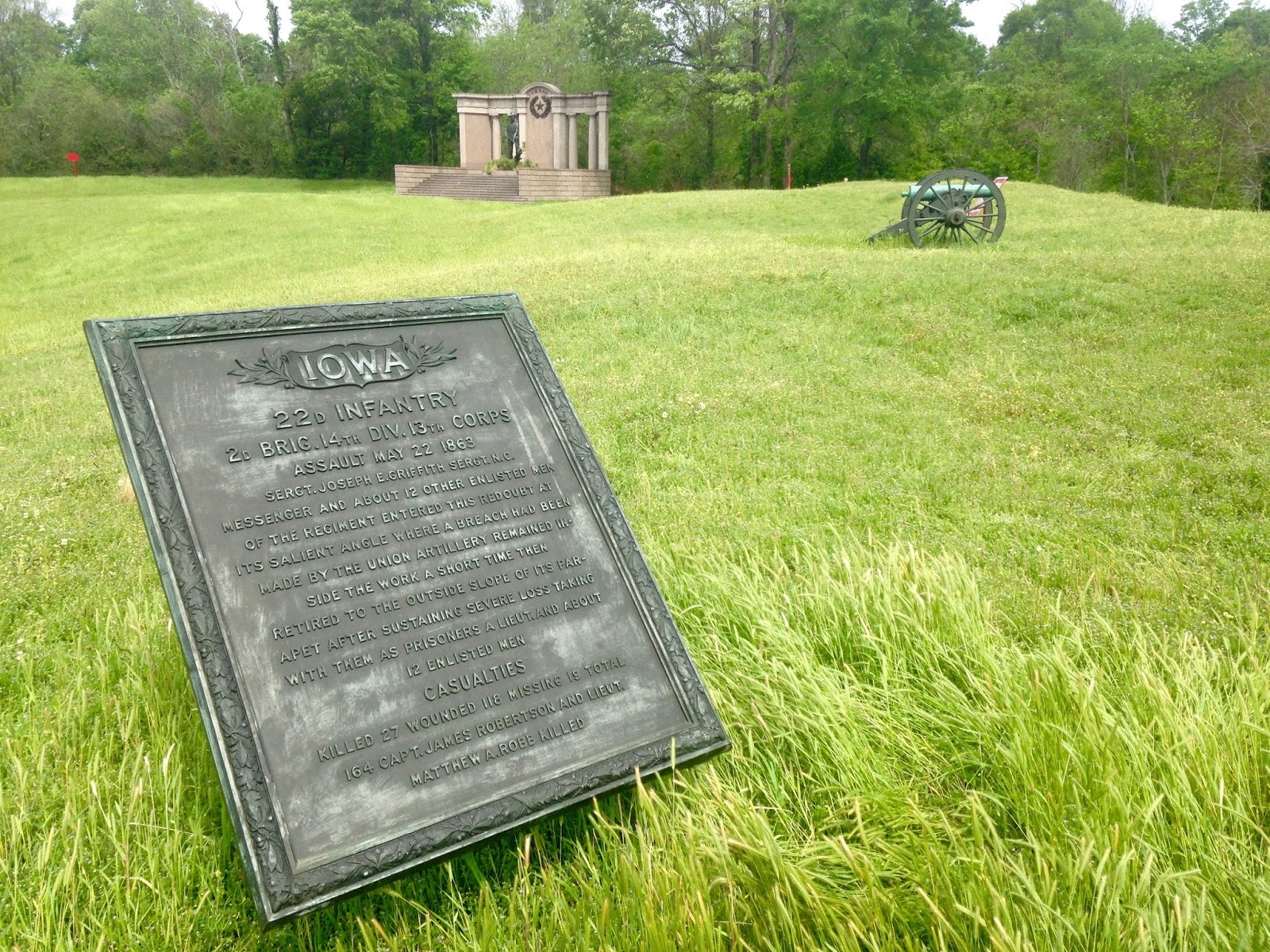
Returning to Vicksburg's Stockade Redan and Railroad Redoubt

22nd Iowa marker at the Railroad Redoubt, with Texas monument in the distance
For the American Civil War history buff, one of life’s great pleasures is tramping around battlefields and associated sites with the preeminent historians of our time. And for Grant’s Vicksburg Campaign, you can do no better than to accompany Terry Winschel on a three-day excursion. Last weekend Terry led a small group of enthusiasts all over the map, from Chickasaw Bayou, to Grant’s Canal, to Grand Gulf and Port Gibson, to Champion Hill and the Big Blackin to Vicksburg itself, and the siege lines encompassing the Confederate Gibraltar. 

Terry Winschel at the U.S.S. Cairo
This was my fourth visit to Vicksburg (one previous tour with Ed Bearss, author of the ultimate Vicksburg campaign study), and I was struck again and again over the weekend by fresh revelations. The campaign was so long, and so convoluted, it challenges even devoted students. The geography of the areaincluding the ever-changing riverfairly demands a personal visit for one to begin to appreciate the chess match played out by Union and Confederate forces. 


Upon my return to California, it dawned on me that it’s been 25 years since Ted Savas and I brought out volume two, number one of Civil War Regiments, devoted to Vicksburg. Terry wrote a couple of articles for that issue, including “The First Honor at Vicksburg: The First Battalion, 13th U.S. Infantry,” and last weekend we visited the Stockade Redan to recount Uncle Billy's assault there, when the colors of the 13th were advanced to the ditch in front of the formidable Confederate works (of the ten members of the color guard, nine were killed or wounded). 

As Ed Bearss writes in the introduction to the Vicksburg issue, the motto of the 13th U.S. Infantry remains today, “First at Vicksburg,” and the unit’s badge honors their service on May 19, 1863: “There is the cross from the Confederate battle flag with the colors changed from blue to red and the shoulder straps of the two future generals associated with the regiment at its organization—William T. Sherman and Philip H. Sheridan, the former as its colonel and the latter a staff officer.” 

Also in that issue was Jeffry Burden’s superb article, “Into the Breach: The 22nd Iowa Infantry at the Railroad Redoubt.” Burden relates one of the most celebrated exploits of a storied regiment, when a handful of men under Sergeant Joseph Griffith temporarily breached the Railroad Redoubt and captured a dozen prisoners. Visiting the Railroad Redoubt again last Sunday, to hear Terry’s account of the action there, was a thrill. Vicksburg is one of the campaigns about which I have read a great deal, but all these years later I’m still learning something new, as if only now beginning to tackle the subject in earnest. 

Artist's rendering of the assault May 22,
1863 assault on the Railroad Redoubt
This is why I will keep traveling to the historic sites, walking the ground, and seeing it with my own eyes. And this is why the preservation of our historic sites is so important. Once it’s gone, it’s gone for good. 


Below are some of my early attempts at map-making, to accompany the Winschel and Burden articles a quarter century ago (click to enlarge). 

Sunday, February 12, 2017

2017 Lincoln Prize winners announced

The 2017 Gilder Lehrman Lincoln Prize will be awarded to two recipients this year: James B. Conroy, author of Lincoln’s White House: The People’s House in Wartime (Rowman and Littlefield), and Douglas R. Egerton, author of Thunder at the Gates: The Black Civil War Regiments That Redeemed America (Basic Books).
Both Conroy and Egerton will be recognized during an event hosted by Gettysburg College and the Gilder Lehrman Institute of American History at the Union League Club in New York City on Wednesday, April 19. The authors, who will split a $50,000 prize, will each receive a bronze replica of Augustus Saint-Gaudens' life-size bust “Lincoln the Man.”
Read the complete press release here. 

Wednesday, February 08, 2017

"Vicksburg is the key!" — Tour set for March 31-April 2

The Campaign and Battles for Vicksburg: 
an in-depth, multi-day tour with Terry Winschel

March 31–April 2, 2017

ITINERARY:
Friday, March 31: 8:00-4:00 — We will make stops at Louisiana Circle to set the stage and talk about the Naval Siege of Vicksburg. We'll then drive north through Vicksburg, past the Warren County Courthouse, Pemberton's Headquarters, and various river battery sites to the Cairo Museum (we will stop there on Sunday), and out to Chickasaw Bayou Battlefield. From there we will proceed across the river to the Williams-Grant's Canal to talk about the Bayou Expeditions and the march south through Louisiana. After lunch we will visit Grand Gulf and Port Gibson battlefields.
Saturday, April 1: 8:00-4:00 — We will first go to Champion Hill and Big Black River Bridge battlefields. After lunch in Vicksburg we will tour the Union siege lines around the city making stops at key sites as time permits.
Sunday, April 2: (1/2 day) We will go to the Cairo Museum and spend the remainder of the morning touring the Confederate defense line making  stops at Stockade Redan and Railroad Redoubt. We'll adjourn around mid-day.

visit my WHT page for all the details 


Saturday, January 14, 2017

Balls Bluff Battlefield Expansion

Interior Secretary Approves Massive Expansion of Balls Bluff Battlefield Landmark

U.S. Interior Secretary Sally Jewell yesterday announced her approval of the expansion of the Balls Bluff Battlefield National Historic Landmark near Leesburg.
The expansion is significant. It increases the battlefield landmark from 76 acres to more than 3,300 acres on both sides of the Potomac River and includes Harrison Island.
The news was especially welcomed by the Loudoun County Heritage Commission, which initiated the project five years ago. Prominent in the effort were former Chairman Bill Wilkin, aided by members Mitch Diamond, Lori Kimball, Childs Burden, former member W. Brown Morton III, advisor Jim Morgan and Loudoun County Preservation Planner Heidi Siebentritt.
Read complete article at LoudounNow

Tuesday, December 27, 2016

Decision at Tom’s Brook: George Custer, Tom Rosser, and the Joy of the Fight, by William J. Miller


Reprinted from
annual Books issue 
(November 2016)

Decision at Tom’s Brook: 
George Custer, Tom Rosser,
and the 
Joy of the Fight

by William J. Miller 
(Savas Beatie, 2016)
—visit the author's website


Above, George Custer, Library of Congress;
below, Thomas Rosser, American Civil War Museum


Civil War Trust's downloadable
map of the Battle of Tom's Brook


The Civil War Trust page
on Tom's Brook (overview,
facts and resources).

Civil War News book review page

Thursday, December 08, 2016

In Volcano, California, a 737-pound brass cannon named "Old Abe" played a pivotal role in ending a secession movement in 1860s California


From the San Luis Obispo Tribune
July 4, 2015 — Dan Krieger - Special to The Tribune
'Old Abe' versus rebels in California's Gold Rush towns
A 737-pound brass cannon named Old Abe played a pivotal role in ending a secession movement in 1860s California with some strategic window breaking.

"A pro-Union group, “the Volcano Blues,” petitioned the arsenal in Benicia for some artillery. All that could be spared was a 737-pound, Boston-manufactured brass cannon from the Mexican era. It fired a 6-pound ball and could do a great deal of damage to the quickly built wooden structures in Volcano. The gun was transported by riverboat to the Carson Pass road and smuggled into town. It was renamed “Old Abe” and mounted on a movable wooden carriage."

Read the full article about Old Abe here

Below, an image of Old Abe in the Library of Congress, dated April, 1940:

According to this Western Mining History website, Old Abe has a brother at Shiloh. I'll need to check with the NPS about that:

"The cannon was cast by Cyrus Alger & Co. in Boston in 1837 and is the first of two 6-pounders made on the same day to be stamped with serial number 4. The cannon was never fired. The other cannon still survives at Shiloh Battlefield and is called "Shiloh Sam". Abe is the only cannon of that age in the U.S. still on a nineteenth century wooden carriage, and has had an interesting history all on its own."


Sunday, November 13, 2016

Remembering the USS Tulip, a Civil War icon


St. Inigoes, MD - It’s been 152 years since the November night when the USS Tulip, serving in the American Civil War—among other things patrolling the Potomac River in search of blockade runners—headed up the river for boiler repairs. The ship never made it to the Anacosta Navy Yard in Washington, D.C.
Just off Piney Point in St. Mary’s County and Raggedy Point in Virginia, the boiler blew Nov. 11, 1864. The ensuing explosion ripped the ship apart, claiming 49 lives in the process.
On a crisp morning in St. Inigoes Friday, Nov. 4, the U.S. Navy paid tribute to those lost in the disaster.
[from BayNet.com: read the full article here]

Friday, November 11, 2016

"Dawn Before Gettysburg" (1938), by Edward Hopper


[Veteran's Day Facebook Post, November 11, 2016]
On this Veteran's Day we wanted to share Edward Hopper's painting "Dawn before Gettysburg" (1938). It belongs to the Tuscaloosa Museum of Art in Alabama, where it is shown in the Civil War Gallery.

Hopper calls up the memory of the bloodiest battle that took place in the Civil War. Fifty-one thousand men lost their lives, almost a third of the men who participated. Hopper does not create a violent bloody scene, but conveys to the viewer a great feeling of anticipation. Nine soldiers are seated on a grassy bank along a dirt road in front of a white house trimmed in blue with a white picket fence. The tenth soldier stands looking off into the distance. 

There is stillness in the air as the sun begins to rise. Each man is engaged in some activity, one is tying his shoe, and another has fallen asleep.

Sunday, November 06, 2016

From the attics and shoeboxes of Virginia, a trove of historical gold

A letter written July 4, 1863, by John Winn Moseley after he was wounded and captured in the Battle of Gettysburg. (Library of Virginia)
From The Washington Post:

The opening line still hurts across the years.
“Dear Mother — I am here a prisoner of war & mortally wounded.”
John Winn Moseley was writing home from the Gettysburg battlefield on July 4, 1863. He was a 30-year-old Confederate from Alabama being cared for by his Yankee captors.
“I can live but a few hours more at farthest,” he wrote. “I was shot fifty-yards of the enemy’s line. They have been extremely kind to me.”
Moseley died the next day. His letter — on delicate blue paper, stained with what might be blood — made it to his mother in Buckingham County, Va., and the family kept it ever after. Now it has come to light in a trove of Civil War documents that the State Library of Virginia discovered in a surprisingly straightforward way: It asked state residents to bring them out of their homes.
From 2010 until last year, as Virginia observed the 150th anniversary of the Civil War, archivists traveled the state in an “Antiques Roadshow” style campaign to unearth the past. Organizers had thought the effort might produce a few hundred new items. They were a little off. It flushed out more than 33,000 pages of letters, diaries, documents and photographs that the library scanned and has made available for study online.
Read the full story here

Monday, October 31, 2016

Harry Houdini and the Ghost of Abraham Lincoln


Mary Lincoln passed away on July 16, 1882, but it appears that, even as late as 1924, there was some curiosity about the spirit realm still surrounding Mary’s descendants. Enough curiosity, it seems, that world-renowned magician Harry Houdini helped to dispel the notion of at least one “spirit photograph” featuring himself and Abraham Lincoln.
On Feb. 13, 1924, just one day after what would have been Abraham Lincoln’s 115th birthday, Houdini typed out a letter to Mary Edwards Lincoln Brown, the grand-daughter of Ninian and Elizabeth Edwards, Mary Lincoln’s sister. The letter reads:
State Lake Theatre, Chicago, Ill. Feb. 13, 1924.
Mrs. Mary Edwards Lincoln Brown,Lincoln Homestead,Springfield, Ill.
My dear Mrs. Brown:
Enclosed you will find Spirit Photograph of your renowned ancestor, and although the Theomonistic Society in Washington, D.C. claim that it is a genuine spirit photograph, as I made this one, you have my word for it, that it is only a trick effect.
Mrs. Houdini joins me in sending you kindest regards,
Sincerely yours,Houdini

[From Abraham Lincoln Presidential Library and Museum]

Monday, October 17, 2016

Today in 1859: John Brown at Harpers Ferry

From the National Museum of American History:


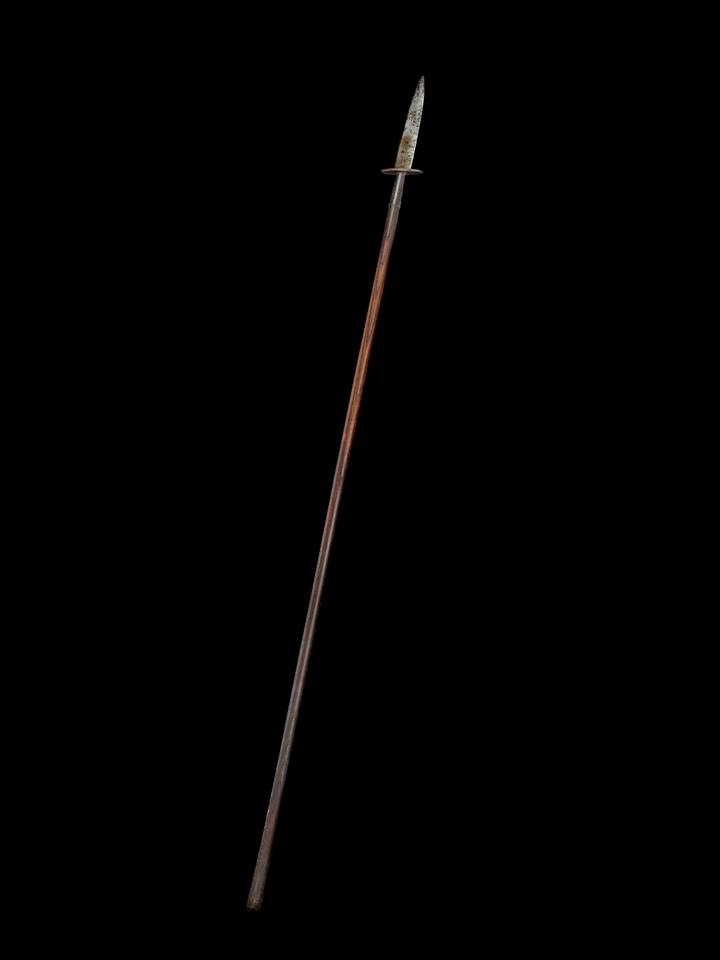
Today in 1859: Abolitionist John Brown seizes the arsenal at Harpers Ferry, hoping to spark a slave uprising. This pike was among 950 pikes that John Brown acquired to arm slaves incited to rebel by his raid on Harpers Ferry.

Tuesday, October 04, 2016

Ronald White’s magisterial new biography offers a fresh view of Ulysses S. Grant (Boston Globe)


By Jordan Michael Smith GLOBE CORRESPONDENT  9/29/16

Ronald White’s magisterial new biography, weighing in at over 800 pages, is the newest heavyweight champion in this movement. White doesn’t explicitly say that Grant was a great president, but instead approvingly cites the favorable judgments of Frederick Douglass and Teddy Roosevelt. The latter, in fact, perhaps overexuberantly ranked Grant with Washington and Lincoln as leaders, ahead of Jefferson, Jackson, and Hamilton. [REVIEW]

Thursday, September 29, 2016

From the Lab: Civil War Blood (NYHS)


 From the Lab: Civil War Blood


The Story . . .
While processing the records of the Military Order of the Loyal Legion of the United States, New York Commandery, we came across a poignant relic of the Civil War: a note passed between the lines at the Battle of Antietam, one of the bloodiest battles in the history of the nation.
The note was sent to the Loyal Legion by Union Captain William J. Carlton, who explains in an accompanying letter that while he was posted “in front of the little Dunker church” – the site of some of the sharpest fighting of the battle – a Confederate soldier approached with a flag of truce and handed over a note asking for the body of confederate Lieutenant Paul Newton.  The note, signed by Colonel A.H. Colquitt – a Georgian who after the war was elected to the U.S. Senate — describes Newton as “tall and well proportioned, has … blond hair and mustaches, with 2 stars on the collar of his coat.”
Carlton took the note to Union Generals William B. Franklin and Henry Warner Slocum, who agreed to comply with the request, and the body was sent across the lines.
The story doesn’t end there, though.  In a sad postscript, Carlton notes that the following morning, after the Confederates retreated into Virginia, he saw the body of Paul Newton with a number of other dead Confederate officers left abandoned on the field: “evidently they had not the means of transportation and had to leave their fallen comrades to be found in unknown graves.”
Click here to read the full article

Sunday, September 11, 2016

Remembering Rick Rescorla, an American soldier, on September 11


"You see, for Rick Rescorla, this was a natural death. People like Rick, they don’t die old men. They aren’t destined for that and it isn’t right for them to do so. It just isn’t right, by God, for them to become feeble, old, and helpless sons of bitches. There are certain men born in this world, and they’re supposed to die setting an example for the rest of the weak bastards we’re surrounded with."

Quoted from this New Yorker article from 2002, featuring Rescorla: "The Real Heroes are Dead, A Love Story," by James B. Stewart. Rescorla died on September 11, 2001 in the terrorist attack on the World Trade Center towers, while helping others to safety.

He is the soldier pictured in the foreground of the dust jacket photo on the Moore and Gallagher book, We Were Soldiers Once and Young. 
In this 8-minute video, Rescorla discusses the Ia Drang battle (Vietnam War), and the future of warfare (terrorists).  

Tuesday, August 30, 2016

"Last photograph of Gen. Grant, four days before death"


Ulysses S. Grant, by John D. Gilman, 1885. National Portrait Gallery