Tuesday, August 19, 2014

The Manuscript Division of the Library of Congress has made three more Civil War-related collections available online (including Clara Barton and Charles Reed)

From Michelle Krowl at the Library of Congress: 

I wanted to let you know about three Civil War-related collections in the Manuscript Division that have recently been digitized and posted to the Library of Congress website. They are chock full of primary source material that may be helpful for classroom use, student papers, scholarly articles, dissertations, books, or just for general interest.

Each collection can be accessed in several ways. Each has its own online presentation site, but can also be accessed through online collection finding aids that are available in html and pdf format. (Sometimes it can be easier to find specific items or types of material through the finding aids.) Original materials can be found through the “Collection Items” tab in the online presentation, and the “Digital Content Available” links in the container lists of the finding aids. All of the collection material is the same regardless of how it is accessed, but two of the online presentations have additional essays, as well as updated related resources.

When you open up the web page with bibliographic information for that set of original materials, you’ll want to either click on the photo of the item (sometimes it is a photo of the file folder) or the “enlarge xx images” link under the photo (both are on the left side of the page). Both will launch the viewer through which the material can be seen.

The new online collections are:

CLARA BARTON PAPERS
Clara Barton achieved historical fame as a nurse during the Civil War, as an international relief worker following the war, and as the founder of the American Red Cross in 1881. All of these activities are reflected in Barton’s extensive collection of personal papers. Of particular interest to students of the Civil War is Barton’s correspondence with family members like Martha Elvira Stone, the pocket diaries in which she noted the names of soldiers she encountered in hospitals, records of the Office of Correspondence with the Friend of the Missing Men of the U. S. Army, documents relating to the identification of Union soldiers buried at the Confederate prison of Andersonville, and Barton’s war lectures.
Online presentation     Finding aid in html     Finding aid in pdf


GRESHAM FAMILY MATERIAL IN LEWIS H. MACHEN FAMILY PAPERS
The Gresham material in the Lewis H. Machen Family Papers includes family correspondence before, during and after the Civil War. The highlight of this section of the collection is the seven Civil War-era diaries kept by LeRoy Wiley Gresham from 1860 to his death in June 1865. LeRoy, a native of Macon, Georgia, kept a diary entry nearly every single day of the war, beginning when he was about 13 and ending at his death at the age of 17. He notes what news he is hearing, the prices of things purchased for him, and generally what life is like for a teenager on the home front during the war. The reason LeRoy does not enlist in the Confederate army is that he was a long-time invalid, and the diaries also reflect the symptoms of his health problems (the exact origin of which are not specified) and what remedies he uses for treatment and pain management.
Online presentation     Finding aid in html     Finding aid in pdf  (Containers 29-32)


CHARLES WELLINGTON REED PAPERS
The papers of Civil War soldier and artist Charles Wellington Reed, who served with the Ninth Independent Battery, Massachusetts Light Artillery, includes approximately seven hundred sketches and correspondence relating primarily to the Civil War. The letters are often prefaced by drawings which further illustrate not only the rigors of military life, but also the amusing and mundane aspects. The contents of the letters and corresponding sketches well document the ways in which soldiers adapted to seasonal changes in the weather, how they amused themselves, and the routines of camp life in the Army of the Potomac.
Online presentation     Finding aid in html     Finding aid in pdf

Other collections with manuscript materials are available at: http://www.loc.gov/manuscripts/collections/, while the legacy collections still part of the American Memory portal are available at: http://memory.loc.gov/ammem/index.html

Tuesday, August 12, 2014

Kansas City Southern

. . . heading east out of Vicksburg across the Big Black River (April 2014). I was singing that old Gene Clark tune in my head for the rest of the day.

Wednesday, July 23, 2014

Battle of Atlanta -- 150 years ago (yesterday)

One of a string of battles in Sherman's Campaign for Atlanta, this July 22, 1864 clash is the only one called the Battle of Atlanta. The Civil War Forum toured the field on 2008. Below are photos of the approximate sites where a general officer on each side was killed—the Union's James Birdseye McPherson, and on the Confederate side, William H. T. Walker. Four days after the battle, Sherman wrote home to his wife Ellen, "I lost my right bower in McPherson."


Tuesday, June 24, 2014

"In an ongoing revisionist history effort, Southern schools and churches still pretend the war wasn't about slavery"

From Salon.com:
The Southern version of history also prevailed for decades at Civil War battle sites, thanks to the fact that Congress appropriated money for the National Park Service, and Southerners in Congress had their hands on the purse strings. It wasn’t until the 1990s that the Park Service—under pressure from the academic community and a few members of Congress—made it a priority to revamp its exhibits to “interpret [the Civil War] and the causes of the war based on current scholarship,” said Dwight Pitcaithley, a professor of history at New Mexico State University who was chief historian of the Park Service from 1995 to 2005. In December 2008, Pitcaithley gave a talk to public school educators in Mississippi, and used as part of his presentation this quote from the Mississippi Declaration of Secession: “Our cause is thoroughly identified with the institution of slavery, the greatest material interest of the world.” That sentence is now prominently displayed on the wall of the National Park Service visitors’ center in Corinth, Mississippi, near the site of the battle of Shiloh. Pitcaithley took a picture of the display and used it in his presentation. After his talk, he was chatting with a thirty-four-year-old black school principal who had grown up in Mississippi, attended its public schools, and received his university education there. “I asked him if he’d ever seen that [quote] and he said no—he’d never even heard of that.”
Read the full article here

Monday, June 09, 2014

Dressing up like a rebel is not enough. You need to do your homework.


What’s with Confederate reenactors and the matter-of-fact denial of slavery’s central role in bringing about the American Civil War? Not a month goes by, it seems, without a news item quoting a reenactor expounding along those lines. Incredibly, they don’t settle for simply diminishing the role of slavery, as some apologists are wont to do. No, frequently they’ll proclaim that the war had nothing to do with slavery whatsoever.

It’s astonishing, and sad, that 150 years after the war, with all of the resources at our disposal, all of the painstakingly researched histories of that era, all of the primary source material that is increasingly being digitized and made accessible, we still have people putting forth this long-discredited, neo-Confederate fantasy.

Like the modern day holocaust denier, one must make a determined and willful effort to ignore or discount a great mountain of evidence to arrive at such a misguided conclusion. Even blinders allow a horse to see what’s in front of it, but the slavery-as-cause denier rejects even that.
 
It’s one thing to tell a reporter, as this reenactor did in Florida recently, "If people know their history, the Civil War has nothing to do with slavery." Discriminating readers can dismiss this nonsense as effortlessly as we dismiss “birthers.” But taking this alternate history into a classroom should not be so easily dismissed. It is an affront to education, and should be refuted.

Most recently I encountered an article about a Confederate reenactor who gave a brief “lecture” to a class of 8th graders in a Santa Clara, California middle school. I knew instinctively as soon as I saw the photo of the gray-clad rebel in a classroom that the article would put forth the great Lost Cause lie. And sure enough, it did.

Said the reenactor: “Most kids say the reason the Civil War happened was because of slavery, and I tell them it wasn’t. The war was about 11 states that wanted to leave the union, and it was about the attack on Fort Sumter.”

Never mind that the lawful governments of two of those states did not vote to leave the union. Never mind that the reason the other slave states wanted to leave the Union was that they saw it as the only way to preserve and perpetuate slavery.

How do we know this? We know this because the secessionists themselves told us that.

Confederates of the day made no bones about this. They were forthright and unabashed about their motivations. Strange then, that people who today dress up like pretend Confederates have come up with an interpretation contrary to that of the secessionists themselves.

I defy any one of them to sit down and read Charles Dew’s, Apostles of Disunion. The first states to secede sent ambassadors to the other slave states to try to convince them to secede. Here we have Southerners speaking to each other in their own words. Their unmistakable message is that the only “state right” under consideration was the right to maintain and perpetuate slavery.

Professor David W. Blight, in his essay, “One Rebel State Never Surrendered: Denial — Confederates’ Own Words Condemn Their Cause,” wrote:
“The best way to understand why secession and war came in 1860-61 is to look at what white Southerners themselves said they were doing. How did the leaders of secession explain the origins of the war?
South Carolina's "Declaration of Causes" justifying secession included the claim that the Republican Party would "take possession of the government the South shall be excluded from the common territory and a war must be waged against slavery until it shall cease throughout the United States."
Texas secessionists proclaimed their greatest fear in the crisis as "the abolition of slavery" and "the recognition of political equality between the white and negro races."

In Mississippi, secessionist delegates unanimously announced that their "position is thoroughly identified with the institution of slavery." The Mississippians declared that they "must either submit to degradation and the loss of property worth four billions of money, or we must secede from the Union."

Georgians agreed, accusing "abolitionists and their allies in the Northern states" of "efforts to subvert our institutions, and to incite insurrection and servile war among us."
Blight also quoted John Mosby, the legendary “Gray Ghost,” who said after the war, “"I always understood that we went to war on account of the thing we quarreled with the North about. I never heard of any other cause of quarrel than slavery."

That pretty well sums it up.


Wednesday, May 28, 2014

Five best books on the Steamboat Sultana, and America's greatest maritime disaster


Gene Salecker at Vicksburg's Sultana mural
My wife and I visited Vicksburg last month for the annual meeting of the Association of Sultana Descendants and Friends. Next year we’ll meet in Marion, Arkansas for the 150th anniversary of the Sultana disaster. 

http://www.barnesandnoble.com/w/disaster-on-the-mississippi-gene-eric-salecker/1000446000?ean=9781557507396It was a great pleasure to finally meet two authors who’ve written important works on the subject. Gene Salecker wrote what most consider the definitive study in, Disaster on the Mississippi, the Sultana Explosion, April 27, 1865. Gene was our guide for the weekend, taking us to the site of Camp Fisk, where former Union POWs from Cahaba and Andersonville, Midwesterners, were processed for parole. Much of the area where Camp Fisk was situated remains undeveloped and bucolic. Once paroled, the soldiers were taken by train to the Vicksburg depot, from whence they hiked to the wharf and boarded steamboats for the trip home. The floodwall at Vicksburg boasts 32 murals depicting scenes from the town’s history, including the fateful boarding of over 2,000 Union soldiers onto the Sultana.

http://www.barnesandnoble.com/w/sultana-alan-huffman/1103372159?ean=9780061470561It was also a treat to meet author Alan Huffman (with Anne, at right), whose book, Sultana: Surviving the Civil War, Prison,and the Worst Maritime Disaster in American History, features Anne’s ancestor, Romulus Tolbert of the 8th Indiana Cavalry. In a bit of geographical schizophrenia, Alan splits time between his exceedingly quiet and lovingly restored old home in rural Mississippi, and an apartment in New York City. Alan has written some intriguing books on a broad array of subjects, which you can read about here

http://bluegraymagazine.com/store/page2.htmlhttp://www.barnesandnoble.com/w/the-sultana-tragedy-jerry-potter/1110828040?ean=9780882898612Three other books round out the respectable Sultana bookshelf. First, Jerry Potter’s outstanding, The Sultana Tragedy: America’s Greatest Maritime Disaster (Jerry also wrote the main article in "Blue and Gray" magazine’s Sultana issue –August 1990, vol. vii, issue 6). William O. Bryant’s contribution, from the University of Alabama Press, is Cahaba Prison and the Sultana Disaster, a fine, fast-moving, and well-documented narrative. And finally, an all-important collection of first-person accounts by survivors – recently reprinted in an attractive edition by the University of Tennessee Press in their “Voices of the Civil War” series – Loss of the Sultana and Reminiscences of Survivors, by Chester D. Berry.

http://www.barnesandnoble.com/w/cahaba-prison-and-the-sultana-disaster-william-o-bryant/1100928352?ean=9780817311339http://www.barnesandnoble.com/w/loss-of-the-sultana-and-reminiscences-of-survivors-chester-d-berry/1101069803?ean=9781572333727There are a couple of lesser books on the subject, including the flawed Transport to Disaster, by James W. Elliott and, if I’m not mistaken, some historical fiction.

More urgently, there is still 7 days to go in the Kickstarter campaign to fund a Sultana documentary. Frodo’s friend Samwise (Sean Astin) has signed on as Executive Producer. Go here to see a little taste of what the documentarians are cooking up. 

Monday, May 12, 2014

"I was always careful after that about joking with Johnnies"


Recent spasms of old-school racism – L.A. Clippers owner Donald Sterling’s bizarre recordings, and the musings of freeloading anarchist Cliven Bundy – have put the subject of racism back in the news on a more or less national scale. It lesser ways, racism is in the news every day, but is probably not something a lot of Americans have cause to spend time thinking about.

Bundy put forth a familiar version of the modern “slaves through dependency” meme, but enlivened it with some choice neo-Confederate sentiments by suggesting  that slave days were happy days, and that picking cotton gave black people a sense of purpose. He said, “And because they were basically on government subsidy, so now what do they do? They abort their young children, they put their young men in jail, because they never learned how to pick cotton. And I’ve often wondered, are they better off as slaves, picking cotton and having a family life and doing things, or are they better off under government subsidy? They didn’t get no more freedom. They got less freedom.”

Reading that, one can’t help but think of the famous quote attributed to Abraham Lincoln, “Whenever I hear any one arguing for slavery I feel a strong impulse to see it tried on him personally”  (The Collected Works of Abraham Lincoln edited by Roy P. Basler, Volume VIII, "Speech to One Hundred Fortieth Indiana Regiment" (March 17, 1865), p. 361).

Coincidentally, when the Bundy and Sterling brouhahas broke out, I was reading an old Civil War memoir by a Wisconsin soldier which addressed the treatment of slaves in the South. It’s strange and disquieting that as a society, we’re rebutting the same arguments and same mythologies that people were rebutting 150 years ago. It seems like it should be ancient history, but it's not.

Melvin Grigsby’s memoir, The Smoked Yank, was published in 1888. Grigsby, a member of the 2nd Wisconsin Cavalry, spent the early part of the war mostly in Arkansas and Mississippi. He was captured by guerillas outside of Vicksburg and was transported to Castle Morgan, the prison at Cahaba, Alabama. Eventually he was transferred to Andersonville prison in Georgia, and later to Florence, South Carolina. He made a number of escape attempts, finally succeeding on the last and made his way back home. 

Grigsby and his comrades disdained slavery, and likewise disdained the early-war policy of protecting the property of slaveowners in areas where the Union army held sway. While stationed at Helena, Arkansas, Grigsby and some buddies took emancipation into their own hands. Of that time, he wrote: 
Helena is in the cotton belt. There were thousands of negroes on the cotton plantations. The government was at that time trying to save the Union and slavery too. The negroes came into Helena by hundreds. Their masters would follow them in and get permits to take them back. The privates, many of us were not in accord with the Government on the negro question. We used to follow the masters when they started away with their slaves, release the slaves and convince the masters that it would be best to keep away from camp. 

On one occasion, Carr and I saw a man leave town with a lot of his negroes who had run away. We followed him out about ten miles and then stopped him. We sent the negroes back to town, took the master's horse, and told him to stay out of Helena. Carr asked me to ride back with the negroes, as they were afraid other slave-owners would arrest them, while he would conceal himself and see if the enraged master would attempt to follow us into camp. 

Before I got back to town, Carr overtook me leading another captured horse. He absolutely refused to answer any questions, and, fearing that the man had started to follow us back, and that Carr had killed him, I was willing that silence should be maintained. A few weeks after, I saw this slave-owner in town. He wasn't trying to take out negroes any more. I pointed him out to Carr, who then told me what had happened before. He saw the man coming on a horse, waylaid him, took him into the woods and handcuffed his hands around a tall tree and left him there. Carr had found the handcuffs on a plantation where they had been used in disciplining negroes, and he carried them in his saddle-bags as a curiosity ; said he left the man near the traveled road so that there would be no question about his being released. 

All that summer we carried on a warfare of that kind against what we believed to be the mistaken policy of the government. It had a bad effect on the soldiers.

Grigsby, as I mentioned, would have taken issue with Rancher Bundy’s notions of happy days on the old plantation. On that subject, he wrote: 

On that plantation I used to read the records kept by the overseer. It seems that every overseer of a large plantation kept a daily record. That record showed that there were negroes whipped, bucked, and gagged, and otherwise punished every day. Every negro who came from the field with less than his stint of cotton, received so many lashes. I saw there the same kind of instruments of torture that I afterward saw in Andersonville. One machine was rigged for stretching negroes over a large roller, so that the lash could be applied to the bare skin. If anyone believes that the cruelties practiced on slaves were exaggerated in Uncle Tom's Cabin, let him hunt up and read one of those plantation records.

Finally, I want to share a passage in which Grigsby has some fun at a slaveowner’s expense, in a section he entitled “Joking with Johnnies.” He makes many sarcastic references to “southern chivalry.” In this instance, Grigsby was being transported to prison, and during one stop along the way, the prisoners were guarded in a slave hut. I have edited out the “N-word,” because that’s the way I was raised.
We witnessed another illustration of southern chivalry at the same town. We were guarded in a negro quarter or hut. Our supper was brought in by a good-looking mulatto girl. The owner of the place, the girl's master, came in while we were eating, and seemed desirous of arguing with us the questions that divided the North and South.

"You uns," said he, "think a [black] just as good as a white man, don't you?"

"Yes, in some respects," we said.

"Now, I suppose you would just as soon marry a [black] wench as to marry a white woman, wouldn't you?"

Thinking the old gentleman would take a joke, I said to him:

“I wouldn't like to marry any [black] wench that I have seen around here, for fear I would have some of you rebels for a daddy-in-law."

As I spoke, I looked from him to the mulatto girl, standing near. Whoopee! How the old man did rave! He stormed and swore and finally started for the house saying, he wouldn't stand such an insult from no damned Yankee. He meant business, too, for he soon came back with a shot gun, which he would doubtless have fired into us, had not Boatwright stood in the door, and, partly by the influence of his drawn revolver and partly by persuasion, appeased the old man's wrath. I was always careful after that about joking with Johnnies.

Sunday, May 11, 2014

150 Years Ago -- reaching the tipping point


Already by May 11, 1864, those of us looking back in hindsight can see the fortunes of war tipping inexorably toward Union arms. General Grant, undaunted by the body blows inflicted on him by Robert E. Lee in the Wilderness, was nearly a week into the unremitting slaughter of Spotsylvania. On this one day, 150 years ago, Grant assured his superiors in Washington that he intended "to fight it out on this line if it takes all summer" (take a look at Grant's May 11 letter at Brooks Simpson's Crossroads blog) and the vaunted Confederate Cavalry chief J.E.B. Stuart was killed by Union cavalry with Richmond at his back.

Photo above:  The J.E.B. Stuart monument at Yellow Tavern. From the NPS driving tour: "Confederate artillery near this location goaded Custer into a second attack at 4 p.m. The Federal charge broke through Lomax's line (behind you, as you face the monument), but was turned back by Company K of the First Virginia Cavalry. The action drew J.E.B. Stuart into the fighting, where he received his fatal wound. The monument marks the approximate spot where Stuart was shot. It is now under the care and protection of the United Daughters of the Confederacy." 

Sunday, May 04, 2014

Hunley finally ready to reveal itself

But within a few months, conservators and archaeologists expect to get their first look at the sub's iron hull - and it may hold clues that finally reveal why the Hunley sank off Charleston 150 years ago.

Friday, April 18, 2014

18th Civil War Forum Conference (April 4-5, 2014) -- Ball's Bluff and Monocacy (Early's 1864 raid)

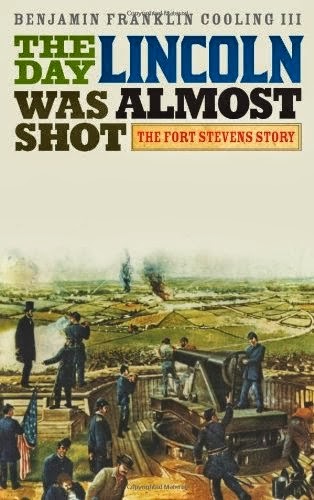
Fort Stevens, where Lincoln was almost shot. On the left, R. Keith Young, former Commander of the sub U.S.S. Silversides, and right, historian and author Dr. Benjamin Franklin Cooling

Point of Rocks, with the inimitable Rich Gillespie.
Jim Morgan, the authoritative Ball's Bluff historian at Fort Evans. 
Worthington House, Monocacy Battlefield

Worthington House, Monocacy Battlefield

Works by our Tour Guides:
http://www.amazon.com/Little-Short-Boats-Battles-Edwards-ebook/dp/B005AV1QNY/ref=sr_1_1?ie=UTF8&qid=1397851572&sr=8-1&keywords=a+little+short+of+boats


http://www.amazon.com/Day-Lincoln-Was-Almost-Shot-ebook/dp/B00CDJR176/ref=sr_1_1?s=digital-text&ie=UTF8&qid=1397851643&sr=1-1&keywords=fort+stevens+cooling
 

Monday, April 14, 2014

Police blotter on the night Lincoln was killed

This Washington, D.C., Metropolitan Police Department logbook for the night of April 14, 1865 recordsthe news of the Lincoln assassination in the bottom right-hand entry.
full story here

Thursday, March 20, 2014

Maryland man may have found two lost or forgotten photos of Lincoln’s funeral procession

From the Washington Post. . .
Mathew Brady/The National Archives - This quad photograph is believed to show President Abraham Lincoln's catafalque as a blur moving past Grace Episcopal Church on Broadway in New York on April 24 or 25, 1865. There were funeral ceremonies around the country for the slain president.

Read the full article here.

Monday, March 17, 2014

Indiana University Press book sale

Good deals on some good books. 
http://www.iupress.indiana.edu/


Monday, February 17, 2014

150 years ago: Hunley sinks the Housatonic


(CNN) -- Born and built amid gray-cloaked secrecy during the American Civil War, the H.L. Hunley — the first submarine to sink an enemy ship — has held tight to its murky mysteries. The 150th anniversary of the Hunley's daring and dangerous raid will be marked this weekend and Monday, but the overarching question remains: What caused the submarine and its eight-member crew to slip to the bottom of the sea on the moonlit evening of February 17, 1864, after it signaled to shore a success that changed naval warfare. Read the full article here.

For some thoughtful reflections on "The men lost on the U.S.S. Housatonic," see Robert Moore's February 17 Cenantua blog entry.

More "Thoughts on the U.S.S. Housatonic the the H.L. Hunley" can be found on Craig Swain's,
To The Sounds of the Guns blog.

And, of course, interesting information on the Confederate submarine is generously offered by the Friends of the Hunley.

Wednesday, February 05, 2014

Ball's Bluff and Monocacy -- 18th Civil War Forum Reunion

18th Civil War Forum Battlefield Conference
Ball’s Bluff, and Monocacy
(with a side trip to Antietam)

Leesburg, Virginia, April 3-6, 2014
Headquarters hotel:
Best Western Leesburg Hotel & Conference Center
726 E. Market Street
Leesburg, Virginia 20176
703-777-9400

Registration is $285.  Registration will cover your seat on the bus (or other transportation, such as a ferry), entrance fees, box lunches for Friday and Saturday, and buffet dinner and presentation on Saturday evening.

Tour guides, speakers, and expert consultants
Jim Morgan, author of, A Little Short of Boats: The Civil War Battles of Ball's Bluff and Edwards Ferry, October 21 - 22, 1861 
B. F. Cooling, author of Monocacy, the Battle that Saved Washington, and The Day Lincoln Was Almost Shot: the Fort Stevens Story
Rich Gillespie, director of education for Mosby Heritage Area Association
Steve Meserve, gentleman, scholar, raconteur

Tentative Itinerary (subject to change):
Thursday, April 3, 1:00 p.m: optional afternoon outing by carpool: Antietam National Battlefield. We'll begin with a presentation by historian Ted Alexander at the Visitor Center, then make a couple stops on the battlefield with a NPS ranger to interpret
Thursday, April 3, 6:00 p.m: informal reception, check-in, programs, name tags (location to be announced); dinner on your own
Friday a.m., April 4: walking tour of historic Leesburg with Rich Gillespie, including visits to Harrison Hall (now known as the Glenfiddich House) where Lee stayed when he passed through town on his way to Maryland in 1862, and where he met with Longstreet, Stuart and Jackson before crossing the river. A short distance from there is the John Janney home, where Lee made his only social call while in town. Janney, I am sure you recall, came within a single vote of becoming President of the United States when John Tyler was chosen instead as Vice President to William Henry Harrison. He later served as President of the Virginia Secession Convention and was the man who offered Lee command of Virginia's troops in 1861. [The latter house is private, and requires special arrangements to tour — thanks to Steve Meserve for recommending these two stops and providing the historic background.]
Friday lunch: picnic on the grounds of Morven Park, one-time estate of Virginia Governor Westmoreland Davis. The Executive Director will present a talk for us while we enjoy our lunches. 
Friday afternoon: visit to Fort Evans, then to Ball’s Bluff battlefield with Jim Morgan for detailed battlefield hikes (3-4 hours all told). 
Saturday a.m., April 5: Frederick, Maryland — visit to the National Museum of Civil War Medicine and, if time permits, the Barbara Fritchie House
Saturday afternoon, April 5: Tour Monocacy battlefield, and visit Ft. Stevens with B. F. Cooling 

Saturday evening, April 5, 6:30-10:00 p.m, in the ballroom at Morven Park Mansion: reception from 6:30-7:00; buffet dinner at 7:00; after-dinner speaker at 8:00 p.m.
Guest speaker: Dr. Benjamin Franklin Cooling

Wednesday, January 15, 2014

‘History of the Slave South’ Online Course Taught by Penn’s Stephanie McCurry Starts Jan. 20


[press release]

In the world of the Internet, slavery and the American Civil War are explosive topics of debate, so Stephanie McCurry is preparing to be globally fact-checked by those with a passion for the subject matter. The University of Pennsylvania history professor and scholar will teach a 10-week, massive open online course, or MOOC, called “History of the Slave South.” It starts January 20.

So far, more than 10,000 people from around the world have signed up for the free, online course.

McCurry, a specialist in 19th century American history, with a focus on the South and the Civil War era and the history of women and gender, is the author of numerous articles and review essays as well as two books, including Confederate Reckoning: Power and Politics in the Civil War South.

Born in Belfast, Northern Ireland, she attended college in Canada before moving to the United States for graduate school. She says that her version of Civil War history is not a Southern history course offered by a Southerner but rather a course taught by an outsider.

“I’ve always thought that’s why my version of it was different and in some ways worth listening to,” she says. “It’s a gripping story in the making of the modern world, how slavery becomes so tied up in the generation of this enormous wealth by the 18th and 19th centuries, but is such a different way of producing wealth than we associate with modernity.”

For people who are not American and who don’t have direct national or ancestral connections to the South, McCurry’s “History of the Slave South” course will articulate what the stakes of slavery were in America.

She says that the course is a thematically concentrated version of what she teaches at Penn. Each week, students will view two online video lectures embedded with quiz questions. There will be weekly discussion questions. Documents and primary sources will be read, with new assignments given every two weeks.

McCurry says she believes that the time is right for a global online course on the slave South given the renewed dialogue spurred by the release of two major motion pictures. Last year’s “12 Years a Slave” and the 2012 film “Django Unchained” explored the brutality and horrors of slavery from the point of view of the enslaved.

McCurry recalls sitting in a theater in the Manayunk section of Philadelphia watching “12 Years a Slave” with a mixed, largely African-American audience. So powerful was the film that she felt silenced, needing to listen, not talk.

She wonders if people can talk about America’s slave history now because “we’ve hit this moment where people feel less directly implicated because they weren’t part of segregation, for example.”

At Penn, McCurry teaches a wide variety of undergraduate and graduate courses in American, Southern and women's history and on the comparative history of slavery and emancipation.

A group of students enrolled in the online course have started a Facebook page and a SlaveSouth MOOCTwitter account @SlaveSouthMOOC. Course registration is available by clicking the Learn for Free banner at https://www.coursera.org/course/slavesouth.

Friday, December 13, 2013

Excerpt from Smithsonian's, "Last of the Blue and Gray"

The last veteran who said he fought for the Union was Albert Woolson; Walter Williams said he was the last Confederate. One of them indeed was a soldier, but one, according to the best evidence, was a fake. One of them had been living a great big lie.
And intriguing excerpt from Richard A. Serrano's, Last of the Blue and Gray (Smithsonian Books) can be read here

Saturday, December 07, 2013

Travelogue: Battle of Apache Pass


In September I attended the 34th Annual Order of the Indian Wars Assembly in Tucson—“On the Trail of Geronimo"—for a few days of talks and tours. Some of this country's top authorities on the Apache were in attendance, including Ed Sweeney, who has authored biographies of both Cochise and Mangas Coloradas. In four days we covered a lot of ground with stops at Mission San Xavier del Bac, San Jose de Tumacacori Mission Church, The Horse Soldier Museum, Fort Huachuca, Tombstone, the Arizona Historical Society Museum (with a special display on Geronimo), Fort Lowell, Dragoon Springs, the American Indian Museum (Amerind). Along the way we drove past Cochise’s stronghold.

For me, the highlight of the weekend was our Sunday hike through the heart of Apache Pass. Our trail took us across a clearly discernible stretch of the Butterfield Overland Mail Route, near the site of the Apache Pass station. Apache Pass station also marks the scene of the infamous Bascom Affair—known to the Apache as “Cut the Tent—the betrayal of Cochise that, along with the execution of some of his family members, led to eleven years of unremitting warfare between the U.S. and the Chiricahua Apaches. 

Butterfield Overland Trail near Apache Station
Continuing beyond this point, we passed Apache Spring, the water source so critical to travelers in the area, and a favorite spot for the Apaches to ambush passers-by. Here, too, is the ground over which the Battle of Apache Pass was fought on July 15-16, 1862, when a detachment of Colonel James H. Carleton’s California Column under Captain Thomas L. Roberts twice drove Apaches under Cochise and Mangas Coloradas from defensive positions on the high ground above the spring. 

To secure this important mountain pass once and for all, Carleton established Fort Bowie, and our hike continued past the ruins of the original fort, as well as the grounds of the relocated fort. Today, there is a NPS installation there, with a small museum and bookstore. 

The Battle of Apache Pass sesquicentennial fell squarely between the sesquicentennials of the Seven Days Battles, and Second Bull Run, so you're forgiven if you forgot to commemorate it.

A mountain howitzer similar to the two used by Roberts to dislodge the Apaches. 
Historian Neil Mangum on the Battle of Apache Pass
Site of the Bascom Affair

Ruins of first Fort Bowie, and the Valley of Apache Pass


Site of the second Fort Bowie.

"Geronimo surrendered this rifle to Indian Agent John Clum in 1877" — U.S. Springfield Model 1868 Military Rifle, Single-shot "Trap Door," Serial No. 28988, Arizona Historical Society, Tucson.
"Eyes of the Army" -- monument to Apache Scouts at Fort Huachuca

Friday, November 29, 2013

Grant, Sherman, and Sheridan slept here. Joe Hooker and Kit Carson too. . . my kids are unimpressed

The operative phrase is, "according to local tradition."
But it could have happened.

Blue Wing Inn, across the street from the Sonoma Mission

After a tremendous Thanksgiving meal and visit with my brother and his family in Glen Ellen (Jack London country), on the way home we decided to take the boys downtown to the Sonoma plaza, one of the true holy lands in the landscape of California history.

We have three sons spread out over a number of years, and it dawned on me that in the lifetime of our three boys, when visiting my brother we have routinely skirted Sonoma proper in favor of more direct and less congested routes. Even the 19- and 15-year-old would have been too young to remember those occasions when we used to walk around the town square. What a grand opportunity to expose the young'uns to some essential Golden State historic sites. All of our kids, when they passed through 4th grade, participated in the requisite study of the California missions (reportedly, and I believe it, there is an underground market for foam-core models of Spanish missions well supported by 4th grade parents), and here in Sonoma, on the plaza, is the northern-most of all the Californian missions. Not only that, but other historic structures abound, like the barracks, and look over there—a monument commemorating the Bear Flag Revolt which happened right on this spot!

First rule, and I should have known better, don't go down to the town square in Sonoma (or any place in the Wine Country, or any other popular destination in California) on a day when nearly everyone is off work, like weekends or holidays. It's crowded, and the road infrastructure doesn't support the volume. Second rule, don't ever think that your kids will even remotely share your interests in history. Don't think they will shiver in awe at the significance of some patch of grass or pasture, or look in wonder on what today, you have to admit, is just a ratty old shed that preservationists—through herculean efforts and much expense—managed to keep from falling down. When we got to the plaza, the two younger boys insisted on "waiting in the car" while we older trio took a stroll. Third rule, don't even try to force them to come with you, because their clinical lethargy, their superhuman disinterest, and their involuntary robo-chants of "can we go now" will detract from your own very real pleasure. No, just crack the windows and say "see you in a bit."

Oh how I enjoyed revisiting California's largest plaza.

Blue Wing Inn

Mission San Francisco Solano (Sonoma Mission)
Founded July 4, 1823

Operation Steal California from Mexico, Phase One