Monday, May 17, 2010

Tommy Lee Jones: "Am I dead?" John Bell Hood: "You don't look like it to me"


Certainly Hood saw enough dead men to answer that question correctly. Back in 1994 I picked up a copy of James Lee Burke's In the Electric Mist with Confederate Dead, because it combined two interests of mine, murder mysteries and the Civil War (though in truth, it has virtually nothing to do with the Civil War). In the novel, detective Dave Robicheaux (the sixth installment with this classic, South Louisiana character) encounters the ghost of Confederate General John Bell Hood with whom he has a conversation or two. There's no particular reason to bring Confederate ghosts into the story, but the general serves to bolster the spirits of the struggling lawman while Robicheaux sees connections between a half-forgotten murder he witnessed as a boy and a string of present day serial killings. Hood's main purpose here seems to be to present the ideal of steadfast honor and adherence to principle.

Spring forward to 2010, last month in New Orleans, I was visiting the grave of John Bell Hood at Metairie Cemetery, and the statue at the Army of Tennessee tomb which provided artwork for the original dust jacket of Burke's book. I mentioned In the Electric Mist and was excited to learn from Civil War Forum member John Lancaster that they'd made a movie of the book. Incidentally, next to the Hood gravein which the Hood name is overshadowed in his wife's family plotis a large metal plaque giving a biography of the general. It's designed to look like a government issue sign, but as our guide told us, it was placed there by a Hood descendantthe same one, I'm pretty sure, who is on a crusade to rehabilitate Hood's military career, and who took out the ad in Civil War News to attack Wiley Sword for unkind words about the general. The plaque, I can report, is a fairly straightforward biography. I was glad it didn't end with a footnote about Sword being a damned liar.

Somehow, this movie (with the title shortened to "In the Electric Mist") passed me by completely, even though it's only from 2009, and had a fairly substantial cast, including Jones, John Goodman, Mary Steenburgen, Ned Beatty, Buddy Guy, Peter Sarsgaard, and Kelly MacDonald. Last week I finally got around to looking up the film on Netflix, and was pleased as punch to see it was among their "Watch Instantly" offerings. I made time for it the other night, and with no expectations at all, enjoyed it very much. Jones and Goodman work pretty hard at their accents, and pull it off for the most part.

Levon Helm of The Band fame plays the one-legged general, and who can resist that gravelly drawl? For all his range as a singer, it's interesting that Helm's on-screen roles seem only to call for a monotone delivery (and Levon, it's cavalry, not calvary). Take off the general's insignia, and this is pretty much exactly the same character that Tommy Lee Jones had a conversation with in the intriguing, "The Three Burials of Melquiades Estrada," except that then he was an old blind man in Mexico, not a dead Confederate general.

Please don't be alarmed by the severity of my comparison.

Below, Hood's grave, and the aforementioned marker.


Wednesday, May 12, 2010

"Making the Civil War Strange Again"

The current issue of Prologue (Spring 2010, Vol. 42, No. 1) has a brief article by Bruce Bustard, curator of the new Civil War exhibit at the National Archives. The ingenious invention above (click to get a larger view) is featured in the article, and the exhibit. The caption reads: "In 1862 Louis Joubert patented this multipurpose device that could serve as a tent, knapsack, or litter. (Records of the Patent and Trademark Office, RG 241)."

Bustard attributes the phrase "make the Civil War strange again" to historian Edward Ayers. It is that spirit which gave the exhibit its name, "Discovering the Civil War"in the expectation that even seasoned students of the Civil War era can "rediscover" a familiar subject. I personally am really looking forward to seeing the exhibit on one of my trips to Washington this fall. The notion of making the war "strange" again is really apt, and not a difficult feat. Those of you who have gotten swept away into a years-long fascination (obsession?) with the Civil War periodwho, though you may have broad interests in the full spectrum of human history, continue to find yourself drawn to yet one more Civil War campaign study, one more biography, one more monograph on an aspect of the periodknow the idea.

It's a subject area that is so big, so all encompassing, so woven into the nation's fabric, so recent, that one can manage to find fresh reading material, and fresh insights, with virtually every trip to the bookstore. One thing I've noticed over the years, something hard to convey to people who don't share an abiding passion for American history (hereafter referred to as soulless robots), is that just when you think you might be getting burned out on the subject, just when you think you can't stomach any more glorification of horrific carnage, when you swear you can not tolerate one more tortured rationalization about fighting for the liberty to keep others in bondage, or one more cliched fairy tale about saintly motivations, something washes over your senses, making you remember why you became fascinated with the subject to begin with.

Some passing thought, or dawning realization, or new-found perspective gives you pause and fills you with awe, causing you to fleetingly graspin a moment of claritythat it's not just a familiar narrative to dissect and critique or challenge or substantiate, but something that actually happened, a strange and amazing story about who we are and where we came from.

History will always be bigger than our attempts to chronicle it.
We shall not cease from exploration
And the end of all our exploring
Will be to arrive where we started
And know the place for the first time.
from "Little Gidding," T.S. Eliot

Monday, May 10, 2010

Some photos from the Civil War Forum's visit to New Orleans in April, 2010

(click to enlarge):

This first one is from the Army of Tennessee tomb at Metairie Cemetery. I'm convinced this soldier is the same one pictured on the original dust jacket of James Lee Burke's, In the Electric Mist with Confederate Dead. But I could be wrong.


Gallier Hall, on St. Charles Avenue, was city hall in 1862 when Federal officers from the U.S. fleet climbed the steps and demanded the surrender of New Orleans.


Monument to the acclaimed Washington Artillery.
And a boy who climbs on everything.


Henry Clay monument in Lafayette Square.


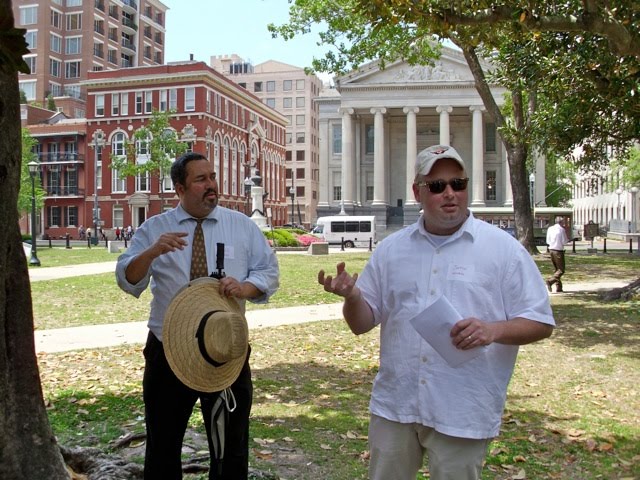
City archivist Greg Osborn, and Loyola history professor Justin Nystrom, begin our walking tour in Lafayette Square, opposite Gallier Hall.


Battle of Liberty Place monument, commemorating the Reconstruction Era fight between the White League and the Metropolitan Police, in 1874. If the South lost the Civil War, this, Nystrom pointed out, was where white supremacists won the peace.


Fort Pike on Lake Ponchartrain, now a Louisiana State Park. Theres' little in the way of interpretation, but the park staff are superb.


The fort was completely underwater after Katrina, though the moat seen here was part of the design.


Original burial place of Jefferson Davis, Metairie Cemetery. Eighteen months after he was buried here, wife Varina had his remains moved to Hollywood Cemetery in Richmond.


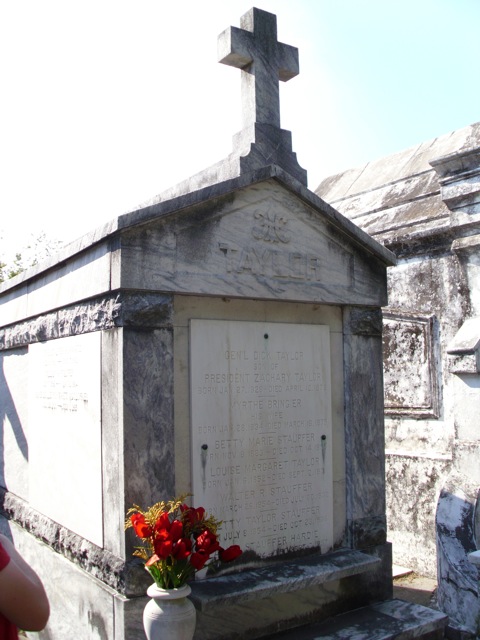
Grave of General Richard Taylor, son of president Zachary Taylor, son-in-law of Jefferson Davis, and author of one of the best reminiscences of the Civil War, Destruction and Reconstruction.


Laura plantation, for many of us, one of the highlights of the weekend. A beautiful spot, quiet and uncrowded when we were there, with a wonderful guide. A unique example of a Creole plantation.


Photo of a slave on the Laura plantation. Note the line of slave cabins on either side of the image.


One of a few surviving slave cabins at Laura, along the Mississippi River. In the distance are sugar cane fields.


Oak Alley Plantation on the Mississippi River. The 300-year-old oaks are pretty stunning, and the architecture presents a classic image of the antebellum plantation, which also makes it one of the more touristy stops on the old river road.


The home of Confederate General Pierre Gustave Toutant Beauregard, from 1866-1868, in the French Quarter.


Bourbon Street. If you're looking for little beers, just keep walking.


This was a long-neglected display window at a liquor store at Canal and Camp. At first I thought that was a voodoo doll holding a giant cookee, but now I think it may be some kind of Aunt Jemima representation holding a tray. The doll, the alligator head and the Confederate battleflag shot glass all combine to broadcast the message that I cannot decipher.


Now this is a message I can understand, and perhaps the only football-related one I saw that did not say "who dat?"

I say, well done Saints!

Friday, May 07, 2010

Doonesbury takes on Virginia's Confederate History Month

It's gratifying to see that Gary Trudeau has turned his attention to another target rich environment. The Confederate History Month theme starts about one week ago, with this strip. Hit "next" to follow the whole string up to today's entry.

Monday, May 03, 2010

"Discovering the Civil War,"


a brand new exhibit, opened at the National Archives last Friday, and by all accounts is an important and substantive presentation. At the heart of it are six original documents, either rarely seen, or never before exhibited, such as Robert E. Lee's resignation from the U.S. army (photo at left).

It's a massive exhibit requiring two visits -- Part I is up and running, and Part II will debut on November 11. At the close of the National Archives show, the combined parts will hit the road for exhibitions at The Henry Ford Museum, Dearborn Michigan (Summer 2011), The Houston Museum of Natural Science, Houston, Texas (Fall 2011 through Spring 2012), and finally at the Durham Museum, Omaha, Nebraska (Fall of 2013).

The exhibit web site is here.

I was reading Drew Wagenhoffer's superb blog this morning, as is my wont


Suddenly it dawned on me. We need to declare a moratorium on Civil War books with "Thunder" in the title, unless the subject of the book is an actual weather event.

Yes, the word evokes the rumbling sound of "deep-throated" artillery, but enough is enough.

Thunder on the River, Valley Thunder, A Distant Thunder, Echoes of Thunder, Thunder in Arcadia Valley, Thunder from a Clear Sky, A Deep, Steady Thunder, Silent Thunder, A Savage Thunder, A Voice of Thunder, Thunder at Gettysburg, Thunder at Hampton Roads, Thunder Along the Mississippi, A Rising Thunder, Fire and Thunder, Gray Thunder, Galloping Thunder. . . you get the idea.

Saturday, May 01, 2010

More on Who Do You Think You Are?

About a month ago I posted a little entry on the episode of NBC's Who Do You Think You Are featuring Matthew Broderick, who made a fascinating discovery regarding one of his Civil War ancestors. The seven-part television series came to a close last night with the genealogical adventures of director Spike Lee.

The concept of the show was pretty interesting, and will no doubt spark tons of subscriptions to Ancestry.com, a not-so-subtle sponsor. Two of the seven "celebrities" were African Americans -- Lee, and former Dallas Cowboys running back Emmit Smith. Their stories illustrated the challenges of tracing one's ancestry through the institution of slavery. Not only are records incomplete, slaves were often listed by only their first name or no name at all, they were sold and relocated, and some who went by the surname of their owner later changed their name to something else.

Still, the paper trail exists to take many African Americans some generations back into antebellum days. In the case of Spike Lee, he was able to trace one of his lines back to a slave owned by a Griswold (of course this made me think of the National Lampoon Griswolds -- a different family). Spike Lee's Griswold was none other the man who gave the name to Griswoldville, Georgia, site of a Confederate armaments factory (at the time producing a knock-off of the Navy Colt revolver), and scene of the only thing approaching a battle during Sherman's March to the Sea.

Upon leaving Atlanta, Uncle Billy sent elements of his Right Wing on a feint toward Macon. On November 20, 1864, 100 men under Captain Frederick Ladd of the 9th Michigan Cavalry burned Mr. Griswold's operation, and his namesake town, to the ground. A couple days later, in what came to be called the Battle of Griswoldville, well-situated troops in Sherman's Right Wing under Brig. Gen. Charles Walcutt withstood assaults from a patched together force of Georgia state troops and militia (mostly old men and young boys), in the only serious infantry fight of Sherman's March.

Interestingly, in the annals of Black Confederate mythology, Griswoldville is one of the places pointed to as having slaves impressed into combat roles in defense of the town, but I don't believe Union accounts of the battle make any mention of these phantom soldiers (we'll let Kevin Levin sort that out in his future book on the subject).

The trail that led to Spike Lee's ancestor at Griswoldville ends with the battle, and there's a pretty good chance he moved on with Sherman's men toward Savannah. It was interesting to see Mr. Lee musing on the irony of his ancestor working to build weapons that would be used to kill the troops sent to liberate him. If you've got 40 minutes to spare, the show is pretty worthwhile, and rams home again why, for so many Americans, all roads lead to the Civil War (full episode can be seen online here). Reminds me of one of my favorite Walker Percy quotes:


The truth of it is, I think, that the whole country, South included, is just beginning to see the Civil War whole and entire for the first time. The thing was too big and too bloody, too full of suffering and hatred, too closely knit into the fabric of our meaning as a people, to be held off and looked atuntil now. It is like a man walking away from a mountain. The bigger it is, the farther he's got to go before he can see it. Then one day he looks back and there it is, this colossal thing lying across his past.

from "The American War," Commonweal 65 (March 29, 1957): 655-57; republished in Signposts in a Strange Land, by Walker Percy, edited by Patrick Samway (New York, 1991).

Tuesday, April 27, 2010

Happy Birthday, General Grant


"I was born on the 27th of April, 1822, at Point Pleasant, Clermont County, Ohio."


-- from Ulysses S. Grant; Memoirs and Selected Letters,1839-1865

Friday, April 23, 2010

Un moment s'il vous plaît


while I close my eyes and gently rub my stomach. I wish to pause long enough to recall a week's worth of delicious meals. There was a shrimp po-boy. There were at least two po-boys of the oyster variety, one as near perfect of a sandwich as I ever hope to savor in this lifetime (a delectable soft roll overflowing with juicy, lightly-breaded oysters from Parkway's Bakery & Tavern). Add a roast beef po-boy somewhere along the way. There was fried chicken with baked beans and cornbread at The Cabin. There was gumbothe real deal. Picture a spicy bowl of Cajun jambalaya, and red beans and rice. I had a steak one night. At Luke, I had the roast cochon du lait with cherry mustard, cornbread dressing and stewed greens. At Mother's, I wolfed down an omelet fit for a king, with grits on the side (I know I promised never to use this blog to muse about my breakfast, but Mother's deserves a mention). And of course, I enjoyed a few beignets with black coffee at the Cafe du Monde.

Incredibly, after eating out for seven days in New Orleans, I came back home at about the same
weight as when I left. Offsetting all the fine eating in the Crescent City is the need to and the sheer pleasure of walking everywhere you go, block after block, particularly in and around the French Quarter.

The 14th Annual Civil War Forum Battlefield Conference is now
"in the books." About 28 hearty souls ventured into the heart of this damaged but inextinguishable metropolis. During the Civil War era, New Orleansby far the largest city in the Confederacyrepresented one of the nation's truly unique cultures, and it has never lost the rich distinctions that set it apart. Its reputation for decadence and crime might cause many otherwise seasoned travelers to keep their distance, but these things are overplayed in popular reportage (as in any U.S. city, visitors need to exercise common sense). Any American who does not spend some time getting to know New Orleans is poorer for it, and I don't mean watching Treme on HBO, or spending a weekend getting wasted on Bourbon Street, though these activities have their charms as well. The unspeakable tragedy of Katrina remains a specter on the periphery of the city's consciousness, with vast swaths of physical reminders, but to most visitors New Orleans remains the same vibrant and colorful city that it was before the storm.

Up next: a short photo essay of our week in the Big Easy.


Picture at top: an infamous Ben Butler chamber pot, this one from the collection of the The American Civil War Center at Historic Tredegar, Richmond, Virginia (borrowed from Civil Warriors). In New Orleans, the Civil War Museum at Confederate Memorial Hall sells replicas of this, or one very much like it, in case you're eyeing it for your own home. They were out of stock last week, but expecting a shipment any day.

Monday, April 12, 2010

Nice try, governor. . .

Jon Meacham, editor of Newsweek, in an Op-Ed piece for the Washington Post, "Southern Discomfort," responds:
As the sesquicentennial of Fort Sumter approaches in 2011, the enduring problem for neo-Confederates endures: anyone who seeks an Edenic Southern past in which the war was principally about states’ rights and not slavery is searching in vain, for the Confederacy and slavery are inextricably and forever linked.
That has not, however, stopped Lost Causers who supported Mr. McDonnell’s proclamation from trying to recast the war in more respectable terms. They would like what Lincoln called our “fiery trial” to be seen in a political, not a moral, light. If the slaves are erased from the picture, then what took place between Sumter and Appomattox is not about the fate of human chattel, or a battle between good and evil. It is, instead, more of an ancestral skirmish in the Reagan revolution, a contest between big and small government.
Photo at top: Virginia Governor Bob McDonnell.

Wednesday, March 31, 2010

Heading out to Where to Where the Civil War Happened


Over the weekend I signed up prolific Civil War author Eric Wittenberg to do two days of guided tours in one of his areas of expertise, the Battle of Brandy Station. We'll do this the weekend after Labor Day, which should be pretty pleasant, weather-wise. I'm really looking forward to this one, as cavalry operations in the Eastern Theater, in particular, remain fuzzy for me, outside of the general outlines and major raids.

To kick-start registrations, I imposed upon Eric to autograph 12 copies of his brand-new book on Brandy Station that I'll ship to the first dozen people to sign up. The itinerary and ordering information his HERE.

It's not too late to sign up for a brilliant, small group tour of largely unknown sites associated with the Appomattox campaign, led by Appomattox Chief Historian Patrick Schroeder. This one is happening in May, so again, we're hitting Virginia at a good time of the year. This is a custom tour devised by Patrick, and will be unlike any that have come before. In addition to the "unseen" parts, there will be plenty of time to spend at Appomattox NHP for those of you visiting for the first time, or for the first time in awhile. Check out a detailed itinerary HERE.

In about two weeks, I'll be getting on a plane to New Orleans for the 14th Civil War Forum Battlefield Tour. We have an interesting itinerary worked out (if I do say so myself). A private visit to the Historic New Orleans collection, tours of Fort Pike, Metairie Cemetery, a couple Mississippi River plantations, and a custom Civil War walking tour in New Orleans led by Dr. Justin Nystrom, assistant professor of history at Loyola University, and City Archivist Greg Osborn.

Says Justin about the afternoon walking tour, "the theme is going to be something along the lines of 'The city where the Civil War began in 1865.' I noticed you had advertised it as a place where there were no battles. They'll discover differently when we go over the 1874 Battle of Liberty Place. The Confederacy may have lost New Orleans early in the war, yet it is where white southerners won the peace. We will definitely start at Lafayette Square across from the old City Hall (Gallier Hall) and end up on Jackson Square. We're working being let into the Custom House. It is the insectarium now, but is worth a peek in the door at the very least."

HERE is the page devoted to New Orleans.
Full list of 2010 tours is HERE, so far.

Saturday, March 27, 2010

Who Do You Think You Are?

My wife and I have been watching installments of "Who Do You Think You Are" on NBC on Friday evenings. It's fair to say its much more than an advertisement for Ancestry.com, as producer Lisa Kudro has managed to put together some intriguing stories of various celebrities discovering their roots, making connections, and filling in gaps in half-remembered family histories.

After spending the first few minutes of each show disdainfully complaining that rich movie stars don't need to be treated to the exhaustive work of teams of archivists and genealogiststhey can afford to hire people like thatwe settle in for what always turns out to be a suspenseful and touching story.


Of special note to Civil War buffs are the episodes on Emmitt Smithdescended from slaves, and slave ownersand Friday's (yesterday's) episode with Matthew Broderick. Broderick, of course, portrayed Colonel Shaw in what is still one of the best Civil War movies ever made, Glory, but he never knew about his own Civil War ancestor.


I heartily recommend watching the Broderick episode on Hulu.com or through iTunes when you get a chance. It's pretty fascinating. Not only does he discover some amazing facts about his grandfather on the battlefields of WWI, Broderick follows another ancestor, on his mother's side, from Gettysburg to Peachtree Creek. The end of that journey is both surprising, and deeply moving.


I won't spoil it here.


In the photo above, Matthew Broderick with Gordon Jones, director of the Atlanta History Center, who graciously spent a lot of time with The Civil War Forum when we visited Atlanta a couple years ago.

Monday, March 08, 2010

ANSWERS to Google Earth Quiz No. 3. . .

Here are the ANSWERS to the latest Google Earth quiz. If you want to take the quiz FIRST, then click here and start identifying the photographs. Otherwise, this post will spoil it for you.

Congratulations to Luke Lemke and Jim Epperson. Luke, true to form, got all of the answers nearly immediately (Thaddeus Lowe really could have used a guy like him). Jim muddled through in time, in the process correcting me on Image Number 1, the birthplace of Ulysses S. Grant.


Sometimes Google Earth's pushpin is off target, even when it's working from a specific address. In the image below, upon further study, I think the actual house is in the red circle. You can see the broad path leading from the road, and the historical marker in the large side yarddown the sidewalk to the left (click to enlarge).


As promised, Luke and Jim will receive a hard-to-find back issue of a now defunct Civil War periodical. Nice work, gentlemen.

ANSWERS (refer to photos in the previous post):


Image Number 1:
Birthplace of Ulysses S. Grant, Point Pleasant, Ohio. Isn't it obvious? There's the mouth of Big Indian Creek, emptying into the Ohio River. According to this web site, the little cottage once "made an extensive tour of the United States on a railroad flatcar." Not many cottages can claim that.

Image Number 2:
The Uncle John and Old Jube clue, and the church setting, could only mean this must be the scene of the Battle of Salem Church, where Early's Confederates, with reinforcements from Lee, turned back Federal troops under John Sedgwick on May 3 and 4, 1863.

Image Number 3: Quite a few of you knew right off the bat that this was Harpers Ferry, due to the confluence of the rivers, and the configuration of bridges and bridge abutments. The fort referred to was "John Brown's fort," the little engine house where he was captured.

Image Number 4:
A star fort, on a big river, labelled "ineffective"several of you got this one as well: Fort Jackson, below New Orleans.

Image Number 5: It was all in the clue, "Unchivalrous terms reluctantly accepted here." This is the Dover Hotel, in Dover, Tennessee, where U.S. Grant accepted the surrender of Simon B. Buckner, who was left holding the bag at Fort Donelson. Buckner called Grant's demand of unconditional surrender "ungenerous and unchivalrous." Grant didn't care.

Image Number 6:
Looking down upon the parade ground at Virginia Military Institute. I thought the grounds, and the distinctive pathways inside the courtyard of the barracks would give it away. But it was not that easy, I agree. Wait! I just now realized that I left the coordinates for that image on the bottom of the photo. The ultimate clue.

Image Number 7:
Most of you could see at a glance that this was Washington D.C., centering on the White House, but if I have my pushpin located correctly, several blocks to the right of the Executive Mansion, you'll find Ford's Theater.

Image Number 8:
A familiar traffic circle to Gettysburg visitors. The pushpin points at the house of David Wills, where Abraham Lincoln stayed on the night before he dedicated the Gettysburg National Cemetery, and where he finalized the Gettysburg Address.

Image Number 9:
Whose house is at the center of the photo? That would be the Lee-Custis mansion, or Arlington House, in Arlington Cemetery. Also known as the Robert E. Lee Memorial.

Image Number 10:
I thought this one would be easy, but it all depends on what you study and where you've visited the most. This is the Kelly Cabin at Chickamauga. When I think of cabins on battlefields, I think first of Chickamauga, which has at least three of them, or more, that are important battlefield landmarks.

Image Number 11: The Cashtown Inn. Okay. Not that easy. When I said "the general is Inn," I thought the geekiest of you might imagine the once-ubiquitous Dale Gallon painting of Lee and A.P. Hill, on the road to Gettysburg.

Image Number 12:
Admittedly obscure, this is the lone remaining building from the Battle of Glorieta Passmore precisely, from the fighting at Pigeon Ranch. I thought the desert terrain, the reference to a sole surviving building, and the way the old road arcs in toward the modern interstate would be dead giveaways. Of course if you've never pictured this area in your head, all bets are off.

Image Number 13: The clue, "once the center of attention, now it is eclipsed," says it all. A small white building now eclipsed by giant construction. This is the White House of the Confederacy in Richmond. Luke Lemke pointed out that I changed the directional orientation of this image, which stumped him for a time. I didn't do that on purpose. I kept spinning it around trying to get my own bearings.

Image Number 14: I got tricky with this one by placing the Dunker Church at Antietamone of the most iconic buildings in all of this nation's Civil War landscapedown in the corner and emphasizing the West Woods. This disoriented people who would instantly have recognized the church in conjunction with other features on the battlefield, or the nearby visitor's center.

Thanks for participating.

Wednesday, February 17, 2010

Google Earth Quiz Number Three

Faithful readers of this blogand I do you mean you, Lukewill recall the first two Google Earth quizes I offered up as a little diversion for you geography lovers. Quiz One can be seen here. Here are the answers to that quiz.

Quiz Two is located here (the answers for Quiz Two are found in the last of the 3 comments attached to that post). This time around I've snapped some aerial views of 13 Civil War-related buildings and one fort. In some photos, a yellow pushpin indicates the building in question. Name the structure, or the place.

The first two or three people to post all 14 correct answers either as a comment to this blog post, or as a reply in The Civil War Forum (where I am cross-posting this quiz) will receive an inexpensive back issue of a long defunct Civil War periodical. I am loathe to post much in the way of clueseven though these images are pulled out of nearly all context—because I end up making things too easy. If necessary, I'll post some easier clues later.


Refill your cup and let's get started. Click on the images to get a better view.

Image Number 1:
The first place he lived, near the confluence of a creek and a river, in the shadow of a giant yellow pushpin.


Image Number 2
Uncle John's men approached the church (in the center of this photo), and Old Jube's men treated them rudely.


Image Number 3
This pushpin points to a small and ineffective "fort."


Image Number 4
This fort was also ineffective, when push came to shove.


Image Number 5
Unchivalrous terms reluctantly accepted here.


Image Number 6
You figure it out.


Image Number 7
Either you know this one, or you don't. See pushpin at far right.


Image Number 8
Whose house was this?


Image Number 9
Whose house was this (center of photo)?


Image Number 10
Cozy cabin (bottom center) till that artillery showed up (top center).


Image Number 11
The general is Inn.


Image Number 12
See that tiny building next to the road in the center of the picture? That's all that's left.


Image Number 13
Once the center of attention, now it is eclipsed.


Image Number 14
After church, you could walk in the woods.