Wednesday, May 24, 2006

The Walk to the Sea


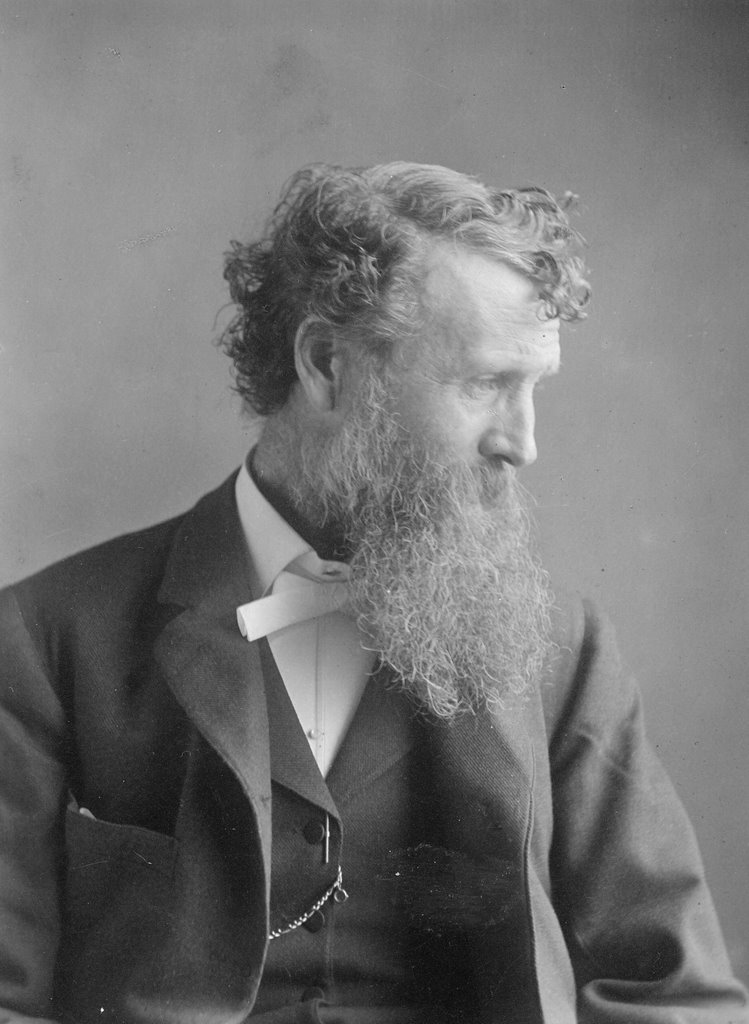
I was slow to come to appreciate the magnitude of John Muir's contribution to conservation, his role in the early establishment of the national park system, his stature as naturalist par excellence. Until I moved to San Francisco in my early 20s, Muir had not even been on my radar. Later, as I came to be captivated by the history and geography of the Sierra Nevada Mountains, Muir became such a towering figure, he was unavoidable. Reading of his adventures as a mountain man — tales of solitary sojourns in the high country expressing unabashed, poetic reverence for sacred wilderness — always makes me itch to break out the tent, gather the Coleman products, and head for the woods.

I was also slow to get around to Muir's early writings. Imagine my delight, then, when I finally came across the unpolished notes of his 1867 walk across the South, from Louisville, Kentucky to Savannah, Georgia, and on into Florida A Thousand-Mile Walk to the Gulf (Boston and New York: Houghton Mifflin Company, 1916). Muir embarked on his journey to look at the plants "grass, weeds, flowers, trees, mosses, ferns," and he comments on them passionately, and at length. But he also gives a sense of the ravaged, post-war South. Muir speaks to many freedmen along the way, enjoys the hospitality of residents in the heart of the old Confederacy, and encounters highwaymen in a largely lawless landscape where every person met on the road is a potential threat.


Happily, the entire book can be read at the Sierra Club site, here (follow links to "Books by John Muir"). I've excerpted a number of interesting passages that present observations of the Civil War South, two and a half years after the end of hostilities.


September 6. Started at the earliest bird song in hopes of seeing the great Mammoth Cave before evening. Overtook an old negro driving an ox team. Rode with him a few miles and had some interesting chat concerning war, wild fruits of the woods, et cetera. "Right heah," said he, "is where the Rebs was a-tearin' up the track, and they all a sudden thought they seed the Yankees a-comin', obah dem big hills dar, and Lo'd, how dey run." I asked him if he would like a renewal of these sad war times, when his flexible face suddenly calmed, and he said with intense earnestness, "Oh, Lo'd, want no mo wa, Lo'd no." Many of these Kentucky negroes are shrewd and intelligent, and when warmed upon a subject that interests them, are eloquent in no mean degree.

September 7. Left the hospitable Kentuckians with their sincere good wishes and bore away southward again through the deep green woods. In noble forests all day. Saw mistletoe for the first time. Part of the day I traveled with a Kentuckian from near Burkesville. He spoke to all the negroes he met with familiar kindly greetings, addressing them always as "Uncles" and "Aunts." All travelers one meets on these roads, white and black, male and female, travel on horseback. Glasgow is one of the few Southern towns that shows ordinary American life. At night with a well-to-do farmer.

As I turned to leave, after bidding her good-bye, she, evidently pitying me for my tired looks, called me back and asked me if I would like a drink of milk. This I gladly accepted, thinking that perhaps I might not be successful in getting any other nourishment for a day or two. Then I inquired whether there were any more houses on the road, nearer than North Carolina, forty or fifty miles away. "Yes," she said, "it's only two miles to the next house, but beyond that there are no houses that I know of except empty ones whose owners have been killed or driven away during the war."

Met a young African with whom I had a long talk. was amused with his eloquent narrative of coon hunting, alligators, and many superstitions. He showed me a place where a railroad train had run off the track, and assured me that the ghosts of the killed may be seen every dark night.

Had a long walk after sundown. At last was received at the house of Dr. Perkins. Saw Cape Jasmine [ Gardenia florida ] in the garden. Heard long recitals of war happenings, discussion of the slave question, and Northern politics; a thoroughly characteristic Southern family, refined in manners and kind, but immovably prejudiced on everything connected with slavery.

The family table was unlike any I ever saw before. It was circular, and the central part of it revolved. When any one wished to be helped, he placed his plate on the revolving part, which was whirled around to the host, and then whirled back with its new load. Thus every plate was revolved into place, without the assistance of any of the family.

Toward evening I arrived at the home of Mr. Cameron, a wealthy planter, who had large bands of slaves at work in his cotton fields. They still call him "Massa." He tells me that labor costs him less now than it did before the emancipation of the negroes. When I arrived I found him busily engaged in scouring the rust off some cotton-gin saws which had been lying for months at the bottom of his mill-pond to prevent Sherman's "bummers" from destroying them. The most valuable parts of the grist-mill and cotton-press were hidden in the same way. "If Bill Sherman," he said, "should come down now without his army, he would never go back."


On no subject are our ideas more warped and pitiable than on death. Instead of the sympathy, the friendly union, of life and death so apparent in Nature, we are taught that death is an accident, a deplorable punishment for the oldest sin, the arch-enemy of life, etc. Town children, especially, are steeped in this death orthodoxy, for the natural beauties of death are seldom seen or taught in towns.


Of the people of the States that I have now passed, I best like the Georgians. They have charming manners, and their dwellings are mostly larger and better than those of adjacent States. However costly or ornamental their homes or their manners, they do not, like those of the New Englander, appear as the fruits of intense and painful sacrifice and training, but are entirely divested of artificial weights and measures, and seem to pervade and twine about their characters as spontaneous growths with the durability and charm of living nature. In particular, Georgians, even the commonest, have a most charmingly cordial way of saying to strangers, as they proceed on their journey, "I wish you well, sir." The negroes of Georgia, too, are extremely mannerly and polite, and appear always to be delighted to find opportunity for obliging anybody.

The traces of war are not only apparent on the broken fields, burnt fences, mills, and woods ruthlessly slaughtered, but also on the countenances of the people. A few years after a forest has been burned another generation of bright and happy trees arises, in purest, freshest vigor; only the old trees, wholly or half dead, bear marks of the calamity. So with the people of this war-field. Happy, unscarred, and unclouded youth is growing up around the aged, half-consumed, and fallen parents, who bear in sad measure the ineffaceable marks of the farthest-reaching and most infernal of all civilized calamities.

Thursday, May 18, 2006

Go West, Young Monitor!


[Naval Trivia, #1]

The U.S.S. Camanche, Passaic class monitor, was built in Jersey City, New Jersey, in 1863. Come November of that same year, she sat on the bottom of San Francisco Bay.


Duel with a Confederate ironclad? No, the Camanche
at least the disassembled kitfared well on the long journey from New Jersey, even rounding Cape Horn in the hull of the Aquila without incident. She made it all the way to a dock in San Francisco Bay, before going to the bottom with the Aquila, which sank at her berth during a storm.

The pieces of the well-traveled Camanche were salvaged, and she was assembled and launched i
n 1864, commissioned in 1865. For a year or so, she was the only U.S. ironclad plying Pacific waters [photo at top: U.S.S. Camanche in 1889, and 1898 below, offshore from Mare Island Navy Yard, where forty-four submarines were built between 1930 and 1970. U.S. Navy Historical Center].

Thursday, April 27, 2006

“The sight of 2,000 ghostly, pallid faces upturned in the chilling waters of the Mississippi, as I looked down on them from the boat, is a picture that haunts me in my dreams.”

– J. Walter Elliott, 10th Indiana, 44th USCT

"The horrors of that night will never be effaced from my memory—such swearing, praying, shouting and crying I had never heard; and much of it from the same throat—imprecations followed by petitions to the Almighty, denunciations by bitter weeping.”
– Chester Berry (photo at top from Harpers Weekly)

Imagine it. Upwards of 2,200 former prisoners of war, only recently released from the Confederate prison pens at Andersonville, Georgia, and Cahaba, Alabama, crowded onto a riverboat built to accommodate 300-some, steaming up the Mississippi River, headed for Cairo, Illinois, and points home. Emaciated, broken, scarredthese men were survivors. They survived camp life in Federal armies, a disease-ridden experience that killed more men in the Civil War than did bullets. They survived battle, too, before being captured. Then, they survived the obscene death rates attendant to Civil War POW camps, including Andersonville, the deadliest of all.

The war finally ended, and POWs North and South were released. The ragged survivors of Andersonville and Cahaba made their way by boat, on foot, and by rail, to Vicksburg, where the government promised private steamboat operators a per-person rate to transport the freed soldiers upriver to rail connections in Illinois' Little Egypt.
When the Sultana got underway, every surface, every nook and cranny, was occupied by a soldier. Looking at the last known photo of the boat, taken at Helena, Arkansas on a coaling stop, the crowded conditions on the boat are clearly discernable.

(Sultana at Helena, Arkansas, loaded with former Union POWs. Library of Congress)

In the early morning hours of April 27, 1865, the Sultana's passengers were mostly asleepat least those who could find a patch of deck, or a wall to lean against. When the recently-patched boilers exploded, many men were killed outright and dozens, or hundreds, were thrown into the water. Hundreds more quickly abandoned the boat as fire ravaged the wreckage. Untold numbers perished in the panicked mass of men clutching at anything and everything in the immediate vicinity of the burning vessel, where swimmers and non-swimmers alike struggled in keep their heads above the swift, freezing current.
Even many of those who were strong, who were good swimmers, and who managed to separate from the pack, surely succumbed to the current and the elements at a time when the Mississippi was out of its banks for miles, flooding the lowlands in both directions. The lucky ones found a snag, or a half-submerged treeline, and managed to hold on till morning. Other fortunate soldiers were plucked from the river by rescue boats.

The toll was staggering. Of the roughly 2,200 men and civilians on board, only about 586 were pulled from the water alive. Of those, another 200 or so perished soon after, leaving about 300 men to tell the tale.
It's hard to know why the largest, most costly maritime disaster in our nation's history remains so obscure. No doubt it's a combination of things, like the fact that it occurred on western waters, and overriding focus of the print media on other big stories, like the surrender of Confederate armies, the end of hostilities, and the assassination of President Lincoln.

Chester Berry of the 20th Michigan Infantry sought to memorialize the event, and the dead, by collecting as many firsthand accounts as possible. His book, Loss of the Sultana and Reminiscences of Survivors, was published in 1892, and included 134 testimonials (remarkably, nearly ½ of the survivors). The University of Tennessee Press just released a facsimile reprint of Berry's book, along with a meaty new introduction by David Madden. In a couple days I'll post a link here to my review of that book.


One survivor whose story does not appear in Berry's book is Romulus Tolbert, my wife's great-grandfather, whose gene pool continues to thrive in my three children.
Romulus was a survivor extraordinaire. He joined the 39th Indiana infantry early in the war and saw action at Shiloh, and Stones River. In Sherman's Atlanta Campaign, on September 10th, 1864, Romulusnow veteranized with the 8th Indiana Cavalryran into an ambush near Campbellton, Georgia, suffering two gunshot wounds, one through the neck and jaw. He was carried to a private home in Alabama and nursed until well enough to be transferred to Cahaba prison, near Selma. People familiar with accounts of Cahaba will think of the time the Alabama River flooded, causing the prisoners to live on platforms, amidst thigh-deep water, for days. Rom was there for that, and survived it to. He had four brothers in other Indiana regiments, three of them in the famed 22nd. His oldest brother died at Perryville.

(Romulus Tolbert)

No one in my wife's family knew about Romulus's Sultana adventure, or even that he had been wounded, or taken prisoner. We found that in his pension files, in the mid-80s, when I first started getting obsessive about Civil War connections. Details are scant. All that is known about his Sultana experience is that he lived, was taken to Adams hospital in Memphis, and was treated for "chills." He returned to Indiana and farmed until his death at age 77.
Whether because of stoicism, or the bad memories it stirred, it wasn't a story that got handed down. We don't know if Chester Berry located Romulus and solicited his tale. Perhaps he simply declined to respond. Some that did respond had nothing more to say about that night than Abraham Cassel of the 21st Ohio, “At the time of the explosion I swam about three miles and was rescued at 10 a.m., more dead than alive.” On this day, 141 years after Romulus took to the water, and somehow managed to find dry land, I honor all those who perished, and I honor those who survived. We can take inspiration from the near-death tales of those who’ve walked away from calamity. Mostly, our problems just aren't that big.

If I start to fret too much, I'll endeavor to remember A. C. Brown's entry in Berry's book. A member of the 2nd Ohio Infantry, captured at Chickamauga, he spent time in numerous POW camps from Belle Isle to Andersonville before catching a ride on the Sultana. Stripped clean in desperate struggles with drowning men in the icy water, Brown swam for miles until catching hold of some branches above a submerged island. "I climbed a tree," he recalled, "and the water surrounding it was about ten feet deep. Now, when I hear persons talking about being hard up, I think of my condition at that timeup in a tree in the middle of the Mississippi river, a thousand miles from home, not one cent to my name, nor a pocket to put it in. . ."

Tuesday, April 11, 2006

A Horse Named Fly

I've seen a few Civil War horses in my time, all stuffed. Winchester, for one (nie Rienzi), in the Smithsonian, and Stonewall Jackson's Little Sorrel at the museum of the Virginia Military Institute (and, as an equestrian aside, I've stood over Traveller's grave at Washington and Lee. What would possess someone to toss coins onto the grave of Robert E. Lee's horse?).

The non-Civil War stuffed horse I've wanted to see since childhood, but still have not seen, is Comanche, of Little Bighorn fame. I hope Commanche will be there for me when I find the time, but lately, ever since about 1977, Kansas has not been along the routes I've traveled.

But I digress. This post is about a horse named Fly. Bridgette Savage of Stanford, Indiana which looks to be in the vicinity of Bloomington has penned, and illustrated, a true-to-life tale based on the service of George Barrett and his horse, Fly, of the 1st Indiana Cavalry (formed from the 28th IN Volunteer Infantry). It's a book for young people, but based on the two articles I've read, here, and here, I cannot tell how young. The Christian Science Monitor piece shows some of Savage's illustrations, and I may pick up the book for the artwork alone.

But Fly is not stuffed. Fly can be seen at the skeletal level in New Harmony, Indiana (again, photo of author and subject can be seen here). In all my years in Evansville where the 1st Cavalry was raised, and where I met my Hoosier wife I never heard of Fly's bones. And in my two or three visits to nearby New Harmony, home to not one, but two full-fledged efforts at creating a utopian community, still, I saw no dead horses, stuffed or otherwise. But that's another story.

Monday, April 10, 2006

Comments Enabled

What the hey. I've decided to diverge from the Dimitri model and allow comments on this blog. I've gotten some worthwhile feedback via email, and by way of The Civil War Forum, and thought it would be interesting to allow that kind of response to be grouped with the actual post.

Replies will be reviewed before they're published, so most of the garbage will be filtered out. But I promise to allow an occasional angry, illiterate zinger (the "cost of doing business" in Civil War circles). One of my favorite parts of the Al Franken show on Air America is the "hatemail" segment, when he reads a featured email.


What if there was a war and nobody came?

This just in the 141st anniversary reenactment of the Battle of Selma is officially cancelled. After peaking with upwards of 2,000 registered reenactors at the 130th anniversary, this year's organizers could barely muster a couple hundred participants.

I have no idea if this is a larger trend throughout the "Living History" hobby. One reason given for the poor Selma registration was the high cost of fuel. I suspect that after general interest in the Civil War was rekindled during the centennial years of the early 1960s, leading to exponential growth of book sales, reenacting groups, and Civil War Round Tables over the next couple decades, interest is beginning to ebb. Certainly that's the case with Civil War-specific book sales. I've also read somewhere that interest in historic wars, which for some has an uncomfortably naive element of nostalgia about it, wanes during times of actual war.

Of course the Selma event has some other things going against it. For one thing, the historic event there was not a momentous battle so much as confirmation that by April of 1865, Federal cavalry columns could effectively operate with impunity throughout the Confederate heartland.

For another thing, the immediate base of paying spectators in Selma is 69% African American, not generally considered the target audience for mock battles featuring overweight white guys, many in Confederate uniforms, fighting for their "rights."

Not that fighting for one's rights isn't of interest to the people of Selma. According to the Los Angeles Times article I read today (registration required), the hottest-selling item at the Selma Visitor Information Center is a shirt commemorating the Edmund Pettus Bridge, where marchers, 100 years after the Battle of Selma, faced down Alabama State Troopers.


Counting, Remembering, U.S.C.T.


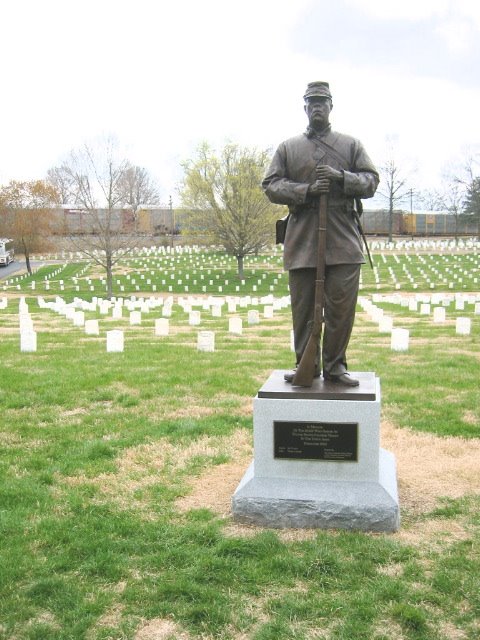
A couple of weeks ago, when the Civil War Forum visited Nashville, our first stop was the Nashville National Cemetery to see the new monument to United States Colored Troops. This moving memorial, set as it is among row after row of USCT gravestones, was in notable contrast to a little wartime cemetery we had visited two days earlier on the Stones River battlefield, near the Hazen Monument (pictured on their start page). There, a single USCT grave stands segregated just outside the brick wall of the proper burial ground.

Our guide at Nashville, if I heard him correctly, mentioned that the Nashville monument was one of only four in the nation memorializing USCT in this country. That sounded unlikely to me, and after digging around a bit I found reference to a number of plaques, monuments, and memorials to black Union troops. One report, I should say, asserts that there are only four Veterans Affairs-operated national cemeteries that boast some sort of monument to USCT. Most likely, that's how our guide settled on the figure "four."
The most famous monument to black Civil War troops is probably the Robert Gould Shaw / 54th Massachusetts sculpture in Boston. Far more interesting, I think, is the African American Civil War Memorial in Washington D.C., captured in various angles at this site.

The Nashville statue is beautifully done. But more than a few people in our group had trouble making sense of the ambiguous phrasing on the plaque. It's hard for me to imagine how something so long in the making, something meant to last for generations, and for which the precise wording presumably required the input and oversight of numerous individuals, could result in a monument that causes
even casual students of the war to mutter, "huh?"

The head scratching, of course, is due to the fact that the commonly published figures for USCT serving in Union armies during the Civil War is between 180,000 and 200,000. Back at home, I searched out some articles on the monument and discovered that the 20,133 refers to the number of USCT who hailed from Tennessee.

Strange that on a monument to United States troops, in a national cemetery, such a grammatically critical qualification was left off. As it is, untold numbers of visitors will now leave with the solid impression that United States Colored Troops, who fought so heroically on many a battlefield, numbered only about one-tenth of what we know to be case.
Whether the plaque is ever edited or replaced, it remains a noble statue, standing sentry among the nearly 2,000 USCT buried here. Couldn't help but notice, though, in the Knoxville newspaper article linked to above, the comments of one Kwame Leo Lillard whose multiple masters degrees failed to touch upon black soldiers largely escaped slaves who fought against the Confederacy in Union regiments. Mr. Lillard's group apparently originated the idea for the statue, and launched the ultimately successful fundraising.

"There were black soldiers in the Confederate army too," Lillard is quoted as saying, "and we need to erect a monument to them."
Hate to break it to him, but using the afore-mentioned formula for composing memorial plaques listing just one-tenth of the total, or only those from Tennessee the number of men honored by a Black Confederates statue would be less men than it takes to build the statue.
Good luck raising funds for that one.

141 Years Ago, at Appomattox

General R.E. Lee, Commanding C.S.A
5 P.M., April 7th, 1865
The results of the last week must convince you of the hopelessness of further resistance on the part of the Army of Northern Virginia in this struggle. I feel that it is so, and regard it as my duty to shift from myself the responsibility of any further effusion of blood by asking of you the surrender of that portion of the Confederate States army known as the Army of Northern Virginia.
U.S. Grant, Lieutenant-General

April 7th, 1865
General: I have received your note of this date. Though not entertaining the opinion you express of the hopelessness of further resistance on the part of the Army of Northern Virginia, I reciprocate your desire to avoid useless effusion of blood, and therefore, before considering your proposition, ask the terms you will offer on condition of its surrender.
R.E. Lee, General

April 8th, 1865
General R.E. Lee, Commanding C.S.A.
Your note of last evening in reply to mine of the same date, asking the conditions on which I will accept the surrender of the Army of Northern Virginia, is just received. In reply I would say that, peace being my great desire, there is but one condition I would insist upon, — namely, that the men and officers surrendered shall be disqualified for taking up arms against the Government of the United States until properly exchanged. I will meet you, or will designate officers to meet any officers you may name for the same purpose, at any point agreeable to you, for the purpose of arranging definitely the terms upon which the surrender of the Army of Northern Virginia will be received.
U.S. Grant, Lieutenant-General

April 8th, 1865
General: I received at a late hour your note of today. In mine of yesterday I did not intend to propose the surrender of the Army of Northern Virginia, but to ask the terms of your proposition. To be frank, I do not think the emergency has arisen to call for the surrender of this army, but, as the restoration of peace should be the sole object of all, I desired to know whether your proposals would lead to that end. I cannot, therefore, meet you with a view to surrender the Army of Northern Virginia; but as far as your proposal may affect the Confederate States forces under my command, and tend to the restoration of peace, I should be pleased to meet you at 10 A.M. to-morrow on the old state road to Richmond, between the picket-lines of the two armies.
R.E. Lee, General

April 9th, 1865
General: Your note of yesterday is received. I have not authority to treat on the subject of peace. The meeting proposed for 10 A.M. today could lead to no good. I will state, however, that I am equally desirous for peace with yourself, and the whole North entertains the same feeling. The terms upon which peace can be had are well understood. By the South laying down their arms, they would hasten that most desirable event, save thousands of human lives, and hundreds of millions of property not yet destroyed. Seriously hoping that all our difficulties may be settled without the loss of another life,
I subscribe myself, etc.,
U.S. Grant, Lieutenant-General

April 9th, 1865
General: I received your note of this morning on the picket-line, whither I had come to meet you and ascertain definitely what terms were embraced in your proposal of yesterday with reference to the surrender of this army. I now ask an interview, in accordance with the offer contained in your letter of yesterday, for that purpose.
R.E. Lee, General

April 9th, 1865
General R. E. Lee Commanding C. S. Army
Your note of this date is but this moment (11:50 A.M.) received, in consequence of my having passed from the Richmond and Lynchburg road to the Farmville and Lynchburg road. I am at this writing about four miles west of Walker's Church, and will push forward to the front for the purpose of meeting you. Notice sent to me on this road where you wish the interview to take place will meet me.
U. S. Grant, Lieutenant-General


Friday, March 31, 2006

Crescent City Gentrification

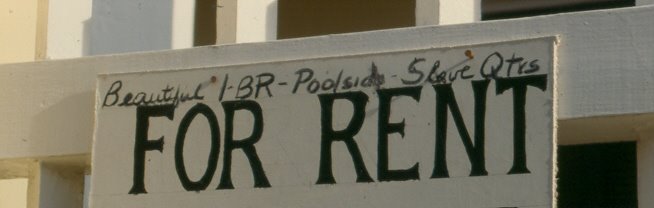
Poolside slave quarters. And "beautiful" to boot.

I took this photo in 1988 on my one and only visit to New Orleans, where my sister was living at the time. First visit, I should say, since our family moved away from New Orleans when I was very small.

What an intriguing city and what a heart-rending tragedy that befell her in 2005. Among other things, I took in some Civil War sites: Confederate Memorial Hall (just reopened) which claims to have "the second largest collection of Confederate memorabilia in the world in the oldest continually operating museum in Louisiana"; Metairie Cemetery; a house once belonging to Pierre Gustave Toutant Beauregard. . .

New Orleans is so infused with its own unique history its own original culture one can't help but be fascinated, or seduced. The religion, food, music, language, none of it reminds you of Dubuque. Same river, different feedcaps.


The city has seen some changes since slaves lived in this now-desirable, 1-bedroom unit in the French Quarter. Fewer slaves, more pools, for one thing. Thank goodness the Quarter was spared. New Orleans is a city apart, a melting pot unto itself. The soul of the city will be revived, in time.


The river rose all day
The river rose all night
Some people got lost in the flood
Some people got away alright
The river have busted through cleard down to Plaquemines
Six feet of water in the streets of Evangeline
(Randy Newman, Louisiana 1927)

Wednesday, March 22, 2006

"The dead are heroes, the living are but men compelled to do the drudgery and suffer the privations incident to the thing called 'glorious war.'"


—quote by Sam Watkins
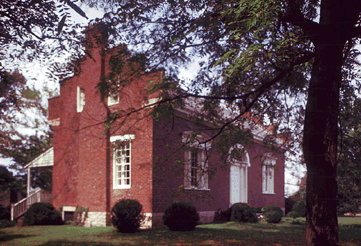
Photo: Carter House, Franklin, Tennessee


Turns out our tour guide on Saturday has fit in a stop for our group at the Tennessee State Museum to see the Old Glory exhibit (I'm still on my own for Old Hickory's crib). Getting ready to leave town, even for a few days, is a stressful time for disorganized people. First, there's making sure your work is covered in the office, anticipating and averting crises, and catching up on all the stuff you failed to get done in weeks past. And for crying out loud, don't forget to roll out the recycle bins. Good feeling, though, to finally shut down the system and head out, knowing there are four days of battlefield tramping ahead. Zeus knows the carpal tunnels can use the time off.

This week about 40 people from 16 states and two countries are gathering in Tennessee to see some things we've never seen, hear some things we've never heard, see and hear familiar things in a new way, and catch up on things since we last assembled one year ago in Manassas. This Thursday is given to Stones River, with Jim Ogden, historian at Chick-Chatt, doing the honors. Friday, Tom Cartwright, Curator at the Carter House, will take us on a full-day tour of Spring Hill and Franklin, and

Saturday, author Mark Zimmerman will guide us all day around Battle of Nashville sites. Finally, Sunday morning, Carter House historian David Fraley will give a presentation at Sam Watkins's grave near Mt. Pleasant.

Monday morning I'll be back at my desk, just over the Santa Cruz Mountains from Half Moon Bay, scanning 100s of unread emails and explaining to my coworkers why some people use vacation days to travel to Tennessee in winter (technically spring), to stand in the cold and photograph muddy fields. We've got room in Brentwood if you want to join us, but you'd better act fast. Leave a message at the Brentwood Suites, and I'll call you back.

Thursday, March 09, 2006

Tennessee, Tennessee / There ain't no place I'd rather be / Baby won't you carry me / Back to Tennessee

"Tennessee Jed," words by Robert Hunter;
music by Jerry Garcia
, copyright Ice Nine Publishing


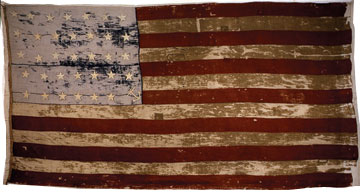
Old Glory is back in town. What is purported to be the original "Old Glory" flag from the 1820s the first U.S. flag to fly over a recaptured secessionist state capitol building has returned to Nashville after a century. It's about time.

Intrepid battlefield trampers from The Civil War Forum will be descending upon Tennessee two weeks from now to cover Stones River, Spring Hill, Franklin, and Nashville (and there are still a few seats available on the tour bus). We don't have the Tennessee State Museum on the itinerary, but I hope to find time to take it in between the close of the conference on Sunday and my flight back to the Left Coast, but I need to be realistic. I have a bad habit — whenever I have occasion to fly into a city I don't know or rarely visit — of trying to fit in one-too-many stops at some local historic site. Two times I have had occasion to fly into and out of Nashville, and both times I overreached and tried to take in Andrew Jackson's Hermitage before returning the rental car. Both times I made it as far as the Hermitage parking lot, where I studied my watch and made precise risk/reward calculations before deciding I was cutting it too close, and shot off in a high-speed trail of tears to the airport. Either the third time will be a charm, or I'm writing off Old Hickory for good.

And maybe there will be time for Old Glory, too. She's on loan from the Smithsonian Institution in Washington, the flag will be on exhibit at the Tennessee State Museum from March 17 to November 12. More information from the museum's website:


The nickname for the United States flag, Old Glory, was originally attached to a flag made in 1824 for a young sea captain, William Driver (1803-1886) from Salem, Massachusetts . When first gazing at the flag, Driver was supposedly moved to call it "Old Glory," a name he used to describe the flag throughout his lifetime.

Old Glory gained its notoriety during the Civil War when Driver, who had moved to Nashville in 1837 after his wife died, raised the flag at the State Capitol after Nashville was captured by the Union Army.

"We are extraordinarily proud to have Old Glory return to Nashville where its fame originated before spreading across America ," said Lois Riggins-Ezzell, executive director of the Tennessee State Museum . "This is a singular opportunity to see a treasured artifact of Tennessee and U.S. history, and we hope the people of Tennessee and surrounding states will take advantage of this rare chance."

Old Glory was originally flown from Driver's merchant ship in the 1820s/1830s. When in Nashville , he hoisted it across the street at each national holiday and on his birthday of March 17. As the Civil War drew near and sentiment for the Confederacy grew in Nashville.

Driver, a staunch Unionist, reportedly hid Old Glory by having it sewn into a quilt. The war divided Driver's family as his two sons fought for the Confederacy and one son was killed at the Battle of Perryville.

In 1862 Nashville became the first state capital in the Confederacy to fall to Union troops. Upon the arrival of Union soldiers, Driver removed Old Glory from its hiding place and flew it from the State Capitol.

The newspapers of the time ran stories of Old Glory being brought out of hiding. Before long, people began referring to all U.S. flags as Old Glory.

Originally a 24-star flag when it was created for Driver, Old Glory was re-sewn around 1860, adding 10 more stars for the states that had joined the Union after the flag was originally constructed. An anchor was also added on the canton of the flag, which referred to Driver's experiences as a sea captain.

Old Glory remained in the Driver family until 1922 when it was presented by his daughter, Mary Jane Roland, to President Warren G. Harding. The flag was in a very delicate condition, and it essentially remained in storage until 1981 when Tennesseans raised the funds necessary to begin conservation efforts.


Wednesday, March 08, 2006

Claude of the Turbervilles


Saw mention of this article over at Kevin Levin's Civil War Memory site — perfect fodder for examining the "memory" of that defining era in American history. Claude Turberville, quoted in The Mississippi Press, is a reenactor, which is to say he engages in "combat karaoke" (a phrase I first saw used by, I think, Prof. Wolfgang Hochbruck).


These days I'm more or less desensitized to assertions, like that attributed to Turberville, that "many people believe the Civil War was fought over slavery. It was not. It was initially about states' rights and taxes." This kind of thing is not going away, no matter what. It's an article of faith in some quarters, like the idea that you'll catch a cold if you go outside with wet hair in winter. It's easy to see the connections. People who go outside with wet hair do frequently catch a cold — albeit from rhinoviruses unrelated to hair. And the Civil War was about state rights — specifically the "right" to perpetuate slavery and to expand it into the vast territories of the growing nation before free soilers got the upper hand to an extent that could never be overcome.


One can make a coherent proposition that places the concept of state rights at the core of the sectional rift. It has to be phrased carefully, and not overreach, lest it expose the unavoidable underpinning that is slavery — not everyone has the stomach for The Apostles of Disunion, or Alexander Stephens's "Cornerstone Speech." But one can at least build an argument about state rights without making things up out of whole cloth. An argument can be offered that allows one to retain a modicum of dignity, and to avoid sounding like a Borg drone parroting a neo-Confederate bible.


But this business about "black Confederates" drives me nuts. As Turberville tells it, "Black soldiers fought alongside white soldiers in the Confederate Army." Sigh. Now, most everyone with a passing interest in the subject of black men under arms for the Confederacy — everyone who's ever argued the point — is well-acquainted with the documentary evidence and anecdotes alike: the pensions, the body servants who picked up a gun, the slaves who rode with Forrest, the teamsters in Lee's retreat from Gettysburg. We've read Richard Rollins's expositions on familial bonds between black and white Southerners, and Art Bergeron's solid accounts of some individuals from Louisiana. We know about the short-lived Native Guard in New Orleans, the phantom black regiment on the Peninsula, the illusive black cannoneers at First Manassas. Likewise, we know about the abortive attempts to field black CS regiments in the waning days of the war. We've seen Walter Williams's column, and the numbers attributed to Dr. Smith of American University. And yes, we realize Williams and Smith are African Americans — that qualification is always included, as if it somehow obviated the need for actual substantiation. 


When we lay all the evidence out neatly, and scrutinize it closely, there is one incontrovertible fact that cannot be denied: except in the rarest of instances, black soldiers did not fight alongside white soldiers in the Confederate Army. As a matter of fact, blacks were not allowed in the ranks of Southern armies. That's why, when it did occur, the occurrence was isolated and exceptional. What blacks did do was flee to the protection of Union arms by the 100s of thousands (is that part of Turberville's classroom presentation?). Some 180,000 of them donned Union uniforms and fought against Confederate armies. The idea that blacks in any significant numbers fought in CS armies is a myth designed to disassociate slavery from secession and war. It is an enduring tenet for latter-day proponents of the Lost Cause apologia launched long ago by folks like Edward Pollard, and Jubal Early.

Notice how, in Turberville's telling (or at least in the way he was quoted), it's an important distinction that blacks were segregated in Union armies, but fought side-by-side with whites in Confederate forces. Lost Cause apologists and neo-Confederate fictioneers invariably seek to seal the deal by highlighting racism in the North, as if the near-universal conviction of white supremacy among white Americans of that time had some bearing on the question. Slaves and free blacks fighting for the Confederacy is an extension of the ultimate irony, in keeping with secessionist Fire-eater rationalizations that theirs was a fight for "liberty" (the liberty to enslave others).

And yes, I think I did just make up the word "fictioneer." I kind of like it. I hope it's original.

Let us all humble ourselves. We don't have to make stuff up to honor our ancestors' memories, or to enjoy studying the past (though of course, we do — I don't know why Lost Cause mythology troubles me more than tried and true myths from the American Revolution, or other staples). Still, we don't need to pretend that Lincoln thought blacks were the equal of whites. He didn't. We don't have to pretend the war was one glorious effort at emancipation from start to finish. It wasn't. And likewise, there's no sense in pretending that the future of slavery wasn't the very crux of the sectional conflict — the issue that required difficult compromises between free soil and slave soil to forestall hostilities for decades, the issue, more than any other, that ultimately precipitated secession, and war. Because it was. That's what the historical record tells us. It's what the architects of secession themselves tell us.


If it were only Mr. Turberville and his weekend warriors validating each other's beliefs around a friendly campfire, where's the harm? Or testing their positions against the beliefs of other adults in various forums — who could complain? But going into elementary schools and dressing up fraudulent declarations as the considered conclusions of honest research, that's something else. I'm guessing that when the gentleman in question talks to school groups, and tells them about the mythological integrated armies of the South, he stops short of telling them that as late as 1864 — 1864! — General Patrick Cleburne was nearly run out of the Confederacy on a rail for daring to suggest the South begin enlisting slaves into the army in return for emancipation. I'm confident that Mr. Turberville neglects to tell the children that when the Confederacy had its back to the wall before the spring campaigns of '64, the CS leadership would not consider for a moment giving up slavery to gain the one ingredient it most needed to ensure independence: manpower. Without slavery, what was the point of independence?

You can be assured that, standing before impressionable school children — where his uniform imbues him, in the eyes of the kids, with the authority of someone who knows what he's talking about — Turberville stops short of quoting Confederate Congressman Robert Toombs, who denounced efforts to create slave regiments even with the CSA in its death throes, worrying that if blacks could be soldiers "our whole theory of slavery is wrong."

Again, if it were just Turberville, his buddies and their families, regaling each other with tales of black Confederates, I'd say, "knock yourselves out." But unfortunately, thanks to his casually inane myth-making in classrooms of young children, there will always be new standard bearers to step up and take his place whenever the Lost Cause flame starts to flicker.

Monday, February 27, 2006

Hey, aren't you the guy who lost 1st Bull Run?

[Photo by Wesley A. Leiser]

I have periodically mulled over the idea of writing a biography of one or another lesser-known or less celebrated Civil War notable. Like a lot of people with an unnatural fixation on the literature of the Civil War, I have spent time thinking about how to make my lasting contribution, how to make my mark, and that invariably leads one to try to discern the gaps on the bookshelf — to try to imagine what's left undone.


For one thing, I think about peripheral, roughly-treated, or short-shrifted officers, and there's no shortage in those categories. I narrow it down further by focusing on character
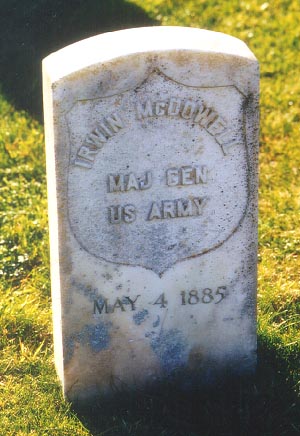
s who had some impact before or after the war in California, because it melds periods of interest for me, and connects them to the geography I live in and love. I mull these biographies at least seriously enough to collect bits and pieces of information along the way, and to record little reminders to myself to mine less obvious sources. I think about people like Frederick Steele, because he is buried not far from my home, because he engaged in operations in areas that hold fascination for me (e.g., Trans-Mississippi), and because his papers are at Stanford. And I think about Irvin McDowell, who came to San Francisco during the war, and who returned later and made part of his legacy an enduring contribution to one of America's great urban open spaces, Golden Gate Park.

Dimitri Rotov's
blog entry today, castigating Carol Bundy for sloppy errors in Nature of Sacrifice [see additional comments below], noted the lack of a McDowell bio. And like a breath on a dying ember, the McDowell reference prompted in me a wistful flare-up of the excitement and dread that surrounds a project that needs doing, and one that inspires more conviction than commitment. McDowell played an important role in the war, and he deserves better than the snide remarks one encounters so frequently in the works of armchair generals, or in the "best" and "worst" lists of buffs, and weekend warriors. I'm reminded of another Dimitri offering, addressing this very point about generals like McDowell, and Nathaniel Banks, men who became cardboard cutouts in the recounting, their long lives of distinction discounted because of the fortunes of war in their short times on stage.

"Honest patriots struggling with their own limitations in trying circumstances at the bottom of the red hot crucible of war are to be dressed in jester's costumes and showered with scorn: the Popes, the McClellans, the Buells, the political generals, the failures. You are invited to hiss at them."


"Commisary Banks," under any other criteria than his generalship in Virginia and Louisiana, has to be regarded as an exceptionally successful and interesting man. But to those who view the four years of the Civil War as a lifetime, Banks is the object of casual ridicule.


McDowell doesn't need a biography to settle the score, or to rehabilitate his image. He just needs one to capture his life as a man, and to present an indifferent appraisal of his Civil War service. Irvin answered the call. He served his country faithfully and well, the chaotic collapse of his green troops at Bull Run notwithstanding. At the very least, we should start by spelling his first name correctly on his tombstone. Cue Rodney Dangerfield punchline.

Getting back to Bundy's biography of Charles Russell Lowell, Jr., this was the subject of quite a bit of discussion in The Civil War Forum last August. What started as a guardedly complimentary appraisal quickly turned into a laundry list of embarrassing errors, as more readers chimed in. Steve Meserve, for example, commented on Bundy's characterization of California governor Leland Stanford as a "copperhead." In fact he was a staunch Unionist and Lincoln man all the way, who campaigned for Lincoln. Nearly everyone who reads this book, apparently, finds something glaringly erroneous. I guess I'll settle for the book reviews.

Friday, February 17, 2006

Please. Just give me the maps and no one gets hurt.


Map: Spotsylvania Court House. This detail of a hand-drawn map shows the location of the Confederate line and the location of Union troops, including the 6th Corps under Upton and 2nd under Hancock; and also the spot where Stonewall Jackson's amputated arm was buried. Robert Goldthwaite Carter papers, 1900-1934 (Mss2 C2467 b) Manuscripts. Library of Congress.


I like reading book reviews. I like studying atlases. Imagine my delight when I came across a book review of Civil War atlases.
This popped up recently on the Civil War Book Review web site, covering six count 'em six Civil War atlases.

The Visualization of Cartographic Information: A Review Essay of Six Civil War Atlases by Hardy, Jr. James D. and Hochberg, Leonard J. [CWBR Issue: Winter 2006]
Books under consideration:
The Official Military Atlas of the Civil War: Atlas to Accompany the Official Records of the Union and Confederate Armies, George B. Davis, Major, U. S. Army; Leslie J. Perry; Joseph W. Kirkley; Calvin D. Cowles, Captain, U. S. Army. Richard Sommers, introduction. Washington, 1891-1895; New York, 1983, 2003 Government Printing Office; Arno Press; Barnes and Noble
Maps of the Civil War: The Roads They Took, David Phillips
New York, 1998, 2001, Metro Books, Friedman/Fairfax

Atlas of the American Civil War: The West Point Military History Series, Thomas E. Griess, Series Editor, Garden City, New York, 2002, Square One Books
Atlas of the Civil War: Month by Month, Major Battles and Troop Movements, Mark Swanson, Athens, Georgia and London, 2004, University of Georgia Press
Great Maps of the Civil War: Pivotal Battles and Campaigns, Featuring 32 Removable Maps. William Miller, Rod Gragg, foreword and additional text, Nashville, Tennessee, 2004, Rutledge Hill Press, Thomas Nelson Publishers
Atlas of the Civil War, Steven E. Wadsworth and Kenneth J. Winkle, James M. McPherson, forward and introduction, Oxford, New York, 2004, Oxford University Press

Eagles, Scalpels, Reputations — all tarnished


How unusual, these days, that an author or team of authors find a vein to mine that is so rich and undisturbed, the resulting scholarship can be considered to have broken new ground in the super-saturated world of Civil War historiography. That's just what Dr. Thomas Lowry and his wife Beverly, and Jack Welsh on one title, have done with the court-martial records in the National Archives. Maybe no one thought anything interesting could be found in the accounts of military legal proceedings. Maybe Jack Nicholson was speaking to timid researchers when he bellowed, "You Can't Handle the Truth!" And maybe some authors found the chaotic disorganization of the courts-martial documentation too daunting to delve into.

But thank goodness the Lowrys gave it a stab.
Handwritten documents for roughly 80,000 Union court-martials (on paper of varying color and size, depending on what was available at the time) reside in a series of numbered manila folders comprising Record Group 153. They are, Dr. Lowry explains, in no particular order other than "vaguely chronological." One folder might contain a single court-martial, or dozens. Pages for a given court-martial were collected together with a ribbon, or paste, or a metal clip, now disintegrating into rust. Lowry notes that some of the unnumbered, gathered pages have been "disassembled, producing a 'paper salad,' with pages out of order." The only guide is an 1885 name index, but to Thomas and Beverly's everlasting credit, they are creating a useable subject index. Sadly, most Confederate transcripts of court-martial proceedings were burned up in the conflagration in Richmond at the close of the war. Two famous examples survive, as Robert K. Krick explains in an introduction to one of Lowry's books: "the ineffectual hounding of General Richard Brooke Garnett" by 'Stonewall' Jackson after Kernstown, and Longstreet's charges against Lafayette McLaws following events at Knoxville. "Court-martial" frequently translates to "very colorful story."


Lowry's books aren't dry recitations of harsh proceedings, as this material might have been presented in lesser hands. They are riveting tales, told efficiently and intelligently, threaded throughout with a wit worthy of the subject matter. You've read about the exploits that made men famous. For every one of those, there are two or three whose exploits made them infamous, just not in ways their descendants necessarily celebrate. Erstwhile professor of psychiatry, graduate of Stanford Medical School and veteran of the Kinsey Institute, Lowry first made a splash in Civil War circles with The Story the Soldiers Wouldn't Tell: Sex in the Civil War (1994). Discerning readers might have been guarded at first (was he using "sex" in the title in the same cynical marketing fashion that some people use "Gettysburg"?). No, turns out it was book of "fresh" research, shocking in the way it detailed things that should have been well known, but which were, in fact, unheard of. Or, unspoken of. It is a rich vein, as I mentioned at top.
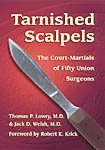
In 1997 Lowry followed up the Sex book with Tarnished Eagles: The Courts-Martial of Fifty Union Colonels and Lieutenant Colonels (the "eagle" referring to a colonel's insignia). Not so sexy, but even more colorful. The year 2000 saw the release of Tarnished Scalpels: The Court-Martials of Fifty Union Surgeons. Alert readers and anal retentive editors will note the Stackpole dust jacket designer quandary between "court-martials" and "courts-martial." Glad I wasn't there for that, but I think you have to go with the plural "courts-martial" in both instances.
Kudos to Stackpole for publishing Lowry's work, these and other titles, which all still look to be available if you search Stackpole's site under author or title name.

Dr. Lowry with my newborn son Atticus, Presidio National
Cemetery, San Francisco, circa 1994.


Tuesday, February 14, 2006

Nashville. You can't ignore it.

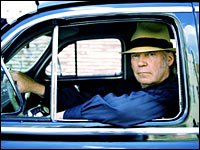
According to Neil Young in interviews here, and elsewhere, when recording the hymn-like final tune on his new album Prairie Wind — a song conspicuously out of place amidst the other compositions, and about which Young said, "I'd never written a song like this before" — he paused to wonder aloud about where this particular muse had come from. One of the studio engineers grabbed a flashlight, signaled Young to follow, removed a part of the modern ceiling and shined the light high into the dark space above, revealing the great arched windows of a very old church. Young, who wrote the song in the studio and was unaware of the building's history, got "goosebumps" as the light illuminated the hidden history of the walls around him.

This church is on 17th Street South in Nashville, and a facade hides the historic structure's original exterior. It was a church before and after the Civil War, and before the Federal army seized the capital it was a Confederate hospital, and morgue. I'm trying to find out if Mark Zimmerman, author of Guide to Civil War Nashville, knows anything about it. The building is most famous as the original Monument Studios (now Masterlink), where Roy Orbison, for one, recorded all his hits, and where Young himself recorded Comes a Time, and his masterpiece, Harvest.


Young is sensitive to history, now more than ever, and spoke of organizing a group to restore the old church while maintaining it's equally historic studio. Time was (and probably still), some in the South bore a grudge against Young for "Southern Man," and "Alabama," powerful, enduring songs that prompted one of Rock and Roll's most lame rejoinders in "Sweet Home Alabama."

Times change. Alabama is different, I suspect. And Neil Young is now the Old Man he once sang to. But this old man has Hank Williams's guitar.

Speaking of Nashville, there are still eight seats left on The Bus for next month's Civil War tours of Franklin, and Nashville. Masterlink Studios is not on the itinerary, but you might find time to drive by while you're there.

Tuesday, February 07, 2006

The Private History of a Campaign That Failed


You can read regimental histories, campaign analysis, letters, diaries, and the Official Records till the end of time, but there's a conspicuous gap in your studies if you've never read Mark Twain's account of his Civil War service. The good news is that it's only a click away, online here, and other places. The passage below gives you the flavor of the story. Here, the young volunteer and his fellow recruits, content in camp, learn that the enemy is headed their way:


For a time, life was idly delicious. It was perfect. There was no war to mar it. Then came some farmers with an alarm one day. They said it was rumoured that the enemy were advancing in our direction from over Hyde's prairie. The result was a sharp stir among us and general consternation. It was a rude awakening from our pleasant trance. The rumour was but a rumour, nothing definite about it, so in the confusion we did not know which way to retreat. Lyman was not for retreating at all in these uncertain circumstances but he found that if he tried to maintain that attitude he would fare badly, for the command were in no humour to put up with insubordination. SO he yielded the point and called a council of war, to consist of himself and three other officers, but the privates made such a fuss about being left out we had to allow them to remain, for they were already present and doing most of the talking too. The question was, which way to retreat; but all were so flurried that nobody even seemed to have even a guess to offer. Except Lyman. He explained in a few calm words, that inasmuch as the enemy were approaching from over Hyde's prairie our course was simple. All we had to do was not retreat toward him, another direction would suit our purposes perfectly. Everybody saw in a moment how true this was and how wise, so Lyman got a great many compliments. It was now decided that we should fall back on Mason's farm.


Tuesday, January 31, 2006

Antebellum Island

"Our 12 strangers must adapt to the altogether-unfamiliar territory of an island where the states and the people are guaranteed those rights not specifically delegated to the federal government!"


From the Nothing is Sacred Department, and the archives of The Onion, here is a handy Fake News Roundup for Civil War-related items of interest. Click on the headline for the full story.

New Alternate-Reality Series Puts 12 Strangers On Island Where South Won Civil War


LOS ANGELES—CBS executives announced Monday that they have begun filming Antebellum Island, a new "alternate reality" series in which 12 strangers compete for $1 million while isolated on an island still under Confederate rule.
December 3, 2003 Issue 39•47 News


Civil War Historians Posit 'You Had To Be There' Theory


ATLANTA—After years of conflicting approaches to interpreting the Civil War, a coalition of historians on Tuesday posited the non-specific theory that "you had to be there" to fully understand the complexities of the war. "It's not just a matter of 'Were the Southern forces as confident and dedicated as their Northern counterparts?'..."
October 23, 2002 Issue 38•39 News in Brief


Civil War Enthusiasts Burn Atlanta To Ground

ATLANTA—The city of Atlanta was destroyed and 230,000 were killed Sunday when a group of overzealous Civil War buffs marched through the Georgian capital, burning it to the ground.
October 29, 1996 Issue 30•12 News


Congolese Civil War Buff Fights In Civil War

BRAZZAVILLE, CONGO–Jean-Pierre Uyoya, a longtime Congolese Civil War enthusiast, was excited to enlist in the Congolese Liberation Movement army Monday. "I can't wait to participate in my first Civil War enactment," said Uyoya, polishing up his authentic 1999-era Uzi. "I've been a huge Cong
October 4, 2000 Issue 36•35 News in Brief


Many Civil War Reenactments, Sadly, Are Still Not Handicap Accessible

There's nothing quite like a Civil War reenactment. Dressing in the woolen uniform of the period, eating hardtack and bacon, and firing black-powder rifles, we are transported back to those darkest of hours when our nation was nearly rent asunder by armed conflict. Brother against brother. Father against son..."
September 23, 1998 Issue 34•08 Opinion


South Postpones Rising Again For Yet Another Year

HUNTSVILLE, AL—According to Dock Mullins, the South will rise again as soon as he gets his old truck fixed up.
April 12, 2000 Issue 36•13 News

Tuesday, January 24, 2006

It’s the Story, Stupid


("history has a plot")

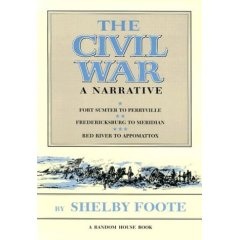
History is a story, after all, and so it’s no surprise that people enjoy history most when it's told by a talented story teller. Shelby Foote’s 3-volume masterpiece, The Civil War, A Narrative, has no footnotes, and no bibliography. But students of the Civil War do not fault Foote for that, because the music of his narrative is mesmerizing, and the scope of his epic so grand. Foote himself explained, “I thought the footnotes would cost me more artistically than they would gain me in academic respect.” And he was right, but don't try this at home.


This is not to say that more military historians or authors should dispense with footnotes or bibliographies. We could hardly take them seriously if they did. But Foote’s comments on melding artistic sensibilities with Civil War scholarship are interesting to consider. Much of today’s Civil War fare is so formulaic and dull, plowing through to the end is a tedious chore. When a book begins to feel like an onerous assignment, I quickly lose interest. It's dismaying to see how many historians can take a subject as spectacularly gripping as the Civil War era in America, and denude it of all drama, all human interest. Post-graduate training and the academy certainly demand rigorous standards, but suffocating the life out of the material is not one of them.

Nor is all this to say that more military historians should take liberties, such as attributing thoughts or feelings to historic figures when those thoughts and feelings are not in evidence. [I remember receiving a copy of a much anticipated biography of Richard Ewell — much anticipated because there were none (this before Pfanz’s excellent tome filled that gaping biographical hole), and slamming it shut with bitter disappointment after encountering one too many descriptions of an officer’s imagined facial expression, or fabricated dialogue]. Infusing a work of history with the basic elements of a story doesn’t mean turning non-fiction into fiction. It means making it readable.


Here are a few excerpts of Shelby Foote’s novelist-as-historian commentary from his 9/11/94 appearance on CSPAN’s BookTV, the transcript of which is here.


I have a strong belief that novelists have a great deal to teach historians about plotting, about character drawing, about other things, especially the concern about learning to be a good writer, which many historians don't bother to do. I was happy the whole time. I never felt really different writing a history from what I'd felt writing novels.

I believe that the artists are out front and have a great deal to teach historians about good writing and dramatic composition, which I consider the best history to be. Aristotle said, in criticizing great drama, that first you learn how to write well -- a good sophomore in high school can do a surprisingly good description of a sunset — then you learn to draw characters that can stand up and cast a shadow, and the last thing you learn to do is plot. That's the skill that comes last, if it comes at all.

That is where I think historians neglect a huge advantage. I think history has a plot. You don't make it up; you discover it. It's there. Oscar Wilde talks about life imitating art. I have noticed that when a man dies, no matter at what age or by what cause, his life then has a beginning and a middle and an end, and sometimes his death explains his youth. Good friends of mine who were killed in the war spent their youth exactly as if they knew they were going to be killed. It's a very strange business, but that's art taking over, insisting on giving a thing form when it seems to be formless. I think that when you supply that form — and, mind you, I'm not talking about superimposing it; I'm talking about discovering the form — it makes that a very exciting reading experience.


-- discuss it here

Thursday, January 19, 2006

Montana's Confederate Dead

Recently I've been revisiting James W. Loewen's, Lies Across America, What Our Historic Sites Get Wrong (introduction here), and I'm reminded of what an entertaining read it is, though the author gets a little too strident at times for the mostly repressed Norwegian bachelor farmer part of my sensibilities, which wants to acknowledge historic lies without embarrassing anyone I know. But it's an engaging book (like the author's earlier, Lies My Teacher Told Me -- see intro here), and as you might imagine, the Civil War period is well represented.

Of course we all know instinctively that America's monuments and roadside markers, like the history books of our youth, are, often as not, studies in myth-making and local boosterism. And for some groups, it was a grand cause. The Masons may have managed to put up the only statue of a Confederate general officer in Washington D.C., but they got it in under the radar by steering clear of The Late Unpleasantness connection. Only the United Daughters of the Confederacy managed to honor the Confederate dead of a place from which no living Confederates originated. Beat that, Masons!

According to Loewen, "by 1916, this [Helena] monument declares implicitly that the Confederacy was somehow patriotic and that whites agreed, even this far north, to honor it nostalgically. Thus this monument also reflects the time when it was erected — the nadir of race relations in the United States, from 1890 to 1920, when segregation gripped the nation and lynchings reached their peak. Most Confederate monuments went up during these years" (103).

As an aside, these incongruous images caused me to think again of Richard Brautigan's, A Confederate General from Big Sur, a novel I read in high school in Iowa, when both the Confederacy and Big Sur were fictional, far off places. I found a cheap ex libris copy online, and am curious to read it again, particularly since those fictional places have become regular haunts in my life. I sure hope my (embryonic) Great California Novel gets a better review.