"Our 12 strangers must adapt to the altogether-unfamiliar territory of an island where the states and the people are guaranteed those rights not specifically delegated to the federal government!"
From the Nothing is Sacred Department, and the archives of The Onion, here is a handy Fake News Roundup for Civil War-related items of interest. Click on the headline for the full story.
New Alternate-Reality Series Puts 12 Strangers On Island Where South Won Civil War
LOS ANGELES—CBS executives announced Monday that they have begun filming Antebellum Island, a new "alternate reality" series in which 12 strangers compete for $1 million while isolated on an island still under Confederate rule.
December 3, 2003 Issue 39•47 News
Civil War Historians Posit 'You Had To Be There' Theory
ATLANTA—After years of conflicting approaches to interpreting the Civil War, a coalition of historians on Tuesday posited the non-specific theory that "you had to be there" to fully understand the complexities of the war. "It's not just a matter of 'Were the Southern forces as confident and dedicated as their Northern counterparts?'..."
October 23, 2002 Issue 38•39 News in Brief
Civil War Enthusiasts Burn Atlanta To Ground
ATLANTA—The city of Atlanta was destroyed and 230,000 were killed Sunday when a group of overzealous Civil War buffs marched through the Georgian capital, burning it to the ground.
October 29, 1996 Issue 30•12 News
Congolese Civil War Buff Fights In Civil War
BRAZZAVILLE, CONGO–Jean-Pierre Uyoya, a longtime Congolese Civil War enthusiast, was excited to enlist in the Congolese Liberation Movement army Monday. "I can't wait to participate in my first Civil War enactment," said Uyoya, polishing up his authentic 1999-era Uzi. "I've been a huge Cong
October 4, 2000 Issue 36•35 News in Brief
Many Civil War Reenactments, Sadly, Are Still Not Handicap Accessible
There's nothing quite like a Civil War reenactment. Dressing in the woolen uniform of the period, eating hardtack and bacon, and firing black-powder rifles, we are transported back to those darkest of hours when our nation was nearly rent asunder by armed conflict. Brother against brother. Father against son..."
September 23, 1998 Issue 34•08 Opinion
South Postpones Rising Again For Yet Another Year
HUNTSVILLE, AL—According to Dock Mullins, the South will rise again as soon as he gets his old truck fixed up.
April 12, 2000 Issue 36•13 News
Tuesday, January 31, 2006


Tuesday, January 24, 2006
It’s the Story, Stupid
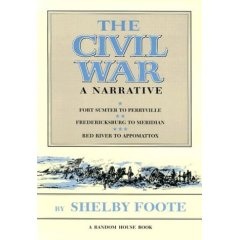
("history has a plot")
History is a story, after all, and so it’s no surprise that people enjoy history most when it's told by a talented story teller. Shelby Foote’s 3-volume masterpiece, The Civil War, A Narrative, has no footnotes, and no bibliography. But students of the Civil War do not fault Foote for that, because the music of his narrative is mesmerizing, and the scope of his epic so grand. Foote himself explained, “I thought the footnotes would cost me more artistically than they would gain me in academic respect.” And he was right, but don't try this at home.
This is not to say that more military historians or authors should dispense with footnotes or bibliographies. We could hardly take them seriously if they did. But Foote’s comments on melding artistic sensibilities with Civil War scholarship are interesting to consider. Much of today’s Civil War fare is so formulaic and dull, plowing through to the end is a tedious chore. When a book begins to feel like an onerous assignment, I quickly lose interest. It's dismaying to see how many historians can take a subject as spectacularly gripping as the Civil War era in America, and denude it of all drama, all human interest. Post-graduate training and the academy certainly demand rigorous standards, but suffocating the life out of the material is not one of them.
Nor is all this to say that more military historians should take liberties, such as attributing thoughts or feelings to historic figures when those thoughts and feelings are not in evidence. [I remember receiving a copy of a much anticipated biography of Richard Ewell — much anticipated because there were none (this before Pfanz’s excellent tome filled that gaping biographical hole), and slamming it shut with bitter disappointment after encountering one too many descriptions of an officer’s imagined facial expression, or fabricated dialogue]. Infusing a work of history with the basic elements of a story doesn’t mean turning non-fiction into fiction. It means making it readable.
Here are a few excerpts of Shelby Foote’s novelist-as-historian commentary from his 9/11/94 appearance on CSPAN’s BookTV, the transcript of which is here.
I have a strong belief that novelists have a great deal to teach historians about plotting, about character drawing, about other things, especially the concern about learning to be a good writer, which many historians don't bother to do. I was happy the whole time. I never felt really different writing a history from what I'd felt writing novels.
I believe that the artists are out front and have a great deal to teach historians about good writing and dramatic composition, which I consider the best history to be. Aristotle said, in criticizing great drama, that first you learn how to write well -- a good sophomore in high school can do a surprisingly good description of a sunset — then you learn to draw characters that can stand up and cast a shadow, and the last thing you learn to do is plot. That's the skill that comes last, if it comes at all.
That is where I think historians neglect a huge advantage. I think history has a plot. You don't make it up; you discover it. It's there. Oscar Wilde talks about life imitating art. I have noticed that when a man dies, no matter at what age or by what cause, his life then has a beginning and a middle and an end, and sometimes his death explains his youth. Good friends of mine who were killed in the war spent their youth exactly as if they knew they were going to be killed. It's a very strange business, but that's art taking over, insisting on giving a thing form when it seems to be formless. I think that when you supply that form — and, mind you, I'm not talking about superimposing it; I'm talking about discovering the form — it makes that a very exciting reading experience.
-- discuss it here
Thursday, January 19, 2006
Montana's Confederate Dead
Recently I've been revisiting James W. Loewen's, Lies Across America, What Our Historic Sites Get Wrong (introduction here), and I'm reminded of what an entertaining read it is, though the author gets a little too strident at times for the mostly repressed Norwegian bachelor farmer part of my sensibilities, which wants to acknowledge historic lies without embarrassing anyone I know. But it's an engaging book (like the author's earlier, Lies My Teacher Told Me -- see intro here), and as you might imagine, the Civil War period is well represented.
Of course we all know instinctively that America's monuments and roadside markers, like the history books of our youth, are, often as not, studies in myth-making and local boosterism. And for some groups, it was a grand cause. The Masons may have managed to put up the only statue of a Confederate general officer in Washington D.C., but they got it in under the radar by steering clear of The Late Unpleasantness connection. Only the United Daughters of the Confederacy managed to honor the Confederate dead of a place from which no living Confederates originated. Beat that, Masons!
According to Loewen, "by 1916, this [Helena] monument declares implicitly that the Confederacy was somehow patriotic and that whites agreed, even this far north, to honor it nostalgically. Thus this monument also reflects the time when it was erected — the nadir of race relations in the United States, from 1890 to 1920, when segregation gripped the nation and lynchings reached their peak. Most Confederate monuments went up during these years" (103).
As an aside, these incongruous images caused me to think again of Richard Brautigan's, A Confederate General from Big Sur, a novel I read in high school in Iowa, when both the Confederacy and Big Sur were fictional, far off places. I found a cheap ex libris copy online, and am curious to read it again, particularly since those fictional places have become regular haunts in my life. I sure hope my (embryonic) Great California Novel gets a better review.
Of course we all know instinctively that America's monuments and roadside markers, like the history books of our youth, are, often as not, studies in myth-making and local boosterism. And for some groups, it was a grand cause. The Masons may have managed to put up the only statue of a Confederate general officer in Washington D.C., but they got it in under the radar by steering clear of The Late Unpleasantness connection. Only the United Daughters of the Confederacy managed to honor the Confederate dead of a place from which no living Confederates originated. Beat that, Masons!
According to Loewen, "by 1916, this [Helena] monument declares implicitly that the Confederacy was somehow patriotic and that whites agreed, even this far north, to honor it nostalgically. Thus this monument also reflects the time when it was erected — the nadir of race relations in the United States, from 1890 to 1920, when segregation gripped the nation and lynchings reached their peak. Most Confederate monuments went up during these years" (103).
As an aside, these incongruous images caused me to think again of Richard Brautigan's, A Confederate General from Big Sur, a novel I read in high school in Iowa, when both the Confederacy and Big Sur were fictional, far off places. I found a cheap ex libris copy online, and am curious to read it again, particularly since those fictional places have become regular haunts in my life. I sure hope my (embryonic) Great California Novel gets a better review.
Monday, January 16, 2006
Breathtaking Brevity, making a long story short
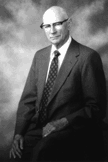
[left, Charles P. Roland]
Is a short story masterpiece harder to write than a good novel? You can certainly make a case, however arbitrarily one rates different forms of fiction. The same holds true for non-fiction, to a certain degree. Of course there's no substitute for prodigious works of research that aim to comprehensively cover a particular subject, or era. But at some point they are no harder to write than a shorter work, only more time-consuming, or more demanding of sustained, single-minded devotion. Crafting a narrative of solidly concise prose in non-fiction is not only highly valued in historical texts, it is a talent generally sought (if rarely found) in professional communications from journalism to corporate memoranda. Done right, less is more. Done wrong, it's just less.
I was given pause (extended, hair-pulling pause) to chew on these things while working on the Library of Congress Civil War Desk Reference. I composed first drafts for dozens of sidebars and short essays on everything from Commerce Raiders, and Civil War era Photography, to the Federal Ambulance Corps and the Emancipation Proclamation. To do justice to any of these topics in a few hundred words — finding the essence, or the kernel that casual readers would take away and that students of the subject would find meaningful — felt more challenging than writing 3,000 words on each, when the constant urge to digress and qualify is easily satisfied. Every cut in the rewriting process subtly shifts the emphasis. Every clarifying fix necessitates trimming another bulge elsewhere. Which brings me to the subject of single-volume histories of the war.
I own and have enjoyed the two best, single-volume studies, James McPherson's incomparable Battle Cry of Freedom, for which Oxford Press recently brought out a spectacular illustrated edition, and David Eicher's military-oriented The Longest Night. Both are notable accomplishments. But what about brief, single-volume histories of the war? That's where the painful editing comes in, and where the author's instincts and judgments are on display in every paragraph. That's where we gain a sense of the author's mettle, and learn whether the author has mastered the art of knowing when to shut the hell up. The Civil War is a long story. So few among us know how to make a long story short.
I think I read the National Geographic volume that one used to see around in battlefield park bookshops, and used bookstores — I remember having it in my hands night after night, I just can't remember reading it (mainly, I remember people complaining that the cavalryman pictured on the front cover was from the wrong era). I also read, a long time ago, Fletcher Pratt's Short History of the Civil War (originally released as Ordeal by Fire). Flipping through it again recently I see how dated it is, though the relaxed style of the narrative is sometimes gripping, and always engaging. It dates to the 30's, and so I am reflexively, and perhaps unfairly, suspicious about the level of scholarship, and turned off by the free and generous use of unattributed quotes. Not to disparage Mr. Pratt — the Fletcher Pratt award by the Civil War Round Table of New York is appropriately prestigious in Civil War book circles.
But, the brief history of the war that I always come back to, and that I unhesitatingly recommend to anyone looking for an outstanding introduction, is Charles P. Roland's, An American Iliad (University Press of Kentucky, 1991). At 289 pages, it's roughly a third the length of Eicher's and McPherson's works, but packs a punch. Roland's volume is a synthesis of the best writing on the subject, and his talent for condensing that scholarship into a graceful narrative — covering the build-up to the war, and wartime politics, as well as military events in all major theaters, while profiling principal figures — is a thing to behold. It's invigorating to read the saga of the Civil War in a brilliantly paced distillation over the course of a handful of sittings. Unlike the campaign studies and biographies that occupy so much of our time, a single volume narrative like Roland's brings the broad scope of the war back into focus, like a reliable wide-angle lens that still allows for sharp detail in the foreground.
An American Iliad does not have notes, only a well-considered bibliographic essay at the end. Roland's experience — his lifetime of researching, writing, and teaching — translates into an authoritative, objective delivery that leaves readers untroubled by the absence of specific documentation. His work has held up in the face of critical scrutiny, and that makes all the difference. I sat next to Professor Roland at dinner one evening during a Civil War Round Table Associates conference, and was very taken by his friendly, unpretentious demeanor. He was smart and humble, and seemed genuinely honored to be asked to speak to our small assemblage. Many years later I came across more information on his life, which looks like it makes for an interesting story in its own right. Next time some non-Civil War type or student asks you for a recommendation, don't start them off on such a daunting assignment as Foote's trilogy, or one of the hefty tomes mentioned above. Send them to Roland, and they'll wonder why they haven't already read more of this endlessly fascinating story.
-- discussion of this posting can be joined here.
Wednesday, January 11, 2006
The Battles of Franklin, and Nashville

(with a side trip to Stones River)
PHOTO: Barnard, George N., 1819-1902, photographer. Created/Published: 1864 December 16. Photograph of the War in the West. These photographs are of Hood before Nashville. Continuing his policy of the offensive at any cost, Gen. John B. Hood brought his reduced army before the defenses of Nashville, where it was overthrown by Gen. George H. Thomas on December 15-16, in the most complete victory of the war. If the date borne on this photograph is correct, it was taken in the course of the battle. [From Library of Congress, Selected Civil War Photos]
Every late March or early April, before the crowds of summer are unleashed, before the lines of sight and sweeping views are obstructed by new spring foliage, three or four dozen members of The Civil War Forum gather for a few days of battlefield tramping.
We drive and fly to the chosen destination from far and wide, from Canada and the U.K., from California, the Eastern Seaboard, from the Midwest and the Deep South. This year will mark our 10th annual get-together, and the featured fields will be Franklin and Nashville.
Many of those in attendance are regulars – veterans of all of our battlefield conferences – some are occasional participants, and a handful each year are newcomers who chanced upon the Forum, or who saw the event listed on an events calendar somewhere. All are welcome, but seats are limited. We always restrict the registration to one full bus, since two is unwieldy, and because so much is missed if you’re not on the bus with the tour guide, who narrates events and relates stories from one stop to the next.
Every year we alternate between Eastern and Western/Trans-Mississippi venues. We round up the best local guides and speakers, find a clean, comfortable hotel as our headquarters, and enlist a much-recommended caterer for our evening banquets.
These yearly gatherings are effectively intensive seminars on a given battle or campaign (about which we read for weeks or months in advance). Because we aren’t trying to make a profit, we’re able to hold the costs to bare bones, though our raffle of donated items usually generates enough for a modest donation to the Civil War Trust.
I invite anyone reading this to join us. We have around 20 people signed up so far, and another half dozen committed to coming. That leaves approximately 20 seats available on the bus, most of which I expect to be snapped up after the the Feb/Mar issue of Civil War News ships this month, which has a listing in the calendar and a small ad regarding the event.
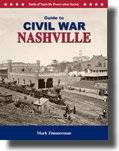
All registration details and itinerary can be found here, and in the Forum. This year we’ll start off at noon on March 23rd for our optional Thursday outing: 4 hours on the Stones River battlefield with the incomparable Jim Ogden, historian at Chickamauga/Chattanooga but no slouch when it comes to Murfreesboro. Thursday night we’ll formally inaugurate the meeting at our hotel with a reception/cocktail hour, dinner, and a presentation by Carter House director Thomas Cartwright, who will set the stage for the first full tour. All day Friday we’ll be on the bus with Tom to cover Franklin sites, before retiring to the hotel for more evening events. Mark Zimmerman, author of Guide to Civil War Nashville, will conduct the Saturday tours of Nashville sites, and will deliver the presentation at the Saturday evening banquet. Arrangements for the optional Sunday morning outing are still being ironed out.
Over at Mike Koepke’s Civil War Musings, the blog entry for January 2 quotes from and links to a Brian Wills essay recalling Patrick Cleburne, and championing preservation efforts at Franklin. We can all be thankful for their perseverance. This will be my first visit to Franklin since the Pizza Hut, reputed to be on the site of Cleburne’s death, has been torn down. It’s a small, but meaningful victory in an area where so much of the 1864 landscape has been irrevocably lost.
I hope to meet some of you at Franklin in March.
Wednesday, January 04, 2006
Unit Histories, and other favorites, part 2
More excerpted replies from the 1995 Civil War Regiments journal survey.
John Hennessy
Rebel Yell and Yankee Hurrah: The Civil War Journal of a Maine Volunteer (Camden, 1985), edited by Ruth L. Silliker—"consisting of the wartime jottings of Pvt. John Haley of the 17th Maine Infantry." Many of the journals or letter collections being published today, Hennessy asserts correctly, "are marginally useful to historians and numbing to the average reader. . . . But John Haley's Journal is different. It is beyond refreshing; it's genuinely delightful and highly useful—in many respects on a par with such classics as Wainwright's Diary of Battle and Lyman's Meade's Headquarters." Some of the witty quotes by Haley, related in Hennessy's submission, include these priceless observations of certain officers:
- On Burnside: No man I've ever seen has such a head as Burnside.
- On Dan Sickles: a gamey looking bird, and a fine specimen of majestic indifference.
- On the death of division commander Amiel Whipple at Chancellorsville: How any bullet ever pierced General Whipple's armor of dirt is a mystery of mysteries. I considered him perfectly safe from any missile weighing less than a ton. . . .
- On division commander David B. Birney: he was as expressionless as Dutch Cheese, and could serve as a bust for his own tomb.
- On Third Corps commander William French ("Old Blinkey"): He is so repulsive in appearance as to invite nausea at the sight of his bloated and discolored visage. He looks a perfect old soaker, a devotee of lust and appetite. One eye has a habit of blinking, which makes it seem drunker than the rest of him.
Maxine Turner
Memoirs of Service Afloat (Baltimore, 1869), by Raphael Semmes. Says Turner, "this book is like a Victorian novel—massive, leisurely, and to those who do not choose that genre, no doubt interminable. That is not to say that the book is not filled with tales of sea chases and captures or of details of the design, construction, and operation of the Alabama." In keeping with the Victorian analogy, Turner writes, "the cast of characters among Alabama's captives is positively Dickensian, especially the captains sailing under false colors who are unmistakably natives of places like Nantucket and Providence. Outmoded and biased though the book may be, it is still a good read for someone content to settle down with a tome that ain't over 'til it's over.'
Glenn LaFantasie
A Stillness at Appomattox, by Bruce Catton. The 1954 Pulitzer Prize-winner is "a brilliant, evocative book that not only tells the story of the last days of the war in Virginia, but paints a startling picture—in various shades of grays and browns and reds—of what life was like in the Army of the Potomac during the months leading up to victory.
John F. Marszalek
Embattled Courage, The Experience of Combat in the American Civil War (New York, 1987), by Gerald F. Linderman. After reviewing this book for a journal, Marszalek was so impressed he assigned it as required reading in his Civil War and Reconstruction course at Mississippi State. "The strength of Linderman's book," Marszalek writes, "is that it allows the reader to get into the mind and spirit of the common Civil War soldier and begin to understand why he was able to fight as he did." Linderman's book is, he concludes, "an example of masterful research and an engaging writing style."
Archie P. McDonald
McDonald first thought of Hood's Texas Brigade, by Col. Harold Simpson, plus the three supporting volumes—"it's difficult to imagine anyone doing a more thorough study or getting more data before the public about any unit in any nineteenth century war." But for our purposes, he settled on The Third Texas Cavalry (Norman, 1993), by Douglas Hale, because, among other reasons, Hale's "book could be used as a prototype of how this kind of thing should be done." Hale, McDonald tells us, "researched in all the right places," including 24 county courthouses.
Alan T. Nolan
The Twentieth Maine, a Volunteer Regiment in the Civil War, by John Pullen. Says Pullen, "He [Chamberlain], William Oates, Ellis Speer, and others provided Pullen with unusually rich primary source materials and eyewitness accounts."
William Marvel
Marvel, who I see had articles in two recent magazines, distinguishes between more recent secondary works of original research, and works written by individual veterans, committees of veterans, or writers enlisted by veterans. In the first category, he does not hesitate to declare The Twentieth Maine, a Volunteer Regiment in the Civil War, by John Pullen, as "the premier example." In the second category, he was "most impressed" with John D. Billings, The History of the Tenth Massachusetts Battery of Light Artillery (Boston, 1881), who also wrote the much-loved Hardtack and Coffee. Like the 20th Maine, Marvel writes, the 10th MA Battery, first saw action later in the war, and "because of that late start the veterans were able to observe their surroundings more philosophically, leaving them with a different viewpoint than those who were thrown early and often into the front lines."
T. Michael Parrish
The Campaigns of Walker's Texas Division (Austin, 1994), by Joseph P. Blessington. "The most powerful value of Blessington's narrative stems from the vivid information included directly from the diary he kept throughout the war, along with supporting testimony he later obtained from former comrades. Although the diary itself is now lost, its singularity can be recognized from the many passages in the book wherein Blessington obviously quotes from his daily entries, producing an immediacy and veracity too often missing from so many postwar reminiscences."
Harry Pfanz
Mr. Pfanz deems a useful unit history to be one compiled by one of its members, one that deals almost exclusively with the unit at hand "in a reasonably full and intimate way, describing what and how things were done." Meeting those standards, he names Nathan Appleton's, History of the Fifth Massachusetts Battery, Marvin A. Haynes's, A History of the Second Regiment, New Hampshire Volunteer Infantry, William R. Kiefer's, History of the One Hundred Fifty-third Regiment Pennsylvania Volunteer Infantry, and George K. Collins's, Memoirs of the 149th [New York] Regiment (Syracuse, 1891). Pfanz's essay concentrates on the attributes of this last title, about which he writes, Collins avoided "flowery phraseology and ventures into the 'big picture' that often burden unit histories without adding to their usefulness. He has provided posterity with a valuable glimpse of a segment of the Civil War as it must have been."
Brian C. Pohanka
Pohanka names three titles, the first of which he purchased when he was 12-years-old: Charles H. Weygant's 1877 History of the One Hundred and Twenty-Fourth Regiment, N.Y.S.V.,—the "Orange Blossoms," the author of which "witnessed the gallantry and horror of Gettysburg, Spotsylvania, and Petersburg." Another favorite named by Pohanka was The Story of Our Regiment, A History of the 148th Pennsylvania Volunteers (reprinted, Butternut & Blue, 1994), edited by former adjutant J. W. Muffly, heavily illustrated and heavy to hold at 1,096 pages. Lastly, Brian listed Alfred Davenport's 1879 work, Camp and Field Life of the Fifth New York. Somehow we knew that Duryee's Zouaves would come up.
James I. Robertson
History of the Twelfth Regiment, New Hampshire Volunteers in the War of the Rebellion (Concord, NH 1897), a regiment that possessed a "good soldier-historian." Bartlett canvassed his compatriots for surviving letters and diaries, and included biographical sketches and dozens of individual pen portraits of regimental members. All this and more, Robertson says, "complete a work that will always serve as a model for a unit history as all-inclusive as it is wonderfully human."
Wiley Sword
A History of the 73rd Illinois -- "the Preacher Regiment" -- composed by a committee of three. Over 100 of the book's 682 pages deal with the actions from Spring Hill to Nashville. Sword writes, "anyone seeking a candid 'inside story' of the Hood Tennessee Campaign is well advised to find a copy and enjoy some of the best raw data to be found in any post-war era regimental history."
Jeffry D. Wert
James J. Williamson's, Mosby's Rangers, the best, Wert says, of the works written by members of the command. Published in 1895, revised in 1909, "Mosby's Rangers follows the format of a journal, but is neither repetitive or dull." Wert compliments Williamson on his accuracy. "Minor mistakes of fact and memory lapses intrude, but the book holds up well under the scrutiny of modern scholarship." Here you'll also find the largest group of photos of individual Rangers in any published account.
John T. Hubbell
The long-time editor of Kent State's Civil War History journal chose to highlight B. H. Liddell Hart's Sherman: Soldier Realist, which he read as a doctoral student at the University of Illinois. "Hart is a superior biographer because he develops Sherman's personal traits clearly and persuasively and with an elegance of language seldom matched. . . . Academic historians would profit as well from a careful reading of Hart's comments on research and annotation."
William J. Miller
Theo F. Rodenbough's, From Everglades to Canon With the Second Dragoons (New York, 1875). Of Rodenbough's works, Miller writes, "Perhaps we cannot see, touch or smell the past, but in the hands of a talented and knowledgeable narrator, we can very definitely feel it." In 1861, the Second Dragoons became the Second U.S. Cavalry, not to be confused, Miller says, with the more famous Second Cavalry (of Johnston, Lee, Thomas, et. al. fame), which became the Fifth U.S. Cavalry in 1861, which overshadowed the exploits of her sister regiment. "The sections dealing with the Civil War are not the strongest part of the book, but the big war was not necessarily the period most remembered by the survivors. . . .For those of us who love biography, military history, or who feel some admiration for those self-reliant souls who set off across prairie or desert with not much more than a horse and a revolver, this is a memorable book."
David Woodbury
The Confederate Cherokees: John Drew's Regiment of Mounted Rifles (Baton Rouge, 1989), by W. Craig Gaines. It treats subjects outside the main theaters of war, and indeed, outside the mainstream societies in the warring sections -- the tragic story of a war within a war. "Drew's regiment was not one of Fox's 'Fighting 300.' Indeed, they did not even complete their one-year term of service. The are remembered chiefly for having taken Federal scalps at Pea Ridge, and hold the distinction of being the only Confederate regiment to desert almost entirely to the Federal side. Thus, what begins as the story of Drew's Mounted Rifles effectively ends as the story of the 3rd Kansas Indian Home Guard Regiment." It likewise has one of the most colorful of all regimental rosters, with names like "Second Lt. Crab Grass Smith and Sgt. Bat Puppy of Company K, Pt. Dreadful Water of Co. H, Moses Dog in the Bush of Co. B, and Co. I's Young Squirrel Flopper. Dozens of other soldiers' names were recorded without translation, as one member of Co. B, Private Pa sooz or kie Cah lor nu hay skie."
Albert Castel
James Taylor Holmes's, Fifty-Second Ohio Volunteer Infantry: Then and Now (Columbus, 1898). "It is a very rare, hard to find title, but unusual and exceptionally good book, both in content and literary quality." It is more a personal memoir than a regimental history, Castel writes, consisting of "excerpts from Holmes's diary and letters written during the war, of his memoirs based on those documents, and finally on an account of a visit he made in the 1890s to the battlefields where he fought during the Atlanta Campaign." Castel found it extremely useful when writing his Decision in the West.
replies to this post can be made in The Civil War Forum, here
Thursday, December 29, 2005
Historians Recall Favorite Unit Histories, pt. 1
(ten years ago, or so)
In 1995, Civil War Regiments quarterly surveyed a host of oft-published authors, historians, battlefield park rangers, and others about what they considered their “favorite” unit-related study of the Civil War era. We did not specify the size of the organization, whether a regiment, a brigade, or even an army. In fact, we did not even restrict them to unit histories, asking that they name any book that was important to them if no unit-related studies came to mind.
In the end, 35 people who have devoted a good portion of their lives to reading about the Civil War era sent in essays of varying lengths (from a few paragraphs to a couple pages). Ted Savas and I added our own, then collected them all together in the “books” issue of CWR, volume four, number three.
If you can track down a copy of issue 4:3, all of these short essays are worth reading for the authoritative commentary on what sets certain books apart from the pack, and personal thoughts on why some books had a more lasting impact than others. Even if you do have the journal copy, you may enjoy reading this recap, recalling a book or two you meant to read but forgot to find before other distractions pushed it aside. I will simply name the books and quote one or two of each respondent’s remarks while paraphrasing others.
A number of the authors chose books that cemented their interest in the subject. Others named a particular title because the featured unit was historically significant, because of the skill of the author and the narrative technique, or because the authentic observations transcended more common accounts. Some discussed the reliability of their favorite books, or availability, if rare. Several survey participants could not resist naming more than one book, and fortunately for them they were not graded on the assignment. All in all, the exercise made for a fine unit history reading list.
On the editorial side, in gathering the essays for publication, no effort was made to balance the sections to which various authors and historians might be associated (Northern or Southern historians, Eastern or Western). I don’t recall how many letters we sent out. As mentioned, about three dozen people returned an essay, two or three responded too late for publication, some unknown number did not respond at all, and one prominent historian sent an awkwardly whiny note declining to participate in the project because a recent book review we'd published -- one that took his latest work to task for a couple of items, but which nonetheless proclaimed his book to be the best on a particular campaign -- had left him “wounded.” To quote the immortal Billy Pilgrim, “so it goes.”
Civil War book buyers will recognize the names of the respondents, since most of them have a book or body of work still on the shelves, or else long-time associations with a particular battlefield park, campaign, or theater.
And so here we go, individually, our author/historian/publisher in bold, followed by his choice, and select comments. Those books that received multiple mentions are grouped together, for the most part.
William C. Davis
History of the First Kentucky Brigade, by Ed Porter Thompson, "one of the most accurate and well-founded of all unit histories by an actual participant." It was one of the earliest Confederate unit histories to appear after the war, and as Davis discovered, Thompson "was actually working on it even before the surrenders. He interviewed scores of soldiers, borrowed the few diaries in existence, and had the benefit of being custodian of a major chunk of the brigade’s official archives, which he later turned over to the National Archives.”
Steven E. Woodworth
If "unit" can refer to an army, he chooses Bruce Catton's “incomparable” Army of the Potomac trilogy: Mr. Lincoln’s Army, Glory Road, and Stillness at Appomattox. For smaller organizations, Steven named Richard Moe's, The Last Full Measure: the Life and Death of the First Minnesota Volunteers (New York, 1993), which suffered 82% casualties at Gettysburg. According to Woodworth, "Moe skillfully blends all of the aspects that went into soldiering in the Civil War, such as camp life, boredom, combat, the food, imprisonment, including such details as the soldiers' insatiable desire for news and newspapers. The narrative flows smoothly, with none of the sense of reading a meaningless compilation of facts that one gets with some books."
Gary Gallagher
Lee's Lieutenants: A Study in Command, 3 vols (New York 1942-1944), by Douglas Southall Freeman. Gallagher notes that Freeman's close identification with the Army of Northern Virginia “sometimes prompts questions about his ability to engage in detached analysis,” and also that “the aroma of the Lost Cause undoubtedly permeates Lee’s Lieutenants, and in some ways Freeman can be considered the 20th-century heir to Jubal Early in Confederate historiography.” And yet, Freeman’s masterpiece still reveals “clear-eyed criticism” of the chain of command, and “never fails to place events on the battlefield within a broader context.”
Lawrence L. Hewitt
Lee's Lieutenants. Hewitt highlights Freeman’s “fog of war” style, giving the reader “no more information than that which was available to the individual being discussed in the text.” Hewitt concludes that “as an example of unit history, Lee’s Lieutenants set a standard that can rarely be equaled.”
Theodore P. Savas
Lee's Lieutenants, the first volume of which was given to him by his Greek immigrant grandfather. At age 11, that was Ted’s first foray into Civil War literature, and it sparked a life-long passion. Ted writes that "the Introduction to the final volume is one of the most moving tributes I have ever had the pleasure of reading. . . . The colossal scope and breadth of the Civil War finally began to dawn on me after I closed the cover of the third installment."
Tom Broadfoot
Top dog at Broadfoot Publishing, Tom’s entire entry reads, “My favorite book, by far, is A Southern Woman's Story (McCowat-Mercer, Jackson, TN 1959), by Phoebe Yates Pember. If you’re going to read one book on the Civil War, that’s the one.”
John Coski
Coski named John O. Casler's, Four Years in the Stonewall Brigade, but was compelled to list three other titles as well: William Miller Owen’s, In Camp and Battle with the Washington Artillery, Ephraim A. Wilson’s, Memoirs of the War (10th Illinois Infantry), and John M. Favill’s, The Diary of a Young Officer (57th New York Infantry). Of Casler’s book, Coski wrote, “although the memoir is not a regimental history, Casler’s affiliation with the 33rd Virginia influenced me to create a character in that unit in a never-to-be-published novel about the Sharpsburg campaign." Coski, whose job I would like to have for a year or so, added, “I have had occasion to write several exhibit labels which have made John Casler and his reminiscences very real to me. In the collections of the Museum of the Confederacy are several items donated by Casler: a steel spoon and fork combination; a brooch which Casler made for his sister out of the hoof of Gen. Turner Ashby’s horse; and a small box which Casler took from the body of a dead Federal soldier at Chancellorsville. Stenciled in gothic lettering on the lid of the box is ‘Help Yourself.’”
Craig Symonds
Shelby Foote's, The Civil War, A Narrative (Random House, 1958-1974). Symonds was 12-years-old when he received the just-published Volume One. He writes, "From the first words, I was hooked." Foote's masterpiece "is not a unit history, but it shares with many of the best works of that genre the ability to focus a sharp, bright beam of light on the role of individuals--on who they were as well as on what they did." Among regimental histories, Symonds lists his favorites as John J. Pullen's, 20th Maine, a Volunteer Regiment in the Civil War, Lance J. Herdegen's and W.J.K. Beaudot's, In the Bloody Railroad Cut at Gettysburg, about the 6th Wisconsin (Dayton, 1991), and Richard Moe's, The Last Full Measure: The Life and Death of the First Minnesota Volunteers. For brigade histories, Symonds likes Alan Nolan's, The Iron Brigade (New York, 1961), and William C. Davis's, The Orphan Brigade (New York, 1980). Lastly, in the category of first-hand accounts by veterans, "my personal favorite is the irreverent account of Company Aytch, by Tennessee infantryman Sam Watkins.
Peter Cozzens
The Citizen Soldier; or Memoirs of a Volunteer (Cincinnati, 1879), by John Beatty. At age 16, Cozzens bought this book in an antiquarian bookshop for $10. A couple decades later it was worth nearly $200 and still his favorite Civil War book. Cozzens relates, "The charm of The Citizen Soldier lies in the absolute frankness -- and good humor -- with which Beatty recorded his war experiences. . . . Corps Commander Alexander McCook was a 'chucklehead,' with a grin that excited 'suspicion that he is still very green or deficient in the upper story.'" Happily, Beatty's volume has been reprinted a number of times since Cozzens first acquired a copy, making it available and affordable.
Arthur W. Bergeron, Jr.
W. H. Tunnard's, A Southern Record: the History of the Third Regiment Louisiana Infantry (Baton Rouge, 1866). Written fresh after the war, Tunnard recounts the exploits of the 3rd LA in such battles as Wilson's Creek, Elkhorn Tavern (Pea Ridge), Iuka, Corinth, Snyder's Bluff, and throughout the siege of Vicksburg (a day-by-day account) where the regiment defended the much-contested 3rd Louisiana Redan, the remnants of which you can still visit today. Bergeron concludes, "As he intended, Will Tunnard penned a story that not only commemorates the deeds of his regiment but also describes the agony and suffering its soldiers experienced during their four year service. No one interested in the Civil War will ever regret reading A Southern Record.
Leonne M. Hudson
Luis F. Emilio's A Brave Black Regiment: History of the Fifty-Fourth Regiment of Massachusetts Volunteer Infantry, 1863-1865 (Cambridge, 1868). "Judicious and analytical," Hudson writes, "A Brave Black Regiment is an impressive work not only as military history, but also because it captures the social, cultural, and political conditions of the period. . . . in a real sense, it is a study of the labyrinth of race relations in the nation during those turbulent times."
Stephen Engle
Emilio's A Brave Black Regiment, in conjunction with Russell Duncan (ed.), Blue-eyed Child of Fortune: the Civil War Letters of Colonel Robert Gould Shaw (Georgia, 1991). "Shaw's letters," Engle asserts, provide an excellent occasion to capture the essence of the Civil War, as soldiers and commanders revealed themselves by taking pen to paper as they had never done before. . . .not only was Shaw's prose among the most eloquent of any soldier writing home during the war, it was perhaps the most revealing as well." Add to that Emilio's military account: "unlike hundreds of regimental histories which are wholly inadequate in detail, Emilio's narrative of the regiment’s operations in South Carolina, Georgia and Florida (at James Island, Fort Wagner, Olustee, Honey Hill and Boykin's Mill) paints a rich description of the regiment's operations."
Noah Andre Trudeau
Emilio's A Brave Black Regiment, and, A Record of the Service of the Fifty-Fifth Regiment of Massachusetts Volunteer Infantry, a committee-written work based mostly on the diary of Colonel Charles B. Fox. “Each was authored by an officer, and each was based on extensive notes and journals of the period.” Trudeau laments that the “popular” Bantam edition of Emilio’s book “lacks the chapter Emilio added to the second edition (1894) about black prisoners of war, as well as the decision to excise the unit roster." The 55th is less known than the 54th, spending most of its service on the Charleston front. But the telling of the 55th’s story is, Trudeau says, like Emilio’s, “sober but vivid.” He supplies this example: “The men marched in silence, listening intently. It was evident to all that a battle was going on; and so deceptive was the sound, as it reverberated through the level pinelands, that it was supposed to be but a few miles off. Sore feet and weariness were forgotten.”
Chris E. Fonvielle
The Third New Hampshire and All About It (Boston, 1893), by Daniel Eldridge, who compiled “one of the most remarkable regimental histories in Civil War literature.” Fonvielle explains that this is much more than a record of the regiment’s role in battles. With chapters formed around each month and year of the unit’s service, 26 plans and maps (including 10 fold-out maps) of battlefields and campsites, 186 illustrations, 73 portraits, biographical sketches, rosters and service records (this monolithic work runs over 1,000 pages), it “is a regimental history, almanac, and compendium rolled into one."
Robert E. L. Krick
The History of a Brigade of South Carolinians, (Dayton, 1984), by J. F. J. Caldwell, on what was known first as Gregg’s, then McGowan’s Brigade. “The chief charm of Caldwell’s book – the quality that raises it above most competitors – is its wartime vintage,” Krick tells us. “It is remarkable to realize that Caldwell composed much of the text for this book while in winter quarters near Petersburg. When he came to record the brigade’s terrible moments at Fredericksburg or Spotsylvania, no doubt Caldwell called upon survivors in the trenches for whom the events still seemed fresh that winter of 1864-65.” Add to that the fact that the regiments in this brigade “featured prominently in most of the army’s big battles,” and the significance is plain. Krick recommends the 1984 Morningside reprint over the original 1866 collectible for the latter book’s enhancements: a model introduction, photos of many brigade members, and an index. Honorable mention in Krick’s essay goes to Henry W. Thomas’s History of the Doles-Cook Brigade, “both useful and attractive.”
Michael P. Musick
The History of a Brigade of South Carolinians (Philadelphia, 1866). In reading Michael Musick’s submission, I had to pause to look up the word “panegyrists,” and maybe you will, too. Musick calls Caldwell’s book “a generally credible depiction of an important fighting force within the myth-shrouded Army of Northern Virginia.” He names it his favorite for three reasons: 1) Caldwell was on hand for much of what is recorded; 2) he wrote it while events were still fresh and vivid, and “the cult of the Lost Cause had not yet descended to stifle every admission of human frailty. Our author frankly addresses the fact of desertion and the morale crisis of 1864-65.” 3) he writes well. It is, Musick concludes, “a genuine rarity, a gem to be cherished.”
Lesley J. Gordon
Warren Wilkinson’s Mother May You Never See the Sights I Have Seen: The Fifty-Seventh Massachusetts Veteran Volunteers in the Army of the Potomac 1864-1865 (Harper & Row, 1990). “Some regimental histories focus too narrowly on their subjects,” says Gordon. Not so with the late Warren Wilkinson’s history of the 57th MA, as he explores broader contexts of the soldier experience. Wilkinson “interweaves exciting scholarship from ‘new military’ historians (such as Gerald Linderman, Michael Barton, Marvin Cain, and John Keegan), into a traditional war genre to present a model for regimental histories. By the book’s end, the reader acquires not only knowledge of the regiment’s history and battle honors, but a deeper understanding of the Union war experience as a whole.”
Pat Brennan
Mother May You Never See the Sights I Have Seen: The Fifty-Seventh Massachusetts Veteran Volunteers in the Army of the Potomac 1864-1865. Brennan relates a story from the preface of Wilkinson’s book, in which the author discusses stumbling upon the story of the 57th MA while doing genealogical research – Wilkinson’s great-great-grandfather, Martin Farrell, was a corporal in the regiment – and how this interest in family history translated, “two years and 1,550 manuscript pages later,” into “one of the finest regimental histories in Civil War literature.” The regiment served for only a year and a half, but in joining the Army of the Potomac just before the launch of Grant’s 1864 Overland Campaign, it was fairly ordained the unit would not remain green for long. As Brennan points out, during the regiment’s first battle, in the Wilderness, 48% of those engaged were casualties. “Losses mounted in successive engagements – Spotsylvania, North Anna, the early battles around Petersburg, the Crater, and the bloody engagement near the Weldon Railroad. At the conclusion of the latter action, three and one-half months after the regiment crossed the Rapidan River, only 29 combat soldiers and one officer remained standing in the ranks.”
Emory Thomas
Mother May You Never See the Sights I Have Seen: The Fifty-Seventh Massachusetts Veteran Volunteers in the Army of the Potomac 1864-1865. Thomas was instrumental in getting Wilkinson’s manuscript into the hands of a publisher, and we thank him for that. He was impressed with Wilkinson’s research, and doubly so with his ability to “think and write.” Thomas asked William C. “Jack” Davis to read some of what might become the “mother” of all regimentals. Thomas writes, “Jack concurred with my opinion of Warren’s abilities and with my idea of putting Warren in touch with M. S. “Buz” Wyeth at Harper & Row (now HarperCollins). And the rest is extremely good history. Warren’s Mother has spoiled me regarding unit histories. Unless someone does what Warren does. . .with the unit rosters, I find it difficult to take his or her work seriously.”
Richard A. Sauers
History of the 51st Regiment of P.V. and V.V. (Philadelphia, 1869), by Thomas H. Parker. Sauers reports, “Parker ended the war as captain of Company I, and although his writing style sometimes degenerated into purple prose, his history of the 51st Pennsylvania is one of the finest examples of an early regimental history.” The regiment served in the IX Corps, what Parker called Burnside’s “geography class.” And indeed, they got around. Sauers concludes, “These men not only stormed the bridge at Antietam, fought in the Crater, and held the line at Knoxville, but also emptied the jail in Camden Courthouse, North Carolina, fought provost guards in Columbus, Ohio, looted a sutler near Falmouth, drank ‘rat coffee’ on shipboard, and got lost in a Virginia snowstorm.”
Part Two, forthcoming:
Submissions by Maxine Turner, Glenn LaFantasie, John F. Marszalek, Archie McDonald, Alan Nolan, William Marvel, Michael Parrish, Harry Pfanz, Brian Pohanka, James I. Robertson, Wiley Sword, Jeffry Wert, John Hubbell, Bill Miller, John Hennessy, Albert Castel, and me.
Replies to this message can be posted here.
In 1995, Civil War Regiments quarterly surveyed a host of oft-published authors, historians, battlefield park rangers, and others about what they considered their “favorite” unit-related study of the Civil War era. We did not specify the size of the organization, whether a regiment, a brigade, or even an army. In fact, we did not even restrict them to unit histories, asking that they name any book that was important to them if no unit-related studies came to mind.
In the end, 35 people who have devoted a good portion of their lives to reading about the Civil War era sent in essays of varying lengths (from a few paragraphs to a couple pages). Ted Savas and I added our own, then collected them all together in the “books” issue of CWR, volume four, number three.
If you can track down a copy of issue 4:3, all of these short essays are worth reading for the authoritative commentary on what sets certain books apart from the pack, and personal thoughts on why some books had a more lasting impact than others. Even if you do have the journal copy, you may enjoy reading this recap, recalling a book or two you meant to read but forgot to find before other distractions pushed it aside. I will simply name the books and quote one or two of each respondent’s remarks while paraphrasing others.
A number of the authors chose books that cemented their interest in the subject. Others named a particular title because the featured unit was historically significant, because of the skill of the author and the narrative technique, or because the authentic observations transcended more common accounts. Some discussed the reliability of their favorite books, or availability, if rare. Several survey participants could not resist naming more than one book, and fortunately for them they were not graded on the assignment. All in all, the exercise made for a fine unit history reading list.
On the editorial side, in gathering the essays for publication, no effort was made to balance the sections to which various authors and historians might be associated (Northern or Southern historians, Eastern or Western). I don’t recall how many letters we sent out. As mentioned, about three dozen people returned an essay, two or three responded too late for publication, some unknown number did not respond at all, and one prominent historian sent an awkwardly whiny note declining to participate in the project because a recent book review we'd published -- one that took his latest work to task for a couple of items, but which nonetheless proclaimed his book to be the best on a particular campaign -- had left him “wounded.” To quote the immortal Billy Pilgrim, “so it goes.”
Civil War book buyers will recognize the names of the respondents, since most of them have a book or body of work still on the shelves, or else long-time associations with a particular battlefield park, campaign, or theater.
And so here we go, individually, our author/historian/publisher in bold, followed by his choice, and select comments. Those books that received multiple mentions are grouped together, for the most part.
William C. Davis
History of the First Kentucky Brigade, by Ed Porter Thompson, "one of the most accurate and well-founded of all unit histories by an actual participant." It was one of the earliest Confederate unit histories to appear after the war, and as Davis discovered, Thompson "was actually working on it even before the surrenders. He interviewed scores of soldiers, borrowed the few diaries in existence, and had the benefit of being custodian of a major chunk of the brigade’s official archives, which he later turned over to the National Archives.”
Steven E. Woodworth
If "unit" can refer to an army, he chooses Bruce Catton's “incomparable” Army of the Potomac trilogy: Mr. Lincoln’s Army, Glory Road, and Stillness at Appomattox. For smaller organizations, Steven named Richard Moe's, The Last Full Measure: the Life and Death of the First Minnesota Volunteers (New York, 1993), which suffered 82% casualties at Gettysburg. According to Woodworth, "Moe skillfully blends all of the aspects that went into soldiering in the Civil War, such as camp life, boredom, combat, the food, imprisonment, including such details as the soldiers' insatiable desire for news and newspapers. The narrative flows smoothly, with none of the sense of reading a meaningless compilation of facts that one gets with some books."
Gary Gallagher
Lee's Lieutenants: A Study in Command, 3 vols (New York 1942-1944), by Douglas Southall Freeman. Gallagher notes that Freeman's close identification with the Army of Northern Virginia “sometimes prompts questions about his ability to engage in detached analysis,” and also that “the aroma of the Lost Cause undoubtedly permeates Lee’s Lieutenants, and in some ways Freeman can be considered the 20th-century heir to Jubal Early in Confederate historiography.” And yet, Freeman’s masterpiece still reveals “clear-eyed criticism” of the chain of command, and “never fails to place events on the battlefield within a broader context.”
Lawrence L. Hewitt
Lee's Lieutenants. Hewitt highlights Freeman’s “fog of war” style, giving the reader “no more information than that which was available to the individual being discussed in the text.” Hewitt concludes that “as an example of unit history, Lee’s Lieutenants set a standard that can rarely be equaled.”
Theodore P. Savas
Lee's Lieutenants, the first volume of which was given to him by his Greek immigrant grandfather. At age 11, that was Ted’s first foray into Civil War literature, and it sparked a life-long passion. Ted writes that "the Introduction to the final volume is one of the most moving tributes I have ever had the pleasure of reading. . . . The colossal scope and breadth of the Civil War finally began to dawn on me after I closed the cover of the third installment."
Tom Broadfoot
Top dog at Broadfoot Publishing, Tom’s entire entry reads, “My favorite book, by far, is A Southern Woman's Story (McCowat-Mercer, Jackson, TN 1959), by Phoebe Yates Pember. If you’re going to read one book on the Civil War, that’s the one.”
John Coski
Coski named John O. Casler's, Four Years in the Stonewall Brigade, but was compelled to list three other titles as well: William Miller Owen’s, In Camp and Battle with the Washington Artillery, Ephraim A. Wilson’s, Memoirs of the War (10th Illinois Infantry), and John M. Favill’s, The Diary of a Young Officer (57th New York Infantry). Of Casler’s book, Coski wrote, “although the memoir is not a regimental history, Casler’s affiliation with the 33rd Virginia influenced me to create a character in that unit in a never-to-be-published novel about the Sharpsburg campaign." Coski, whose job I would like to have for a year or so, added, “I have had occasion to write several exhibit labels which have made John Casler and his reminiscences very real to me. In the collections of the Museum of the Confederacy are several items donated by Casler: a steel spoon and fork combination; a brooch which Casler made for his sister out of the hoof of Gen. Turner Ashby’s horse; and a small box which Casler took from the body of a dead Federal soldier at Chancellorsville. Stenciled in gothic lettering on the lid of the box is ‘Help Yourself.’”
Craig Symonds
Shelby Foote's, The Civil War, A Narrative (Random House, 1958-1974). Symonds was 12-years-old when he received the just-published Volume One. He writes, "From the first words, I was hooked." Foote's masterpiece "is not a unit history, but it shares with many of the best works of that genre the ability to focus a sharp, bright beam of light on the role of individuals--on who they were as well as on what they did." Among regimental histories, Symonds lists his favorites as John J. Pullen's, 20th Maine, a Volunteer Regiment in the Civil War, Lance J. Herdegen's and W.J.K. Beaudot's, In the Bloody Railroad Cut at Gettysburg, about the 6th Wisconsin (Dayton, 1991), and Richard Moe's, The Last Full Measure: The Life and Death of the First Minnesota Volunteers. For brigade histories, Symonds likes Alan Nolan's, The Iron Brigade (New York, 1961), and William C. Davis's, The Orphan Brigade (New York, 1980). Lastly, in the category of first-hand accounts by veterans, "my personal favorite is the irreverent account of Company Aytch, by Tennessee infantryman Sam Watkins.
Peter Cozzens
The Citizen Soldier; or Memoirs of a Volunteer (Cincinnati, 1879), by John Beatty. At age 16, Cozzens bought this book in an antiquarian bookshop for $10. A couple decades later it was worth nearly $200 and still his favorite Civil War book. Cozzens relates, "The charm of The Citizen Soldier lies in the absolute frankness -- and good humor -- with which Beatty recorded his war experiences. . . . Corps Commander Alexander McCook was a 'chucklehead,' with a grin that excited 'suspicion that he is still very green or deficient in the upper story.'" Happily, Beatty's volume has been reprinted a number of times since Cozzens first acquired a copy, making it available and affordable.
Arthur W. Bergeron, Jr.
W. H. Tunnard's, A Southern Record: the History of the Third Regiment Louisiana Infantry (Baton Rouge, 1866). Written fresh after the war, Tunnard recounts the exploits of the 3rd LA in such battles as Wilson's Creek, Elkhorn Tavern (Pea Ridge), Iuka, Corinth, Snyder's Bluff, and throughout the siege of Vicksburg (a day-by-day account) where the regiment defended the much-contested 3rd Louisiana Redan, the remnants of which you can still visit today. Bergeron concludes, "As he intended, Will Tunnard penned a story that not only commemorates the deeds of his regiment but also describes the agony and suffering its soldiers experienced during their four year service. No one interested in the Civil War will ever regret reading A Southern Record.
Leonne M. Hudson
Luis F. Emilio's A Brave Black Regiment: History of the Fifty-Fourth Regiment of Massachusetts Volunteer Infantry, 1863-1865 (Cambridge, 1868). "Judicious and analytical," Hudson writes, "A Brave Black Regiment is an impressive work not only as military history, but also because it captures the social, cultural, and political conditions of the period. . . . in a real sense, it is a study of the labyrinth of race relations in the nation during those turbulent times."
Stephen Engle
Emilio's A Brave Black Regiment, in conjunction with Russell Duncan (ed.), Blue-eyed Child of Fortune: the Civil War Letters of Colonel Robert Gould Shaw (Georgia, 1991). "Shaw's letters," Engle asserts, provide an excellent occasion to capture the essence of the Civil War, as soldiers and commanders revealed themselves by taking pen to paper as they had never done before. . . .not only was Shaw's prose among the most eloquent of any soldier writing home during the war, it was perhaps the most revealing as well." Add to that Emilio's military account: "unlike hundreds of regimental histories which are wholly inadequate in detail, Emilio's narrative of the regiment’s operations in South Carolina, Georgia and Florida (at James Island, Fort Wagner, Olustee, Honey Hill and Boykin's Mill) paints a rich description of the regiment's operations."
Noah Andre Trudeau
Emilio's A Brave Black Regiment, and, A Record of the Service of the Fifty-Fifth Regiment of Massachusetts Volunteer Infantry, a committee-written work based mostly on the diary of Colonel Charles B. Fox. “Each was authored by an officer, and each was based on extensive notes and journals of the period.” Trudeau laments that the “popular” Bantam edition of Emilio’s book “lacks the chapter Emilio added to the second edition (1894) about black prisoners of war, as well as the decision to excise the unit roster." The 55th is less known than the 54th, spending most of its service on the Charleston front. But the telling of the 55th’s story is, Trudeau says, like Emilio’s, “sober but vivid.” He supplies this example: “The men marched in silence, listening intently. It was evident to all that a battle was going on; and so deceptive was the sound, as it reverberated through the level pinelands, that it was supposed to be but a few miles off. Sore feet and weariness were forgotten.”
Chris E. Fonvielle
The Third New Hampshire and All About It (Boston, 1893), by Daniel Eldridge, who compiled “one of the most remarkable regimental histories in Civil War literature.” Fonvielle explains that this is much more than a record of the regiment’s role in battles. With chapters formed around each month and year of the unit’s service, 26 plans and maps (including 10 fold-out maps) of battlefields and campsites, 186 illustrations, 73 portraits, biographical sketches, rosters and service records (this monolithic work runs over 1,000 pages), it “is a regimental history, almanac, and compendium rolled into one."
Robert E. L. Krick
The History of a Brigade of South Carolinians, (Dayton, 1984), by J. F. J. Caldwell, on what was known first as Gregg’s, then McGowan’s Brigade. “The chief charm of Caldwell’s book – the quality that raises it above most competitors – is its wartime vintage,” Krick tells us. “It is remarkable to realize that Caldwell composed much of the text for this book while in winter quarters near Petersburg. When he came to record the brigade’s terrible moments at Fredericksburg or Spotsylvania, no doubt Caldwell called upon survivors in the trenches for whom the events still seemed fresh that winter of 1864-65.” Add to that the fact that the regiments in this brigade “featured prominently in most of the army’s big battles,” and the significance is plain. Krick recommends the 1984 Morningside reprint over the original 1866 collectible for the latter book’s enhancements: a model introduction, photos of many brigade members, and an index. Honorable mention in Krick’s essay goes to Henry W. Thomas’s History of the Doles-Cook Brigade, “both useful and attractive.”
Michael P. Musick
The History of a Brigade of South Carolinians (Philadelphia, 1866). In reading Michael Musick’s submission, I had to pause to look up the word “panegyrists,” and maybe you will, too. Musick calls Caldwell’s book “a generally credible depiction of an important fighting force within the myth-shrouded Army of Northern Virginia.” He names it his favorite for three reasons: 1) Caldwell was on hand for much of what is recorded; 2) he wrote it while events were still fresh and vivid, and “the cult of the Lost Cause had not yet descended to stifle every admission of human frailty. Our author frankly addresses the fact of desertion and the morale crisis of 1864-65.” 3) he writes well. It is, Musick concludes, “a genuine rarity, a gem to be cherished.”
Lesley J. Gordon
Warren Wilkinson’s Mother May You Never See the Sights I Have Seen: The Fifty-Seventh Massachusetts Veteran Volunteers in the Army of the Potomac 1864-1865 (Harper & Row, 1990). “Some regimental histories focus too narrowly on their subjects,” says Gordon. Not so with the late Warren Wilkinson’s history of the 57th MA, as he explores broader contexts of the soldier experience. Wilkinson “interweaves exciting scholarship from ‘new military’ historians (such as Gerald Linderman, Michael Barton, Marvin Cain, and John Keegan), into a traditional war genre to present a model for regimental histories. By the book’s end, the reader acquires not only knowledge of the regiment’s history and battle honors, but a deeper understanding of the Union war experience as a whole.”
Pat Brennan
Mother May You Never See the Sights I Have Seen: The Fifty-Seventh Massachusetts Veteran Volunteers in the Army of the Potomac 1864-1865. Brennan relates a story from the preface of Wilkinson’s book, in which the author discusses stumbling upon the story of the 57th MA while doing genealogical research – Wilkinson’s great-great-grandfather, Martin Farrell, was a corporal in the regiment – and how this interest in family history translated, “two years and 1,550 manuscript pages later,” into “one of the finest regimental histories in Civil War literature.” The regiment served for only a year and a half, but in joining the Army of the Potomac just before the launch of Grant’s 1864 Overland Campaign, it was fairly ordained the unit would not remain green for long. As Brennan points out, during the regiment’s first battle, in the Wilderness, 48% of those engaged were casualties. “Losses mounted in successive engagements – Spotsylvania, North Anna, the early battles around Petersburg, the Crater, and the bloody engagement near the Weldon Railroad. At the conclusion of the latter action, three and one-half months after the regiment crossed the Rapidan River, only 29 combat soldiers and one officer remained standing in the ranks.”
Emory Thomas
Mother May You Never See the Sights I Have Seen: The Fifty-Seventh Massachusetts Veteran Volunteers in the Army of the Potomac 1864-1865. Thomas was instrumental in getting Wilkinson’s manuscript into the hands of a publisher, and we thank him for that. He was impressed with Wilkinson’s research, and doubly so with his ability to “think and write.” Thomas asked William C. “Jack” Davis to read some of what might become the “mother” of all regimentals. Thomas writes, “Jack concurred with my opinion of Warren’s abilities and with my idea of putting Warren in touch with M. S. “Buz” Wyeth at Harper & Row (now HarperCollins). And the rest is extremely good history. Warren’s Mother has spoiled me regarding unit histories. Unless someone does what Warren does. . .with the unit rosters, I find it difficult to take his or her work seriously.”
Richard A. Sauers
History of the 51st Regiment of P.V. and V.V. (Philadelphia, 1869), by Thomas H. Parker. Sauers reports, “Parker ended the war as captain of Company I, and although his writing style sometimes degenerated into purple prose, his history of the 51st Pennsylvania is one of the finest examples of an early regimental history.” The regiment served in the IX Corps, what Parker called Burnside’s “geography class.” And indeed, they got around. Sauers concludes, “These men not only stormed the bridge at Antietam, fought in the Crater, and held the line at Knoxville, but also emptied the jail in Camden Courthouse, North Carolina, fought provost guards in Columbus, Ohio, looted a sutler near Falmouth, drank ‘rat coffee’ on shipboard, and got lost in a Virginia snowstorm.”
Part Two, forthcoming:
Submissions by Maxine Turner, Glenn LaFantasie, John F. Marszalek, Archie McDonald, Alan Nolan, William Marvel, Michael Parrish, Harry Pfanz, Brian Pohanka, James I. Robertson, Wiley Sword, Jeffry Wert, John Hubbell, Bill Miller, John Hennessy, Albert Castel, and me.
Replies to this message can be posted here.
Tuesday, December 27, 2005
The War, On Christmas.
Happy Holidays. And I do mean holidays. Sticking an "s" on the end of "holiday" creates a plural form of the word, and that's really handy when one is referring to multiple holidays. And while I'm at it, Season's Greetings.
For our purposes, if you want to talk about "the war on Christmas," it means you're curious about what was happening on Christmas Day during the Civil War. For queries like that, I always turn to E. B. and Barbara Long, and their endlessly helpful The Civil War Day by Day. Let's have a look-see:
For our purposes, if you want to talk about "the war on Christmas," it means you're curious about what was happening on Christmas Day during the Civil War. For queries like that, I always turn to E. B. and Barbara Long, and their endlessly helpful The Civil War Day by Day. Let's have a look-see:
December 25, 1861, Wednesday:
It was a busy Christmas Day in the White House. Mr. Lincoln and his cabinet met for lengthy discussions about the British demands for the release of Confederate commissioners Mason and Slidell. A decision was to be made the next day. The Lincolns at Christmas dinner entertained many guests.
The shooting did not stop for the holiday. The was skirmishing at Cherry, western Va., near Fort Frederick, Md.; a Union expedition operated near Danville, Mo. Off Cape Fear, N.C., a blockade-runner was taken.
December 25, 1862, Thursday:
Christmas Day brought no cessation of lesser action throughout the warring nations. Sherman's expedition operated near Milliken's Bend north of Vicksburg. Morgan's men in Kentucky fought at Green's Chapel and Bear Wallow. There was a skirmish near Warrenton, Va.; and a Federal reconnaissance from Martinsburg to Charles Town, western Va. Fighting occurred on the Wilson Creek Pike near Brentwood and at Prim's Blacksmith Shop on the Edmondson Pike, Tenn., as well as at Ripley, Miss. President and Mrs. Lincoln visited wounded soldiers in Washington hospitals.
December 25, 1863, Friday:
On the third Christmas Day of the war Federal gunboats operated in the Stono River, S.C., and Confederate field and siege guns sorely damaged U.S.S. Marblehead. There was fighting at Fort Brooke, Fla., and Federals destroyed Confederate salt works at Bear Inlet, N.C. Union cavalry under Averell reached Beverly, W. Va. In addition, Federals skirmished with Indians near Fort Gaston, Calif., and scouted from Vienna to Leesburg, Va., for three days. Shore batteries and U.S.S. Pawnee dueled at John's Island near Charleston.
December 25, 1864, a Sunday:
FEDERAL LANDINGS AT FORT FISHER FAIL
Nearly sixty warships continued the Federal bombardment of Fort Fisher, easily hitting the parapets and traverses of the sand-built fort. Meanwhile the Federal troops landed two miles north, captured a battery, and pushed close to the fort itself. However, as darkness came on, Confederate troops closed in from the north. Furthermore, assault was deemed too expensive in lives, so the troops were taken off (the last on Dec. 27), and the whole fleet returned to Hampton Roads, devoid of success but with light casualties. Fort Fisher still stood active at the entrance to the Cape Fear River. The Confederates realized this would not be the last attempt, but at the moment they had been victorious. For the Federals it was an ignominious failure, resulting in violent charges and countercharges between Butler and Porter, Butler and army officers, Butler and nearly everyone else.
Hood's Army of Tennessee reached Bainbridge on the Tennessee River. There were skirmishes at Richland Creek, and King's or Anthony's Hill or Devil's Gap, and White's Station, Tenn. Other action included an engagement at Verona, Miss., and a skirmish at Rocky Creek Church, Ga. Price's Confederate command, still retreating from Missouri, reached Laynesport, Ark.
It was a busy Christmas Day in the White House. Mr. Lincoln and his cabinet met for lengthy discussions about the British demands for the release of Confederate commissioners Mason and Slidell. A decision was to be made the next day. The Lincolns at Christmas dinner entertained many guests.
The shooting did not stop for the holiday. The was skirmishing at Cherry, western Va., near Fort Frederick, Md.; a Union expedition operated near Danville, Mo. Off Cape Fear, N.C., a blockade-runner was taken.
December 25, 1862, Thursday:
Christmas Day brought no cessation of lesser action throughout the warring nations. Sherman's expedition operated near Milliken's Bend north of Vicksburg. Morgan's men in Kentucky fought at Green's Chapel and Bear Wallow. There was a skirmish near Warrenton, Va.; and a Federal reconnaissance from Martinsburg to Charles Town, western Va. Fighting occurred on the Wilson Creek Pike near Brentwood and at Prim's Blacksmith Shop on the Edmondson Pike, Tenn., as well as at Ripley, Miss. President and Mrs. Lincoln visited wounded soldiers in Washington hospitals.
December 25, 1863, Friday:
On the third Christmas Day of the war Federal gunboats operated in the Stono River, S.C., and Confederate field and siege guns sorely damaged U.S.S. Marblehead. There was fighting at Fort Brooke, Fla., and Federals destroyed Confederate salt works at Bear Inlet, N.C. Union cavalry under Averell reached Beverly, W. Va. In addition, Federals skirmished with Indians near Fort Gaston, Calif., and scouted from Vienna to Leesburg, Va., for three days. Shore batteries and U.S.S. Pawnee dueled at John's Island near Charleston.
December 25, 1864, a Sunday:
FEDERAL LANDINGS AT FORT FISHER FAIL
Nearly sixty warships continued the Federal bombardment of Fort Fisher, easily hitting the parapets and traverses of the sand-built fort. Meanwhile the Federal troops landed two miles north, captured a battery, and pushed close to the fort itself. However, as darkness came on, Confederate troops closed in from the north. Furthermore, assault was deemed too expensive in lives, so the troops were taken off (the last on Dec. 27), and the whole fleet returned to Hampton Roads, devoid of success but with light casualties. Fort Fisher still stood active at the entrance to the Cape Fear River. The Confederates realized this would not be the last attempt, but at the moment they had been victorious. For the Federals it was an ignominious failure, resulting in violent charges and countercharges between Butler and Porter, Butler and army officers, Butler and nearly everyone else.
Hood's Army of Tennessee reached Bainbridge on the Tennessee River. There were skirmishes at Richland Creek, and King's or Anthony's Hill or Devil's Gap, and White's Station, Tenn. Other action included an engagement at Verona, Miss., and a skirmish at Rocky Creek Church, Ga. Price's Confederate command, still retreating from Missouri, reached Laynesport, Ark.
Replies to this message can be posted in The Civil War Forum here.
Monday, December 19, 2005
Favorite Historians and Guides, part one
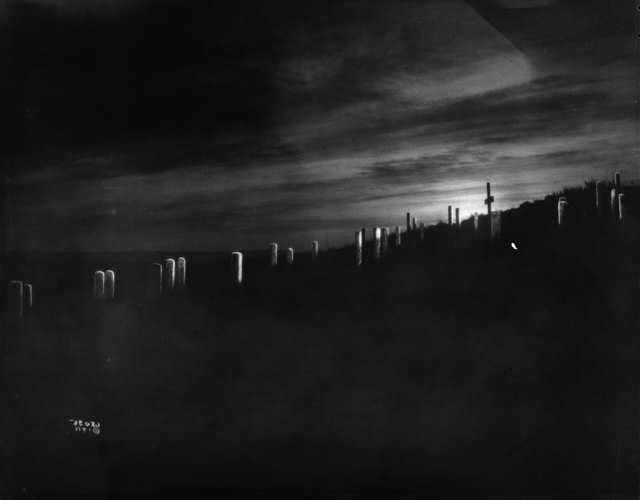
Sunrise on Custer's Battlefield, photo by Richard Throssel (d. 1933); Created/Published 1911. Dramatic view of sunlit tombstones including a cross at Little Bighorn, Little Bighorn River, Montana. Site of the Battle of the Little Bighorn between the United States Cavalry and Native American Sioux (Lakota), Crow, Northern Cheyenne, and Arapaho and Arikara army scouts. Available at Library of Congress's American Memory web site.
With "blogger's prerogative," and the readers' indulgence, I'll begin a 2nd straight entry in the vicinity of Last Stand Hill, where troopers -- some of whom had survived many a close scrape on the battlefields of the Civil War -- found themselves without an "exit strategy" on June 25, 1876. On that day a barren, remote landscape, one that even in 2005 remains a long way from nowhere, became infused with American history for all time -- an iconic episode for which the enduring interest seems far out of proportion to the actual events that transpired there.
Some 47 years after the fight at the Little Bighorn, 33 years after Sitting Bull died -- Edwin Cole Bearss (pronounced BARs) was born in Billings. He was raised on a ranch near Hardin, Montana, mere miles from the scene of Custer's demise (there's the Civil War connection). The oft-told anecdotes relate -- and one National Park Service biography affirms -- that he named the cows on his ranch after Civil War battles and generals, the milk cow Antietam being his favorite. Ed Bearss grew up to be the closest thing we have today to a "living legend" in Civil War studies, still going strong at age 82 as the foremost tour guide and speaker on the Civil War circuit. Turns out Antietam became one of his favorite fields to visit as well.
Like a number of men in his family, including his father, and another relative, Medal of Honor winner "Hiking Hiram" Bearss, Ed joined the Marine Corps. Since he graduated high school in May of 1941, his stint in the Marines was destined to be eventful. Far from the Rosebud and Bighorn Mountains of his youth, Bearss suffered four machine gun wounds -- two more bullets than felled Custer in Montana -- on the second day of the year 1944 (which, incidentally, was New Year's Day in the U.S.). While scouting ahead of his battalion on New Britain, seven days after the landing, he moved into the field of fire of a Japanese pillbox at "Suicide Creek." Grievously wounded, Ed was confined to naval hospitals for over two years, but lived to tell the tale. For a detailed account of his encounter with the Japanese, see this interview in the June 2002 issue of Naval History magazine: "Nothing Stinks Like Blood."
In time, Ed attended Georgetown for his undergraduate degree, and completed a masters in History at Indiana. He started his storied National Park Service career at Vicksburg, the Confederacy's principal Mississippi River stronghold. Ed would spend 20 years there as historian, and regional researcher, drafting maps still much relied upon today, and penning the definitive 3-volume history of the Vicksburg Campaign, over 2,000 pages. And, in the fulfillment of every red-blooded American boy's dream, he tracked down and salvaged an ironclad warship from the bottom of a muddy river.
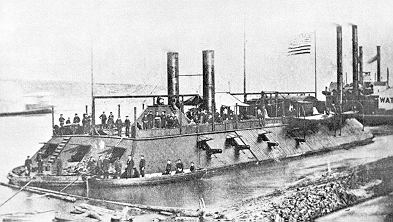


. . . .
In 1981 Ed became Chief Historian of the National Park Service, and held that position until his "retirement" 14 years later. Now, as Historian Emeritus with the NPS, Ed spends virtually every weekend, and then some, guiding one group or another over the historic landscapes of this country, voice booming, swagger stick tucked under his arm, eyes closed tight as he envisions the events he is narrating. The commanding Bearss delivery is one-of-a-kind, and you can get a sense of it from his many talking head roles on The History Channel, or on Ken Burns's Civil War documentary. There is also a meaty Smithsonian Associates interview that can be heard on-line here. In this interview it is revealed that the calf of the milk cow Antietam was appropriately named Sharpsburg ("McClellan's Golden Opportunity Squandered" was obviously too unwieldy).
Ed has always been willing to encourage fresh research wherever he found it, and graciously lent his considerable credibility to our publishing projects from the very start. He contributed essays and innumerable introductions for Civil War Regiments and stand-alone volumes. Later, for SW's Peninsula Campaign series, he wrote a lengthy article on Stuart's ride around McClellan, for which I drew some maps (I'll insert one of those here, once I dig out the Illustrator file and convert it to pdf). As Ed relates in the linked interview, it was a biography of Stuart -- read aloud to him by his father -- that helped spark his life-long interest in the Civil War.
Ed has always been willing to encourage fresh research wherever he found it, and graciously lent his considerable credibility to our publishing projects from the very start. He contributed essays and innumerable introductions for Civil War Regiments and stand-alone volumes. Later, for SW's Peninsula Campaign series, he wrote a lengthy article on Stuart's ride around McClellan, for which I drew some maps (I'll insert one of those here, once I dig out the Illustrator file and convert it to pdf). As Ed relates in the linked interview, it was a biography of Stuart -- read aloud to him by his father -- that helped spark his life-long interest in the Civil War.
The editorial comments Ed penned onto galleys we sent him were sometimes astonishing: corrections to errors so far removed from common knowledge and standard references we wouldn't have known where to look it up even had we recognized the miscue. Frequently he made corrections to errors introduced by the most commonly cited texts of the time, texts that authors routinely relied upon with confidence. Likewise, his corrections to map drafts made us shake our heads in wonder. Regimental fronts were realigned, troop designations were corrected or rearranged, creek beds were redirected. It's unlikely he needed to consult a book while marking up the pages.
Certainly, an encyclopedic memory is one of Ed's most fascinating attributes. In Civil War Round Table folklore, tales were told about how one could blindfold Ed, randomly transport him to part of an obscure field of battle from the Civil War, give him a moment to get his bearings, and he would then proceed to narrate the action there in dramatic and detailed fashion, with plenty of asides to spotlight one little-known figure after another. After one attends a tour with Bearss, or hears him handle a Q&A session after a talk, it is soon understood that the Bearss battlefield mystique is not exaggerated. Even more remarkable, he brings the same breadth of knowledge to virtually any other era of American military history, from the Revolution and the Indian Wars to D-Day and the South Pacific.
Ed did a live conference in The Civil War Forum nearly 10 years ago, June 20, 1996. It is interesting to learn what battlefields stand out for someone who has studied and walked them all (since this session was conducted I imagine he's visited the scene of every notable action from the war). Additionally, we asked him to name some of the officers, apart from the big names, that impressed or intrigued him most in his readings. I'll excerpt his answers here:
Certainly, an encyclopedic memory is one of Ed's most fascinating attributes. In Civil War Round Table folklore, tales were told about how one could blindfold Ed, randomly transport him to part of an obscure field of battle from the Civil War, give him a moment to get his bearings, and he would then proceed to narrate the action there in dramatic and detailed fashion, with plenty of asides to spotlight one little-known figure after another. After one attends a tour with Bearss, or hears him handle a Q&A session after a talk, it is soon understood that the Bearss battlefield mystique is not exaggerated. Even more remarkable, he brings the same breadth of knowledge to virtually any other era of American military history, from the Revolution and the Indian Wars to D-Day and the South Pacific.
Ed did a live conference in The Civil War Forum nearly 10 years ago, June 20, 1996. It is interesting to learn what battlefields stand out for someone who has studied and walked them all (since this session was conducted I imagine he's visited the scene of every notable action from the war). Additionally, we asked him to name some of the officers, apart from the big names, that impressed or intrigued him most in his readings. I'll excerpt his answers here:
Civil War Forum: You've tramped around more battlefields, more times, than just about anyone. What are a few of your favorite sites, and why? Are there any Civil War battle sites you've yet to visit?Ed Bearss: Well, I've tramped all the major battlefields. There are a few I've missed, such as Pacheco Pass out in Arizona, and the newly discovered farthest-west battle at Stanwick Station. And Missouri has over 1,000 actions, a number of them very small, with a handful of partisans or soldiers engaged, and there are a number of them I've not seen. But of the 383 identified and evaluated by the Civil War Sites Study Commission, there are probably a 1/2 a dozen that I haven't been to, and I pick up a new one every so often -- like 3 weeks ago, I visited the site of the two Cabin Creek raids out in Oklahoma, which I'd not seen before.My favorite ones. . . I'll break them into several categories: the battlefields that are maintained as parks by the Federal government, or some other public body, of these I would say in the East, Gettysburg and Antietam. If you're going to visit Gettysburg, you better be prepared to spend three days. In the West, my favorite park battlefields are Shiloh, and Perryville. Vicksburg -- I like the campaign. Most of the sites associated with the Vicksburg Campaign are outside the park. In the East, I particularly like the campaigns in the Shenandoah Valley. The country is wonderful, the road network is little changed, and there's a mix of battlefields, such as New Market, that are in quasi-public ownership -- such as with the Virginia Military Institute, and Fisher's Hill, of which 200-plus acres are owned by the Association for the Preservation of Civil War Sites [now merged with Civil War Trust]. There are a large number of others that are in various types of ownership, and I find these intriguing, and challenging to the intellect -- these battlefields that have not been developed. A wonderful site is Allatoona Pass, where I was last week, down in Georgia. I find particularly rewarding on visits to the non-big name battlefields, the great interest shown in them by the local people.. . . .Civil War Forum: In your many years studying the Civil War and the multitude of men who orchestrated the fighting, can you mention a few officers -- apart from the obvious icons like Grant and Lee -- who stand out to you as remarkable soldiers, or remarkable men.Ed Bearss: I'm going to talk about military leaders rather than political leaders. The ones that particularly interest me, beyond the icons: I'm a great admirer of Nathan Bedford Forrest. Forrest is a modern soldier, a genius who knew that war means fighting, and fighting means killing, and believed in getting the "skeer" on the enemy, and keeping him skeered. Then there is of course, [also] on the Confederate side, Patrick Cleburne, former corporal in the British Army, a dynamic leader whose advancement to possible corps command was stifled by his January, 1864 proposal to recruit African Americans into Confederate armies. A brilliant leader -- of Cleburne it was said that where his division defended, no one broke their line. And where they attacked, they only failed once -- and that was where Cleburne was killed.. . . .General Longstreet. . . of all the Confederate leaders in the war, his attacks were the most savage, and successful. Whether it is at 2nd Manassas, the 2nd Day at Gettysburg, Chickamauga, or at Wilderness on May 6th.. . . .My three favorite Union leaders that are not icons would be: Winfield Scott Hancock -- his nom de guerre, "Hancock the Superb" is earned. More than anybody else, he was responsible for turning back Lee's veterans at the Battle of Gettysburg. Phil Sheridan, like Bedford Forrest, a modern soldier. He and Forrest utilized cavalry as mounted infantry, using their mounts for mobility, and fighting afoot. They were the precursors of Erwin Rommel and George S. Patton in World War II.John Wilder. . . Wilder, a forward-looking soldier, realized the importance of the Spencer 7-shot repeating rifle. Purchasing Spencers, he sold them to his command, the Lightning Brigade, and demonstrated their deadly effectiveness first at Hoover's Gap, Tennessee, on June 24, '63, at Chickamauga.
Here's a picture of Ed (left) and the late Brian Pohanka at the 4th annual Civil War Forum Battlefield Conference at Vicksburg (2000). Both Ed and Brian generously gave of their time and talents to help CWR get off the ground. Brian wrote the Union article for the 2nd issue -- an account of his beloved 5th New York and their tragic day along Young's Branch at 2nd Bull Run.
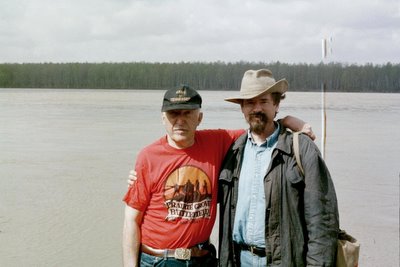
Photo by Rudy Perini. On the banks of the Mississippi River.
And returning once more to the Greasy Grass, one of the last labors of love Brian worked on before his death -- aside from his regimental history of the 5th New York, completed almost literally on his death bed -- was the "rephotography" project, Where Custer Fell. I'm going to buy myself that one for Christmas. And that brings us full circle, with the opportunity to include one more captivating Richard Throssel photo of Ed Bearss's childhood stomping grounds.
And returning once more to the Greasy Grass, one of the last labors of love Brian worked on before his death -- aside from his regimental history of the 5th New York, completed almost literally on his death bed -- was the "rephotography" project, Where Custer Fell. I'm going to buy myself that one for Christmas. And that brings us full circle, with the opportunity to include one more captivating Richard Throssel photo of Ed Bearss's childhood stomping grounds.
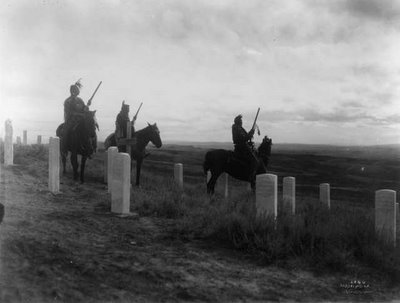 Sunrise on Custer Battle field, the Custer scouts are Indians who were with Custer the morning of the fight / copyright Richard Throssel. Created/Published, 1908. View at sunrise of tombstones and three mounted Native American Arapaho or Arikara scouts with rifles at the Little Bighorn Battlefield, Little Bighorn River, Montana, site of the Battle of the Little Bighorn between United States soldiers and Native American Lakota Sioux, Crow, Northern, and Cheyenne.
Ed Bearss will be conducting the battlefield tours for the 11th Annual Civil War Forum Battlefield Conference in March, 2007, covering Lee's Retreat and Appomattox. Details will be published here next summer. Meanwhile, you may want to catch his next Little Bighorn tour in August, 2006.
Replies to this entry can be posted here.
Thursday, December 08, 2005
Benteen Come on. Big Village. Be quick. Bring Packs. W.W. Cooke P.S. Bring pacs
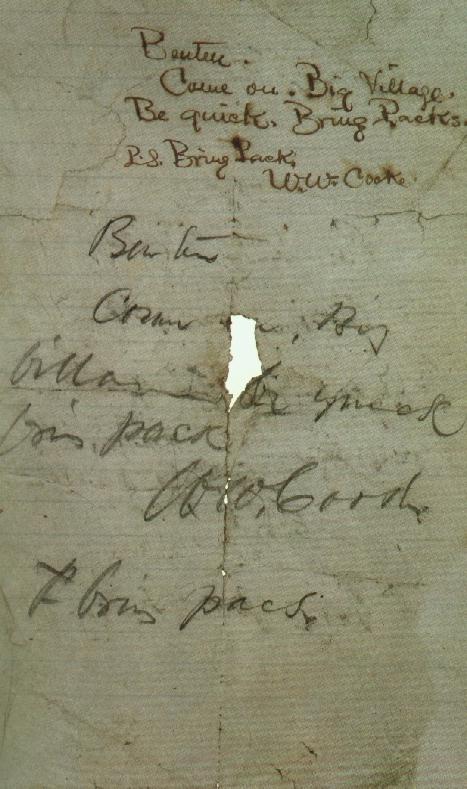 Did I mention that I need you to bring the packs? Pronto? That’s one little note I’m glad was saved. It is, of course, Custer’s last message, written by an adjutant, and carried by a bugler -- one very fortunate Italian immigrant, John Martin (born Geovanni Martini). That little piece of paper proved to be Martin’s ticket to a longer life – good for an additional 46 years. Martin spent quite a few years in the army, finally retiring as a sergeant in 1904, after which he reportedly worked as a ticket taker for the New York City subway (103rd Street Station), a long way from the Greasy Grass. See a later photo of Martin, and his tombstone, here.
The writing at top is apparently Benteen's rendition of what Cooke scrawled. One way or another, by way of Benteen, the note made its way to the United States Military Academy Library. I hope to see it in person one day.
Visiting the scenes of historic events is hard to beat, but history geeks love a good document. I remember when first I laid eyes on Grant's message to Simon B. Buckner, on display at the Smithsonian. There it was, in black and white. I could hardly believe my eyes -- it was just as the books had promised.
HEADQUARTERS ARMY IN THE FIELD
Camp near Fort Donelson
February 16, 1862.
General S. B. BUCKNER,
Confederate Army.
SIR: Yours of this date, proposing armistice and appointment of commissioners to settle terms of capitulation, is just received. No terms except unconditional and immediate surrender can be accepted. I propose to move immediately upon your works.
I am, sir, very respectfully, your obedient servant,
U.S. GRANT,
Brigadier-General, Commanding.
With obedient servants like that, who needs unfaithful ones?
Since that Smithsonian visit, I've enjoyed many memorable moments looking through our well-preserved documentary heritage in places like the Huntington Library, Library of Congress, and numerous regional repositories. There's something about holding the original of a hand-written, historic document that fires the imagination and gives structure and permanence to the wispy mental images one constructs while reading.
Speaking of historic documents, and speaking of the National Archives -- as I did in the last post -- all Americans need to make the trip to the NARA rotunda, once in their lives, to see the Declaration of Independence, the Constitution, and the Bill of Rights. Get up close and take a look. Powerful stuff.
Of course you Civil War buffs know all about the National Archives. Almost 10 years ago (June 6, 1996), The Civil War Forum hosted an online Q&A session with Michael Musick, Subject Area Expert for Civil War Materials at the Archives. Nobody knows more about the Civil War treasures there than Mike. Here are a couple of highlights from that discussion. Of particular interest, to me, is his answer about some of the most memorable items he's encountered (pasted below). The full transcript is available in the forum (files and messages are treated the same in a search, so select "advanced search," set the range to "beginning of time" and type "Musick" in the keyword box -- that will bring up a plain text document).
from A Conversation with Michael Musick, Thursday, June 6, 1996
CWF: Mike, what one or two things that you've come across stand out most in your memory?bonus question:
MIKE MUSICK: One which occurs to me is Henry Wirz's order book from Andersonville, which is filed among the records of his trial. Another would be a moving letter from an Illinois mother, whose son was killed at Kennesaw Mountain, seeking to recover his body. There are many similar things in the files.
A third would be a letter from Lemuel T. Conner to Leonidas Polk detailing in passing the suppression of a purported slave insurrection. This has recently been published in Winthrop Jordan's Tumult and Silence at Second Creek. A fourth would be a register of wounded Union soldiers from New York who were patients at a hospital in Alexandria, Virginia. It is tucked in with 11,000 other hospital registers, and contains photographs and biographical sketches of each individual. I came across it through pure serendipity.
A fifth item would be an amnesty application from Nathan Bedford Forrest in which he offers to fight against the French in Mexico as a U. S. officer. A sixth would be my own ancestors draft enrollment record in New York City, and the report of the district provost marshall describing the tenements of German immigrants among which he lived. Another item would be the pension file for the son of Solomon Northup. Northup, Sr. was the author of the autobiography, Twelve Years a Slave, which I found a particularly moving narrative.
Another find would be the patriotic carts de visite found hidden at Mrs. Surrat's boarding house in Washington and entered in evidence at her trial. They include portraits of prominent Confederates, the state seal of Virginia, with the motto "Virginia the Mighty," and other such pro-Confederate items. Another would be the humorous photographs and drawings of military inventions submitted to the Union's chief of ordnance. Many of these have subsequently been published.
For those interested in firearms, a particularly nice discovery were some lists of serial numbers of Civil War pistols and carbines. Many of these have subsequently been published also. Another find which was enjoyable for me were some letters of Shelby Foote's ancestor, Hecekiah Foote, among the records of the Confederate Secretary of War.
CWF: Historian Bob Krick wrote in the acknowledgments to one of his books: "It is literally impossible to do adequate research for a serious Civil War book without Mike's collaboration." How, specifically, are you able to help scholars such as Krick?
MIKE MUSICK: I will interview the prospective researcher in person, or on the telephone, eliciting as best I can what that person is looking for. I try to find out where he lives, and how much time he can spend on his project. We, meaning I and my colleagues, must generally recast questions into a form that relates to our holdings. and how they are arranged and described. Often, we make people aware of other institutions and resources which will help them. You don't need to deal with me if you are doing a standard search for service and pension records.
Also, Bob Krick's kind words notwithstanding, I have a number of extremely capable colleagues who can help researchers at least as well as I. I will try to explain the Archives system to researchers, identify records which may be helpful, and explain how to go about ordering them and obtaining copies. If I know someone is interested in something, when I come across pertinent documentation, I can try to contact that person, perhaps even years afterwards. As someone who has been around a long time, with a keen interest in the War, I may well have come across something relating to the subject at hand, which has stayed in my mind. An example might be Dr. Tom Lowry and his studies of sex in the Civil War. Those kinds of documents one tends to remember.
Comments on this post may be made here.
Subscribe to:
Posts (Atom)